Normal view

There are new articles available, click to refresh the page.
Before yesterdayMain stream

How To Unlock DLSS Multi Frame Generation on RTX 40, RTX 30 & RTX 20 GPUs

12 September 2026 at 22:00

NVIDIA GeForce RTX 4090, RTX 3090, and RTX 2080 Ti graphics cards are displayed under the title 'How To Unlock DLSS Multi Frame Generation on RTX 40/30/20 Series GPUs.'

NVIDIA officially reserves DLSS Multi Frame Generation for its GeForce RTX 50 Series “Blackwell” GPUs, but the PC modding community has spent the past few weeks systematically tearing down those barriers. We have now reached the point where experimental implementations of NVIDIA's DLSS-G pipeline can run on RTX 40 Series “Ada Lovelace” GPUs, RTX 30 Series “Ampere” cards, and even the older RTX 20 Series “Turing” hardware. These projects are fundamentally more interesting than the numerous "DLSS (Multi) Frame Generation" mods that appeared over the past couple of years. Many of those older solutions simply intercepted NVIDIA's DLSS-G calls and […]

Read full article at https://wccftech.com/how-to/how-to-unlock-dlss-multi-frame-generation-on-rtx-40-rtx-30-rtx-20-gpus/

DLSS Multi Frame Generation Has Now Been Modded Onto RTX 40, RTX 30 & Even RTX 20 GPUs

11 September 2026 at 14:20

NVIDIA graphics cards RTX 4090, RTX 3090, and RTX 2080 Ti are displayed under the text 'DLSS Multi Frame Generation mods for RTX 40/30/20 Series GPUs'.

NVIDIA's DLSS Multi Frame Generation remains officially exclusive to the GeForce RTX 50 "Blackwell" Series, but the modding community has now managed to get NVIDIA's own DLSS MFG frame interpolation technology running across three older GeForce RTX generations. Unlike previous workarounds that substituted AMD FSR Frame Generation, these new projects are attempting to run native DLSS (Multi) Frame Generation code on Ada Lovelace, Ampere, and even Turing GPUs. RTX 40 Series: Ada MFG Unlockers Are Already Quite Advanced The RTX 40 "Ada Lovelace" Series is perhaps unsurprisingly the furthest along. Dashdogy's RTX40MFG-Unlock has evolved into a universal DirectX 12/Vulkan solution […]

Read full article at https://wccftech.com/dlss-multi-frame-generation-has-now-been-modded-onto-rtx-40-rtx-30-even-rtx-20-gpus/

Unofficial mod brings DLSS Multi Frame Generation to RTX 40 series cards

7 September 2026 at 17:00

Modders have expanded Nvidia’s DLSS Multi Frame Generation support to GeForce RTX 40‑series GPUs, bypassing official restrictions that limit Ada hardware to standard 2x Frame Generation. With the unlock applied, RTX 40 cards can run 3x and 4x frame generation using Nvidia’s own DLSS‑G code, a feature Nvidia currently reserves for its newer RTX 50‑series GPUs.

The MFGAdaUnlock tool (via VideoCardz) works by patching memory restrictions, allowing Nvidia’s native DLSS‑G routines to run on Ada GPUs. Early demonstrations were shown in Cyberpunk 2077, confirming that higher‑multiplication frame generation does function on RTX 40 hardware. Compatibility briefly broke when Nvidia pushed DLSS‑G provider 310.9, which renamed the temporal kernel and changed descriptor layouts, disabling existing mods.

Modders responded quickly with version 0.4 of the unlock, restoring Ada temporal‑position correction and fixing frame‑pacing issues and duplicate frames at higher multiplication levels. With these adjustments, RTX 40‑series cards can once again run the latest 310.9 provider code with 3x and 4x frame generation enabled.

It’s worth noting that Multi Frame Generation still isn’t officially supported on RTX 40‑series GPUs. As a result, performance, latency and stability may vary compared to Nvidia’s tuned implementation for Blackwell‑based RTX 50‑series cards.

KitGuru Says: Seeing RTX 40‑series GPUs handle Multi Frame Generation raises questions about why Nvidia won’t enable the feature officially. Are you planning to try the mod, or does 3x and 4x frame generation not matter much to you?

The post Unofficial mod brings DLSS Multi Frame Generation to RTX 40 series cards first appeared on KitGuru.

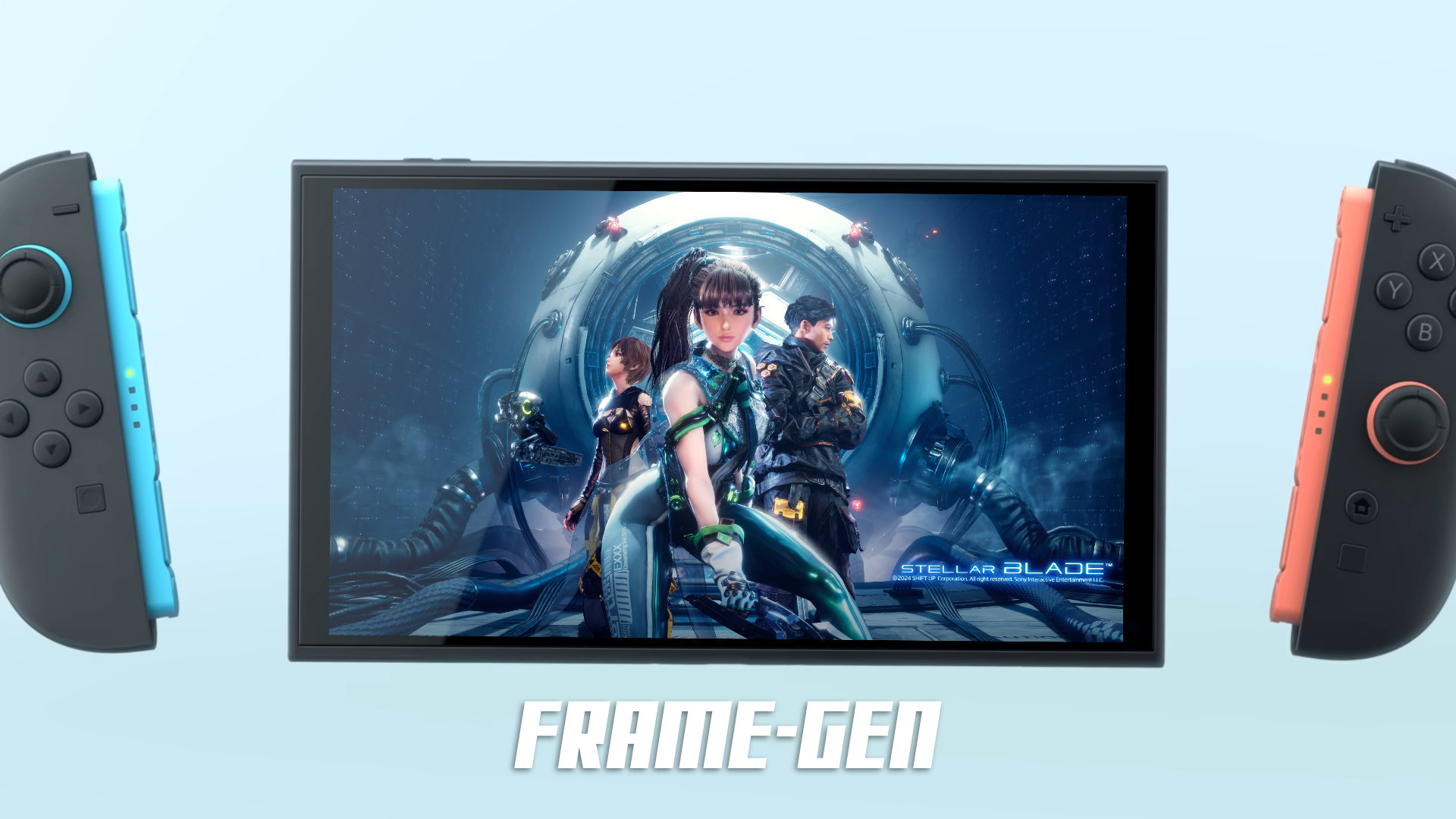
Stellar Blade will use frame-generation to hit 60fps on Nintendo Switch 2

3 September 2026 at 08:00

Starting its life in 2024 as a PlayStation 5 exclusive, ShiftUp’s Stellar Blade has slowly but surely made its way over to other platforms – landing on PC last year and officially set to arrive on Switch 2 before the end of 2026. While an exciting prospect, the team have now revealed that they’ve had to use AMD’s FSR frame-generation in order to hit 60fps on the handheld hybrid.

Taking part in an interview with the publication NintendoEverything, Stellar Blade studio ShiftUp spoke on the upcoming Switch 2 release, providing some details on the game’s technical makeup.

In terms of resolution, the team claimed that Stellar Blade will utilise DLSS in both handheld and docked mode – running the former at an upscaled 720p and the latter at an upscaled 1080. As of now, it is unknown what resolution the game will operate at internally prior to its upscaling.

By far the more controversial reveal however came in the fact that Stellar Blade will make use of frame-gen on Switch 2, with ShiftUp’s CTO and technical director DongKi Lee stating:

“So we targeted 60 frames per second in both handheld mode and docked mode […] What we did was we take AMD’s FSR 3.1 for PC and used the feature called frame interpolation to achieve the target for 60 frames per second. We use DLSS for upscaling, and then took the result we got and used frame interpolation from FSR 3.1 to be able to target 60 frames per second.”

Stellar Blade Switch 2

While upscalers in general have their own benefits and downsides, frame generation in particular remains rather contentious, with the technology potentially causing increased input latency among other issues.

In an effort to try and minimise its impact, Lee made sure to note that “it was important to have even latency for players. We have 30 frames per second to have it even and then use interpolation – a frame interpolation – for targeting 60.”

Though certainly preferable when compared to the likes of Black Myth Wukong (which used frame-gen on an already inconsistent framerate experience), hopefully the team include a standard 30fps option for those who are averse to frame-generation.

KitGuru says: What do you think of frame-gen? Is the technology still too early? Does input latency bother you? Let us know down below.

The post Stellar Blade will use frame-generation to hit 60fps on Nintendo Switch 2 first appeared on KitGuru.

AMD FSR 3.1 Frame Generation Reaches Switch 2 With Stellar Blade, Yet Fake 60 FPS Hides Real Input Lag

1 September 2026 at 09:13

A futuristic character in a sleek, dark suit floats in a high-tech environment with glowing circular patterns and a mechanical device on their side.

Following its launch on PlayStation 5 and PC, Korean developer Shift Up is hard at work on the Nintendo Switch 2 port of Stellar Blade. The release of the popular action game on the next-generation Nintendo system will be notable not only for its use of NVIDIA DLSS, which many third-party ports such as Oblivion Remastered use to deliver ports with great image quality despite rendering at low resolutions, but also for debuting AMD FSR 3.1 Frame Generation on the system. However, this may not lead to a great experience, due to the base framerate of the port. Using NVIDIA […]

Read full article at https://wccftech.com/amd-fsr-3-1-frame-generation-switch-2-stellar-blade-fake-60-fps/

MSI MPG 322UR QD-OLED X24 Gaming Monitor Review – Viewing Experience That Will Blow You Away

21 August 2026 at 11:00

A gaming scene from Forza Horizon 4 is displayed on an MSI monitor with an MSI Suprim GeForce RTX GPU visible in the reflection, accompanied by a Razer keyboard below.

MSI's gaming monitor lineup has seen various additions in the past couple of years, with designs that cater to all kinds of gamers. These monitors come in four different tiers, from the high-end MEG series to the gaming-minded MPG series, the entry-level MAG series & the budget G-Series. The company has a vast array of options in 24, 25, 27, 32, 34, 40, and 49" sizes and a total of 17 models within its OLED lineup, which range from 27, 32, 34, & 49" options. MSI recently refreshed its QD-OLED lineup with new options that come with improved panels, upgraded […]

Read full article at https://wccftech.com/review/msi-mpg-322ur-qd-oled-x24-gaming-monitor-review/

A Developer Made A Frame Generation App For Mac To Broaden The Gaming Experience, But AMD FSR 1 Implementation And Other Trade-Offs Produces Subpar Results

6 August 2026 at 11:58

A developer made a Frame Generation app for the Mac, but it has some problems

Apple’s macOS Tahoe introduces native support for MetalFX Frame Interpolation, but when it comes to adopting the technology in older and newer titles, that’s still a dream that we haven’t woken up from. Fortunately, an independent developer has taken matters into his own hands through Adrenaline, his own frame generation tool for the Mac. However, to say that this is a polished release would be far from the truth, as the use of AMD’s FSR 1 makes the experience less than stellar. The plus point of using Adrenaline for generating frames on a Mac is that it doesn’t require modifying […]

Read full article at https://wccftech.com/developer-launches-mac-frame-generation-app-amd-fsr-1/

How to Properly Use Frame Generation Technologies ft. NVIDIA DLSS, AMD FSR, Intel XeSS

25 July 2026 at 18:35

The image shows the logos and graphics of Intel XeSS, AMD FSR, and NVIDIA DLSS 4.5, each described as Frame Generation, with visual representations of their technology in action.

Frame generation (oftentimes abbreviated as “FG”) has quickly solidified itself as one of the most vital and hotly debated innovations in modern PC gaming. When implemented correctly and used properly, it can greatly enhance the smoothness of modern, demanding PC games, particularly on high-refresh-rate monitors. Unfortunately, it’s also very easy to misuse under many circumstances, by game developers and gamers alike. As such, we decided to write this guide to illustrate the most optimal ways of using frame generation in modern PC games. Let's clear something up right away: Frame generation isn't a panacea meant to fix low gaming performance […]

Read full article at https://wccftech.com/how-to/how-to-use-nvidia-dlss-amd-fsr-intel-xess-frame-generation-technologies/

Gears of War: E-Day Will Launch with NVIDIA DLSS 4.5 Dynamic Multi Frame Generation and Ray Tracing on PC

14 July 2026 at 13:00

The image shows a promotional banner for Gears of War: E-Day featuring soldiers with weapons amid a fiery backdrop, accompanied by the text 'RTX. It's On.' and 'Launching with ray tracing and DLSS 4.5.' on the left with an NVIDIA GeForce RTX logo.

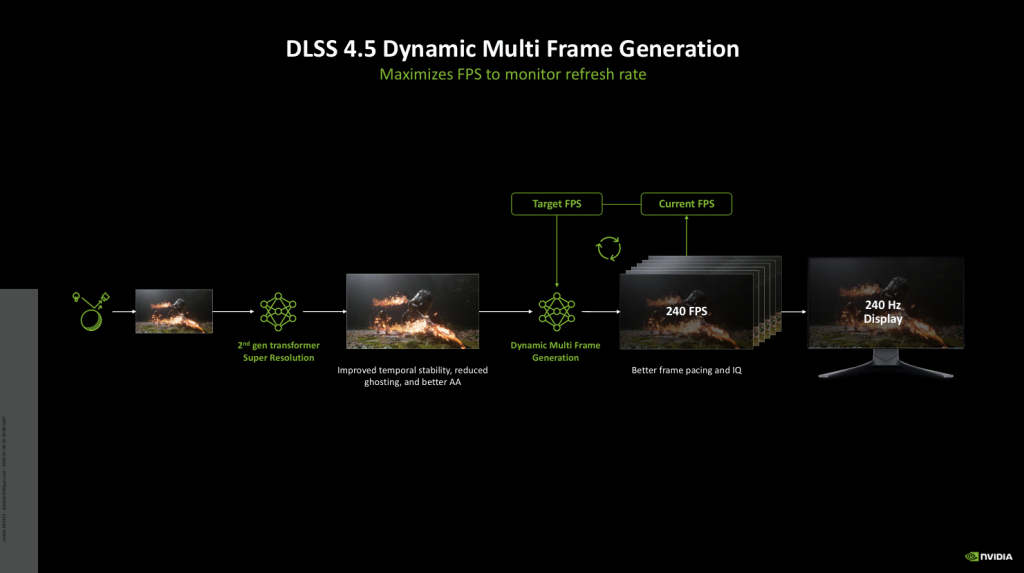
Today, NVIDIA announced a technical partnership with Gears of War: E-Day developer The Coalition to bring its RTX technologies to the upcoming third-person shooter game. DLSS Super Resolution, Dynamic Multi Frame Generation, NVIDIA Reflex, and Ray Tracing (for shadows, Lumen global illumination, and ambient occlusion) will all be supported for GeForce RTX Series owners. NVIDIA hasn't provided frame rate estimates yet, but early access to the multiplayer Open Beta begins on Thursday, August 6, so it's not too far off from being available to the public. It's likely that most, if not all, of these technologies will already be there. […]

Read full article at https://wccftech.com/gears-of-war-e-day-dlss-4-5-ray-tracing-pc/

RadeonTuner leak points to AMD FSR multi-frame generation with up to 8x multiplier

13 July 2026 at 13:30

AMD seems to be testing its upcoming FSR multi-frame generation (MFG) technology within its Radeon drivers. Discoveries in the third-party software RadeonTuner show that the company has added placeholders for the feature, offering options ranging from 1x to 8x frame generation.

RadeonTuner allows users to modify Radeon driver settings without using the standard AMD Software: Adrenalin Edition application. According to the utility's developer, AMD frequently implements placeholders well ahead of a feature's official launch. The multi-frame generation within AMD's ecosystem was the latest one to be found.

Image credit: Chiphell

A Chiphell user (via Wccftech) attempted to force the technology on using a Radeon RX 9070 XT graphics card but found it entirely non-functional. AMD has not yet shipped the underlying model required to make the frame generation operational. This upcoming technology puts AMD against competitors like Nvidia, which offers DLSS Dynamic MFG with up to 6x generation, and Intel, which provides 4x XeSS MFG through its XeSS 3 release.

Other options available in the RadeonTuner tool include overrides for FSR Ray Regeneration and FSR Neural Radiance Caching. These are already available, but they require native support to be enabled. However, according to this third-party tool, AMD appears to be working on a manual override to extend these benefits to more games.

KitGuru says: Are you a fan of multi-frame generation? What MFG multiplier do you usually choose? 

The post RadeonTuner leak points to AMD FSR multi-frame generation with up to 8x multiplier first appeared on KitGuru.

Display Times, Frame Times, And The Truth About Smoothness

24 June 2026 at 17:21

A comparison chart titled 'Frame Times vs Display Times' shows fluctuating frame times in blue and stable display times in green.

In the world of PC gaming performance analysis, we tend to obsess over frame times, and for good reason. A simple average FPS number can be extremely misleading, while a frame time graph can immediately show you whether a game is delivering frames smoothly or whether it is suffering from stutters, hitches, CPU/platform bottlenecks, or other forms of inconsistent frame pacing. However, as useful as frame times are, there is one major problem with relying on them alone: they do not always tell us what the player actually sees on the monitor. This is especially important nowadays, as modern PC […]

Read full article at https://wccftech.com/display-times-frame-times-and-the-truth-about-smoothness/

Forza Horizon 6 PC Performance Analysis & Tuning Guide – How To Get Best Experience On PC

24 May 2026 at 09:05

A red sports car drifts around a curve in front of Mount Fuji and cherry blossoms, next to 'Forza Horizon 6' and 'Performance Analysis & Tuning Guide' text.

With PC games becoming increasingly complex nowadays — especially large-scale open-world games with dense environments, high-speed traversal, and ray/path tracing — default/maxed-out graphics settings rarely, if ever, strike the optimal balance between visual fidelity and performance that most PC gamers seek, and Forza Horizon 6 is no exception to this rule. Thankfully, Playground Games’ latest open-world racing title arrives on PC with an impressively complete graphics menu, support for modern temporal upscaling solutions, uncapped framerates, ultrawide support, ray-traced reflections, ray-traced global illumination, and even live previews for many of its individual graphics settings. However, while Forza Horizon 6 is a […]

Read full article at https://wccftech.com/how-to/forza-horizon-6-pc-performance-analysis-tuning-guide/

NVIDIA DLSS 4.5 SDK Now Available, Enabling Devs To Integrate Ray Reconstruction, Dynamic Frame Gen, & More In Their Games

21 April 2026 at 13:00

NVIDIA DLSS 4.5 SDK Now Available, Enabling Devs To Integrate Ray Reconstruction, Dynamic Frame Gen, & More In Their Games 1

NVIDIA has just released its latest DLSS 4.5 SDK, which allows developers to integrate the latest tech, such as Dynamic Frame Gen & More, into their latest games. NVIDIA DLSS 4.5 Dynamic Frame-Generation, Updated Ray Reconstruction, & Enhanced Upscaling Tech Is Now Available To Devs With The Latest Streamline SDK Release Today, NVIDIA is finally releasing the highly anticipated DLSS 4.5 Streamline SDK. With this release, devs have the ability to easily integrate all the DLSS 4.5 goodies that come with the 2nd Gen transformer AI models, such as enhanced upscaling, frame-gen, Ray Reconstruction, and dynamic frame-generation support to their […]

Read full article at https://wccftech.com/nvidia-dlss-4-5-sdk-now-available-enabling-devs-to-integrate-dynamic-frame-gen-in-games/

User Confirms Intel Arc Pro B70 Can Play Crimson Desert, But The Artifacts Are Irksome

13 April 2026 at 16:02

An Intel Arc Pro B70 graphics card is placed on a rock in a fantasy landscape, with a warrior in the foreground approaching a treehouse built within an enormous tree creature.

It's good to see even workstation Intel Arc GPUs being able to play Crimson Desert, but the game shows some weird behavior. Crimson Desert Now Supports Intel Arc Pro B70 Workstation GPU, But Shimmering Ruins the Experience Except on Ultra Settings After nearly three weeks of launch, the latest Pearl Abyss title Crimson Desert received support for Intel Arc GPUs. The official notes for the latest game patch revealed that the game should now run on Intel Arc discrete and integrated graphics cards, and should also bring the XeSS 3 and Frame Generation support. Since Arc GPUs are categorized into […]

Read full article at https://wccftech.com/user-confirms-intel-arc-pro-b70-can-play-crimson-desert/

Crimson Desert Officially Receives Intel Arc GPU And XeSS 3.0 Frame Generation Support

11 April 2026 at 11:41

An Intel Arc Limited Edition GPU is displayed next to a gaming scene featuring a knight facing a fiery dragon.

Finally, the game has received official support for Intel Arc GPUs as well as its upscaling technology and Frame Gen feature. Pearl Abyss Adds Support for Intel Arc GPUs, XeSS 3.0, and Frame Generation for Crimson Desert Three Weeks After Launch With the latest Intel Arc driver update released a few days ago, Pearl Abyss's Crimson Desert finally started to launch on Intel Arc GPUs, but the latest patches further optimize the compatibility. If you have been following the developments around the game, you might be aware that the Intel Arc GPUs weren't supported in Crimson Desert. After a huge […]

Read full article at https://wccftech.com/crimson-desert-officially-receives-intel-arc-gpu-and-xess-3-0-frame-generation-support/

Mark Cerny confirms ML-based frame generation is coming to PlayStation

23 March 2026 at 10:30

Sony has officially lifted the curtain on its “Project Amethyst” collaboration with AMD, confirming that machine learning-based frame generation is headed to PlayStation hardware. The news comes alongside the debut of PSSR 2.0, which has recently been rolled out to 12 games. This update finally leverages the full AI capabilities of the PlayStation 5 Pro's APU, bringing the console ecosystem closer to feature parity with PC gaming.

In a technical deep dive with Digital Foundry, PlayStation lead system architect Mark Cerny clarified that the latest PSSR iteration shares its foundational DNA with AMD's FSR Redstone. According to Cerny, the frame generation technology currently in development is also a “co-engineered” effort between Sony and AMD. While he expressed confidence in the project's current progress, he was quick to temper expectations for a near-term release, stating that Sony has no further hardware or major software feature launches scheduled for the remainder of 2026.

PS5 CFO

This timeline suggests that while the PlayStation 5 Pro is the most logical candidate for frame generation support, the feature may be reserved for the PlayStation 6. While initially the next-gen PlayStation console was expected by the end of 2028, ongoing memory chip shortages have market analysts predicting that it may be delayed to 2029.

The technical hurdles for bringing this to existing hardware remain significant. While the PC community has already seen modders successfully backport FSR 4 Redstone features to RDNA 3 architectures, the PlayStation 5's base RDNA 2 APU lacks the dedicated AI hardware found in newer silicon. Implementing a machine learning-based frame interpolator on the standard console would likely incur a substantial performance penalty, leaving the PlayStation 5 Pro as Sony's only current-gen machine with the dedicated hardware to handle such a workload.

Discuss on our Facebook page, HERE.

KitGuru says: Do you think we'll see ML-based frame generation on the PS5 Pro, or will Sony reserve it as a killer feature for the PS6?

The post Mark Cerny confirms ML-based frame generation is coming to PlayStation first appeared on KitGuru.

PlayStation System Architect Confirms FSR Redstone Frame Generation Is Coming “at Some Point” (But Not This Year)

20 March 2026 at 19:00

The left side of the image features 'PSSR2' with text PlayStation Spectral Super Resolution and a PlayStation console and controller, while the right side shows 'FSR Redstone' with the text powered by Machine Learning Frame Generation

Mark Cerny, Lead System Architect at PlayStation on the last two console generations, has officially confirmed to Digital Foundry that Sony co-engineered the tech behind FSR Redstone Frame Generation as part of the Project Amethyst collaboration with AMD, and an "equivalent library" should appear on PlayStation platforms at some point. While the date remains vague, Cerny did say there are no more releases planned this year, hinting that frame generation won't be available on PlayStation consoles before 2027 at the earliest. He also clarified that PlayStation Spectral Super Resolution 2.0, released earlier this week on PlayStation 5 Pro systems, uses the same […]

Read full article at https://wccftech.com/playstation-architect-confirms-fsr-redstone-frame-generation/

NVIDIA DLSS 5 Honors Artist’s Intent, Will Be Optimized To Run On Single GPUs At Launch

16 March 2026 at 21:30

NVIDIA DLSS 5 Honors Artist's Intent, Will Be Optimized To Run On Single GPUs At Launch1

NVIDIA has shared more information on how DLSS 5 works, the GPUs that will support it, and how it honors the original artist's intent. NVIDIA's Revolutionary DLSS 5 Tech Will Not Compromise Artists' Vision, GeForce Team Shares More Info on Hardware Support & More A few hours ago, NVIDIA unveiled its groundbreaking and disruptive new technology called DLSS 5, which leverages Neural Rendering to achieve unforeseen levels of visual fidelity uplift. While the initial unveil has all of us left shocked, there are a few who have raised some valid questions based on the comparisons, as the scenes presented with […]

Read full article at https://wccftech.com/nvidia-dlss-5-honors-artists-intent-optimized-to-run-on-single-gpus-at-launch/

ASRock Recommends Intel Arc A380 For DeskMeet Series For Gamers On A budget

10 March 2026 at 22:51

A DeskMeet Series tower is paired with an Intel Arc A380 graphics card, featuring the text 'XeSS PERFORMANCE BOOST UNLEASHED'.

It's unusual to see a hardware maker recommend older, slower hardware, but ASRock justifies it by noting that the Arc A380 now supports the latest XeSS 3. ASRock Says DeskMeet Series + Intel Arc A380 Will Deliver "Strong Performance" While Providing an "Outstanding Value" The sky-high prices of memory and SSDs have made it extremely difficult for gamers to build a budget gaming PC. Previously, it was easy to build a powerful gaming PC for 1080p gaming for a sub-$1000 gaming PC. It's still possible, assuming you can manage both memory and a storage drive at good prices or by […]

Read full article at https://wccftech.com/asrock-recommends-intel-arc-a380-for-deskmeet-series-for-gamers-on-a-budget/

❌
❌