AMD EXPO 1.2 is launching soon, and with it, some new features, along with support for Chinese DDR5 memory, are being added too. AMD EXPO 1.2 Enables Support For Chinese DDR5 Memory Makers To Tackle DRAM Shortages & Increasing Prices New information about EXPO 1.2 comes from 1usmus, the author of HYDRA, CTR, and DRAM calculator for Ryzen, & leaker chi11eddog. The new information covers various aspects of the new memory tech, which is anticipated soon. Starting with the details, AMD EXPO 1.2 will be adding support for module geometry, allowing users to mix and match various memory capacities. But […]
AMD’s Ryzen 9000 series desktop processors are by now well into the second half of their lifecycle as AMD’s leading-edge desktop chips. With a complete product stack in play – ranging from 6 up to 16 CPU cores on a single chip – In most generations, this would be where AMD would stand pat on […]
ASUS has prepared a new Mini-ITX AM5 motherboard, the TUF Gaming B850I WIFI NEO, for budget-tier Ryzen PC builds. ASUS's TUF Gaming B850I WIFI NEO Motherboard Is Catered Towards Budget Mini-ITX Ryzen Builders Motherboard makers have been making some really impressive, cost-effective motherboards based on the AM5 socket for budget-tier Ryzen PC builders. We have seen and tested a lot of these designs over the past few months, and it looks like ASUS has a new product for SFF PC builders. The company has just introduced its latest addition, the ASUS TUF Gaming B850I WIFI NEO, which is a Mini-ITX […]
Panther Lake high-end laptops are seeing significant price hikes in the Chinese market, making them less affordable than the Apple MacBook M5 series. Panther Lake X Series Laptops See a Price Hike of $145-$870 in China, While MacBook M5 Series Laptop Prices Stay Stagnant The DRAM and SSD shortages have affected a wide range of PC hardware, including pre-built systems, GPUs, and laptops. Even unrelated PC hardware is getting more expensive, including CPUs, and if you have read our recent report on Intel, you can expect a noticeable price increase in Intel CPUs in the following months. Looks like the […]
The Apple Silicon continues to be efficient enough to the point that chipsets like the M5 can be used in portable Macs like the newly updated MacBook Air lineup for the majority of tasks without worrying about performance drops. However, when it comes to sustained workloads, which matter greatly, like gaming, an active cooling fan continues to tower over those silent passive solutions because the latest comparison shows that titles like Cyberpunk 2077, Baldur’s Gate 3, and others can lose up to 40 percent in framerates because of the cooling design difference alone. An active cooling fan gives Apple’s M5 sufficient […]
The ASUS ROG X870E APEX presents stunning DDR5 OC capabilities when paired with AMD's Ryzen 9 9950X3D2 Dual Edition CPU. AMD Ryzen 9 9950X3D2 Dual Edition & ASUS ROG Crosshair X870E APEX Showcase Impressive DDR5 OC Capabilities AMD's Ryzen 9 9950X3D2 Dual Edition CPU is the talk of the town. The chip represents the pinnacle of enthusiast-tier processing capabilities coupled with a behemoth cache, which is made possible using the latest 2nd Gen 3D V-Cache technology. Our sources who have access to these chips presented us with a teaser of what AMD's flagship AM5 platforms can achieve when paired with […]
AMD has officially announced its first dual 3D V-Cache CPU, the Ryzen 9 9950X3D2 Dual Edition, offering a massive 208 MB cache design. AMD's Ryzen 9 9950X3D2 Dual Edition: Dual 3D V-Cache CPU Tiles, With Cache Scaling Up To a Phenomenal 192 MB A dual 3D V-Cache CPU from AMD has been expected for a while. The company has made prototypes of such chips with their Zen 4 architecture, but has stuck to a singular stack design till now. The rumors of an ultimate dual CCD and dual stacked X3D chip started floating on the internet back in August 2025, […]
AMD has officially confirmed the processor enthusiasts have been waiting months for. The Ryzen 9 9950X3D2 Dual Edition is the world’s first desktop chip to feature 3D V-Cache on both compute chiplets, and it arrives April 22nd.
There have been few processor announcements in recent memory that felt genuinely, structurally different from what came before. AMD’s Ryzen 9 9950X3D2 Dual Edition is one of them. Announced this morning by Jack Huynh, AMD’s SVP and GM of Computing and Graphics, through a video posted to AMD’s YouTube channel, this chip does something no desktop processor has ever done: it applies 3D V-Cache technology across both of its compute chiplets simultaneously, not just one.
The result is 208MB of total on-chip cache, comprising 192MB of L3 and 16MB of L2. That is the highest cache figure ever shipped in a consumer Ryzen processor, and AMD is not shy about leaning into that record. Full official specifications are available on the AMD product page.
What Is Dual 3D V-Cache, Exactly?
To understand why this matters, a quick bit of context helps. AMD’s 3D V-Cache technology works by stacking additional SRAM directly on top of a compute chiplet via through-silicon vias. Previous X3D processors, including the Ryzen 9 9950X3D, applied this extra cache to only one of the two CCDs in a dual-chiplet design. The second CCD ran with standard cache allocations. That asymmetry created real-world trade-offs, with certain workloads performing better depending on which CCD a task was scheduled to.
The 9950X3D2 eliminates that compromise entirely. Both CCDs now carry stacked V-Cache, meaning every core on the chip has equal access to the expanded cache pool. A useful way to picture it: imagine two Ryzen 7 9850X3D processors fused onto a single package. That is essentially what AMD has engineered here.
“208MB of cache means more game data, more assets, and more working data sitting right next to the CPU cores.” — Jack Huynh, AMD SVP
Specifications at a Glance
Architecture
Zen 5 (Granite Ridge)
Cores / Threads
16 / 32
Base / Boost Clock
4.3 GHz / Up to 5.6 GHz
L1 / L2 / L3 Cache
1280 KB / 16 MB / 192 MB
Total Cache
208 MB
3D V-Cache
Both CCDs (second-generation)
TDP
200W
Socket
AM5
Memory
DDR5, up to 256 GB
PCIe Version
PCIe 5.0
Instruction Set Extensions
AVX-512, AVX2, AES-NI
Cooler Included
No (liquid cooler recommended)
Overclocking
Unlocked
Launch Date
April 22, 2026
Price
TBA
Performance Claims and Target Workloads
AMD is quoting 5 to 10 percent performance gains over the existing Ryzen 9 9950X3D across creative workloads, with applications like DaVinci Resolve, Blender, and large-scale source code compilations such as Unreal Engine and Chromium cited specifically. Some third-party analyses of AMD’s slide deck suggest gains of up to 13 percent in select tasks, though those figures come with the usual caveats around controlled testing conditions.
It is worth stressing that AMD is not pitching this primarily as a gaming upgrade. The company acknowledges that standard X3D gaming performance is already exceptional, and incremental frame rate gains from the dual-cache design are unlikely to be the headline story. Where AMD says the 9950X3D2 will really distinguish itself is in workloads that live and die by data access latency: large software builds, game engine compiles, AI model training on-device, 3D rendering pipelines, and complex content creation workflows.
That 200W TDP is a number worth paying close attention to, and AMD’s note that a liquid cooler is recommended for optimal performance underscores just how much heat this chip is designed to manage. AMD has historically made strong arguments for the efficiency credentials of its Zen architecture; we have covered that ground in detail at BonTech Labs, including why Intel continues to trail AMD on power efficiency. Whether dual 3D V-Cache pushes AMD’s thermal story in a direction that complicates those comparisons will be worth examining carefully when review hardware is in hand.
The Long Road to Announcement
The 9950X3D2 has had a peculiar path to official existence. Rumours of a dual X3D design circulated throughout 2025, and by the time CES 2026 arrived, most enthusiasts expected AMD to confirm it alongside the Ryzen 7 9850X3D. It did not. The chip was conspicuously absent from AMD’s CES press event, and it remained officially unacknowledged for weeks afterwards.
Then, just days ago, ASRock inadvertently published BIOS support documentation for the 9950X3D2 across its motherboard lineup, effectively announcing the chip before AMD had a chance to. This morning’s video from Jack Huynh brings everything to light at last, with a confirmed worldwide launch date of April 22nd.
For owners of existing AM5 motherboards, the transition should be straightforward. The 9950X3D2 supports the same chipset lineup as current Ryzen 9000 series processors, including X870E, X870, B650E, B650, and A620, so a BIOS update should be all that is required.
What About Zen 6?
The 9950X3D2 arrives at an interesting moment on AMD’s roadmap. Zen 5 has proven competitive across both consumer and professional segments, but speculation about what comes next is already building. If you are trying to decide whether now is the right time to invest in an AM5 flagship or whether it is worth waiting, BonTech Labs has a detailed breakdown of what Zen 6 and AVX-512 support means for PC and server buyers, and it is worth reading before committing to a platform decision.
Pricing and Availability
AMD has not yet revealed the retail price, and that remains the most consequential unknown right now. The Ryzen 9 9950X3D currently sits at around $675 to $700 in most markets. The 9950X3D2 carries additional manufacturing complexity with its three-die package design, so a premium over the existing flagship is virtually certain. Whether AMD prices it to compete with its own Threadripper line or positions it closer to the top of the mainstream desktop stack will define its appeal to the professional and enthusiast markets it is clearly targeting.
We will be pursuing review hardware ahead of the April 22nd launch and will have full performance analysis live as close to release as possible.
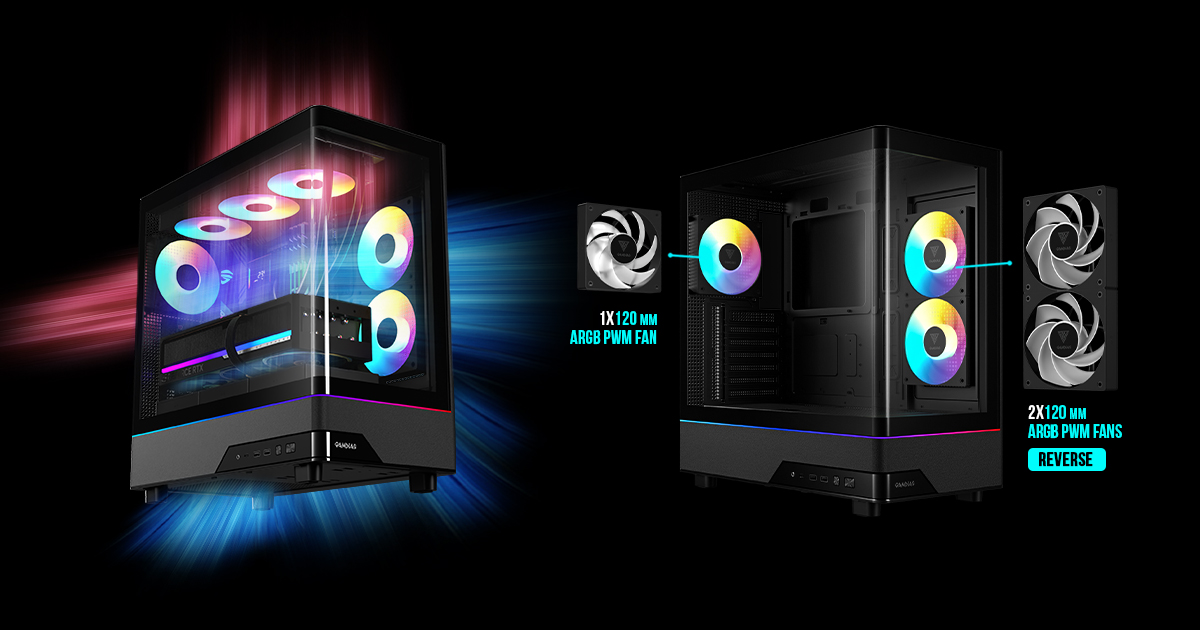
GAMDIAS has introduced the ATLAS M5 series, a new line of mid‑tower PC cases designed to offer wider component visibility and improved airflow. The range includes two models, the ATLAS M5 and the ATLAS M5 CG, with the latter being distinguished by a single-piece curved tempered glass panel.
Both cases focus on panoramic component presentation. The ATLAS M5 CG uses an L‑shaped curved glass panel for an unobstructed view of the interior, while the standard ATLAS M5 features tempered glass panels on the front and side. The design removes corner obstructions to create a cleaner showcase layout.
Cooling is handled by three pre‑installed NOTUS M1 ARGB PWM fans, with support for up to nine fans in total. The cases also include an integrated ARGB light strip and offer multiple radiator mounting points for liquid cooling setups.
Connectivity is provided through a side‑mounted I/O panel with a USB 3.2 Gen2x2 Type‑C port, two USB 3.0 ports, LED controls and HD audio. Inside, the ATLAS M5 supports Mini‑ITX, Micro‑ATX and ATX motherboards, GPUs up to 425mm long and PSUs up to 140mm. Storage options include configurations for 3.5‑inch and 2.5‑inch drives. To keep your system clean and simplify maintenance, dust filters are included at the top, side and bottom of the case.
The ATLAS M5 will be available around $84.90, while the Atlas M5 CG will cost slightly more at $99.90.
Future Intel Desktop sockets might support several generations of CPUs, as hinted by Robert Hallock in an interview with Club386. Intel Might Finally Offer Extended Desktop Socket Support For Multiple CPU Generations If there's one area where Intel has lagged versus AMD, that's socket support. Since the release of the first "Ryzen" CPU back in 2017, AMD has released two sockets, AM4 and AM5. Meanwhile, Intel has a total of four socket releases since then, starting with LGA 1151, LGA 1200, LGA 1700, & the most recent, LGA 1851 socket. Later this year, Intel will release a fifth socket, LGA […]
Another lucky user gets a powerful gaming PC for less than half its price. With RAM, SSD, and GPU prices rising, getting such a system for $1000 is nearly impossible these days. Redditor Snags Powerful Gaming PC for Just $1,000 at Costco; A Build Worth Nearly $2,500 There is a rare chance you could get your hands on such a decently powerful gaming PC when you shop at Costco or Walmart next time. Changes are largely low, but never zero. This is why we keep posting such "inspiring" stories, encouraging you to check out what your local retailer is currently […]
The library of native titles on macOS is slowly expanding, but the number of games available on the platform is always expected to be less than what Windows supports. However, this disparity didn’t stop ASUS from comparing its Zenbook A16, which is kitted with the Snapdragon X2 Elite Extreme, to the M5, and that too in a gaming comparison surrounding a title that’s not even natively available on Apple’s macOS. Even worse, ASUS’s marketing team doesn’t understand what unified memory bandwidth is and has instead implied that its Zenbook A16 has a higher transfer rate than the M5 MacBook Pro. […]
NVIDIA has revealed more details of its next-generation AI Data Center solution, Rosa Feynman, built using 3D Die-Stacking. NVIDIA Goes With 3D Die Stacking & Custom HBM Solution For Its Next-gen Rosa Feynman AI Chips NVIDIA's Feynman GPU architecture was confirmed back at GTC 2025. During the announcement, NVIDIA listed the Feynman GPU with next-gen HBM, Vera CPU, and several other connectivity chips that make up the foundation of the AI data center. Well, this year at GTC 2026, NVIDIA is revealing more information and some big changes. First up, NVIDIA is now confirming that its Feynman GPUs will adopt […]
The new AMD APU family has received support in the latest CPU-Z software, and the upcoming Intel Wildcat Lake has also been mentioned. CPU-Z Adds Support for AMD Ryzen AI 400 "Kraken Point 2" APUs and Preliminary Support for Intel Wildcat Lake in Version 2.19 AMD's recently launched Ryzen AI 400 CPU series has just received support in the latest CPU-Z version 2.19. As per the release notes of the latest version, all the new Ryzen AI 400 desktop APUs, including the G and GE versions, have been added to the CPU-Z database. The series includes several SKUs under the […]
The long-standing issue that still exists on MSI motherboards has been identified by the company. MSI Rolls Out BIOS Version 7E51v1A81 for MAG X870 Tomahawk WiFi to Fix PCIe GPU Throttling A strange bug was reportedly affecting the PCIe lane allocation for GPUs installed on MSI AM5 motherboards. There have been numerous reports from last year indicating that the issue isn't limited to MSI motherboards, but sometimes occurs on motherboards from GIGABYTE and ASUS. https://x.com/unikoshardware/status/1909314979968528496 previously reported several such instances, where users found their GPUs capped at a much lower PCIe link speed than they should. This issue usually appeared […]
New memory and filler kits have arrived, offering users a combo of real and fake memory DIMMs. V-Color Debuts 16 GB/24 GB DDR5 Memory + RGB Filler Kit for AMD AM5 Platform, Offering Versatile Configurations Popular memory maker V-Color has launched a new memory-filler combo kit for gamers who want a flexible way of populating their DIMM slots without needing to buy multiple real memory modules. The kits are specially designed for AM5 builds, offering a 1+1 combo kit with memory capacities available in 16 GB and 24 GB. V-Color has launched its 1+1 Value Pack, featuring either a 24 […]
Apple has officially announced the M5 Pro and M5 Max, the new chips powering the latest 14-inch and 16-inch MacBook Pro, with pre-orders opening March 4 and availability from March 11. On the surface, this looks like another generational chip update, but dig into what Apple has actually done here, and it is a more interesting story than the spec sheet alone suggests.
A New Architecture at the Core of It
The biggest change with M5 Pro and M5 Max is not the core count or the clock speeds; it is how Apple has built the chips in the first place. Both are constructed using what Apple calls Fusion Architecture, which bonds two third-generation 3nm dies together into a single package using TSMC’s advanced SoIC packaging technology. Every M1 through M4 Pro and Max before this was a single monolithic die. That changes here, and the reason why matters.
TSMC’s manufacturing process limits how large a single die can be while maintaining reasonable yield. By splitting the design across two smaller dies and bonding them together, Apple sidesteps that constraint and can reach memory bandwidth and core count figures that a single N3P die could not have delivered economically. The key claim Apple is making is that the inter-die interconnect is fast and low-latency enough that the operating system and applications treat the package as a single unified device, preserving the unified memory model that Apple Silicon has always depended on. Apple has done something similar at the Ultra tier since the M1 Ultra in 2022, but bringing it to the Pro and Max tiers for laptop chips is a harder engineering challenge, and apparently one Apple has now solved.
Apple M5 Pro and M5 Max CPU’s: More Cores, New Core Design
M5 Pro and M5 Max both run an 18-core CPU comprising six super cores and twelve all-new performance cores. The super core is Apple’s highest-performance core design, the same one introduced in the base M5, and Apple claims it delivers the world’s fastest single-threaded performance, driven by increased front-end bandwidth, a revised cache hierarchy, and better branch prediction.
The twelve performance cores are a new design built specifically for the Pro and Max tiers and are not the same as the efficiency cores in previous generations. Where M4 Pro’s E-cores were optimised primarily for power gating, the new performance cores in M5 Pro and M5 Max are designed to deliver sustained multithreaded throughput at lower power than the super cores. That distinction is important for professionals running long compilation jobs, simulations, and rendering workloads that sit somewhere between light background tasks and all-out burst workloads.
Apple is claiming a 30 percent multithreaded uplift for M5 Pro over M4 Pro, which is the largest single-generation CPU gain at the Pro tier since the original M1 Pro. M4 Pro had 14 cores and M5 Pro jumps to 18, a 29 percent increase in core count alone, so the claim is internally consistent. M5 Max gets a more modest 15 percent MT uplift over M4 Max, reflecting the smaller core count jump from 16 to 18.
GPU and Neural Accelerators
M5 Pro gets up to a 20-core GP, U and M5 Max scales to 40 cores. The M5 Pro GPU core count matches the M4 Pro exactly, so the graphics performance gains here are entirely from architectural improvements per core rather than from adding more cores. Apple puts that at around 20 percent better conventional graphics performance and up to 35 percent for ray-traced workloads, with the ray-tracing improvement specifically attributed to Apple’s third-generation ray-tracing engine alongside second-generation dynamic caching and hardware-accelerated mesh shading support.
The more significant GPU addition is the Neural Accelerator that sits inside each GPU core. This is separate from the Neural Engine that handles background Apple Intelligence and Core ML workloads. The Neural Accelerators are dedicated to accelerating matrix multiplication operations that dominate large-model inference when they run through the GPU compute pipeline, as they do in applications like LM Studio and ComfyUI. Apple claims over 4x the peak GPU compute for AI relative to M4 Pro and M4 Max. However, it is worth noting that this figure reflects the Neural Accelerator path specifically, not the conventional shader performance improvement, which is the more measured 20 percent figure.
Memory Bandwidth: The Number That Actually Matters
M5 Pro supports up to 64 GB of unified memory with 307 GB/s of bandwidth, up from 48 GB and 273 GB/s on M4 Pro. M5 Max holds at a maximum capacity of 128 GB but raises bandwidth from 546 GB/s to 614 GB/s in the top 40-core configuration.
For a growing number of professional workloads, memory bandwidth is more important than raw compute performance, and local LLM inference is the clearest example of why. When generating tokens, a large language model must load its full parameter weights from memory on every forward pass. For a 70B-parameter model in 16-bit floating point, that is roughly 140 GB of data moving per token generated, with comparatively little computation performed on it. That makes the workload bandwidth-bound rather than compute-bound, which means 614 GB/s translates directly into faster token generation. For context, AMD’s Ryzen AI Max Plus in the best Windows laptop configuration delivers around 273 GB/s, less than M5 Pro and considerably less than M5 Max. M5 Max also has the memory capacity to run models that cannot fit on any discrete GPU configuration available today, making the bandwidth advantage meaningful in practice rather than just on paper.
Everything Else Worth Knowing About Apple’s new M5 Pro and M5 Max SoCs
Thunderbolt 5 is standard across M5 Pro and M5 Max, and Apple specifies that each port has its own dedicated on-chip controller rather than sharing bandwidth through a motherboard switch. That means each port gets the full 120 Gb/s bandwidth independently. The Media Engine handles H.264, HEVC, and AV1 decode, and ProRes encode and decode, with the Max tier doubling the encode and ProRes throughput, as it has in previous generations. Internal SSD speeds are claimed at up to 14.5 GB/s, roughly double the previous generation, which matters for model loading and high-bitrate video workflows. The new MacBook Pro also picks up Apple’s N1 wireless chip, bringing Wi-Fi 7 and Bluetooth 6.
One feature that tends to get overlooked in launch coverage is Memory Integrity Enforcement, which Apple’s platform security documentation confirms is available on M5-class processors. It is an always-on, hardware-level memory safety mechanism that does not compromise device performance and is specifically designed to protect the kernel attack surface. For enterprise and research users, that is a meaningful security addition that no competing laptop platform currently matches.
The Competitive Picture
No Windows laptop in 2026 combines the memory bandwidth, memory capacity, and power efficiency of M5 Max in a laptop form factor. AMD Strix Halo is the closest competitor for the LLM inference use case and deserves credit for meaningfully closing the gap over recent generations. Still, the bandwidth gap remains a structural disadvantage to overcome within laptop thermal and form-factor constraints. Qualcomm’s Snapdragon X2 Elite is a credible CPU competitor at the consumer tier. Still, the GPU and memory bandwidth situation is not on the same level at the Pro and Max tiers.
Wrapping it Up: Apple M5 Pro and M5 Max look the part on paper
M5 Pro and M5 Max are genuine steps forward,d not just tick-tock updates. Fusion Architecture is the most important Apple Silicon architectural change since M1 Ultra, now applied to the chips that actually go into MacBook Pros. The memory bandwidth figures are the highest available in any laptop, the CPU gains at the Pro tier are the strongest in years, and the Neural Accelerator addition positions both chips well for the continued growth of local AI inference as a professional workload.
Whether Apple’s claimed numbers hold up in independent testing is the question that matters most right now, and that answer starts arriving when hardware ships on March 11.

 Login
Login