Normal view

There are new articles available, click to refresh the page.
Today — 14 September 2026Main stream

AZZA PSAZ-750G ATX 3.1 power supply review: An adequate budget 750W unit

13 September 2026 at 13:30

AZZA is one of those brands that has been around far longer than its shelf presence suggests. The company is the PC-components arm of Linkworld Electronic, and it has spent the better part of two decades selling cases, coolers, chassis fans and power supplies into the value end of the market, mostly through regional distribution rather than the big review-sample circuit. That low profile cuts both ways. AZZA has never had the marketing budget to overpromise the way larger brands do, but it also has never had to answer for its power supplies in public the way brands like Corsair or Cooler Master routinely do. Like almost every brand in this segment, AZZA designs none of their units themselves but buys platforms from (usually Chinese) OEMs and puts its own sticker on the side.

The PSAZ series is AZZA's mainstream ATX line, and the PSAZ-750G is the 750W Gold-badged member of it. The unit we have is marked ATX 3.1 and PCIe 5.1 Ready on the box, carries a native 12V-2x6 connector, and is rated for its full 750W at 40°C ambient. It ships with a 2-year warranty, which is a statement all by itself. The platform comes from Helly, a manufacturer that supplies a number of platforms and we meet their products frequently in mainstream units. What makes the PSAZ-750G interesting is not the specification sheet but the badge on it: the box, the label and the retail listings all carry the 80 PLUS Gold logo, and AZZA has not put a PSAZ unit through 80 PLUS certification since 2015. That claim, more than anything else, is what this review has to settle and determine whether it deserves a spot in our list of best power supplies.

Specifications and Design

AZZA PSAZ-750G ATX 3.1 Power specifications ( Rated @ 40 °C )

RAIL

+3.3V

+5V

+12V

+5Vsb

-12V

MAX OUTPUT

20A

20A

62A

2.5A

0.3A

100W

100W

744W

12.5W

3.6W

TOTAL

750W

AC INPUT

100 - 240 VAC, 50 - 60 Hz

MSRP

$78

In the Box

Packaging is plain and inexpensive, and honest about it. The sleeve is a flat slate-blue with the AZZA wordmark rendered as three large outlined chevrons on the left, a line drawing of the unit on the right, and the model and wattage stacked underneath. The badges run along the lower half - PCI-e 5.1 Ready, ATX 3.1, and the 80 PLUS Gold logo in its usual gold square. The unit sits inside between two moulded protective inserts, with the cables bundled beside it.

AZZA PSAZ-750G ATX 3.1

(Image credit: Tom's Hardware)

The bundle is as thin as it gets. There is the AC power cord, four mounting screws and four black zip ties. No Velcro straps, no cable combs, no pouch, no tester, and nothing in the way of printed documentation beyond what is on the box itself. At $78 for a 750W unit, none of that is unreasonable, but it is worth noting that the four zip ties are doing real work here. With a hardwired cable set there is no way to leave unused cables out of the case, so whatever routing tidiness you get, you will be building yourself.

AZZA PSAZ-750G ATX 3.1

(Image credit: Tom's Hardware)

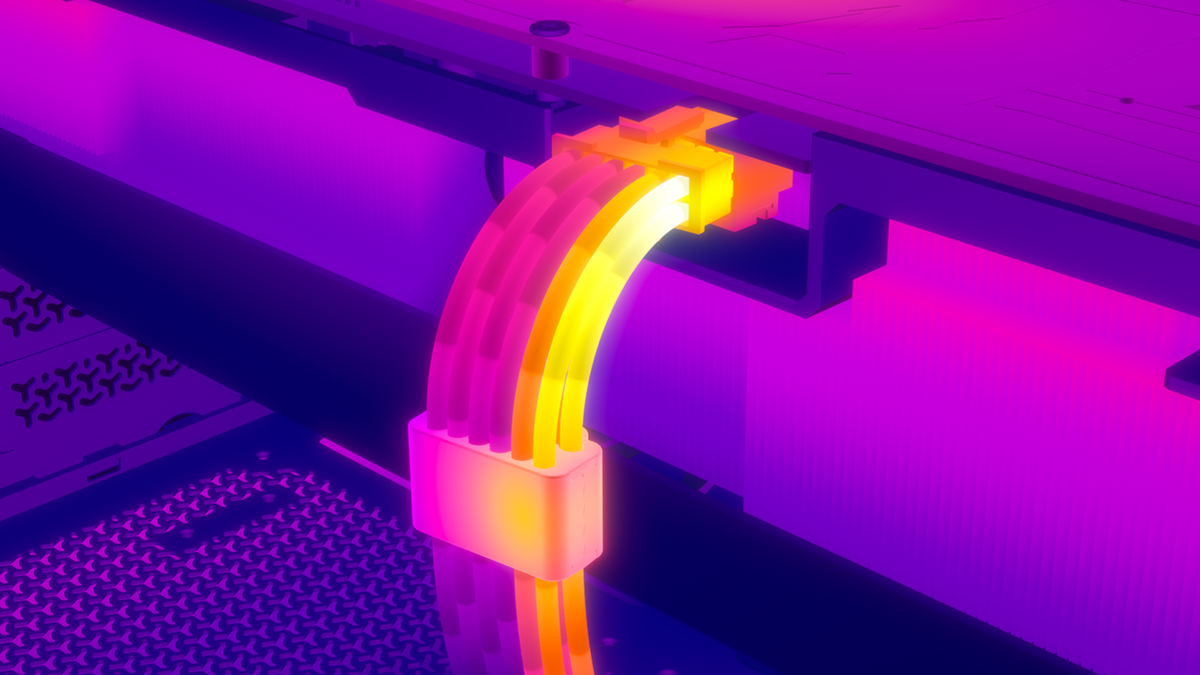
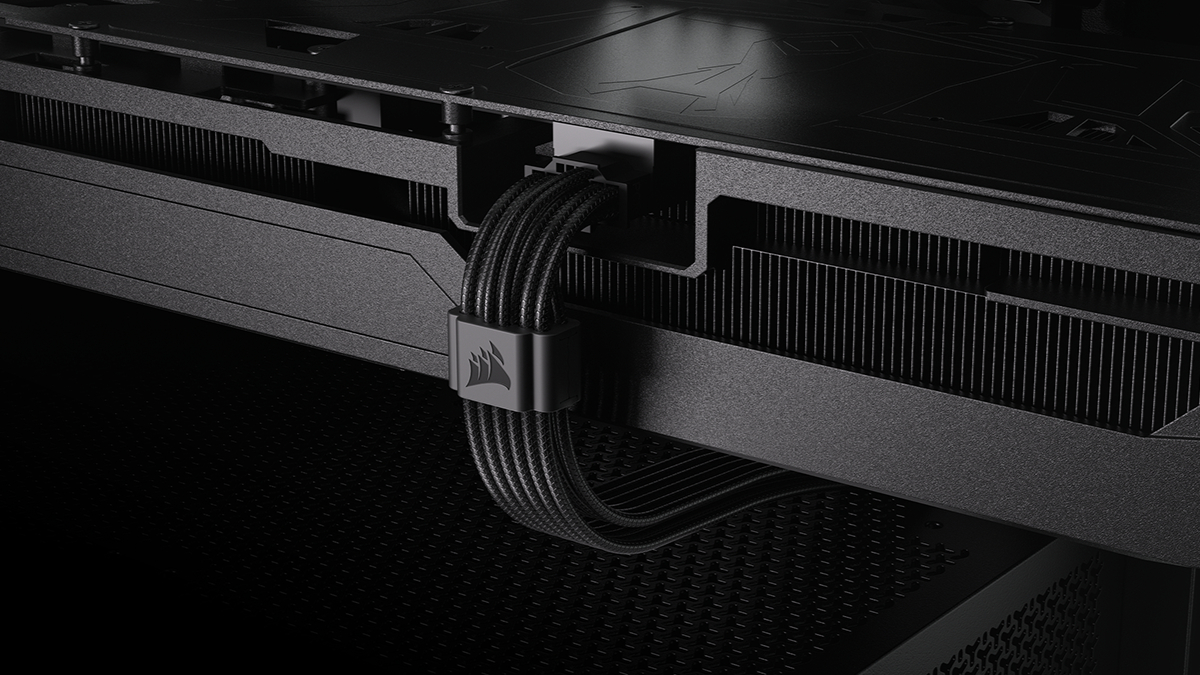
The cables themselves are better than the accessory list implies. All of them are black nylon-sleeved rather than the flat ribbon type common at this price, sleeved right up to the connector housings, and the wire gauges look appropriate throughout. The 12V-2x6 cable is a native run from the PCB rather than an adapter, and it is printed with a 450W rating along its length, which is the single most important thing to know about this power supply before you buy it. That is enough for a mid-range card, and not enough for a 500W+ flagship, regardless of what the 750W on the box suggests. There is no dual-color keying on the connector, so seating it correctly is on you.

AZZA PSAZ-750G ATX 3.1

Connector type

Hardwired

Modular

ATX 24 Pin

1

-

EPS 4+4 Pin

2

-

EPS 8 Pin

-

-

PCI-E 5.1

1

-

PCI-E 8 Pin

3

-

SATA

6

-

Molex

2

-

Floppy

-

-

External Appearance

At 150 x 86 x 140 mm the PSAZ-750G is a standard-depth ATX unit, and 140 mm means it drops into essentially any case that takes an ATX supply, with enough clearance left over to deal with the fixed cable loom. The chassis is finished in a dark grey-brown matte paint and it is a better finish than the price would predict. The top face carries a slotted grille with wide diagonal bars over the fan, cut off at one corner by a plain triangular panel bearing the AZZA logo and a few thin pinstripes. It is a restrained, slightly industrial look, and the diagonal grille bars do restrict airflow area more than a wire or honeycomb grille would, which increases noise.

AZZA PSAZ-750G ATX 3.1

(Image credit: Tom's Hardware)

The side panel carries the only color on the unit: a grey hatched rectangle with the AZZA wordmark in outline and 750W set in a bright cyan that matches the box. The top side holds the specifications label, and it is worth reading. It lists the ATX 3.1 and PCIe 5.1 Ready marks and, again, the 80 PLUS Gold logo.

AZZA PSAZ-750G ATX 3.1

(Image credit: Tom's Hardware)

The rear face is a hexagonal honeycomb exhaust panel with the AC receptacle, the main I/O rocker, and a second, smaller square button beside it. That button is the hybrid fan mode switch: press it and the semi-passive behavior is disabled, so the fan runs continuously from idle rather than waiting for load. It is a feature several units at three times this price still omit, and it is faintly odd to find it here. The front face is solid, with the fixed cable loom leaving through a single rubber-grommeted opening. There is no modular bay, no LED, and no other features.

AZZA PSAZ-750G ATX 3.1
Tom's Hardware
AZZA PSAZ-750G ATX 3.1
Tom's Hardware

Internal Design

Cooling comes from a 120 mm Yate Loon D12BH-12, a ball-bearing fan rated at 12V and 0.60A. Yate Loon publishes this model at 2300 RPM, 89 CFM and 41 dB(A) at full speed, which puts it firmly in the high-airflow, high-noise half of the catalogue. Ball bearings are a durability advantage over the sleeve-bearing fans that usually appear at this price, and given the 2-year warranty that matters - a fan that outlasts the coverage period is the minimum bar. What it is not is a quiet fan, and the platform leans on it hard, as the hot-box results below make clear.

AZZA PSAZ-750G ATX 3.1

(Image credit: Tom's Hardware)

The platform is a Helly design and is similar to the platform Phanteks AMP GH series is using - but that is where the similarities end. The layout is clean and reasonably modern, with the main PCB carrying the primary and secondary stages and a pair of small vertical daughterboards near the front handling the minor rails. Heatsinks are generously sized for the class, dark-anodised finned extrusions rather than the bent aluminium strips that budget platforms often make do with, and the board is well populated with silicone glue on the taller components. The main transformer is marked ATX3.0 on the bobbin, which is a small reminder of how recent the 3.1 revision on the box actually is.

AZZA PSAZ-750G ATX 3.1
Tom's Hardware
AZZA PSAZ-750G ATX 3.1
Tom's Hardware

Transient filtering runs to four Y capacitors, three X capacitors and two common-mode chokes, which is a complete filter by any reasonable standard and better provisioned than several units we have looked at this year. Inrush is handled by an NTC thermistor with a relay for bypass. Two bridge rectifiers sit on their own dedicated heatsink, feeding an APFC stage built around two Oriental Semiconductor OSG55R190F MOSFETs. The bulk capacitor is a 560 µF, 420V Ltec from its HP series, rated at 105°C. That is a low-cost Taiwanese part rather than a premium one, and it is the first place the budget shows. Capacity is adequate for 750W, the temperature rating is right, but the pedigree is not. The APFC coil beside is unshielded, which is a cost decision rather than a functional problem, though it does nothing for radiated noise.

AZZA PSAZ-750G ATX 3.1

(Image credit: Tom's Hardware)

The primary inversion stage uses two PIP PTA25N50 MOSFETs in a half-bridge LLC resonant arrangement, the standard modern topology at this power level. On the secondary side, the 12V rail is rectified by four Fuxin FXN0204C MOSFETs in synchronous rectification, with the 3.3V and 5V rails generated by DC-to-DC converters on the two vertical daughterboards.

AZZA PSAZ-750G ATX 3.1
Tom's Hardware
AZZA PSAZ-750G ATX 3.1
Tom's Hardware

Secondary filtering is a mix of Ltec electrolytics and a smaller number of APAQ polymer capacitors, both Taiwanese. This is the part of the component list that will decide how the unit ages: Ltec electrolytics are not terrible parts, but they are at best ordinary ones, and they will spend their life sitting next to secondary heatsinks that may hit well over 70 °C in a normal system. A 2-year warranty against that combination is not a comfortable pairing.

AZZA PSAZ-750G ATX 3.1

(Image credit: Tom's Hardware)

Cold Test Results (25°C Ambient)

Cold Test Results (25°C Ambient)

For the testing of PSUs, we are using high-precision electronic loads with a maximum power draw of 2700 Watts, a Rigol DS5042M 40 MHz oscilloscope, an Extech 380803 power analyzer, two high-precision UNI-T UT-325 digital thermometers, an Extech HD600 SPL meter, a self-designed hotbox, and various other bits and parts.

AZZA PSAZ-750G ATX 3.1
Tom's Hardware
AZZA PSAZ-750G ATX 3.1
Tom's Hardware
AZZA PSAZ-750G ATX 3.1
Tom's Hardware
AZZA PSAZ-750G ATX 3.1
Tom's Hardware
AZZA PSAZ-750G ATX 3.1
Tom's Hardware

At 25°C ambient the PSAZ-750G averaged 90.6% at 230 VAC and 88.6% at 115 VAC across the nominal load range. The curve peaks at about 92% at 230 VAC around 300W and holds 90.2% at a sustained 750W, with the 115 VAC line topping out at 90.3% and finishing at 87.3%. Those are respectable numbers and the shape of the curve is healthy, with no full-load collapse. They are also, and this is the point, not Gold. 80 PLUS Gold requires 90/92/89% at 20/50/100% load on 230 VAC and 87/90/87% on 115 VAC. We measured 90.1/91.8/90.2% and 88.7/89.9/87.1% respectively. The unit clears the 20% and 100% checkpoints on both inputs and misses the 50% checkpoint on both, by 0.2 and 0.1 points. It is a near miss rather than a fraud and CLEAResult tests at 23 °C so it could possibly pass, but there is no 80 PLUS entry for the PSAZ series after 2015 to argue otherwise. There is no Cybenetics listing either.

Acoustically the cold run is the best part of this review. The fan stays completely stopped up to roughly 40% load, giving a genuine 300W fanless window that covers desktop work and a good deal of gaming outright. It starts at 31.6 dB(A) and ramps gently to about 33 dB(A) at half load, at which point it becomes the quietest thing in most builds. Past 450W the curve steepens noticeably, reaching 38 dB(A) at 600W and 42 dB(A) at a sustained 750W. That is audible but not intrusive, and it is a reasonable trade for a good thermal result. The heatsinks reached 66-68°C at full load. Nothing here is under severe stress.

Hot Test Results (~45°C Ambient)

Hot Test Results (~45°C Ambient)

Inside the hotbox at roughly 45°C ambient, five degrees above the unit's own 40°C rating, efficiency falls by roughly a point and a half. It was not an unexpected result but it is severe for a 750W unit. The averages come to 89.4% at 230 VAC and 87.5% at 115 VAC, with the curve peaking near 90.8% and finishing at 88.5% and 85.6% respectively at full load. Nothing in the electrical behavior suggests the platform is in deep trouble but we can see the signs of thermal degradation at full load.

AZZA PSAZ-750G ATX 3.1
Tom's Hardware
AZZA PSAZ-750G ATX 3.1
Tom's Hardware
AZZA PSAZ-750G ATX 3.1
Tom's Hardware
AZZA PSAZ-750G ATX 3.1
Tom's Hardware
AZZA PSAZ-750G ATX 3.1
Tom's Hardware

The thermal and acoustic picture is where the platform shows its limits. The fan leaves its passive mode in the hot box very quickly, starting at about 33.6 dB(A) from 200W, then climbing steeply and continuously: 43 dB(A) at 500W, 48.6 dB(A) at 600W, and 52.2 dB(A) at a sustained 750W. That last figure is loud in the plain sense of the word, well past the point where the PSU is the loudest component in a mid-tower and into the range where it likely is the loudest thing in the room. It is also the fan doing exactly what it should, because the internal temperatures need it. The heatsinks reached 94°C at full load, which is on the high side for a 750W unit. Those are not typically failure temperatures, but they are high enough to matter for the Ltec secondary electrolytics sitting beside them over a several-year ownership period.

PSU Quality and Bottom Line

Power Supply Quality

Voltage regulation is the strongest result on the sheet. Across the 20% to 100% load span the 12V rail moved by just 0.9%, with the 3.3V and 5V rails both at 1.4%. Sub-1% on 12V is genuinely good, better than several other Gold units, and it is the credit side of the DC-to-DC secondary arrangement. The minor rails are looser, but both stay comfortably inside the ±5% ATX window and neither matters much to a modern system.

Ripple suppression is adequate rather than good. The 12V rail peaked at 52 mV at full load and 50 mV in the 12V-weighted cross-load test, against a 120 mV ATX limit. The 3.3V and 5V rails topped out at 26 and 28 mV against their 50 mV limits. Those are passes with about 57% headroom on 12V and roughly 45% on the minor rails, so nothing is close to the edge. They are also roughly double what a well-filtered enthusiast platform delivers, and the 12V figure more than doubles between 50% and 100% load, which points at secondary filtering that is sized to the requirement rather than beyond it. For the hardware a 750W unit at this price will actually feed, it is sufficient.

During our thorough assessment, we evaluate the essential protection features of every power supply unit we review, including Over Current Protection (OCP), Over Voltage Protection (OVP), Over Power Protection (OPP), and Short Circuit Protection (SCP).

All protection mechanisms were present and triggered correctly. With the unit hot, OCP tripped at 146% on the 3.3V rail (29.2A), 140% on the 5V rail (28A), and 128% on the 12V rail (79.4A), with OPP shutting the unit down at about 130% of rated output, or roughly 975W. The 12V threshold is the sensible one of the three. The minor-rail thresholds are loose enough that the 100W combined budget is the real constraint there, not the protection.

Main Output

Load (Watts)

151.27 W

377.39 W

563.17 W

749.01 W

Load (Percent)

20.17%

50.32%

75.09%

99.87%

Amperes

Volts

Amperes

Volts

Amperes

Volts

Amperes

Volts

3.3 V

1.81

3.37

4.53

3.36

6.8

3.33

9.07

3.32

5 V

1.81

5.06

4.53

5.05

6.8

5.01

9.07

4.99

12 V

11.25

12.09

28.11

12.07

42.17

12.01

56.23

11.98

Line

Regulation

Voltage Ripple (mV)

(20% to 100% load)

20% Load

50% Load

75% Load

100% Load

CL1
12V

CL2
3.3V + 5V

3.3V

1.4%

20

16

22

26

22

26

5V

1.4%

20

16

20

28

22

26

12V

0.9%

30

22

36

52

50

28

Bottom Line

The PSAZ-750G is a competent budget power supply carrying a claim it cannot support. The Helly platform underneath is more modern than the price suggests and used by several manufacturers at this price point. Inside, we have a half-bridge LLC primary, DC-to-DC minor rails, a complete transient filter, generously sized heatsinks, a ball-bearing fan and a native 12V-2x6 connector. Regulation on the 12V rail is genuinely good at 0.9%, ripple is comfortably inside specification everywhere, protections all work and trip at sane thresholds, and the 300W fanless window at room temperature is real. There is nothing broken here.

AZZA PSAZ-750G ATX 3.1

(Image credit: Tom's Hardware)

The efficiency claim, however, is one that does not survive contact with the bench. Our numbers put the unit 0.2 points under the Gold requirement at 50% load on 230 VAC and 0.1 under it on 115 VAC, clearing every other checkpoint. CLEAResult tests at 23°C, so a good sample could plausibly clear the bar on the official bench. On the other hand, other units using the same platform passed our testing, even if they were fully modular (typically hardwired cables increase efficiency slightly). AZZA has not certified a PSAZ unit since 2015, there is no official 80 PLUS entry for this particular model, no Cybenetics listing and no PLPP listing, yet the Gold logo is printed on the box, on the label and in the retail listings. The unit performs like a borderline Gold supply. It is being sold as a certified one. Those are not the same thing, and the second is the vendor's choice, not a measurement artifact.

Most of the remaining compromises are ordinary for the money. Hardwired cabling at 750W in 2026 is behind the market but forgivable at $78, but the Ltec capacitors is what a $78 budget buys. One thing is harder to wave through. That is the 2-year warranty, which is half or less of what every serious competitor offers; set against heatsinks that reached 94°C at full load in the hot box, with ordinary electrolytics sitting beside them, it reads as the manufacturer telling you how long it expects the unit to be its problem.

AZZA PSAZ-750G ATX 3.1

(Image credit: Tom's Hardware)

Against named rivals, the placement is straightforward. The Phanteks AMP GH series runs a related Helly platform, which is worth keeping in mind - the design itself is not the problem here; the specification is. The MSI MAG A750GL PCIE5 is fully modular, genuinely 80 PLUS Gold certified, and backed by a 10-year warranty, and it is better than the AZZA on every axis except price. The Cooler Master MWE Gold 750 V4 at $119 MSRP is quieter under sustained load, carries verified Gold efficiency and a 10-year warranty, and gives up only a little on 12V regulation, where the AZZA's 0.9% is the better figure.

The PSAZ-750G beats them on nothing but cost, but it beats them there by a wide margin. So the recommendation is narrow but real. If you are building a mid-range machine on a tight budget, the card you are pairing it with draws under 450W, and you can live with 2 years of coverage and a fixed cable loom, the PSAZ-750G will do the job, and it will do it quietly at the loads you will actually run. If any of those three conditions do not hold, the extra money for a certified, longer-warrantied, fully modular unit is the better spend, and it is not a close call. Buy it for what it measures, not for the badge on the box.

MORE: Best Power Supplies

MORE: How We Test Power Supplies

MORE: All Power Supply Content

Before yesterdayMain stream

Thermalright TR-KG750 750W power supply review: HKC-built KG unit with a Thermalright badge for $91

11 September 2026 at 11:05

Thermalright is a CPU cooling company that happens to sell power supplies. Established in Taipei in 2001, it spent its first two decades building a reputation on air coolers - the Ultra-120 eXtreme and the HR series were enthusiast reference points long before the current wave of tower coolers - then drifted out of the conversation for years before the Peerless Assassin 120 dragged it back to the top of every budget build list in 2021. Its catalog has expanded aggressively since: case fans, all-in-one liquid coolers, thermal compounds, chassis, and, since 2022, power supplies. That last category deserves a different kind of scrutiny than the rest. Much like most brand names, Thermalright does not build power supplies; it commissions them, and a heatsink company's engineering credibility transfers to a PSU exactly as far as the OEM behind it allows. Every Thermalright power supply has to be judged on its platform rather than its badge.

The KG series occupies the value end of Thermalright's power supply range, and the TR-KG750 reviewed here is its 750W entry. How does it hold up against the best power supplies on the market? On paper, the specification is current, with ATX 3.1 and PCIe 5.1 compliance, a native 12V-2x6 connector, full modularity, 80 PLUS Gold certification at 115 VAC, a 120 mm fan inside a 140 mm-deep chassis, and a five-year warranty. The label on the PSU itself answers the platform question without much digging. The manufacturer of record is Somore Tech Co., Ltd., the production is credited to Jiushouyangguang Power Supply (Shenzhen), and the internal designation printed beside the 80 PLUS badge is HKCMAX-750 - this is an HKC platform, and the silkscreen on the main board dates the design to April 2023. There is no Cybenetics entry for the model at the time of writing, so the 80 PLUS report is the only third-party data available on it. At a retail price of $91, it undercuts essentially every name-brand 750W Gold unit on the US market, which is the whole of its pitch.

Specifications and Design

Thermalright TR-KG750 Power specifications ( Rated @ 40 °C )

RAIL

+3.3V

+5V

+12V

+5Vsb

-12V

MAX OUTPUT

20A

20A

62.5A

3A

0.3A

100W

100W

750W

15W

3.6W

TOTAL

750W

AC INPUT

100 - 240 VAC, 50 - 60 Hz

MSRP

$91

In the Box

The TR-KG750 arrives in a compact cardboard box wrapped in a black-to-bronze gradient sleeve, with a three-quarter render of the unit dominating the front and the wattage set in large gold type beside it. The badge strip along the bottom edge is short: 80 PLUS Gold, ATX 3.1, PCIe 5.1, and the model number.

ThermalRight TR-KG750 750W

(Image credit: Tom's Hardware)

The bundle is as thin as they come. Under the protective packaging the supply is accompanied by a multilingual user’s guide, the AC power cord, a small bag of mounting screws, and four zip ties. That is the entire accessory list: no Velcro straps, no cable combs, no storage pouch. Four zip ties for an eight-cable modular supply is a token rather than a provision, and it is one of the few places where the price makes itself felt before you take the lid off.

ThermalRight TR-KG750 750W

(Image credit: Tom's Hardware)

The cables are all-black flat ribbon types throughout, with no sleeving anywhere in the set. They are all uniform, adding points to the aesthetics of the unit. The 12V-2x6 cable is native - a single run from the modular panel to the graphics card, with no adapter or splitter involved - but its plug does not use the dual-color keying the ATX 3.1 specification encourages, which makes an incompletely seated connector easy to spot at a glance.

ThermalRight TR-KG750 750W

(Image credit: Tom's Hardware)
Thermalright TR-KG750

Connector type

Hardwired

Modular

ATX 24 Pin

-

1

EPS 4+4 Pin

-

2

PCI-E 5.1

-

1

PCI-E 8 Pin

-

2

SATA

-

6

Molex

-

3

Floppy

-

-

External Appearance

At 150 x 86 x 140 mm, the TR-KG750 is a standard-width ATX unit with a short 140 mm body, which is about as compact as a 750W supply practically gets and leaves useful slack for cable management even in a mid-tower. The chassis is finished in a matte black with a fine texture, and the top panel carries a stamped fan grille in a diamond-and-chevron pattern - four angled spokes radiating from a central square, framed by long slotted vents - with the Thermalright wordmark pressed into a raised panel at the edge. Four exposed screws sit at the corners, one of them beneath the warranty-void sticker.

ThermalRight TR-KG750 750W

(Image credit: Tom's Hardware)

The rear face is a large square perforated exhaust panel with the AC receptacle and a rocker. The front face hosts the modular connector bay, cleanly silkscreened into four labeled groups: MOTHERBOARD for the split 24-pin, SATA/PATA for the peripheral cables, CPU/PCIe for the four eight-pin sockets, and a dedicated 12V 2x6 socket in the bottom corner. A scratch-off authenticity tag with a QR code sits alongside the panel.

ThermalRight TR-KG750 750W
Tom's Hardware
ThermalRight TR-KG750 750W
Tom's Hardware

The specification label occupies the top face rather than a side panel, which is the more useful placement for a bottom-mounted supply sitting under a windowed case, and both side panels are given over to a large bronze-gradient decal carrying the wattage, model number, and 80 PLUS Gold badge. That decal is the only decoration, and the finish underneath it is unremarkable but honest - evenly applied, no orange peel, no sharp edges. The label repeats the rail ratings, the CCC certificate number, and the internal model designation, and it is where the platform gives itself away. Build quality overall is what the price suggests: the steel gauge is adequate, the panels line up, nothing rattles, but there is none of the extra finishing that separates a $90 unit from a $150 one.

ThermalRight TR-KG750 750W
Tom's Hardware
ThermalRight TR-KG750 750W
Tom's Hardware

Internal Design

Cooling is handled by a 120 mm Yate Loon D12SH-12 rated for 12V at 0.30A. Yate Loon is a long-established Chinese fan maker, and the D-series is its bread-and-butter sleeve-bearing line, which makes this the single most consequential cost-saving in the unit. Sleeve bearings are quiet, like fluid-dynamic alternatives at equivalent speed, but wear faster and are more sensitive to heat and mounting orientation - all three of which matter in a supply that, as the test results show, runs its fan constantly and pushes it hard as soon as ambient temperature rises. The five-year warranty covers the fan, but it is not a part most owners will enjoy chasing a replacement for.

ThermalRight TR-KG750 750W

(Image credit: Tom's Hardware)

The platform is HKC’s, supplied to Thermalright under the internal designation HKCMAX-750, and the main board is silkscreened as ATX32 Main BD Rev1.2. A row of wattage selection pads along the board edge runs from 500W to 850W, with the 750W position populated, confirming this is a single design scaled across a whole product family rather than a layout drawn for 750W specifically. Component density is fair, the soldering is tidy, and some black silicone anchors the larger parts. Only two heatsinks are fitted - a small one carrying the input bridges and a taller, simple finned unit shared by the APFC and primary switching stages - and everything on the secondary side relies on the PCB and a tiny sheet heatsink soldered to it.

ThermalRight TR-KG750 750W
Tom's Hardware
ThermalRight TR-KG750 750W
Tom's Hardware

The transient filtering stage starts at the back of the AC receptacle and continues on the main PCB. In total, there are four Y capacitors, two X capacitors, and two filtering inductors, with an MOV and an NTC thermistor also present - a complete filter with nothing omitted, if not a generous one. Two input rectifying bridges follow on their own small dedicated heatsink. The APFC stage uses two MOSFETs and a boost diode sharing the tall heatsink, paired with a large open-frame filtering coil, and the bulk capacitor is a Nichicon 450V/560 uF part from the 105C-rated GN(M) series. That capacitor is comfortably the best component in the unit and practically the only one sourced from a manufacturer with a genuine reliability record. The primary inversion stage is a half-bridge arrangement built from two 65R160FR MOSFETs on the shared heatsink, feeding the main transformer.

ThermalRight TR-KG750 750W

(Image credit: Tom's Hardware)

The secondary side is where the cost engineering becomes plain. The 12V rail is rectified by six Perfertway PWC012N04ES MOSFETs mounted directly on the main PCB with no heatsink of their own, and the 3.3V and 5V rails are derived from DC-to-DC converters that also live on the main board rather than a vertical daughterboard. As a layout, this is conventional and modern. The problem is provenance: essentially every active device in the conversion path - the bridges, the APFC and primary MOSFETs, the six synchronous rectifiers - comes from manufacturers with no established track record in this application. Secondary filtering is a mix of Teapo parts and capacitors branded NICON that, despite carrying a series designation borrowed from Nippon Chemi-Con’s catalog, do not appear to be a genuine Nippon Chemi-Con nor a Nichicon product, and polymer capacitors handle high-frequency filtering on the modular board. None of this is unusual at the price. It is worth stating plainly, though, that the "all Japanese" capacitor language attached to some retail listings for this model describes the bulk capacitor and nothing else.

ThermalRight TR-KG750 750W
Tom's Hardware
ThermalRight TR-KG750 750W
Tom's Hardware

Cold Test Results (25°C Ambient)

Cold Test Results (25°C Ambient)

For the testing of PSUs, we are using high-precision electronic loads with a maximum power draw of 2700 Watts, a Rigol DS5042M 40 MHz oscilloscope, an Extech 380803 power analyzer, two high-precision UNI-T UT-325 digital thermometers, an Extech HD600 SPL meter, a self-designed hotbox, and various other bits and parts.

ThermalRight TR-KG750 750W
Tom's Hardware
ThermalRight TR-KG750 750W
Tom's Hardware
ThermalRight TR-KG750 750W
Tom's Hardware
ThermalRight TR-KG750 750W
Tom's Hardware
ThermalRight TR-KG750 750W
Tom's Hardware

At 25°C ambient, the TR-KG750 averaged 89.5% at 230 VAC and 88.5% at 115 VAC across the nominal load range, peaking at 91.2% and 90.3%, respectively, at 50% load and settling to 89.2% and 87.9% at a sustained 750W. The curve is well shaped, with the usual broad plateau between 40% and 70% load and no collapse at the top end. What it does not have is margin. Against the 80 PLUS Gold thresholds at 115 VAC - 87% at 20% load, 90% at 50%, and 87% at 100% - our measured 87.2%, 90.3%, and 87.9% clear the bar by 0.2, 0.3, and 0.9 percentage points. The unit’s own 80 PLUS report reads slightly kinder at 90.2%, 91.4% and 88.3%, but the conclusion does not change: this is a Gold unit by a narrow margin.

Acoustically, there is no great news. The Yate Loon spins whenever the supply is powered but remains quiet across the first half of the load range. The ramp through the middle of the range is gentle enough, but it steepens past 70% load, reaching 42 dB(A) at 600W and almost 51 dB(A) at a sustained 750W. That is loud for an efficient 750W unit at room temperature. Thermally, the platform is comfortable at 25°C. The primary and secondary heatsinks stabilized at around 60°C. Those are unremarkable numbers, with the small heatsinks and mediocre efficiency being the obvious culprits.

Hot Test Results (~45°C Ambient)

Hot Test Results (~45°C Ambient)

Inside the hotbox at roughly 45°C ambient - five degrees beyond the unit’s own 40°C rating - efficiency averaged 87.6% at 230 VAC and 86.6% at 115 VAC, an almost uniform 1.9-point loss against the cold run. Full load is where the degradation concentrates: 85.8% at 230 VAC and 84.5% at 115 VAC, both 3.4 points down on the 25°C figures. A drop of that size is larger than we like to see, and it puts the unit well outside Gold territory under heat, although it is being measured beyond its rated envelope and the shape of the curve essentially holds throughout. The supply completed every load step without shutting down.

ThermalRight TR-KG750 750W
Tom's Hardware
ThermalRight TR-KG750 750W
Tom's Hardware
ThermalRight TR-KG750 750W
Tom's Hardware
ThermalRight TR-KG750 750W
Tom's Hardware
ThermalRight TR-KG750 750W
Tom's Hardware

Heat turns the fan from merely constant into genuinely intrusive. The floor rises to 37 dB(A), which is audible but not dramatic. It maintains reasonable noise figures up to 525W and then the curve breaks: between 525W and 600W the fan jumps almost ten decibels to 56 dB(A), settling at 58 dB(A) at a sustained 750W. A step that abrupt points to a coarse thermal control scheme rather than a tuned curve, and at 58 dB(A) the power supply is likely to be the loudest component in almost any system. The internal readings explain the urgency: the primary heatsink reached well over 100°C at full load. Those are very high figures for parts of uncertain pedigree and for a 750W PSU, and while the unit held together for the duration, sustained full load at 45°C is not an environment we would ask this platform to live in.

PSU Quality and Bottom Line

Power Supply Quality

Voltage regulation is adequate rather than tight. Between 20% and 100% load, the 3.3V rail moved 1.2%, the 5V rail 1.4%, and the 12V rail 1.8%. The 12V figure is the one that matters, and it is the loosest of the three, sliding from 12.11V at 151.5W to 11.89V at 744.5W. That sits comfortably inside the ±5% ATX window and will not trouble any component, but it is roughly double what a well-tuned modern LLC platform delivers, and most of the drop arrives between 50% and 75% load rather than being spread evenly across the range.

Ripple suppression follows the same pattern of simple adequacy. On the 12V rail we measured 24 mV at 20% load rising to 62 mV at full load, against the 120 mV ATX limit - a comfortable pass with roughly 48% headroom, though the jump from 38 mV at 75% load to 62 mV at 100% is steeper than the rest of the curve. The minor rails run closer to their ceilings: 34 mV on 3.3V and 38 mV on 5V against a 50 mV limit, leaving 32% and 24% headroom respectively. Cross-load behavior was unremarkable, with 60 mV on 12V under the 12V-heavy test and 34 mV on 5V under the minor-rail test. None of this is a problem for the hardware a 750W supply will realistically feed, but the minor rails have less room than we would expect from a DC-to-DC design.

During our thorough assessment, we evaluate the essential protection features of every power supply unit we review, including Over Current Protection (OCP), Over Voltage Protection (OVP), Over Power Protection (OPP), and Short Circuit Protection (SCP).

All protection mechanisms were verified and triggered correctly during testing. With the unit hot, OCP tripped at 140% on the 3.3V rail (28A), 142% on the 5V rail (28.4A), and 136% on the 12V rail (85A), with OPP shutting the supply down at 134% of rated output, or approximately 1005W. Those are generous thresholds, more generous than most mainstream 750W units carry, and they mean the platform will ride out the transient excursions a modern graphics card throws at it without any complaint - which is precisely what ATX 3.1 compliance is meant to guarantee.

Main Output

Load (Watts)

151.52 W

377.76 W

558.95 W

744.47 W

Load (Percent)

20.2%

50.37%

74.53%

99.26%

Amperes

Volts

Amperes

Volts

Amperes

Volts

Amperes

Volts

3.3 V

1.8

3.38

4.5

3.37

6.75

3.36

9

3.34

5 V

1.8

5.11

4.5

5.10

6.75

5.05

9

5.04

12 V

11.25

12.11

28.14

12.07

42.2

11.90

56.27

11.89

Line

Regulation

Voltage Ripple (mV)

(20% to 100% load)

20% Load

50% Load

75% Load

100% Load

CL1
12V

CL2
3.3V + 5V

3.3V

1.2%

22

26

30

34

24

30

5V

1.4%

20

26

32

38

24

34

12V

1.8%

24

30

38

62

60

32

Bottom Line

What the TR-KG750 is, stated plainly, is an HKC platform wearing a Thermalright badge at a $91 price, and most of what follows from that is predictable. The specification sheet is current - ATX 3.1, PCIe 5.1, a native 12V-2x6 connector, full modularity, a compact 140 mm chassis - and the engineering is competent in the sense that nothing is missing or obviously wrong. The transient filter is complete, the topology is a modern half-bridge LLC with DC-to-DC minor rails, and the Nichicon bulk capacitor is a real Japanese part. Measured performance is broadly consistent with the class: regulation within 2% on every rail, ripple with meaningful headroom on 12V, and protection thresholds more generous than most.

ThermalRight TR-KG750 750W

(Image credit: Tom's Hardware)

The problems concentrate in two places. The first is efficiency, where the unit clears its 80 PLUS Gold thresholds at 115 VAC by a small margin. Certification is a floor, and this unit sits on it. Under heat, the margin vanishes entirely - 84.5% at 115 VAC and full load - and with no Cybenetics listing, there is no other independent data to weigh against ours. The second is acoustics, and the fault there is part control, part hardware. The Yate Loon is quiet enough through the first half of the load range, but the curve steepens past 70%, and the supply reaches almost 51 dB(A) at a sustained 750W at room temperature. In a warm case, it is worse: a ten-decibel step between 525W and 600W, and 58 dB(A) from there to full load. That is a coarse fan profile rather than a tuned one, and there is no fanless mode to fall back on at idle. It was little choice, as the heatsinks are too small to combat such thermal needs. Builders who care about a perfectly quiet machine can stop reading here.

Underneath those sit the component choices. The Nichicon bulk capacitor aside, the secondary filtering is Teapo and NICON, and every active device in the conversion path - bridges, APFC and primary MOSFETs, the six synchronous rectifiers - comes from manufacturers with no track record to point at. That is not automatically a defect; plenty of anonymous silicon runs happily for a decade. But it is unverifiable, and heatsink temperatures well over 100°C at 45°C ambient leave less comfort than we would like, as does a sleeve-bearing fan if asked to run continuously in that heat. The five-year warranty is doing real work in the value case here, and it is the correct length for this class rather than a generous one.

ThermalRight TR-KG750 750W

(Image credit: Tom's Hardware)

At $91, the TR-KG750 is around $30 cheaper than the Cooler Master MWE Gold 750 V4, and that comparison is the instructive one. The Cooler Master is quieter by a wide margin, holds tighter regulation, runs a cooler secondary side under heat, and carries a ten-year warranty; the Thermalright answers with a lower price, and concedes almost everything else. Set against the Thermaltake Toughpower GX3 850W or the MSI MAG A850GLS, the picture is similar - more wattage and better-documented platforms, for more money. The TR-KG750 earns its place on price alone. If the budget is fixed near $90 and the machine lives under a desk rather than on it, this is a defensible purchase with a current feature set and adequate measured performance behind it. If there is $30 of headroom, or if noise matters substantially, have a look at higher price tags.

MORE: Best Power Supplies

MORE: How We Test Power Supplies

MORE: All Power Supply Content

Phanteks AMP GH 750W power supply review: Great buy at sub-$90 street pricing, but comes with a 450W cap on its 12V-2x6 connector

9 September 2026 at 11:05

Phanteks is a Dutch company, founded in 2007 and best known for enclosures, alongside air coolers, AIOs, and a steadily expanding catalog of accessories. Power supplies came later, and they have always been commissioned work. As with most such companies, Phanteks does not own a factory, and the identity of the power supply inside a Phanteks box has changed more than once. For example, the original AMP series from 2020 was a Seasonic Focus derivative, a genuinely strong platform that earned the AMP series a significant reputation. The AMP GH is the current mainstream range, and it is a different animal.

The platform of the AMP GH 750W that we are reviewing today comes from Helly Technology, the Guangzhou outfit founded in 2008 that has spent the last few years building the mid- and upper-tier units. Young by the standards of this industry, but no longer an unknown quantity. The series spans 650W to 1200W across Gold and Platinum tiers, in black or white. We take a closer look at the AMP GH 750W to see how it ranks against our best power supplies list. Everything in it is ATX 3.1 and PCIe 5.1 compliant, fully modular, and cooled by a single 120 mm fan that stops entirely at low load. The 750W model reviewed here is the volume seller of the range, aiming squarely at the mid-range gaming build.

Specifications and Design

Phanteks AMP GH 750W Power specifications ( Rated @ 40 °C )

RAIL

+3.3V

+5V

+12V

+5Vsb

-12V

MAX OUTPUT

20A

20A

62A

2.5A

0.3A

100W

100W

744W

12.5W

3.6W

TOTAL

750W

AC INPUT

100 - 240 VAC, 50 - 60 Hz

MSRP

$110

In the Box

The AMP GH 750 arrives in a white cardboard box with mint-green edges and sides, the product name in large type across the front, and the 80 PLUS Gold badge in the top corner. Three black-and-grey strips along the bottom edge carry the three main headline claims: ATX 3.1 PSU, PCIe Gen5.1 support, fully modular. That is about the extent of the marketing. It is a restrained, we dare say almost clinical presentation next to what most of this segment ships in.

Phanteks  AMP GH 750W

(Image credit: Tom's Hardware)

Inside, the power supply sits between molded protective inserts, with the cables bagged separately. The bundle is far better than the price suggests and one of the most complete we have seen this year. It comprises of the AC cable, four chrome mounting screws, a very generous bunch of white zip ties, a few black and white Velcro straps, and a bag of white cable combs. There is also an installation guide and manual that are shared across the whole series.

Phanteks  AMP GH 750W

(Image credit: Tom's Hardware)

The cables themselves are the highlight. Every wire is individually sleeved in white braid rather than the flat ribbon type this class usually gets, and they stay flexible enough to be easily routed. Even the 12V-2x6 signal wires are, creating a very high-quality aesthetic result. They do take up a little bit more room behind a motherboard tray than flat cables would, but we are certain that this is a sacrifice builders are willing to make. The 12V-2x6 cable is marked 450W on the connector housing and uses mint-green latch tabs, which do double duty as a seating indicator (if you can still see green, the plug is incorrectly seated). The 12V-2x6 and ATX 24-pin cables have cable combs pre-installed.

Phanteks  AMP GH 750W
Tom's Hardware
Phanteks  AMP GH 750W
Tom's Hardware
Phanteks AMP GH 750W

Connector type

Hardwired

Modular

ATX 24 Pin

-

1

EPS 4+4 Pin

-

2

PCI-E 5.1

-

1

PCI-E 8 Pin

-

3

SATA

-

6

Molex

-

2

Floppy

-

-

External Appearance

At 140 x 150 x 86 mm, the AMP GH 750 is about as short as a modern ATX unit gets, which means it will fit anything that takes a standard supply and leave room for cable slack in front of it. Our sample obviously is the white version, and the finish is the first thing worth commenting on. It is a clean, even satin snow white with an exceptional finish. This is not a given with white units, as they can easily look a little grey next to a truly white item/case. This one does not. Phanteks also sells the unit in black, and at MSRP, the black version is $10 cheaper.

Phanteks  AMP GH 750W

(Image credit: Tom's Hardware)

The bottom carries a fan grille cut as a field of staggered rectangles rather than the usual honeycomb, with the company logo embossed across the middle and four polished exposed screws at the corners. The side panels get the company and series logo, as well as a scattered pixel-dot pattern in grey. The specification label is found at the top. The specification label deserves a read before purchase: 62A on the 12V rail for 744W, 100W combined on the minor rails, and a separate line stating 450W for the 12V-2x6 output. That is a hard limit on what you can hang off the single native Gen5 connector, and it is printed on the unit and on the connector rather than buried in a datasheet, which is at least honest.

Phanteks  AMP GH 750W
Tom's Hardware
Phanteks  AMP GH 750W
Tom's Hardware

The rear face is somewhat straightforward, with an AC receptacle and a rocker switch, with the only difference being that these are all white. Even though one is pictured in the manufacturer’s website, there is no switch for the semi-passive mode, so the fanless mode is automatic and not something you can override in either direction. The front of the unit hosts the connectors for the modular cables. The top row starts with the dedicated 12V-2x6 socket and continues with five shared 8-pin sockets marked CPU and PCIe. The bottom row has three sockets for the SATA and Molex cables, then two for the motherboard cable.

Phanteks  AMP GH 750W
Tom's Hardware
Phanteks  AMP GH 750W
Tom's Hardware

Internal Design

Cooling comes from a 120 mm Yate Loon D12SH-12, a 12V/0.3A sleeve-bearing fan rated for 2200 RPM in Yate Loon's catalog. Yate Loon is a long-standing name, and the D12SH has been turning up in power supplies for years, but a sleeve bearing is a sleeve bearing - it is the cheapest part of an otherwise decent bill of materials. The fan is white to match the chassis rather than the usual black part hidden behind a grille.

Phanteks  AMP GH 750W

(Image credit: Tom's Hardware)

The platform is Helly's, and the layout is tidy. We have proper heatsinks rather than basic aluminum plates, sensible component spacing, and a restrained amount of glue holding the taller parts down. Transient filtering begins at the AC receptacle and continues on the main board, totaling three X capacitors, four Y capacitors, and two filtering inductors. Two bridge rectifiers sit on their own dedicated heatsink, which is more than this class usually gets.

Phanteks  AMP GH 750W
Tom's Hardware
Phanteks  AMP GH 750W
Tom's Hardware

The APFC stage uses a pair of Oriental Semiconductor OSG55R190F MOSFETs, sharing the long heatsink with the primary side inversion switchers. This is a common cost-and-space-saving arrangement but hardly matters when the heatsink is large enough. The bulk capacitor is a Nichicon rated 560 μF at 420V and 105°C and the choke beside it is on the small side and unshielded. Primary inversion is a half-bridge LLC resonant arrangement driving two PIP PTA25N50 MOSFETs, which is the standard and entirely sensible topology for a 750W Gold unit.

Phanteks  AMP GH 750W
Tom's Hardware
Phanteks  AMP GH 750W
Tom's Hardware

On the secondary side, four Fuxin FXN0204C MOSFETs generate the 12V rail through synchronous rectification, and the 3.3V and 5V rails come off two vertical DC-DC daughterboards standing near the modular connector board. Capacitor sourcing is the pleasant surprise, with the secondary electrolytics coming from Rubycon and Nippon Chemi-Con and APAQ polymers filling the rest. That is a fully Japanese set of capacitors on a unit that sells for under $90, and it is the single strongest argument that the 8-year warranty is more than a marketing number.

Phanteks  AMP GH 750W
Tom's Hardware
Phanteks  AMP GH 750W
Tom's Hardware

Cold Test Results (25°C Ambient)

Cold Test Results (25°C Ambient)

For the testing of PSUs, we are using high-precision electronic loads with a maximum power draw of 2700 Watts, a Rigol DS5042M 40 MHz oscilloscope, an Extech 380803 power analyzer, two high-precision UNI-T UT-325 digital thermometers, an Extech HD600 SPL meter, a self-designed hotbox, and various other bits and parts.

Phanteks  AMP GH 750W
Tom's Hardware
Phanteks  AMP GH 750W
Tom's Hardware
Phanteks  AMP GH 750W
Tom's Hardware
Phanteks  AMP GH 750W
Tom's Hardware
Phanteks  AMP GH 750W
Tom's Hardware

At 25°C ambient, the AMP GH 750 averaged 91.0% at 230 VAC and 89.0% at 115 VAC across the full load range, peaking at 92.3% (230 VAC) at around 300W and holding 90.8% at a sustained 750W. The curve is well shaped. It climbs fast, is stable between 250W and 450W, and loses very little ground at the top end, which is exactly the profile you want from a PSU that will spend its life between 30% and 70% load. At 115 VAC, the equivalent figures are 90.6% at peak and 87.5% at full load. The 80 PLUS Gold asks for 87% at 100% load on 115V, so the margin is half a point. It is a pass, but our numbers land roughly one point below the CLEAResult published certification report, which is dated 4/8/22 and lists the same PH-P750GH_01 model code. That certificate predates the ATX 3.1 revision of this unit by some margin, so it is describing an earlier configuration sharing the model number.

Acoustically, the cold run is the unit's best showing. The fan stays completely stopped up to nearly 300W, which is almost 40% of its maximum rating, comfortably wider than the 30% Phanteks claims. It will easily cover any system idling and even performing medium-power tasks as well. It comes on at 31.6 dB(A) and climbs gently, crossing 38 dB(A) only past 590W and topping out at 43.2 dB(A) at a sustained 750W. That is audible in a quiet room but not intrusive, and you have to be pushing a 750W load through a 750W supply to get there. Thermals are unremarkable but in a good way, with both the exhaust and internal temperatures well within the acceptable margins while the fan is largely idling. Nothing here is working hard.

Hot Test Results (~45°C Ambient)

Hot Test Results (~45°C Ambient)

Inside the hotbox at roughly 45°C (five degrees past the unit's own 40°C rating), efficiency degraded far less than we expected. The 230 VAC average fell from 91.0% to 90.3% and the full-load figure from 90.8% to 89.8%, a single point for a twenty-degree increase in ambient. At 115 VAC, the average went from 89.0% to 88.3%, with full load dropping to 86.5%, which does slip under the 80 PLUS Gold threshold. That threshold is defined at 23°C ambient, so what we have here is a note rather than a failure. Full-load losses rose from 69W to 76W. This is a better hotbox result than most mainstream Gold units manage, and it says something reassuring about the heatsink sizing and choice of components.

Phanteks  AMP GH 750W
Tom's Hardware
Phanteks  AMP GH 750W
Tom's Hardware
Phanteks  AMP GH 750W
Tom's Hardware
Phanteks  AMP GH 750W
Tom's Hardware
Phanteks  AMP GH 750W
Tom's Hardware

Heat makes little impact on the unit’s electrical performance, but noise is where it makes itself felt. The fanless window narrows from about 300W to roughly 220W, and from there the ramp is much steeper than it was at room temperature: 38 dB(A) at 450W, 46 dB(A) at 600W, and 50.2 dB(A) at a sustained 750W. That is loud, and the sleeve-bearing Yate Loon is working hard. The trade-off is that internal temperatures stay very well controlled, so the fan is doing real work rather than spinning for the sake of it, with the designer obviously favoring reliability over acoustics when ambient conditions are tense. Even though sustained full output in a 45°C environment is outside this unit's specifications, it handled it without complaint and without shutting down.

PSU Quality and Bottom Line

Power Supply Quality

Voltage regulation is the standout result of the whole test. Across the 20% to 100% load span, the 12V rail moved by just 0.4%, an enthusiast-tier tightness on a sub-$90 unit and better than several platforms costing twice as much. The 3.3V and 5V rails came in at 1.2% each, which is ordinary but perfectly fine given DC-DC conversion and the negligible loads modern systems put on them. There is no sign of the minor rails dragging the 12V line around under uneven loading.

Ripple suppression is equally comfortable. The 12V rail peaked at 38 mV under full load against the 120 mV ATX limit, leaving nearly 70% headroom, while the 3.3V and 5V rails topped out at 24 mV against their 50 mV limits. Nothing in this data set gets anywhere near a limit, with the Japanese capacitors on the secondary clearly backing their reputation.

During our thorough assessment, we evaluate the essential protection features of every power supply unit we review, including Over Current Protection (OCP), Over Voltage Protection (OVP), Over Power Protection (OPP), and Short Circuit Protection (SCP).

All protection mechanisms were verified and triggered correctly during testing. With the unit hot, OCP tripped at 150% on the 3.3V rail, 148% on the 5V rail, and 138% on the 12V rail. OPP shut the unit down at approximately 1050W, or 140% of rated output. Those are loose thresholds and generous enough that a genuine fault has room to develop before anything intervenes. However, these are not unusual for the ATX 3.1 class, and every protection engaged cleanly when it should have.

Main Output

Load (Watts)

150.89 W

376.35 W

563.58 W

750.68 W

Load (Percent)

20.12%

50.18%

75.14%

100.09%

Amperes

Volts

Amperes

Volts

Amperes

Volts

Amperes

Volts

3.3 V

1.81

3.40

4.53

3.38

6.80

3.37

9.07

3.36

5 V

1.81

5.07

4.53

5.05

6.80

5.03

9.07

5.01

12 V

11.25

12.05

28.11

12.03

42.17

12.01

56.23

12.00

Line

Regulation

Voltage Ripple (mV)

(20% to 100% load)

20% Load

50% Load

75% Load

100% Load

CL1
12V

CL2
3.3V + 5V

3.3V

1.2%

18

16

18

24

18

22

5V

1.2%

18

18

18

24

18

24

12V

0.4%

26

26

26

38

38

24

Bottom Line

The AMP GH 750 is a better PSU than its price implies at the time of this review, but the reasons are not the ones Phanteks leads with. Phanteks spent considerable effort and resources on the aesthetics of the unit, leading their marketing campaign with the appearance and quality of the wires. It is undeniable that the cables of this unit have been exceptionally well designed and made, with extreme attention to quality and detail. The same is true about the unit itself, the construction and appearance of which are immaculate and attractive.

Phanteks  AMP GH 750W

(Image credit: Tom's Hardware)

While unquestionably important, aesthetics can only take you so far when we are talking about any tech equipment. What makes the AMP GH 750 really worth buying is the bill of materials and the electrical results. Japanese capacitors throughout, amazing regulation on the 12V rail, and ripple that never gets within two-thirds of the ATX limit. Helly is not a famous name amongst enthusiast cycles, but this is a well-executed platform, and the 8-year warranty behind it looks like a considered commitment rather than a gamble.

Phanteks  AMP GH 750W

(Image credit: Tom's Hardware)

The measurements may look indifferent, but the results are honest. Efficiency clears 80 PLUS Gold at both input voltages and holds its curve well, but that level of performance is hardly stellar by today’s standards. Our numbers sit about one percentage point below the CLEAResult certification report on file for this model code, a report dated 2022, which predates the ATX 3.1 revision the unit ships as today. There are no Cybenetics or PLPP certifications at the time of this review. We feel that two things hold the AMP GH 750 back. The first is the 12V-2x6 connector's 450W rating. On a 750W unit, that is not fatal; anything you would sensibly pair with 750W stays under it, but anyone planning to move a heavier card into this system later will be facing a limit. The second is the fan. The Yate Loon D12SH-12 is a sleeve-bearing part that does not match the eight-year warranty's ambition.

Phanteks  AMP GH 750W

(Image credit: Tom's Hardware)

At $109.99 MSRP for the white unit and $99.99 for the black, and at the time of writing, $84.99 and $89.99 respectively at Newegg, both landing at $74.99 after Phanteks' mail-in rebate, the value case is straightforward. Under $80 buys you Japanese capacitors, near-flat 12V regulation, a 300W fanless window, and 8 years of warranty. The compromises are a connector limit you should check against your GPU plans, and a fan that will remind you it exists in a warm case. For a mid-range build that lives between 200W and 500W most of the time, which is exactly what a 750W supply is for, that is an easy recommendation.

MORE: Best Power Supplies

MORE: How We Test Power Supplies

MORE: All Power Supply Content

Montech Century II Gold 850W power supply review: Excellent budget-friendly Gold-tier ATX 3.1 unit with Cybenetics Platinum efficiency

7 September 2026 at 12:05

Montech is one of those brands that, despite a relatively recent international profile, traces its lineage back through the Taiwanese components industry to engineers with three-plus decades of experience. The company formally took shape in 2016 and entered Western retail channels around 2019, initially building its name on aggressively priced PC cases. From that beachhead, Montech expanded methodically into air and liquid coolers, fans, mechanical input devices, and, most relevant for this review, power supplies.

The original Century line positioned Montech at the value-conscious end of the PSU market. At the same time, the more recent Titan series advanced to premium territory by relying on Seasonic and CWT for its underlying platforms. The Century II line, refreshed for ATX 3.1 and PCIe 5.1 with native 12V-2x6 connectivity, sits between those bookends. It is meant to deliver modern-spec compliance and Gold-level efficiency at a price point that undercuts the established premium players by a meaningful margin. The 850W model is the entry point of the family, and today we examine whether it belongs among our list of best power supplies on the market.

Specifications and Design

Montech Century II Gold 850W ATX 3.1 Power specifications (Rated @ 40 °C)

RAIL

+3.3V

+5V

+12V

+5Vsb

-12V

MAX OUTPUT

20A

20A

70.8A

3A

0.3A

100W

100W

849.6W

15W

3.6W

TOTAL

850W

AC INPUT

100 - 240 VAC, 50 - 60 Hz

MSRP

$90

In the Box

The Century II 850W ships in a tidy cardboard box dressed in a charcoal/silver color scheme that attempts to mirror the unit's own finish. Montech leans hard on the dual certification story up front, with the 80Plus Gold and Cybenetics Platinum badges both printed prominently on the box face, alongside the ten-year warranty claim and references to the ATX 3.1 and PCIe 5.1 standards. Foam inserts protect the PSU itself.

Montech Century II Gold 850W ATX 3.1

(Image credit: Tom's Hardware)

Bundled accessories are beyond modest, especially for the price range of the unit. We found the AC power cable, a sleeve of mounting screws, a few reusable Velcro-style cable straps, a few cable ties, and a small user manual. At this price point, that is an unexpectedly good unboxing experience.

Montech Century II Gold 850W ATX 3.1

(Image credit: Tom's Hardware)

The cable bundle itself is all-black and entirely flat-ribbon in construction. The native 12V-2x6 cable is the highlight, rated at the full 600W of the connector standard. Buyers get two 6+2-pin PCIe cables carrying four connectors total, two EPS 8-pin runs for CPU power, two SATA chains with four connectors apiece, and a single Molex chain. The total connector count covers every realistic single-GPU configuration this PSU should be paired with, including current-generation cards with multiple PCIe inputs.

Montech Century II Gold 850W ATX 3.1

(Image credit: Tom's Hardware)
Montech Century II Gold 850W ATX 3.1

Connector type

Hardwired

Modular

ATX 24 Pin

-

1

EPS 4+4 Pin

-

-

EPS 8 Pin

-

2

PCI-E 5.1 (12V-2x6)

-

1

PCI-E 6+2 Pin

-

4

SATA

-

8

Molex

-

4

Floppy

-

-

External Appearance

At 160mm in length, the Century II 850W is a touch longer than the ATX guideline 140mm reference, though well within what any modern mid-tower will accept without complaint. Compact-case builders should double-check clearances before committing.

Montech Century II Gold 850W ATX 3.1

(Image credit: Tom's Hardware)

Visually, this is one of the most distinctive units in its class. Where the vast majority of competitors stick to plain black sheet metal, Montech has gone with a two-tone treatment: a matte silver top panel cut with a geometric triangular grille that looks like an architectural detail more than a fan vent, paired with a black chassis body. Both side panels carry a subtle, debossed angular pattern and the Century II wordmark, while a discrete "Montech" logo is along the bottom edge. The finish is clean, and the panel gaps are tight.

Montech Century II Gold 850W ATX 3.1
Tom's Hardware
Montech Century II Gold 850W ATX 3.1
Tom's Hardware

The rear face holds the AC receptacle and the primary on/off switch, plus a smaller secondary toggle that lets the user disable the hybrid mode and run the fan continuously if they prefer. That second switch is something Montech could easily have buried, and it is a small feature but one we are glad to see. At the front, we can only see the modular connectors with their silkscreened labels that clearly identify each socket. Connector keying makes mis-insertion practically impossible anyhow.

Montech Century II Gold 850W ATX 3.1
Tom's Hardware
Montech Century II Gold 850W ATX 3.1
Tom's Hardware

Internal Design

Cooling falls to a 135mm Hong Hua HA13525M12SF-Z fan, which uses a fluid-dynamic bearing engine. The model designation indicates a medium-speed variant rather than the higher-rated H-series spindle some premium Hong Hua models employ, but the maximum speed of 2000 RPM is very high. In practice, fluid-dynamic bearings are the right choice for a unit pitched for long service life, and the fan curve of this unit is calibrated conservatively enough.

Montech Century II Gold 850W ATX 3.1

(Image credit: Tom's Hardware)

The OEM is Shenzhen Xinweiye Technology Co., typically referred to as XWY. XWY is not as familiar a name as Seasonic, CWT, or Great Wall, but the company has been quietly supplying Montech's Century II family and a handful of other brands' mainstream ATX 3.x designs.

Montech Century II Gold 850W ATX 3.1
Tom's Hardware
Montech Century II Gold 850W ATX 3.1
Tom's Hardware

Filtering on the AC inlet PCB consists of four Y capacitors, two X capacitors, and two filtering inductors – a good, complete configuration for a unit at this wattage. The two bridge rectifiers sit on the large heatsink across the unit’s edge, sharing it with the APFC stage components. The APFC stage uses a typical inductor paired with two bulk capacitors mounted side by side, one from Rubycon and one from Nippon Chemi-Con, both branded for 105°C operation. These are two of the most reputable Japanese manufacturers, in line with Montech's marketing claim of 100% Japanese capacitors, although the products themselves are extremely unlikely to have been made in Japan nowadays.

Montech Century II Gold 850W ATX 3.1

(Image credit: Tom's Hardware)

The primary inversion stage topology is a half-bridge LLC with two PIP Semiconductor SPTA65R130FDD MOSFETs, entirely appropriate for the price point and well-proven at this output rating. The main transformer sits centrally on the board with gold tape insulation, dividing primary from secondary. The rectification stage on the secondary side is handled by six SPTJ04R014E MOSFETs operating in synchronous-rectifier mode. 3.3V and 5V is generated through typical DC-to-DC conversion, but unlike the commonly found vertical daughterboard, all components are on the main PCB.

Montech Century II Gold 850W ATX 3.1

(Image credit: Tom's Hardware)

Secondary-side electrolytics are predominantly TK-branded, which corresponds to the Japanese manufacturer Toshin Kogyo. TK is genuinely Japanese, which validates Montech's marketing copy, but enthusiasts should be aware that Toshin Kogyo is widely regarded as a second-tier domestic capacitor brand rather than a peer of Nippon Chemi-Con, Rubycon, or Nichicon. Then again, TK’s reputation is solidly higher than that of the manufacturers supplying the silicon of this unit. In practical terms, the unit should age perfectly well, but it is a tier below what the higher-end competition uses (and that is reflected in the price).

Montech Century II Gold 850W ATX 3.1

(Image credit: Tom's Hardware)

Cold Test Results (25°C Ambient)

Cold Test Results (25°C Ambient)

For the testing of PSUs, we are using high-precision electronic loads with a maximum power draw of 2700 Watts, a Rigol DS5042M 40 MHz oscilloscope, an Extech 380803 power analyzer, two high-precision UNI-T UT-325 digital thermometers, an Extech HD600 SPL meter, a self-designed hotbox, and various other bits and parts.

Montech Century II Gold 850W ATX 3.1
Tom's Hardware
Montech Century II Gold 850W ATX 3.1
Tom's Hardware
Montech Century II Gold 850W ATX 3.1
Tom's Hardware
Montech Century II Gold 850W ATX 3.1
Tom's Hardware
Montech Century II Gold 850W ATX 3.1
Tom's Hardware

At 115 VAC, the Century II 850W averaged 90.5% efficiency across the 10-100% load range during cold testing. At 230 VAC, the figure rose to 92.5%. Both numbers comfortably exceed the Cybenetics Gold threshold, with Cybenetics independently certifying the unit as Platinum across both input voltages. The unit holds 80Plus Gold certification under the 115V input voltage because it does not meet the 100% load efficiency requirement for the 80Plus Platinum badge, which is why Montech labels it Gold rather than Platinum on that scheme. The Cybenetics methodology, which considers the average efficiency rather than the four-point 80Plus protocol, reflects the platform's strengths more accurately. The efficiency curve peaks just below the 50% load mark and stays largely flat from there through the upper end of the range.

Fan behavior under cold conditions is adequately good. The smart fan mode keeps the rotor stationary at the lowest load points, and even after the fan begins spinning, the noise floor stays well under the threshold of audibility in a typical desktop environment. There is a ramp toward maximum output, but the fan does not approach anything resembling a high RPM during room-temperature testing. Internal temperatures climb predictably with load but remain well within the comfort zone of the components throughout.

Hot Test Results (~45°C Ambient)

Hot Test Results (~45°C Ambient)

Inside the hot box, the average efficiency at 115 VAC fell to 89.2%, while 230 VAC operation averaged 91.1%. The roughly 1.3-1.4 percentage-point degradation is not small but is in the expected range for a Gold-tier 850W design under sustained elevated ambient conditions. The unit shrugged off the thermal stress impressively, better than we thought it would after checking its parts.

Montech Century II Gold 850W ATX 3.1
Tom's Hardware
Montech Century II Gold 850W ATX 3.1
Tom's Hardware
Montech Century II Gold 850W ATX 3.1
Tom's Hardware
Montech Century II Gold 850W ATX 3.1
Tom's Hardware
Montech Century II Gold 850W ATX 3.1
Tom's Hardware

The fan ramp under hot conditions is, as expected, much steeper than under cold testing. The fanless operation threshold moves down, and the speed curve becomes more aggressive. The fan reached its maximum rated speed at maximum load. The heatsink temperatures we measured are fair, suggesting that the platform has a cooling margin but largely depends on its massive fan for cooling.

PSU Quality and Bottom Line

Power Supply Quality

Electrical performance is solid across the board. Voltage regulation sat at 0.4% on the 12V rail, 0.5% on the 5V rail, and 0.4% on the 3.3V rail across the 20-100% load range. Those numbers are well below the ATX specification recommendations and demonstrate that the unit is extremely well-tuned. They do not match the absolute best units we have tested, but they are firmly in exceptional territory for a Gold-class design.

Ripple suppression follows a similar pattern. At 100% load, the 12V rail peaked at 30 mV, the 5V at 24 mV, and the 3.3V at 22 mV. All of these figures sit well inside ATX limits (120 mV on 12V, 50 mV on the minor rails). They are not the cleanest numbers we have ever seen, but they are clean enough that system components will see a stable, quality power supply.

During our thorough assessment, we evaluate the essential protection features of every power supply unit we review, including Over Current Protection (OCP), Over Voltage Protection (OVP), Over Power Protection (OPP), and Short Circuit Protection (SCP).

All four protection mechanisms triggered correctly during our hot-box stress runs. OCP on the 3.3V and 5V rails sat at 154% and 150%, respectively, with the 12V triggering around 126% of its nominal rating. OPP triggered at approximately 124% of the 850W output during hot testing, which translates to roughly 1,050W of sustained delivery before the unit pulled the plug. That is a substantial cushion. The minor rails in particular carry far more headroom than the nameplate implies, and even the 12V rail tolerates well over its rated current before tripping.

Main Output

Load (Watts)

171.92 W

429.38 W

643.02 W

855.86 W

Load (Percent)

20.23%

50.52%

75.65%

100.69%

Amperes

Volts

Amperes

Volts

Amperes

Volts

Amperes

Volts

3.3 V

1.82

3.40

4.56

3.40

6.84

3.39

9.11

3.39

5 V

1.82

5.09

4.56

5.09

6.84

5.07

9.11

5.06

12 V

12.91

12.12

32.26

12.11

48.40

12.09

64.53

12.07

Line

Regulation

Voltage Ripple (mV)

(20% to 100% load)

20% Load

50% Load

75% Load

100% Load

CL1
12V

CL2
3.3V + 5V

3.3V

0.4%

14

16

20

22

16

22

5V

0.5%

16

16

22

24

16

22

12V

0.4%

12

20

26

30

28

20

Bottom Line

At its $90 pricing at the time of this review, the Century II 850W is one of the most aggressively priced ATX 3.1 units with a native 12V-2x6 connector and Cybenetics Platinum-equivalent efficiency on the market. Competition at that price point exists but is genuinely thin once you start filtering for fully modular, all-Japanese capacitor designs with a decade of warranty coverage. Especially at the $80 sale price that it reaches periodically, it becomes a borderline default recommendation for mid-range 5070-tier and 9070-tier builds.

Montech Century II Gold 850W ATX 3.1

(Image credit: Tom's Hardware)

The performance picture is a study in restraint. Voltage regulation and ripple suppression are not class-leading, but they surely are exceptional. Efficiency comfortably exceeds the Gold thresholds across almost all of the load range, easily granting the platform a Platinum certification badge when the average efficiency is the primary factor. Fan management is quiet, and the Smart Zero mode behaves the way the marketing claims.

Where the unit shows its budget positioning most clearly is in the platform and silicon. XWY is a less established OEM than Seasonic or CWT, much of the silicon comes from relatively unknown Chinese manufacturers, and TK secondary capacitors - while genuinely Japanese - are not Nippon Chemi-Con. None of these are problems per se but simply the cost-engineering decisions that make the $90 price possible. The 10-year warranty is the strongest signal that Montech itself expects the platform to age gracefully, and that warranty length is a meaningful feature, not marketing decoration.

Montech Century II Gold 850W ATX 3.1

(Image credit: Tom's Hardware)

Taken on its own terms, the Century II 850W ATX 3.1 unit is exactly the unit Montech intended to build: a no-nonsense, modern-spec, Gold-tier 850W power supply that does not try to compete with the premium tier on engineering pedigree, but does compete, and very effectively so, on overall value. It is the sort of PSU we expect to see in a lot of mainstream builds over the next few years, and there are worse fates than that for any product.

MORE: Best Power Supplies

MORE: How We Test Power Supplies

MORE: All Power Supply Content

FSP Mega GM 1200W power supply review: An in-house FSP platform that quietly overshoots its own Gold label

6 September 2026 at 13:57

FSP is not a brand that needs an introduction so much as a reminder of scale. Founded in Taiwan in April 1993 as a joint venture between Fortron/Source of the United States, Sparkle Power International, and Powertech Systems — the three names that give the company its initials — FSP grew into one of the largest power-supply manufacturers in the world. It became one of Intel’s early seed partners during the formative years of the ATX standard, was listed on the Taiwan Stock Exchange in 2002, and has spent three decades quietly building units for a long list of system integrators and consumer brands. When most companies want a power supply, they call an OEM. FSP is the company that frequently gets the call.

That distinction matters here. The Mega GM is not a contracted design wearing someone else’s sticker but FSP’s own platform, engineered and assembled under its roof. We evaluate the Mega GM 1200W to see whether it belongs on our best power supplies list. The series spans 850W, 1000W, and the 1200W flagship reviewed here, all built around the same ATX 3.1 and PCIe 5.1 brief: native 12V-2x6 delivery, support for the 200% transient power excursions modern GPUs demand, and FSP’s proprietary MTLC (Micro Tolerance Load Control) regulation scheme. On paper, it is positioned as a Gold-class product. In practice, as the testing will show, it behaves like something a tier above.

Specifications and Design

FSP Mega GM 1200W ATX 3.1 — Power Specifications (Rated @ 50 °C)

RAIL

+3.3V

+5V

+12V

+5Vsb

-12V

MAX OUTPUT

20A

20A

100A

3A

0.3A

100W

100W

1200W

15W

3.6W

TOTAL

1200W

AC INPUT

100 – 240 VAC, 50 – 60 Hz

MSRP

$229

WARRANTY

10 Years

In the Box

The Mega GM 1200W arrives in a cleanly designed box, black with a high-resolution render of the unit and the certifications laid out plainly on the front: 80 PLUS Gold, Cybenetics Gold, and the Cybenetics A++ acoustic award, alongside the PCIe 5.1 and ATX 3.1 badges – which is kind of weird considering the unit’s actual certifications are not aligned with those on the box!

FSP Mega GM ATX 3.1 1200W

(Image credit: Tom's Hardware)

Inside, the supply is well protected within a molded cardboard housing, with the accessories boxed separately. The bundle is sensible, if not lavish: mounting screws, the AC power cable, cable ties, a set of cable combs, an ATX jump-start tester, the usual paperwork, and a storage pouch for whatever cables a given build leaves unused.

FSP Mega GM ATX 3.1 1200W

(Image credit: Tom's Hardware)

The cables themselves are individually sleeved with FSP’s embossed weave and shipped in two tidy bundles held together by another two reusable cable straps. Gauges are appropriate to the tier. That native 12V-2x6 lead is the headline inclusion - a full 600W with no adapters, which is exactly what an RTX 50-series build wants to see. Sadly, there is only one, which is a shame for a 1200W unit.

FSP Mega GM ATX 3.1 1200W

(Image credit: Tom's Hardware)
FSP Mega GM 1200W ATX 3.1 — Connectors

Connector type

Hardwired

Modular

ATX 24 Pin

-

1

EPS 4+4 Pin (CPU)

-

2

PCI-E 5.1 (12V-2x6)

-

1

PCI-E 8 Pin (6+2)

-

3

SATA

-

10

Molex

-

6

Floppy

-

-

External Appearance

At 150 x 150 x 86 mm, the Mega GM 1200W is genuinely compact for its output. A great many 1200W units stretch to 160 mm or beyond, so the standard 150 mm depth here is a real practical advantage — it drops into mid-tower cases without the clearance anxiety that so often accompanies this wattage. The chassis is finished in a matte, lightly textured black that hides fingerprints well, and build quality is reassuring.

FSP Mega GM ATX 3.1 1200W

(Image credit: Tom's Hardware)

The top panel is given over to the intake fan, sitting behind a diagonally slatted finger guard finished in champagne-silver that lifts the otherwise monochrome look. At the sides of the unit, the “Mega” wordmark is picked out in one corner and the FSP logo resting above it. The full-length specification and certification label occupies the top side of the unit, the face that points upward in most installations. For the record, this sample is assembled in China, which is normal for FSP’s consumer lines despite the company’s Taiwanese roots.

FSP Mega GM ATX 3.1 1200W
Tom's Hardware
FSP Mega GM ATX 3.1 1200W
Tom's Hardware

The mains side carries the AC receptacle and the primary rocker switch, joined by a separate ECO switch that enables or disables the semi-fanless mode — a welcome piece of user control rather than a fixed, non-negotiable profile for users that prefer the fan running at all times even if at a minimum speed. That same face is a large honeycomb exhaust grille, perforated edge to edge so the fan can push warm air straight out of the chassis. The opposite end houses the fully modular connector bay, with the sockets keyed so that plugging a cable into the wrong port during installation is effectively impossible.

FSP Mega GM ATX 3.1 1200W
Tom's Hardware
FSP Mega GM ATX 3.1 1200W
Tom's Hardware

Internal Design

Cooling is handled by a 135 mm Power Logic PLA13525S12M, a fluid (hydro) dynamic bearing (FBD) fan drawing 0.40A at 12V. It is a known, well-regarded part. Τhe same model has turned up inside several other premium PSUs. An FBD is the right call at this tier, trading a little extra cost for low noise and a long service life.

FSP Mega GM ATX 3.1 1200W

(Image credit: Tom's Hardware)

FSP both designs and builds the platform, so there is no hidden OEM behind it. The internals are tidy and logically laid out on a double-sided PCB. The transient filtering stage is good, with two Y capacitors, three X capacitors, two common-mode filtering inductors, and a single MOV. Mains rectification is handled by a pair of 600V bridges mounted on their own heatsink immediately after the filter.

FSP Mega GM ATX 3.1 1200W
Tom's Hardware
FSP Mega GM ATX 3.1 1200W
Tom's Hardware

The active PFC stage pairs two Infineon 60R080P7 MOSFETs with two STMicroelectronics diodes found on their dedicated heatsink. Bulk energy storage is, pleasingly, entirely Japanese: two Nippon Chemi-Con 680 µF and 330 µF capacitors, both rated to 420V and 105 °C. The primary inversion stage uses two Greatpower GP47S60 MOSFETs arranged in a half-bridge LLC resonant topology, also found on their dedicated heatsink. This is a mature, reliability/cost-focused topology rather than the full-bridge arrangement reserved for top tier units. On the secondary side, the +12V rail is produced by synchronous rectification, with six Infineon 07N04LS6 MOSFETs doing the work. The minor 3.3V and 5V rails are derived from DC-to-DC converters.

FSP Mega GM ATX 3.1 1200W
Tom's Hardware
FSP Mega GM ATX 3.1 1200W
Tom's Hardware

FSP has stayed disciplined with the secondary capacitors, which is the clearest single signal that the company is being serious regarding the marketing claims of this unit. The electrolytics are entirely Japanese, with all of the electrolytics supplied by Nippon Chemi-Con and Rubycon. The same goes for the solid-state capacitors, with Nippon Chemi-Con and Nichicon products handling high-frequency filtering. The one notable omission is dedicated fan-failure protection, which the unit does without.

FSP Mega GM ATX 3.1 1200W
Tom's Hardware
FSP Mega GM ATX 3.1 1200W
Tom's Hardware

Cold Test Results (25°C Ambient)

Cold Test Results (25°C Ambient)

For the testing of PSUs, we are using high-precision electronic loads with a maximum power draw of 2700 Watts, a Rigol DS5042M 40 MHz oscilloscope, an Extech 380803 power analyzer, two high-precision UNI-T UT-325 digital thermometers, an Extech HD600 SPL meter, a self-designed hotbox, and various other bits and parts.

FSP Mega GM ATX 3.1 1200W
Tom's Hardware
FSP Mega GM ATX 3.1 1200W
Tom's Hardware
FSP Mega GM ATX 3.1 1200W
Tom's Hardware
FSP Mega GM ATX 3.1 1200W
Tom's Hardware
FSP Mega GM ATX 3.1 1200W
Tom's Hardware

At 25 °C ambient, the Mega GM 1200W posts strong efficiency through the low and middle of its range. It averaged 93.0% at 230 VAC and 90.7% at 115 VAC across the nominal load band, peaking at roughly 94.6% near 30% load and holding above 92% across most of the curve. The weakness is at the top: efficiency sags as the unit approaches full output, dropping to 91.0% at 230 VAC and just 87.3% at 115 VAC at a sustained 1200W. That full-load dip has consequences for how the unit is rated. Despite the 80 PLUS Gold logo printed on the box, the Mega GM’s only independently verified efficiency credential is its Cybenetics certification — there is no corresponding entry in CLEAResult’s 80 PLUS database. The distinction is not academic: Cybenetics averages efficiency across the whole operating range, which is generous enough here to reach Platinum, whereas 80 PLUS tests fixed 20/50/100% load points with a strict full-load threshold. Under that methodology, the efficiency drop at maximum load is exactly what would cap the unit at Gold rather than Platinum. The headline efficiency is real, but it is flattered by the rating system it was measured under.

Acoustically, the cold run is where the rating earns its keep. With the ECO mode engaged, the fan simply stays off below roughly 50% load. Once it does spin up, it registers a barely-there 31.6 dB(A) at 600W, climbing gently to about 41 dB(A) only at the very top of the load range. For most real-world workloads, this supply is effectively inaudible. Internal temperatures stay well in hand throughout: the primary heatsink tops out near 65 °C and the secondary near 69 °C at full load.

Hot Test Results (~45°C Ambient)

Hot Test Results (~45°C Ambient)

Raising the ambient to roughly 45 °C predictably trims efficiency, but not alarmingly. Average efficiency settles to 91.4% at 230 VAC and 89.2% at 115 VAC, with full-load figures of 88.9% and 85.3%, respectively. The drop of around 1.6 points at 230 VAC is measurable but normal for the temperature delta, and at no load point did the unit show any hint of thermal instability or output stress during sustained running.

FSP Mega GM ATX 3.1 1200W
Tom's Hardware
FSP Mega GM ATX 3.1 1200W
Tom's Hardware
FSP Mega GM ATX 3.1 1200W
Tom's Hardware
FSP Mega GM ATX 3.1 1200W
Tom's Hardware
FSP Mega GM ATX 3.1 1200W
Tom's Hardware

Noise is the one area where the heat clearly changes the character of the unit. The fan engages earlier and ramps harder, rising from the low-30s dB(A) through the mid-load range to about 55.0 dB(A) at a sustained 1200W. That is a substantial step up from the cold run and the loudest this supply gets — though it is worth keeping in perspective that it only happens at the intersection of maximum load and elevated ambient, a corner most systems should never visit. Internal temperatures rise accordingly, with the secondary heatsink reaching roughly 109 °C and exhaust air near 70 °C at full load, figures that are flirting with the OTP protection, but the platform held composure for the duration of testing.

PSU Quality and Bottom Line

Power Supply Quality

Voltage regulation is solid without being a strong point. Across the 20% to 100% load span, the 12V rail moved by 1.2%, the 5V rail by 1.5%, and the 3.3V rail by 1.3%. FSP markets its MTLC scheme as delivering ±1% regulation, but only the 12V rail comes close to that figure. The minor rails clearly miss it, with the 5V line in particular drifting half a point beyond the claim. It is a perfectly acceptable result for a 1200W unit, just not the precision the marketing implies.

Ripple suppression is another weak point. The unit stays very well inside the ATX limits, but it is some way off class-leading. The 12V rail peaked at 44 mV under full load and 46 mV under the harsher cross-load condition, with the 5V rail at 28 mV and the 3.3V rail at 26 mV. Against the 120 mV (12V) and 50 mV (3.3V/5V) ATX ceilings, that is a comfortable pass, yet the best units in this price bracket hold the filtering tighter. For a supply that does so well on efficiency and noise, the ripple figures are a conspicuous step down.

During our thorough assessment, we evaluate the essential protection features of every power supply unit we review, including Over Current Protection (OCP), Over Voltage Protection (OVP), Over Power Protection (OPP), and Short Circuit Protection (SCP).

All protection mechanisms, including OCP, OVP, OPP, and SCP, were verified and triggered correctly during testing. The OCP tripped at 126% on the 3.3V rail, 128% on the 5V rail, and 120% on the 12V rail, with OPP engaging only at roughly 120% of rated output before shutdown. The protection circuitry is on the conservative side, favoring equipment reliability.

Main Output

Load (Watts)

242.42 W

603.12 W

901.88 W

1197.63 W

Load (Percent)

20.20%

50.26%

75.16%

99.80%

Amperes

Volts

Amperes

Volts

Amperes

Volts

Amperes

Volts

3.3 V

1.87

3.37

4.68

3.36

7.01

3.34

9.35

3.33

5 V

1.87

5.10

4.68

5.09

7.01

5.03

9.35

5.02

12 V

18.71

12.11

46.77

12.05

70.15

12.02

93.53

11.97

Line

Regulation

Voltage Ripple (mV)

(20% to 100% load)

20% Load

50% Load

75% Load

100% Load

CL1
12V

CL2
3.3V + 5V

3.3V

1.3%

20

16

18

26

20

26

5V

1.5%

22

18

24

28

18

26

12V

1.2%

22

28

32

44

46

24

Bottom Line

Specifications aside, the Mega GM 1200W is a very capable power supply that falls just short of the top tier on a handful of specific, identifiable points. FSP designs and builds the platform itself, which is worth more than it sounds, as this is not a rebadged contract design but an in-house effort from one of the largest and oldest power-supply manufacturers in the world, and the engineering discipline shows in the layout, the soldering quality, and the parts selection. The bones of this unit are excellent.

FSP Mega GM ATX 3.1 1200W

(Image credit: Tom's Hardware)

The build is where it is least open to criticism. The capacitor complement is 100% Japanese on both the primary and secondary sides, while the active components also are top-tier, a choice that speaks to longevity rather than to a cost target. The 150 mm chassis is genuinely compact for 1200W and drops into mid-tower cases that many rivals of this output simply will not fit. The ten-year warranty is the kind of commitment that, in this segment, tracks platform quality more reliably than almost any single number on the box.

Efficiency is where the marketing and the measurements part ways, and it deserves to be spelled out for prospective buyers, even if the marketing actually undersells the unit. The low and middle of the load range the unit is excellent but it sags at full load, and that has a concrete consequence. The Mega GM officially carries only a Cybenetics certification — there is no 80 PLUS listing from CLEAResult behind the Gold logo on the box. Cybenetics’ whole-range averaging is forgiving enough to award Platinum, but under 80 PLUS’s fixed-load-point testing that full-load dip would probably pull the unit down to Gold. Anyone shopping on the strength of a Platinum efficiency figure should understand that the number depends entirely on which methodology you trust, or the kind of use you are going to put the Mega GM to.

FSP Mega GM ATX 3.1 1200W

(Image credit: Tom's Hardware)

The electrical results reinforce the impression of a unit that is good rather than outstanding. Ripple suppression is always within spec, but the figures are noticeably higher than what the best units in this bracket achieve. Load regulation is acceptable yet misses FSP’s own ±1% MTLC claim on the minor rails, with the 5V line the clear laggard. The protections all work, though their thresholds prioritize conservative shutdown. None of these is a deal-breaker on its own; collectively, they are the difference between a strong unit and a class-leading one, and they are why this review stops short of a higher score.

Availability is the last thing to weigh, and it is sharply regional. Across Europe and Asia, the Mega GM 1200W is available but, even then, not readily. At an MSRP of $229 and significantly lower retail pricing, the unit is sensibly priced for what it delivers, which makes it an easy unit to recommend to readers in those markets. In the United States, by contrast, stock is currently very hard to come by, even though the manufacturer assures us that the unit will eventually become available. Taken as a whole, this is an FSP-built, all-Japanese, compact 1200W supply with excellent acoustics and strong everyday efficiency. It earns a solid recommendation in the regions where you can actually buy it - just not an unqualified one.

MORE: Best Power Supplies

MORE: How We Test Power Supplies

MORE: All Power Supply Content

Questionable PC power supply 'explodes,' bursts into flames the moment it's plugged into a socket in viral video — video captures moment repair shop worker avoids disaster

The power supply is the lifeblood of your PC, responsible for regulating power that goes into the entire system and, thus, determining how well it runs. Clearly, one PSU in Vietnam did not live up to this expectation, as CCTV footage from a shop shows it bursting into flames as soon as it's plugged into the socket. Even though it caught on fire, thankfully, no one was injured as the tester acted quickly to cut it off from the wall.

PSU fails dramatically
 from r/pcmasterrace

Details are scarce, but we know the footage comes from some sort of service center in Vietnam. The power supply in question is the VSP MEGA MAX VS750D, and it doesn't appear to be new because the person pulls it out of the box without any packaging material around it. The OP confirms our suspicion in one of their comments, saying it came in for an RMA request from a customer.

The tester already had the power cord ready to go, and the moment he plugged the other end into the PSU, sparks flew out, and it caught on fire. The tester was startled, understandably so, but quickly regained his composure and came back to yank the cord out of the PSU. He then proceeded to pick it up in his hands to blow out the fire, which was followed by a flurry of smoke coming out of the unit. Heroic? Maybe. Reckless? Definitely.

Throughout the endeavor, this person was also barefoot. For those who don't know, carpets build up static electricity through friction as you move around. This is not dangerous to you, but the electricity builds up and can discharge itself into an electronic component. This sudden shock, known as ESD, can very much short out an expensive PC part if you're on a carpeted floor.

Since the footage shows wooden flooring, the only concern here would be lava-hot debris falling out of the PSU and onto his foot. Besides, power supplies are generally shielded from ESD because they're completely enclosed in a metal case. Unfortunately, this specific VSP unit is quite terrible. It has an 80+ White rating and is ranked at Tier E in the PSU tier list. The aftermath of the incident further proves this notion.

The aftermath of the PSU that caught on fire

(Image credit: u/Front_Cookie_1198 on Reddit)

The original poster did not provide the actual reason behind the PSU burning up, but you can see how scorched it is in the picture above. Some people in the comments speculate that the PCB wasn't properly isolated inside the case, shorting out the PSU. That is plausible because a short on the 12V rail alone can pull up to 1,800W of power (150A) without tripping a circuit breaker.

However, in the footage, the PSU catches on fire before the tester even has the chance to turn it on. The 12V rail would be completely dead without a motherboard explicitly turning on the system, or if you were to short the 24-pin connector yourself. Moreover, modern units with Active PFC feature auto-sensing input (including even this cheap VPS model), but since Vietnam already operates on 220V mains, this is not a voltage mismatch issue either.

Therefore, the cause is likely tied to a bridge rectifier failing to properly convert AC to DC, or a MOSFET failing to chop voltage into pulses so it can be stepped down to the 12V, 5V, or 3V rails by the transformer. Either would lead to a short internally, which is why we saw sparks before flames in the footage. We can't confirm any of this, of course, especially because the video is so low-quality, but it's our best guess.

be quiet! Dark Power Pro 14 IO 1600W Power Supply Unit Review

INTRODUCTION


be quiet dark power pro 14 io 1600w review a


    High‑wattage power supplies sit at the top of the PC ecosystem, built to deliver clean, stable output for systems running flagship GPUs, heavy multi‑rail loads, and increasingly, AI‑focused setups where multi‑GPU configurations and sustained compute loads demand far more electrical headroom than traditional gaming rigs. Their value isn’t just raw wattage, it’s the electrical discipline behind it. That’s where 80 PLUS certifications come in, defining efficiency thresholds that reduce wasted energy, lower heat, and help the PSU maintain voltage stability under demanding conditions. At the premium end of this segment, be quiet! introduces the Dark Power Pro 14 IO 1600W, a model positioned as a high‑efficiency, high‑headroom powerhouse for extreme builds.


    We are the German premium brand manufacturer of quiet hardware components for gaming, workstations and desktop PCs. Since our foundation in 2001, we are proud to have more than 20 years of experience in the industry. Our goal from the very beginning has been to develop products of the highest quality that are not only quiet, but also extremely powerful. With a wide range of power supplies, PC cases, water and air coolers and fans, we have established ourselves as a leading manufacturer in this field.


    The brand-new Dark Power Pro 14 IO line currently includes two output models (1300/1600W) both of which are 80 PLUS Titanium certified (up to 94.9% electrical efficiency) and PCIe 5.1 and ATX 3.1 compliant. The 1600W output model features a total of six +12V rails (2x40A/2x45A/2x55A) capable of delivering 100% of the units’ total power output (1600W), peak output of 1773W (3440W+ for 100ms), two angled 12V-2x6 600w connectors, six PCIe 6+2 connectors, high-speed frameless Silent Wings fan, 100% Japanese capacitors, wire-free interior, and individually sleeved cables. The Dark Power Pro 14 IO line is also the first by be quiet! that allows the end user to monitor and control its rails and fan via the IO Center software. As for available technologies the fully digital Dark Power Pro 14 IO line features active rectifier with full bridge LLC technology, is Energy Star v9.0 compliant, has a projected lifetime of well over 100.000 hours and is secured with a full array of electrical protections including over-current (OCP), over-voltage (OVP), under-voltage (UVP), short-circuit (SCP), over-temperature (OTP), over-power (OPP) and Surge & Inrush (SIP). As always, be quiet! covers the brand-new Dark Power Pro 14 IO line with a very generous 10-year limited warranty.


SPECIFICATIONS AND FEATURES


PACKAGING AND CONTENTS


be quiet! uses a large thick black box to ship the Dark Power Pro 14 IO the front of which has the product name, product picture, output and available certifications.


Certifications, serial numbers and barcodes and the electrical table are all located at the rear.


The PSU is wrapped inside a cloth cover and a thick piece of foam while the cables are placed inside another cardboard box.


Along with the Dark Power Pro 14 IO 1600W unit, its sleeved modular cables and its power cord inside the box you'll also find a USB header to USB-C cable, 5 cable ties, 10 cable straps, several plastic cable holders 5 thumb screws, 5 regular screws and the user manual.


THE DARK POWER PRO 14 IO 1600W EXTERIOR


Measuring 200mm in length, 150mm in width and 86mm in height the Dark Power Pro 14 IO 1600W is a large power supply unit.


be quiet! equipping the Dark Power Pro 14 IO with two angled 12V-2x6 sleeved power cables is certainly a good thing.


At the top (or bottom once mounted) we find an 135mm SilentWings fan just under a large removable grille.


The electrical table is printed on the right side of the enclosure.


On the opposite side we find the company name with the PSU line.


All 14 modular connectors at the front are tagged and different in shape (there's also a USB-C port here).


Most of the rear is as usual perforated and also has the on/off power switch and the power port.


THE DARK POWER PRO 14 IO 1600W INTERIOR


As with past Dark Rock Pro models to access the interior of the Dark Rock Pro 14 IO you will need to remove the front cover and just slide the fan grille outwards.


The 135mm SilentWings fan used can reach speeds up to 2600RPM.


Once again, the OEM behind the latest Dark Power Pro 14 IO is no other than CWT (Channel Well Technology).


All three primary capacitors are manufactured by Nippon Chemi-Con and are certified for use up to 105 degrees Celsius.


Secondary capacitors are also manufactured by Nippon Chemi-Con and are also certified for use up to 105 degrees.


IO CENTER


You can control the fan speed (semi-passive and performance) and switch between single and multi-rail from within the IO Center software (as long as the PSU is connected to one of your motherboard’s USB headers). Unfortunately, IO center didn’t work well with my test rig (wouldn't display 12V numbers) so I had to connect it with one of my newer systems.


You can also change the language, temperature system/scale and check for updates from the settings tab.


TEST BED


TESTING METHODOLOGY


     Using a dedicated measurement instrument such as a Chroma or a SunMoon to test power supply units is without doubt the most ideal and accurate way (not to mention the fastest) to do that currently. However, it's certainly not the only way there is and so pretty much anyone can test a power supply unit just by using a test rig. Certainly, limitations do apply and so you can't really push a 1000W power supply to its limits if your system only uses 500W at peak loads and that's why over the years we saved certain hardware components for the purpose of building a dedicated PSU test rig. True it may not be as accurate as the above-mentioned solutions, but it comes really close and is in fact much closer to real world usage. So as always, we ran several games with maximum graphic options enabled at a resolution of 2560x1600 in order to stress every hardware component and increase the overall power demands of the system. The Passmark BurnIn Test was also used to overstress the components in an effort to provide the most accurate results possible. As a final test we also used the latest OCCT software and its dedicated PSU testing suite since it can really bring a power supply to its knees after inside a few minutes.


   Rail stability was checked/measured with the CPUID Hardware monitor and a Metex multimeter which also recorded the system load in idle and in load. As always try to remember that the power consumption numbers listed in the graph are the highest (Peak) ones recorded during the entire duration of the tests and not the average ones. Noise levels coming from the fan were recorded using the high precision HD600 ExTech Sound dBA Meter from the rear of the unit and at a range of no more than 5-10cm. Readings under load are recorded the exact moment we manually switch the fans of all graphics cards from full speed to almost zero, that way the fan of the power supply does not have enough time to slow its RPM and so by doing this we get very accurate noise level readings. Needless to say, in order to get 100% accurate readings, you need to have a noise isolated room for that exact purpose, something which is quite impossible unless you are working inside a real lab (some people use very small noise insulated boxes but due to their size both heat and noise exceed normal levels and so the results can't really be considered to be 100% accurate, nor realistic for that matter). Also do take into account that since all noise measurements take place from just 5-10cm away the final noise levels to reach your ears will be considerably less.


* After well over 10 years of testing PSUs the Intel Core i7-920 CPU of this rig failed and so we replaced it with a Xeon X5660 (we also swapped the GA-X58A-UD7 for the G1. Assassin).


TEST RESULTS


rails


CONCLUSION


be quiet dark power pro 14 io 1600w review b


    In all my years in the industry I've yet to test a Dark Rock Pro power supply unit that didn't perform as expected and the Dark Power Pro 14 IO 1600W is no exception. Its excellent build quality, largely thanks to Channel Well Technology as the OEM, sets a strong foundation, while the unit follows through with rail stability that stays consistent even when the load shifts sharply. Noise output remains impressively low (first PSU in the lab to be inaudible during idle, even in performance mode), giving high‑end systems a quieter baseline, while the IO Center software adds meaningful control by letting you adjust fan behavior (semi-passive, performance) and choose between single‑rail or multi‑rail operation. The angled 12V‑2x6 connectors are a thoughtful touch that makes cable routing cleaner in modern GPU layouts. Its downsides are exactly what we’ve come to expect based on past models, meaning mainly the price and size, real considerations, which don’t overshadow the fact that this is a premium, purpose‑built unit for systems where stability, acoustics, and configurability matter more than anything else.


    The Dark Power Pro 14 IO line was just officially released and so you can find the 1600W output model for 480.54Euros inside the EU (Amazon.de), a price tag which again is what we’ve come to expect from the flagship power supply unit by be quiet!. Cost aside the Dark Power Pro 14 IO leaves nothing to luck. It produces rock solid rails, is inaudible (can hardly hear it before it hits 500W), build quality is top notch and having the ability to control its fan and rails from the IO center will certainly come in handy and so the Platinum Award is in order.

PROS


- Excellent Build Quality
- Solid Rail Stability
- ATX 3.1 & PCIe 5.1 Compliant
- 80 Plus Titanium Certified
- 1600W Output (Two Angled +12V-2x6 600W Cables)
- 135mm SilentWings Fan With Aluminum Heatsink
- Electrical Protections (OCP/OVP/SSP/OPP/UVP/OTP/SIP)
- Noise Levels
- Multi & Single Rail Mode (2x40A/2x45A/2x55A)
- IO Center (Fan & Rails Control)
- 10 Year Limited Warranty


CONS


- Price (For Some)
- Length (For Some)


be quiet! Dark Power Pro 14 IO 1600W Power Supply Unit Review

1 September 2026 at 15:49

INTRODUCTION


be quiet dark power pro 14 io 1600w review a


    High‑wattage power supplies sit at the top of the PC ecosystem, built to deliver clean, stable output for systems running flagship GPUs, heavy multi‑rail loads, and increasingly, AI‑focused setups where multi‑GPU configurations and sustained compute loads demand far more electrical headroom than traditional gaming rigs. Their value isn’t just raw wattage, it’s the electrical discipline behind it. That’s where 80 PLUS certifications come in, defining efficiency thresholds that reduce wasted energy, lower heat, and help the PSU maintain voltage stability under demanding conditions. At the premium end of this segment, be quiet! introduces the Dark Power Pro 14 IO 1600W, a model positioned as a high‑efficiency, high‑headroom powerhouse for extreme builds.


    We are the German premium brand manufacturer of quiet hardware components for gaming, workstations and desktop PCs. Since our foundation in 2001, we are proud to have more than 20 years of experience in the industry. Our goal from the very beginning has been to develop products of the highest quality that are not only quiet, but also extremely powerful. With a wide range of power supplies, PC cases, water and air coolers and fans, we have established ourselves as a leading manufacturer in this field.


    The brand-new Dark Power Pro 14 IO line currently includes two output models (1300/1600W) both of which are 80 PLUS Titanium certified (up to 94.9% electrical efficiency) and PCIe 5.1 and ATX 3.1 compliant. The 1600W output model features a total of six +12V rails (2x40A/2x45A/2x55A) capable of delivering 100% of the units’ total power output (1600W), peak output of 1773W (3440W+ for 100ms), two angled 12V-2x6 600w connectors, six PCIe 6+2 connectors, high-speed frameless Silent Wings fan, 100% Japanese capacitors, wire-free interior, and individually sleeved cables. The Dark Power Pro 14 IO line is also the first by be quiet! that allows the end user to monitor and control its rails and fan via the IO Center software. As for available technologies the fully digital Dark Power Pro 14 IO line features active rectifier with full bridge LLC technology, is Energy Star v9.0 compliant, has a projected lifetime of well over 100.000 hours and is secured with a full array of electrical protections including over-current (OCP), over-voltage (OVP), under-voltage (UVP), short-circuit (SCP), over-temperature (OTP), over-power (OPP) and Surge & Inrush (SIP). As always, be quiet! covers the brand-new Dark Power Pro 14 IO line with a very generous 10-year limited warranty.


SPECIFICATIONS AND FEATURES


PACKAGING AND CONTENTS


be quiet! uses a large thick black box to ship the Dark Power Pro 14 IO the front of which has the product name, product picture, output and available certifications.


Certifications, serial numbers and barcodes and the electrical table are all located at the rear.


The PSU is wrapped inside a cloth cover and a thick piece of foam while the cables are placed inside another cardboard box.


Along with the Dark Power Pro 14 IO 1600W unit, its sleeved modular cables and its power cord inside the box you'll also find a USB header to USB-C cable, 5 cable ties, 10 cable straps, several plastic cable holders 5 thumb screws, 5 regular screws and the user manual.


THE DARK POWER PRO 14 IO 1600W EXTERIOR


Measuring 200mm in length, 150mm in width and 86mm in height the Dark Power Pro 14 IO 1600W is a large power supply unit.


be quiet! equipping the Dark Power Pro 14 IO with two angled 12V-2x6 sleeved power cables is certainly a good thing.


At the top (or bottom once mounted) we find an 135mm SilentWings fan just under a large removable grille.


The electrical table is printed on the right side of the enclosure.


On the opposite side we find the company name with the PSU line.


All 14 modular connectors at the front are tagged and different in shape (there's also a USB-C port here).


Most of the rear is as usual perforated and also has the on/off power switch and the power port.


THE DARK POWER PRO 14 IO 1600W INTERIOR


As with past Dark Rock Pro models to access the interior of the Dark Rock Pro 14 IO you will need to remove the front cover and just slide the fan grille outwards.


The 135mm SilentWings fan used can reach speeds up to 2600RPM.


Once again, the OEM behind the latest Dark Power Pro 14 IO is no other than CWT (Channel Well Technology).


All three primary capacitors are manufactured by Nippon Chemi-Con and are certified for use up to 105 degrees Celsius.


Secondary capacitors are also manufactured by Nippon Chemi-Con and are also certified for use up to 105 degrees.


IO CENTER


You can control the fan speed (semi-passive and performance) and switch between single and multi-rail from within the IO Center software (as long as the PSU is connected to one of your motherboard’s USB headers). Unfortunately, IO center didn’t work well with my test rig (wouldn't display 12V numbers) so I had to connect it with one of my newer systems.


You can also change the language, temperature system/scale and check for updates from the settings tab.


TEST BED


TESTING METHODOLOGY


     Using a dedicated measurement instrument such as a Chroma or a SunMoon to test power supply units is without doubt the most ideal and accurate way (not to mention the fastest) to do that currently. However, it's certainly not the only way there is and so pretty much anyone can test a power supply unit just by using a test rig. Certainly, limitations do apply and so you can't really push a 1000W power supply to its limits if your system only uses 500W at peak loads and that's why over the years we saved certain hardware components for the purpose of building a dedicated PSU test rig. True it may not be as accurate as the above-mentioned solutions, but it comes really close and is in fact much closer to real world usage. So as always, we ran several games with maximum graphic options enabled at a resolution of 2560x1600 in order to stress every hardware component and increase the overall power demands of the system. The Passmark BurnIn Test was also used to overstress the components in an effort to provide the most accurate results possible. As a final test we also used the latest OCCT software and its dedicated PSU testing suite since it can really bring a power supply to its knees after inside a few minutes.


   Rail stability was checked/measured with the CPUID Hardware monitor and a Metex multimeter which also recorded the system load in idle and in load. As always try to remember that the power consumption numbers listed in the graph are the highest (Peak) ones recorded during the entire duration of the tests and not the average ones. Noise levels coming from the fan were recorded using the high precision HD600 ExTech Sound dBA Meter from the rear of the unit and at a range of no more than 5-10cm. Readings under load are recorded the exact moment we manually switch the fans of all graphics cards from full speed to almost zero, that way the fan of the power supply does not have enough time to slow its RPM and so by doing this we get very accurate noise level readings. Needless to say, in order to get 100% accurate readings, you need to have a noise isolated room for that exact purpose, something which is quite impossible unless you are working inside a real lab (some people use very small noise insulated boxes but due to their size both heat and noise exceed normal levels and so the results can't really be considered to be 100% accurate, nor realistic for that matter). Also do take into account that since all noise measurements take place from just 5-10cm away the final noise levels to reach your ears will be considerably less.


* After well over 10 years of testing PSUs the Intel Core i7-920 CPU of this rig failed and so we replaced it with a Xeon X5660 (we also swapped the GA-X58A-UD7 for the G1. Assassin).


TEST RESULTS


rails


CONCLUSION


be quiet dark power pro 14 io 1600w review b


    In all my years in the industry I've yet to test a Dark Rock Pro power supply unit that didn't perform as expected and the Dark Power Pro 14 IO 1600W is no exception. Its excellent build quality, largely thanks to Channel Well Technology as the OEM, sets a strong foundation, while the unit follows through with rail stability that stays consistent even when the load shifts sharply. Noise output remains impressively low (first PSU in the lab to be inaudible during idle, even in performance mode), giving high‑end systems a quieter baseline, while the IO Center software adds meaningful control by letting you adjust fan behavior (semi-passive, performance) and choose between single‑rail or multi‑rail operation. The angled 12V‑2x6 connectors are a thoughtful touch that makes cable routing cleaner in modern GPU layouts. Its downsides are exactly what we’ve come to expect based on past models, meaning mainly the price and size, real considerations, which don’t overshadow the fact that this is a premium, purpose‑built unit for systems where stability, acoustics, and configurability matter more than anything else.


    The Dark Power Pro 14 IO line was just officially released and so you can find the 1600W output model for 480.54Euros inside the EU (Amazon.de), a price tag which again is what we’ve come to expect from the flagship power supply unit by be quiet!. Cost aside the Dark Power Pro 14 IO leaves nothing to luck. It produces rock solid rails, is inaudible (can hardly hear it before it hits 500W), build quality is top notch and having the ability to control its fan and rails from the IO center will certainly come in handy and so the Platinum Award is in order.

PROS


- Excellent Build Quality
- Solid Rail Stability
- ATX 3.1 & PCIe 5.1 Compliant
- 80 Plus Titanium Certified
- 1600W Output (Two Angled +12V-2x6 600W Cables)
- 135mm SilentWings Fan With Aluminum Heatsink
- Electrical Protections (OCP/OVP/SSP/OPP/UVP/OTP/SIP)
- Noise Levels
- Multi & Single Rail Mode (2x40A/2x45A/2x55A)
- IO Center (Fan & Rails Control)
- 10 Year Limited Warranty


CONS


- Price (For Some)
- Length (For Some)


be quiet! Dark Power Pro 14 IO 1600W Power Supply Unit Review

INTRODUCTION


be quiet dark power pro 14 io 1600w review a


    High‑wattage power supplies sit at the top of the PC ecosystem, built to deliver clean, stable output for systems running flagship GPUs, heavy multi‑rail loads, and increasingly, AI‑focused setups where multi‑GPU configurations and sustained compute loads demand far more electrical headroom than traditional gaming rigs. Their value isn’t just raw wattage, it’s the electrical discipline behind it. That’s where 80 PLUS certifications come in, defining efficiency thresholds that reduce wasted energy, lower heat, and help the PSU maintain voltage stability under demanding conditions. At the premium end of this segment, be quiet! introduces the Dark Power Pro 14 IO 1600W, a model positioned as a high‑efficiency, high‑headroom powerhouse for extreme builds.


    We are the German premium brand manufacturer of quiet hardware components for gaming, workstations and desktop PCs. Since our foundation in 2001, we are proud to have more than 20 years of experience in the industry. Our goal from the very beginning has been to develop products of the highest quality that are not only quiet, but also extremely powerful. With a wide range of power supplies, PC cases, water and air coolers and fans, we have established ourselves as a leading manufacturer in this field.


    The brand-new Dark Power Pro 14 IO line currently includes two output models (1300/1600W) both of which are 80 PLUS Titanium certified (up to 94.9% electrical efficiency) and PCIe 5.1 and ATX 3.1 compliant. The 1600W output model features a total of six +12V rails (2x40A/2x45A/2x55A) capable of delivering 100% of the units’ total power output (1600W), peak output of 1773W (3440W+ for 100ms), two angled 12V-2x6 600w connectors, six PCIe 6+2 connectors, high-speed frameless Silent Wings fan, 100% Japanese capacitors, wire-free interior, and individually sleeved cables. The Dark Power Pro 14 IO line is also the first by be quiet! that allows the end user to monitor and control its rails and fan via the IO Center software. As for available technologies the fully digital Dark Power Pro 14 IO line features active rectifier with full bridge LLC technology, is Energy Star v9.0 compliant, has a projected lifetime of well over 100.000 hours and is secured with a full array of electrical protections including over-current (OCP), over-voltage (OVP), under-voltage (UVP), short-circuit (SCP), over-temperature (OTP), over-power (OPP) and Surge & Inrush (SIP). As always, be quiet! covers the brand-new Dark Power Pro 14 IO line with a very generous 10-year limited warranty.


SPECIFICATIONS AND FEATURES


PACKAGING AND CONTENTS


be quiet! uses a large thick black box to ship the Dark Power Pro 14 IO the front of which has the product name, product picture, output and available certifications.


Certifications, serial numbers and barcodes and the electrical table are all located at the rear.


The PSU is wrapped inside a cloth cover and a thick piece of foam while the cables are placed inside another cardboard box.


Along with the Dark Power Pro 14 IO 1600W unit, its sleeved modular cables and its power cord inside the box you'll also find a USB header to USB-C cable, 5 cable ties, 10 cable straps, several plastic cable holders 5 thumb screws, 5 regular screws and the user manual.


THE DARK POWER PRO 14 IO 1600W EXTERIOR


Measuring 200mm in length, 150mm in width and 86mm in height the Dark Power Pro 14 IO 1600W is a large power supply unit.


be quiet! equipping the Dark Power Pro 14 IO with two angled 12V-2x6 sleeved power cables is certainly a good thing.


At the top (or bottom once mounted) we find an 135mm SilentWings fan just under a large removable grille.


The electrical table is printed on the right side of the enclosure.


On the opposite side we find the company name with the PSU line.


All 14 modular connectors at the front are tagged and different in shape (there's also a USB-C port here).


Most of the rear is as usual perforated and also has the on/off power switch and the power port.


THE DARK POWER PRO 14 IO 1600W INTERIOR


As with past Dark Rock Pro models to access the interior of the Dark Rock Pro 14 IO you will need to remove the front cover and just slide the fan grille outwards.


The 135mm SilentWings fan used can reach speeds up to 2600RPM.


Once again, the OEM behind the latest Dark Power Pro 14 IO is no other than CWT (Channel Well Technology).


All three primary capacitors are manufactured by Nippon Chemi-Con and are certified for use up to 105 degrees Celsius.


Secondary capacitors are also manufactured by Nippon Chemi-Con and are also certified for use up to 105 degrees.


IO CENTER


You can control the fan speed (semi-passive and performance) and switch between single and multi-rail from within the IO Center software (as long as the PSU is connected to one of your motherboard’s USB headers). Unfortunately, IO center didn’t work well with my test rig (wouldn't display 12V numbers) so I had to connect it with one of my newer systems.


You can also change the language, temperature system/scale and check for updates from the settings tab.


TEST BED


TESTING METHODOLOGY


     Using a dedicated measurement instrument such as a Chroma or a SunMoon to test power supply units is without doubt the most ideal and accurate way (not to mention the fastest) to do that currently. However, it's certainly not the only way there is and so pretty much anyone can test a power supply unit just by using a test rig. Certainly, limitations do apply and so you can't really push a 1000W power supply to its limits if your system only uses 500W at peak loads and that's why over the years we saved certain hardware components for the purpose of building a dedicated PSU test rig. True it may not be as accurate as the above-mentioned solutions, but it comes really close and is in fact much closer to real world usage. So as always, we ran several games with maximum graphic options enabled at a resolution of 2560x1600 in order to stress every hardware component and increase the overall power demands of the system. The Passmark BurnIn Test was also used to overstress the components in an effort to provide the most accurate results possible. As a final test we also used the latest OCCT software and its dedicated PSU testing suite since it can really bring a power supply to its knees after inside a few minutes.


   Rail stability was checked/measured with the CPUID Hardware monitor and a Metex multimeter which also recorded the system load in idle and in load. As always try to remember that the power consumption numbers listed in the graph are the highest (Peak) ones recorded during the entire duration of the tests and not the average ones. Noise levels coming from the fan were recorded using the high precision HD600 ExTech Sound dBA Meter from the rear of the unit and at a range of no more than 5-10cm. Readings under load are recorded the exact moment we manually switch the fans of all graphics cards from full speed to almost zero, that way the fan of the power supply does not have enough time to slow its RPM and so by doing this we get very accurate noise level readings. Needless to say, in order to get 100% accurate readings, you need to have a noise isolated room for that exact purpose, something which is quite impossible unless you are working inside a real lab (some people use very small noise insulated boxes but due to their size both heat and noise exceed normal levels and so the results can't really be considered to be 100% accurate, nor realistic for that matter). Also do take into account that since all noise measurements take place from just 5-10cm away the final noise levels to reach your ears will be considerably less.


* After well over 10 years of testing PSUs the Intel Core i7-920 CPU of this rig failed and so we replaced it with a Xeon X5660 (we also swapped the GA-X58A-UD7 for the G1. Assassin).


TEST RESULTS


rails


CONCLUSION


be quiet dark power pro 14 io 1600w review b


    In all my years in the industry I've yet to test a Dark Rock Pro power supply unit that didn't perform as expected and the Dark Power Pro 14 IO 1600W is no exception. Its excellent build quality, largely thanks to Channel Well Technology as the OEM, sets a strong foundation, while the unit follows through with rail stability that stays consistent even when the load shifts sharply. Noise output remains impressively low (first PSU in the lab to be inaudible during idle, even in performance mode), giving high‑end systems a quieter baseline, while the IO Center software adds meaningful control by letting you adjust fan behavior (semi-passive, performance) and choose between single‑rail or multi‑rail operation. The angled 12V‑2x6 connectors are a thoughtful touch that makes cable routing cleaner in modern GPU layouts. Its downsides are exactly what we’ve come to expect based on past models, meaning mainly the price and size, real considerations, which don’t overshadow the fact that this is a premium, purpose‑built unit for systems where stability, acoustics, and configurability matter more than anything else.


    The Dark Power Pro 14 IO line was just officially released and so you can find the 1600W output model for 480.54Euros inside the EU (Amazon.de), a price tag which again is what we’ve come to expect from the flagship power supply unit by be quiet!. Cost aside the Dark Power Pro 14 IO leaves nothing to luck. It produces rock solid rails, is inaudible (can hardly hear it before it hits 500W), build quality is top notch and having the ability to control its fan and rails from the IO center will certainly come in handy and so the Platinum Award is in order.

PROS


- Excellent Build Quality
- Solid Rail Stability
- ATX 3.1 & PCIe 5.1 Compliant
- 80 Plus Titanium Certified
- 1600W Output (Two Angled +12V-2x6 600W Cables)
- 135mm SilentWings Fan With Aluminum Heatsink
- Electrical Protections (OCP/OVP/SSP/OPP/UVP/OTP/SIP)
- Noise Levels
- Multi & Single Rail Mode (2x40A/2x45A/2x55A)
- IO Center (Fan & Rails Control)
- 10 Year Limited Warranty


CONS


- Price (For Some)
- Length (For Some)


be quiet! Dark Power Pro 14 IO 1600W Review

1 September 2026 at 11:00

Today we take a look at a new flagship power supply from be quiet!, the Dark Power Pro 14 IO, in 1600W capacity. This unit is fully modular, has a Titanium/Platinum certification from Cybenetics and has a 10-year warranty. This unit also has software connectivity to control and monitor the PSU in be quiet!'s IO Center.

Highlights:

  • Software connectivity to control and monitor the PSU in be quiet! IO Center
  • Active and semi-passive cooling can also be selected with the software
  • Aluminum heat sink to support the semi-passive cooling concept and improve longevity of the components
  • 80 PLUS® Titanium and Cybenetics Titanium efficiency (up to 94.9%)
  • Silent Wings fan for virtually inaudible operation
  • Fully digital control and Active Rectifier + full bridge LLC technology for unmatched signal stability
  • Easy software-controlled rail configuration and power monitoring
  • ATX 3.1 PSU with full support for PCIe 5.1 GPUs and GPUs with 6+2-pin connector
  • Full-mesh front upholds the high air circulation abilities
  • Modular single sleeved cables for maximum convenience
  • 10-year manufacturer’s warranty
The post be quiet! Dark Power Pro 14 IO 1600W Review first appeared on KitGuru.

Corsair RM1000e (2026) ThermalProtect power supply review: Temperature-sensing 12V-2x6 cable shuts the GPU down before a connector can melt

30 August 2026 at 11:05

Corsair has been selling power supplies for long enough that most builders have owned one without ever thinking about it. The company started in California in 1994 making memory modules, moved into cases and cooling, then peripherals, and picked up power supplies somewhere along the way. It has been nearly two decades since its first PSU launch, and today its PSU catalog runs from small SFX units up to 2000W flagships. Like almost every brand, Corsair commissions platforms from OEMs - CWT, Seasonic, Great Wall, and HEC have all had their turn - and the quality of any given Corsair unit has always been affected by it. Regardless, we should note that Corsair’s engineers typically alter the core platform significantly to improve its performance and reliability. What the company reliably adds on top of the hardware is distribution, a reputable RMA operation, and warranty terms that are a little better than the tier would suggest.

The RMe line is the mainstream series of Corsair’s huge lineup, sitting below the RMx and a longer way below the HXi and AXi units. It has been through several revisions since 2022. The 2026 version launched on the 18th of August and brings just one significant change, which is the 12V-2x6 cable. Every 2026 RMe unit now ships with a ThermalProtect 12V-2x6 cable, a 600W cable with a temperature sensor built into the comb near the graphics card end, providing hardware aimed at the melting-connector problem rather than a leaflet warning about it. Another noteworthy point is efficiency, with Corsair typically marketing their RMe series with a Gold badge and now seems to be claiming a Cybenetics Platinum rating, with the box carrying both the Platinum ETA badge and a LAMBDA A noise badge.

We take a closer look at the Corsair RM1000e (2026) ThermalProtect to ascertain whether it ranks among the best power supplies in the PSU market today. The RM1000e reviewed here is the larger of the two launch models, at $179.99 MSRP with a 7-year warranty and a 1000W single-rail 12V output rated for 50°C ambient.

Specifications and Design

Corsair RM1000e 2026 (ThermalProtect) Power specifications ( Rated @ 50°C )

RAIL

+3.3V

+5V

+12V

+5Vsb

-12V

MAX OUTPUT

20A

20A

83.3A

3A

0.A

150W

150W

1000W

15W

0W

TOTAL

1000W

AC INPUT

100 - 240 VAC, 50 - 60 Hz

MSRP

$180

In the Box

The box is the yellow-and-black theme Corsair has used for years, with the modular panel photographed on the front and "with ThermalProtect" under the model name. The badge strip along the bottom is the interesting part: Cybenetics Platinum, Cybenetics LAMBDA A, ATX 3.1 with PCIe 5.1 and 12V-2x6, and an Nvidia 50 Series Ready sticker. There is no 80 PLUS logo anywhere on the box, which is deliberate rather than accidental, as Corsair had publicly announced that they would only be using Cybenetics for certifications a while ago.

Corsair RM1000e 2026 (ThermalProtect)

(Image credit: Tom's Hardware)

Inside, the unit is sandwiched between protective packaging, cables bagged separately. The bundle is very thin, with just an AC cord, four mounting screws, a handful of zip ties, and a basic booklet. No Velcro straps, no combs, no tester. At $180, that reads as stingy.

Corsair RM1000e 2026 (ThermalProtect)

(Image credit: Tom's Hardware)

The cables are all-black, individually sleeved and debossed rather than the flat ribbon type earlier RMe units used. You get a 610mm 24-pin, two 750mm EPS 4+4 leads, the 650mm ThermalProtect 12V-2x6, a 650mm 12V-2x6-to-dual-8-pin PCIe cable, two single 650mm 8-pin PCIe leads, a four-connector SATA cable and a mixed two-SATA/two-Molex cable, both 750mm. The 12V-2x6-to-dual-8-pin PCIe cable occupies the same PSU-side socket as the 12V-2x6 cable, so you can run the 12V-2x6 or four PCIe 8-pins, not both.

Corsair RM1000e 2026 (ThermalProtect)

(Image credit: Tom's Hardware)

ThermalProtect is the reason this revision exists, and it lives in the cable rather than the power supply. A temperature sensor sits inside the comb 30mm back from the graphics card connector, wired into the 12V-2x6 sense pins. If the cable passes 65°C there, it pulls those lines and tells the card to shut down, which Corsair says takes milliseconds. The user sees a black screen with the rest of the system still running.

It is blunter than per-pin current monitoring and watches the cable rather than the socket on the card, but it needs no software, no header, and no help from the GPU vendor, and works with any card and any supply carrying a native 12V-2x6. With ThermalProtect, Corsair effectively invented the seatbelt for power-hungry GPUs, and they made it available to the world. The only limitation here is that the ThermalProtect 12V-2x6 cable has orientation, and the sensor needs to be connected towards the GPU in order for it to function.

Corsair RM1000e 2026 (ThermalProtect)

Connector type

Hardwired

Modular

ATX 24 Pin

-

1

EPS 4+4 Pin

-

2

PCI-E 5.1

-

1

PCI-E 8 Pin

-

4

SATA

-

6

Molex

-

2

Floppy

-

-

External Appearance

At 140 x 150 x 86 mm, the RM1000e is about as short as a 1000W ATX unit practically gets, and it will drop into anything that accepts an ATX supply at all. The chassis is all matte black with a slightly rough powder-coat texture that hides fingerprints much better than a smooth satin finish. The fan grille is a stamped tri-lobe pattern, three-armed cutouts tiled across the entire top face, and it looks considerably more expensive than the unit is. Branding is restrained: CORSAIR and RM1000e in white on stickers partially covering the right side panel, a small sail logo on the rear side, and nothing else.

Corsair RM1000e 2026 (ThermalProtect)

(Image credit: Tom's Hardware)

The rear face gives most of its area over to the same tri-lobe perforation, with the AC receptacle and a rocker switch set into the left side. The switch deserves a mention because it is unusually large for a modern supply, making it easy to find by feel behind a case. There is no switch for the Zero RPM mode; the semi-passive behavior is automatic and cannot be overridden, which may irritate the small group of builders who would rather keep the fan turning permanently. The specification label lives on the left side panel rather than the top face, listing 20A each on 3.3V and 5V for 150W combined, 83.3A on 12V for the full 1000W, 3A on 5Vsb, and no -12V rail at all.

Corsair RM1000e 2026 (ThermalProtect)
Tom's Hardware
Corsair RM1000e 2026 (ThermalProtect)
Tom's Hardware

The modular bay is clearly silkscreened and sensibly grouped. We have two sockets for the 24-pin under 'motherboard ', four 8-pin sockets under 'CPU/PCIe', and two under 'SATA/PATA'. Checking the supplied cables, we can see that not all of them can be inserted at the same time, so builders need to be a little careful about their selection. Corsair has stamped DESIGNED FOR USE WITH GENUINE CORSAIR TYPE 4 CABLE SETS ONLY across the bottom of the panel.

Corsair RM1000e 2026 (ThermalProtect)
Tom's Hardware
Corsair RM1000e 2026 (ThermalProtect)
Tom's Hardware

Internal Design

Cooling comes from a 120mm Hong Hua HA1225H12SF-Z rated at 12V and 0.58A. Hong Hua does not publish a datasheet for this exact suffix but the closely related HA1225H12F-Z is listed a rifle-bearing model with an identical electrical rating, which makes a rifle bearing the reasonable assumption. The only difference that the “SF” designation adds seems to be PWM control. It is not a premium fan and Corsair has not pretended otherwise. Given how much of this unit's acoustic story is about the fan not spinning at all, the choice matters less than it would on a supply with a lower fanless threshold.

Corsair RM1000e 2026 (ThermalProtect)

(Image credit: Tom's Hardware)

The platform is built by HEC, also known as Heroichi or Compucase, which has been Corsair's partner for several years and also made the previous RMe revision. The layout is conventional and neatly executed. We have a small transient filter board behind the AC receptacle, a main PCB carrying the primary side and 12V rectification, and a vertical daughterboard along one flank for the minor rails with its own small ribbed heatsink. The heatsinks are fairly good for the class, black-anodised and properly finned rather than the plain bars lower quality units usually get. Silicone glue has been applied liberally, arguably too liberally around the main transformer, but everything is anchored, and nothing rattles.

Corsair RM1000e 2026 (ThermalProtect)
Tom's Hardware
Corsair RM1000e 2026 (ThermalProtect)
Tom's Hardware

The transient filter comprises two Y capacitors, three X capacitors, and two filtering inductors, a complete filter with no omissions for the class. A Sanyou SJ-S-112DM relay handles inrush bypass duty alongside the usual NTC thermistor. Two bridge rectifiers share the large heatsink with the APFC section, whose active components are a pair of Great Power GP47S60YERD MOSFETs. The APFC coil is fully encased. Bulk storage is a single Teapo 680 μF / 400V capacitor, and this is the first place the budget shows through. Teapo is a competent Taiwanese manufacturer, and 680 μF is an appropriate capacitance for 1000W, but unconsciously we were hoping for a Nippon Chemi-Con or Rubycon part on the primary at this price range.

Corsair RM1000e 2026 (ThermalProtect)
Tom's Hardware
Corsair RM1000e 2026 (ThermalProtect)
Tom's Hardware

Primary inversion is a half-bridge LLC resonant arrangement built on two Great Power GP36S60YERD MOSFETs, feeding a Corsair-branded main transformer. On the secondary side, the 12V rail is generated by eight PWC012N04ES MOSFETs in synchronous rectification, while the 3.3V and 5V rails come off DC-to-DC converters on the vertical daughterboard. Secondary filtering is again mostly Teapo, a mix of electrolytics and polymers, with two Nippon Chemi-Con electrolytics standing out among them. Corsair advertises 105°C capacitors throughout, and the parts we could read do carry that rating. It is a coherent, sensible parts list, yet not a parts list that will impress anyone reading it.

Corsair RM1000e 2026 (ThermalProtect)
Tom's Hardware
Corsair RM1000e 2026 (ThermalProtect)
Tom's Hardware

Cold Test Results (25°C Ambient)

Cold Test Results (25°C Ambient)

For the testing of PSUs, we are using high-precision electronic loads with a maximum power draw of 2700 Watts, a Rigol DS5042M 40 MHz oscilloscope, an Extech 380803 power analyzer, two high-precision UNI-T UT-325 digital thermometers, an Extech HD600 SPL meter, a self-designed hotbox, and various other bits and parts.

Corsair RM1000e 2026 (ThermalProtect)
Tom's Hardware
Corsair RM1000e 2026 (ThermalProtect)
Tom's Hardware
Corsair RM1000e 2026 (ThermalProtect)
Tom's Hardware
Corsair RM1000e 2026 (ThermalProtect)
Tom's Hardware
Corsair RM1000e 2026 (ThermalProtect)
Tom's Hardware

At 25°C ambient, the RM1000e averaged 92.4% at 230 VAC and 90.4% at 115 VAC across the nominal load range. The 230 VAC curve peaks at roughly 94% somewhere between 400W and 450W, sits at or above 93% from 200W right through 600W, and only starts sliding meaningfully past 700W, finishing at 90.4% with the full 1000W on the output. The 115 VAC curve sits about two points lower throughout, peaking near 92.4% and ending at 87.1%. From Cybenetics' point of view, the high average efficiency would get it a Platinum certification. The dip at maximum load would limit a CLEAResult certification to Gold. However, both of these are currently theoretical, as there is no Cybenetics database entry for the ThermalProtect revision at the time of writing, nor is there (or will be) a published 80 PLUS certification.

Acoustically, the cold run is the best part of this review. Zero RPM holds the fan completely still up to 500W, which is half the unit's rated output. That is a genuinely large fanless window and covers everything short of sustained gaming on a heavy GPU. The first measurable reading is 31.6 dB(A) as the fan comes on, and it climbs slowly from there, with about 34.5 dB(A) at 700W, just under 38 dB(A) at 800W, and 40.7 dB(A) at a sustained 1000W. Even at maximum load, the RM1000e is barely audible and is extremely unlikely to be the main source of noise in any system taking in that kind of power. The thermal performance is not stellar, but it is very much okay. There is a small plateau in both heatsink curves right around 400W to 500W where the fan starts and claws back a couple of degrees, which is the only interesting feature on an otherwise mostly linear ramp.

Hot Test Results (~45°C Ambient)

Hot Test Results (~45°C Ambient)

The RM1000e proved to be resilient towards high ambient temperatures, with slight signs of stress under maximum load. Inside the hotbox at roughly 45°C intake, efficiency gives up less than a point on average. The RM1000e averaged 91.7% at 230 VAC and 89.7% at 115 VAC, with the 230 VAC curve peaking around 93.2% between 300W and 500W and finishing at 89.4% at full load. The 115 VAC figure falls further, to 86.1% at 1000W, and most of that loss appears in the last 20% of the range.

Corsair RM1000e 2026 (ThermalProtect)
Tom's Hardware
Corsair RM1000e 2026 (ThermalProtect)
Tom's Hardware
Corsair RM1000e 2026 (ThermalProtect)
Tom's Hardware
Corsair RM1000e 2026 (ThermalProtect)
Tom's Hardware
Corsair RM1000e 2026 (ThermalProtect)
Tom's Hardware

The fan is now working significantly harder than before. Zero RPM gives up much earlier, with the fan already turning at 300W at about 31 dB(A), and from there the ramp is aggressive: 36 dB(A) at 500W, 44 dB(A) at 700W, and past 50 dB(A) by 800W. It levels off at 54.3 dB(A) from roughly 900W onwards, which looks like the fan reaching its ceiling rather than a thermal target being satisfied. That is loud, and in a very warm case at high load you should be able to discern it. The temperatures explain the effort, at least, with high numbers in absolute terms, but they are what a 1000W supply rated for 50°C ambient ought to be easily able to sustain.

PSU Quality and Bottom Line

Power Supply Quality

Voltage regulation is tight. Across the 20% to 100% load span the 12V rail moved by 1%, the 5V rail by 1% and the 3.3V rail by 1.4%. Even though that level of performance is not stellar by today’s standards, it is more than appropriate for the class of this unit. Ripple suppression is perhaps the standout electrical result. The 12V rail peaked at 42 mV under full load and 40 mV in the 12V-heavy crossload test, against the 120 mV ATX design limit, with roughly 65% of the allowance left unused on the rail that matters the most. The 5V and 3.3V rails topped out at 14 mV and 12 mV against their 50 mV limits, which is even better. Ripple on the 12V line actually improves between 20% and 50% load, dropping from 22 mV to 18 mV before climbing again, which is usual for an LLC platform settling into its efficient operating point. These are enthusiast-tier figures and they are the single most impressive thing on the bench sheet.

During our thorough assessment, we evaluate the essential protection features of every power supply unit we review, including Over Current Protection (OCP), Over Voltage Protection (OVP), Over Power Protection (OPP), and Short Circuit Protection (SCP).

All protection mechanisms were verified and triggered correctly during testing. With the unit hot, OCP tripped at 134% on the 3.3V rail (26.8A), 130% on the 5V rail (26A) and 120% on the 12V rail, which works out to about 100A. OPP shut the unit down at 120% of rated output, or about 1200W. Those thresholds appear conservative rather than generous for an ATX 3.1 unit but we would rather have it that way, as there is less slack for a developing fault to sit in before something intervenes.

Main Output

Load (Watts)

202.66 W

504.96 W

755.42 W

1003.02 W

Load (Percent)

20.27%

50.5%

75.54%

100.3%

Amperes

Volts

Amperes

Volts

Amperes

Volts

Amperes

Volts

3.3 V

1.85

3.38

4.62

3.37

6.93

3.35

9.24

3.34

5 V

1.85

5.09

4.62

5.09

6.93

5.06

9.24

5.04

12 V

15.39

12.15

38.47

12.11

57.71

12.08

76.94

12.03

Line

Regulation

Voltage Ripple (mV)

(20% to 100% load)

20% Load

50% Load

75% Load

100% Load

CL1
12V

CL2
3.3V + 5V

3.3V

1.4%

8

10

12

12

10

12

5V

1%

10

12

12

14

10

12

12V

1%

22

18

30

42

40

22

Bottom Line

The 2026 RM1000e is less a new power supply than a familiar one with a much better cable attached, and that is fine, because the platform underneath was already doing the important things properly. HEC's design, with Corsair's own tuning on top of it, averages 92.4% at 230 VAC and still holds 90.4% with a full kilowatt on the output, keeps every rail inside 1.4% regulation, and leaves roughly two-thirds of the ATX ripple allowance unused on 12V. Add a fanless window that runs to 500W and a fan that typically stays barely audible above it, and the result is a PSU that most owners will simply never hear.

Corsair RM1000e 2026 (ThermalProtect)

(Image credit: Tom's Hardware)

ThermalProtect is the headline, and it earns the billing. A 65°C cutout inside the cable and near the connector is a viable mitigation for a genuine issue; it asks nothing of any hardware or software, and shipping it in the box rather than selling it as a thirty-dollar accessory is exactly the right call. It is a cable rather than a PSU feature, which cuts both ways - you can even buy one separately and fit it to another unit, and Corsair seems perfectly happy for the rest of the industry to follow. The one thing owners need to know is that it is directional, and the sensor end has to face the graphics card for it to work.

Corsair RM1000e 2026 (ThermalProtect)

(Image credit: Tom's Hardware)

The compromises are the ones you would expect at this price. Teapo carries most of the capacitor load on both sides of the transformer, with two Nippon Chemi-Con parts on the secondary as the exception, and while 105°C ratings from a competent Taiwanese supplier are nothing to be ashamed of, there is a reason why we have a 7-year warranty here versus the ten years Corsair’s better series get. The accessory bundle is stingy for a $180 product. The modular panel cannot take every supplied cable at once, so reading the list of connectors alone can be a bit misleading. Under sustained full load in a hot case the fan does become audible, although that is not unreasonable for the power involved.

Corsair RM1000e 2026 (ThermalProtect)

(Image credit: Tom's Hardware)

Against its rivals, the placement depends on how much weight you give a certification that is not yet on paper, and what Corsair’s retail policy will be. Our numbers say the efficiency is Platinum-grade, which would put it against Corsair's own RM1000x, the Seasonic Focus GX-1000 V4 and the MSI MPG A1000GS. But there is no Cybenetics entry for this revision yet, and there will not be an 80 PLUS one at all, so for the moment it is a badge on a box plus our own measurements (which confirm it should receive a Cybenetics Platinum certification but an 80 PLUS Gold one). It is comfortably quiet, better than most other units, and it is beaten by the RM1000x and the Seasonic on component sourcing and warranty length. The issue here is pricing, as the ThermalProtect cable increases the cost. We have no solid retail price data yet but the MSRP of $180 it will have severe problems competing not only against other brands but against Corsair’s own higher series as well.

MORE: Best Power Supplies

MORE: How We Test Power Supplies

MORE: All Power Supply Content

MSI MPG Ai1600TS PCIE5 1600W power supply review: GPU Safeguard+ protection with Titanium effeciency

28 August 2026 at 11:05

MSI has built its PSU lineup steadily over the past several years, and the new MPG Ai1600TS PCIE5 currently sits at the top of that stack. At 1600 watts and with a retail price of about $500, it targets a narrow buyer profile: builders running power-hungry multi-GPU workstations, extreme overclockers, and system integrators who treat protection features as infrastructure rather than marketing copy. At this price and wattage, the bar is high, and a respectable label on the box is not enough.

The platform, as with MSI's MAG series, comes from Channel-Well Technology (CWT), a Taiwanese OEM with a long and well-regarded history across mid-to-top-tier PSU design. Regardless, at this price range, even CWT’s involvement is a baseline assurance and not a selling point by itself. What matters here is the specification level MSI has chosen, and the Ai1600TS is built to a meaningfully higher standard than the MAG units. The distinction begins with the USB-C connector on the rear of the unit, which is the feature MSI has built its entire MPG marketing strategy around. Several PSU manufacturers have been trying to combat the plague of damaged 12V-2x6 connectors due to overcurrent and overheating – MSI’s approach, the GPU Safeguard/Safeguard+, fundamentally is per-wire current monitoring on the GPU connector. Let's examine the MSI MPG Ai1600TS PCIE5 to see if it is worthy of grabbing a spot in our best power supplies list.

Specifications and Design

MSI MPG Ai1600TS PCIE5 Power specifications ( Rated @ 40 °C )

RAIL

+3.3V

+5V

+12V

+5Vsb

-12V

MAX OUTPUT

22A

22A

133.33A

3A

0.A

120W

120W

1599.96W

15W

0W

TOTAL

1600W

AC INPUT

100 - 240 VAC, 50 - 60 Hz

MSRP

$ 500

In the Box

The outer packaging is a large, sturdy cardboard box with a blue and purple color scheme and a photograph of the unit on the front. Inside, the unit sits in a synthetic pouch surrounded by foam inserts on both ends. The presentation is confident and visually excessive, hinting at the visuals of the unit itself.

MSI MPG Ai1600TS PCIE5 PSU

(Image credit: Tom's Hardware)

The bundle is unexpectedly Spartan for a unit at this price. Mounting screws, an AC power cable with a NEMA C19 connector, and a few cable ties are what you get. No additional accessories, not even cable ties – with such a price tag we believe that buyers have every right to expect more.

MSI MPG Ai1600TS PCIE5 PSU

(Image credit: Tom's Hardware)

Setting the frugal bundle aside, cable quality is outstanding. All cables are fully modular, all-black from connector to tip, and use MSI's “embossed jacket” wires, which give them a scaled, textured appearance. Cable combs are preinstalled on all cables except the SATA and PATA lines. The connector count is genuinely strong even for this power class: two 12V-2x6 connectors and seven 6+2 pin PCI Express connectors. Five of the PCIe connectors arrive on individual cables, while the sixth cable carries two 6+2 connectors in a piggyback arrangement. Having two 12V-2x6 connectors is the minimum we expect on a 1600W unit and the Ai1600TS did not disappoint. Both 12V-2x6 connectors use a dual-color design with a yellow lower section that vanishes entirely once the connector is fully seated, providing an unambiguous visual confirmation of complete insertion.

MSI MPG Ai1600TS PCIE5 PSU

(Image credit: Tom's Hardware)
MSI MPG Ai1600TS PCIE5

Connector type

Hardwired

Modular

ATX 24 Pin

-

1

EPS 4+4 Pin

-

1

EPS 8 Pin

-

1

PCI-E 5.0

-

2

PCI-E 8 Pin

-

7

SATA

-

8

Molex

-

4

Floppy

-

-

External Appearance

At 190mm in length, the Ai1600TS is substantially longer than the ATX design guide's recommendation and will not fit in compact enclosures. Case compatibility should be verified before purchase. The chassis carries a satin black paint finish that is applied evenly across all surfaces with no visible inconsistencies or runs.

MSI MPG Ai1600TS PCIE5 PSU

(Image credit: Tom's Hardware)

The aesthetic is deliberately complex. The fan finger guard is formed directly from the chassis itself, shaped by parallel trapezoidal cutouts running the diagonal of the intake face. Purple and white fonts and decorative elements appear on nearly every external surface. Glossy stickers cover the left and right side panels, and the top surface carries the standard electrical specifications and certifications label.

MSI MPG Ai1600TS PCIE5 PSU

(Image credit: Tom's Hardware)

The front panel holds only the rocker switch and the NEMA C20 AC receptacle. The rear panel houses the modular connector array with a white legend printed alongside each socket group, and notably, a USB Type-C port. That connector is the hardware expression of the Ai1600TS's defining feature.

MSI MPG Ai1600TS PCIE5 PSU
Tom's Hardware
MSI MPG Ai1600TS PCIE5 PSU
Tom's Hardware

The USB-C port links the PSU directly to the motherboard, enabling two-way communication between the unit and MSI's Afterburner software. On the monitoring side, this means real-time visibility into output parameters that would otherwise require a separate inline meter or dedicated hardware. On the control side, it allows basic operational parameters to be adjusted from within the software environment rather than requiring physical intervention.

More significantly, it is the foundation for Safeguard+, MSI's GPU protection system. On the MAG series, Safeguard+ operates as a connector-level OCP trigger - when a threshold is breached, the system shuts down. On the MPG series, the communication channel allows the PSU to react differently. Rather than cutting power entirely, the unit signals the motherboard to reduce GPU power draw in real time (throttling), keeping the system running while bringing consumption back within safe limits. A physical buzzer on the unit provides an audible alert when a Safeguard event occurs. For workloads that push GPU hardware continuously, the difference between a controlled throttle and a full system shutdown is operationally significant, and probably is the primary justification MSI can claim for the price premium over the MAG lineup.

Internal Design

The Ai1600TS is cooled by a Power Logic PLA13525S12H 135mm fan running a fluid dynamic bearing engine. FDB remains the most practical bearing technology for high-wattage units where both acoustics and service life matter. The rated maximum speed of 2300 RPM is high for this fan diameter but not unusual given the sustained thermal load a 1600W design must manage. MSI has added a rotation sensor that triggers an audible buzzer if the fan stops, as well as real-time fan monitoring and profile control via the Afterburner application.

MSI MPG Ai1600TS PCIE5 PSU

(Image credit: Tom's Hardware)

The unit is built by CWT, a Taiwanese OEM with several decades of experience producing mid-to-top-tier PSU platforms for major brands. Channel-Well's track record is well established and generally positive; their designs have underpinned well-regarded units across multiple product generations.

MSI MPG Ai1600TS PCIE5 PSU
Tom's Hardware
MSI MPG Ai1600TS PCIE5 PSU
Tom's Hardware

Input filtering is adequate for the class, with four Y capacitors, two X capacitors, and two common-mode inductors. Two rectifying bridges are installed on the largest heatsink along the board edge.

MSI MPG Ai1600TS PCIE5 PSU

(Image credit: Tom's Hardware)

The APFC stage uses four Toshiba K040N60Z1/K015N65C MOSFETs alongside two diodes in a semi-digital, load-based topology, mounted on the same large heatsink as the rectifying bridges. The passive components consist of two large encased inductors and three bulk capacitors, two Nippon Chemi-Con 680μF units and one Rubycon 470μF.

MSI MPG Ai1600TS PCIE5 PSU

(Image credit: Tom's Hardware)

Primary inversion is handled by four Alpha & Omega TF095A60 MOSFETs in a full-bridge topology, mounted on a dedicated heatsink directly ahead of the main transformers. The secondary side generates the 12V rail using twelve Vishay Dale SiRS4600DP MOSFETs in a synchronous rectification topology, arranged on two vertical PCBs next to the main transformers. DC-to-DC converters on a separate daughterboard produce the 3.3V and 5V lines. All electrolytic and solid-state capacitors on the secondary side are sourced from Nippon Chemi-Con and Rubycon exclusively, making this an entirely Japanese passive component design.

MSI MPG Ai1600TS PCIE5 PSU

(Image credit: Tom's Hardware)

Cold Test Results (25°C Ambient)

Cold Test Results (25°C Ambient)

For the testing of PSUs, we are using high-precision electronic loads with a maximum power draw of 2700 Watts, a Rigol DS5042M 40 MHz oscilloscope, an Extech 380803 power analyzer, two high-precision UNI-T UT-325 digital thermometers, an Extech HD600 SPL meter, a self-designed hotbox, and various other bits and parts.

MSI MPG Ai1600TS PCIE5 PSU
Tom's Hardware
MSI MPG Ai1600TS PCIE5 PSU
Tom's Hardware
MSI MPG Ai1600TS PCIE5 PSU
Tom's Hardware
MSI MPG Ai1600TS PCIE5 PSU
Tom's Hardware
MSI MPG Ai1600TS PCIE5 PSU
Tom's Hardware

At 115 VAC, average nominal load efficiency is 92.9%. At 230 VAC, it reaches 93.8%. Both figures comfortably satisfy the Cybenetics and CLEAResult Titanium certification thresholds at 115 VAC. As a matter of fact, it flirts with the Cybenetics Diamond certification at 115 VAC. The 230 VAC result is a little harder to explain, as our sample easily met the Cybenetics Titanium figures, yet the Ai1600TS holds a Cybenetics Platinum certification for 230 VAC input. Efficiency peaks at approximately 50% load, while low-load efficiency is very good as well.

The fan begins spinning at just above 30% load but is effectively inaudible throughout most of the operating range. There is a speed increase approaching full load, but the unit does not become acoustically prominent under cold ambient conditions. Thermal performance is excellent.

Hot Test Results (~45°C Ambient)

Hot Test Results (~45°C Ambient)

At 115 VAC under elevated ambient conditions, average nominal efficiency drops to 91.4%. At 230 VAC, it falls to 92.3%. The degradation is measurable but reasonable, and there are no signs of thermal stress despite the 40°C rating. The unit handles the step-up in ambient temperature without any indication that it is approaching its thermal limits, which is a meaningful result for a 1600W design.

MSI MPG Ai1600TS PCIE5 PSU
Tom's Hardware
MSI MPG Ai1600TS PCIE5 PSU
Tom's Hardware
MSI MPG Ai1600TS PCIE5 PSU
Tom's Hardware
MSI MPG Ai1600TS PCIE5 PSU
Tom's Hardware
MSI MPG Ai1600TS PCIE5 PSU
Tom's Hardware

Fan behavior shifts as expected. Under hot conditions, the fan begins spinning at 20% load rather than 30%, and it ramps more quickly than in cold testing. It does not, however, reach maximum speed even at 100% load, which is an exceptionally strong result for a 1600 watt unit. Thermal performance under these conditions is outstanding for the power class.

PSU Quality and Bottom Line

Power Supply Quality

Voltage regulation is very good by current standards. The 12V rail holds to within 0.9% across the full load range, and both the 5V and 3.3V rails regulate to within 0.6%. All three figures sit comfortably below the 1% threshold that characterizes a well-executed high-end design. Ripple filtering is good but not exceptional. The 12V rail peaks at 46mV, the 5V rail at 26mV, and the 3.3V rail at 24mV. All three figures clear the ATX specification limits by a meaningful margin, but stronger ripple suppression on the 12V line would be expected at such a price.

During our routine evaluation, we examine the fundamental protection features of all power supply units we review, including Over Current Protection (OCP), Over Voltage Protection (OVP), Over Power Protection (OPP), and Short Circuit Protection (SCP).

Protection circuit behavior is conservative but sound. The 3.3V OCP triggers at 130% of rated current, and the 5V OCP at 128%. The 12V OCP activates at just 116%, which is a tighter margin than seen on many competing units and leaves less headroom for transient load spikes, though it does not present a practical problem for normal high-load operation. OPP under hot conditions engages at 118% of rated output, a conservative and responsible threshold given the wattage involved.

Main Output

Load (Watts)

322.59 W

805.14 W

12.01.59 W

1598.5 W

Load (Percent)

20.16%

50.32%

75.1%

99.91%

Amperes

Volts

Amperes

Volts

Amperes

Volts

Amperes

Volts

3.3 V

2.08

3.34

5.2

3.34

7.8

3.32

10.41

3.32

5 V

2.08

5.1

5.2

5.1

7.8

5.07

10.41

5.07

12 V

25.23

12.09

63.07

12.07

94.6

12.01

126.14

11.98

Line

Regulation

Voltage Ripple (mV)

(20% to 100% load)

20% Load

50% Load

75% Load

100% Load

CL1
12V

CL2
3.3V + 5V

3.3V

0.6%

20

22

24

24

22

24

5V

0.6%

22

24

24

26

20

24

12V

0.9%

24

32

40

46

46

28

Bottom Line

The MSI MPG Ai1600TS PCIE5 is a technically accomplished unit. The component selection is impeccable, the efficiency is confirmed comfortably reaching Titanium levels, the thermal performance under sustained load is genuinely impressive, and the Safeguard+ implementation on the MPG platform is a functionally distinct feature with real operational value for users pushing GPU hardware continuously. The 12-year warranty is one of the longest in the industry and reflects a manufacturer that stands behind the build quality. These are not incremental improvements over lower-tier offerings; they are substantive differences.

MSI MPG Ai1600TS PCIE5 PSU

(Image credit: Tom's Hardware)

The component selection deserves specific mention. Nippon Chemi-Con and Rubycon capacitors throughout the secondary side are not a given at any price point, and these are paired with silicon like Vishay Dale MOSFETs on the secondary side and Toshiba silicon in the APFC stage. The Ai1600TS reads like a bill of materials assembled without negotiation on component quality. That matters for long-term reliability in a way that efficiency figures and marketing language cannot fully capture.

MSI MPG Ai1600TS PCIE5 PSU

(Image credit: Tom's Hardware)

The overall performance results are very good, although they undeniably could have been better. The stock fan curve is well-tuned, conservative enough to remain inaudible through most of the operating range and never reaches its ceiling even at maximum load under elevated ambient conditions. For a 1600W unit, that is quite rare. Voltage regulation across all three rails is tight, and the thermal testing produced no signs of stress even under sustained full load in a hot environment. Power quality is very good, but we would have liked to see better ripple filtering at this price point. The price, however, is a serious obstacle.

Retailing at $500, the Ai1600TS costs more than twice what comparably performing units typically ask, and the premium is driven almost entirely by the digital interface and the Afterburner ecosystem rather than raw electrical performance. Buyers who have no interest in Safeguard+ integration or real-time software monitoring are effectively paying a large surcharge for features they will never use.

MSI MPG Ai1600TS PCIE5 PSU

(Image credit: Tom's Hardware)

The unit delivers on every technical promise MSI makes for it. However, the value equation requires careful consideration. At $500, the pricing is reasonable and competitive, landing significantly below the Seasonic Prime TX-1600 Noctua Edition and MSI’s own MEG AI1600T Titanium, undercutting both a major rival and MSI’s flagship. On the other hand, those shopping for a $500+ unit are hardly ever limited by budget and their selection criteria lie elsewhere.

Builders who specifically need the Safeguard+ GPU communication feature, who intend to run sustained maximum loads in thermally demanding enclosures, and who are investing in a long-term platform where the 12-year warranty carries genuine weight, may find the MPG Ai1600TS PCIE5 a justifiable purchase.

MORE: Best Power Supplies

MORE: How We Test Power Supplies

MORE: All Power Supply Content

Montech Titan PLA 750W power supply review: A powerful and stunning all-white Seasonic-built Platinum unit

26 August 2026 at 11:05

Montech is a Taiwanese PC hardware brand with deeper roots than its relatively recent public profile suggests. Founded in 2016 by engineers with over three decades of experience in Taiwan's PC industry, the company entered the Western market in 2019 with a value-focused positioning built around PC cases. Those cases sold well, and the catalog expanded quickly into power supplies, air coolers, liquid coolers, fans, and mechanical keyboards. The ambition from the beginning was to become a full-spectrum component brand rather than a niche case maker, and the PSU division is now central to that effort.

The earlier Century series established Montech's credentials in the mainstream segment, but the Titan PLA line represents a substantially higher level of commitment. Rather than sourcing from a mid-tier OEM and competing on price alone, Montech contracted Seasonic. That is not a trivial decision. Seasonic manufactures some of the best power supplies today and is widely regarded as perhaps the most consistently reliable OEM in the consumer PSU industry, responsible for technically accomplished designs under both its own brand and as the manufacturer behind multiple third-party lines. Montech prints the Seasonic name directly on the Titan PLA packaging, which communicates more about the product's engineering pedigree than any marketing copy could.

Specifications and Design

Montech Titan PLA 750W ATX 3.1 Power specifications ( Rated @ 50 °C )

RAIL

+3.3V

+5V

+12V

+5Vsb

-12V

MAX OUTPUT

20A

20A

62A

3A

0.3A

100W

100W

744W

15W

3.6W

TOTAL

750W

AC INPUT

100 - 240 VAC, 50 - 60 Hz

MSRP

$160

In the Box

The Titan PLA 750W ships in a large, sturdy cardboard box with a restrained and effective visual theme - a black and polished metal aesthetic with a photograph of the unit printed on the front. The Seasonic OEM designation is printed openly on the packaging. For anyone with even a passing familiarity with the PSU market, that detail is more persuasive than any graphic design choice.

Montech Titan PLA 750W

(Image credit: Tom's Hardware)

Inside the box, the PSU sits in a synthetic pouch surrounded by foam inserts. The accessory bundle is unexpectedly generous. We found mounting screws, an AC power cable, basic cable ties, five quality reusable cable straps, a set of cable combs, and an ATX jump-start adapter for testing. Few companies at any price point include all of that.

Montech Titan PLA 750W

(Image credit: Tom's Hardware)

The cables are immediately distinctive. Bright white wiring runs throughout, paired with black connectors across the board. The wires feature an embossed braiding across their full length, giving them a slightly textured, uniform appearance that holds up well in windowed builds. The single 12V-2x6 connector is rated at 600W, which is the full ATX 3.1 specification requirement and not a given on a 750W unit. There are two 6+2 pin PCI Express connectors, which covers the most common configurations at this wattage tier but leaves no margin for extremes. It is a practical limitation worth noting before purchase.

Montech Titan PLA 750W

(Image credit: Tom's Hardware)
Montech Titan PLA 750W ATX 3.1

Connector type

Hardwired

Modular

ATX 24 Pin

-

1

EPS 4+4 Pin

-

-

EPS 8 Pin

-

2

PCI-E 5.0

-

1

PCI-E 8 Pin

-

2

SATA

-

8+2

Molex

-

4

Floppy

-

-

External Appearance

At 160mm length, the Titan PLA 750W is marginally longer than the ATX design guide considers standard. Any quality modern tower case will accommodate it without difficulty, but it is worth verifying clearance in compact enclosures before ordering.

Montech Titan PLA 750W

(Image credit: Tom's Hardware)

The chassis finish is satin white, excellently applied. A diagonally wired, chromed fan finger guard covers the intake, and chrome decorative elements extend to both side panels. The result is refined without being ostentatious. The top panel is home to a black electrical specification and certification sticker.

Montech Titan PLA 750W
Tom's Hardware
Montech Titan PLA 750W
Tom's Hardware

The front panel houses the standard power switch, AC receptacle, a small decorative plate, and a toggle switch for the hybrid fan mode. The rear modular connector bank is organized logically, with a subtle black legend identifying each port type. The ports are keyed anyhow, and inserting cables into the wrong connector is practically impossible.

Montech Titan PLA 750W
Tom's Hardware
Montech Titan PLA 750W
Tom's Hardware

Internal Design

Cooling relies on a Hong Hua HA13525H12F-Z 135mm fan with a fluid dynamic bearing (FDB) engine, rated to a maximum of 2300 RPM. That ceiling is high for a 750W unit and this unit should not need it, although the headroom is appreciated. FDB fans are a reasonable choice at a premium tier, balancing acoustic performance with long-term bearing reliability.

Montech Titan PLA 750W

(Image credit: Tom's Hardware)

As noted, well, everywhere around the packaging and promotional material of this unit, the OEM is Seasonic. Founded in Taiwan in 1975, Seasonic has a vast reputation in the PC market. The company serves simultaneously as a retail brand and as the manufacturer behind several third-party labels, with past collaborators including Antec, NZXT, and XFX. The Vertex platform, launched in late 2022 as Seasonic's response to the ATX 3.0 and PCIe 5.0 standards, underpins the entire Titan PLA line. The Montech collaboration reportedly required 18 months of development before reaching production, and the unit was first revealed publicly at Computex 2024.

Montech Titan PLA 750W
Tom's Hardware
Montech Titan PLA 750W
Tom's Hardware

The filtering stage comprises four Y capacitors, two X capacitors, and two filtering inductors, which is a complete and adequate configuration. Two rectifying bridges sit on a dedicated heatsink immediately after the filtration stage.

Montech Titan PLA 750W

(Image credit: Tom's Hardware)

The APFC stage uses two Infineon 6R190P6 MOSFETs and a CREE diode mounted on the unit's largest heatsink, with passive components consisting of a large encased inductor and two Nippon Chemi-Con 330 μF bulk capacitors. The primary inversion stage is where this design distinguishes itself most clearly from the competition, featuring four Infineon 6R230P6 MOSFETs arranged in a full-bridge LLC converter topology. Full-bridge LLC is a configuration far more commonly reserved for units above 1000W.

Montech Titan PLA 750W
Tom's Hardware
Montech Titan PLA 750W
Tom's Hardware

On the secondary side, four Nexperia PSMN1R4-40YLD MOSFETs generate the 12V rail via synchronous rectification. The tall secondary-side heatsinks are not in direct thermal contact with the MOSFETs, an unusual arrangement for top-mounted chips, though the thermal results indicate it presents no operational limitation. The 3.3V and 5V rails are derived from DC-to-DC converters on a vertical daughterboard, standard practice in any design of this caliber.

Montech Titan PLA 750W

(Image credit: Tom's Hardware)

Secondary-side capacitors are almost entirely Nippon Chemi-Con, with a small number of Rubycon electrolytics. Both are Japanese manufacturers with long, consistent track records in the PC enthusiast community for durability and electrical stability. The component selection throughout reflects engineering priorities, not cost reduction.

Montech Titan PLA 750W

(Image credit: Tom's Hardware)

Cold Test Results (25°C Ambient)

Cold Test Results (25°C Ambient)

For the testing of PSUs, we are using high-precision electronic loads with a maximum power draw of 2700 Watts, a Rigol DS5042M 40 MHz oscilloscope, an Extech 380803 power analyzer, two high-precision UNI-T UT-325 digital thermometers, an Extech HD600 SPL meter, a self-designed hotbox, and various other bits and parts.

Montech Titan PLA 750W
Tom's Hardware
Montech Titan PLA 750W
Tom's Hardware
Montech Titan PLA 750W
Tom's Hardware
Montech Titan PLA 750W
Tom's Hardware
Montech Titan PLA 750W
Tom's Hardware

At 115 VAC, the Titan PLA 750W averaged 91.1% efficiency across the nominal load range. At 230 VAC, that figure climbed to 92.6%. Both results comfortably clear the Platinum certification thresholds under both Cybenetics and CLEAResult's 80Plus methodology. Efficiency stability is a particular strength here, as the curve holds level across most of the range, peaks near 50% load, and performs well even at low loads.

Fan behavior under cold conditions is excellent. The hybrid mode keeps the fan stationary at low loads and engages the fan once load surpasses roughly 30%, which is earlier than several competing designs allow. Audibility, however, remains minimal across most of the load range. There is a brief speed step approaching maximum output, but the fan does not approach its 2300 RPM ceiling under cold conditions. Internal temperatures are well controlled throughout.

Hot Test Results (~45°C Ambient)

Hot Test Results (~45°C Ambient)

Under elevated ambient temperatures, average efficiency at 115 VAC falls to 89.8%, and 91.3% at 230 VAC. The degradation of more than 1% on average is measurable and slightly above the typical expectation, but no signs of thermal instability or output stress appeared at any load point during sustained testing. The platform handles thermal stress composedly.

Montech Titan PLA 750W
Tom's Hardware
Montech Titan PLA 750W
Tom's Hardware
Montech Titan PLA 750W
Tom's Hardware
Montech Titan PLA 750W
Tom's Hardware
Montech Titan PLA 750W
Tom's Hardware

Fan behavior expectedly shifts under heat but not as intensely as we are used to. Engagement drops to around 20% load, and the speed ramp is steeper than under cold conditions. The more noteworthy finding is that the fan barely exceeds the speeds it reached during cold testing, even at 100% output. That speaks directly to how well the thermal management architecture performs paired with a relatively stable efficiency design. Internal operating temperatures remain genuinely low across the entire load range.

PSU Quality and Bottom Line

Power Supply Quality

The electrical results are exceptional, with the unit delivering spectacular power quality. Voltage regulation sits at 0.5% on the 12V rail and 0.2% on both the 5V and 3.3V rails. Those figures are outstanding by any standard. Ripple suppression is equally clean, just 26 mV maximum on the 12V rail and 20 mV on both the 5V and 3.3V rails. These are numbers we infrequently get from top-tier products.

During our thorough assessment, we evaluate the essential protection features of every power supply unit we review, including Over Current Protection (OCP), Over Voltage Protection (OVP), Over Power Protection (OPP), and Short Circuit Protection (SCP).

All protection mechanisms, including OCP, OVP, OPP, and SCP, were verified and triggered correctly during testing. The OCP thresholds, however, are set very high: 158% on the 3.3V rail, 160% on the 5V rail, and 146% on the 12V rail. OPP triggered at 146% of rated output during hot testing. The unit sustained power delivery well beyond its 750W nameplate rating for significant time periods before shutting down. Rather than this being an issue and considering the platform, parts, and their ratings, it would seem that this unit deliberately carries substantially more headroom than the nameplate implies. The protection circuitry functions correctly - the thresholds simply reflect what this hardware is actually capable of.

Main Output

Load (Watts)

152.14 W

379.66 W

568.61 W

757.1 W

Load (Percent)

20.29%

50.62%

75.82%

100.95%

Amperes

Volts

Amperes

Volts

Amperes

Volts

Amperes

Volts

3.3 V

1.81

3.41

4.53

3.41

6.8

3.41

9.07

3.41

5 V

1.81

5.13

4.53

5.13

6.8

5.11

9.07

5.11

12 V

11.25

12.15

28.11

12.13

42.17

12.11

56.23

12.09

Line

Regulation

Voltage Ripple (mV)

(20% to 100% load)

20% Load

50% Load

75% Load

100% Load

CL1
12V

CL2
3.3V + 5V

3.3V

0.2%

16

12

16

20

16

18

5V

0.2%

16

16

18

20

16

20

12V

0.5%

12

18

22

26

26

18

Bottom Line

At the $160 MSRP, the Titan PLA 750W sits at the upper boundary of what the 750W segment will typically support. The competition at that price is real. At the $130 sale price it regularly appears at, the value calculation changes considerably. The electrical performance, component selection, and Seasonic engineering together produce a unit that easily competes technically against products priced $30 to $50 higher from comparable brands.

Montech Titan PLA 750W

(Image credit: Tom's Hardware)

Taken as a whole, the performance profile of the Titan PLA 750W is difficult to fault. Voltage regulation figures comfortably outclass the majority of the competition at any wattage. Ripple suppression stays at or below 26 mV across all three rails under any load condition tested, including sustained full-load runs under elevated ambient temperatures. The efficiency figures meet the Platinum certification threshold with margin to spare and remain stable across the entire load range rather than peaking sharply at optimal points. Hot testing introduces a degradation which is measurable but entirely manageable, and critically, the unit shows no signs of thermal stress or output instability at any point during sustained high-load operation. The fan management is competent and audibility remains low for the overwhelming majority of real-world operating conditions. These are benchmark-level results and reflect the underlying platform more than any cosmetic or marketing consideration.

The advanced platform design and exceptional quality silicon used by Montech and Seasonic are what stands out about this series. The nearly exclusive use of Nippon Chemi-Con and Rubycon capacitors throughout the secondary stage reinforces that this product was not engineered down to a cost target.

Montech Titan PLA 750W

(Image credit: Tom's Hardware)

Two 6+2 pin PCI Express connectors cover the most common use cases at this wattage, but the count could become a constraint for some builders. It is the most concrete criticism that can be leveled at an otherwise well-considered overall design. The 12V-2x6 connector is rated at 600W, the white cable aesthetic is genuinely distinctive and well executed, and the chassis finish is among the cleanest examples seen at this price point. The chrome accents could register as excessive depending on personal preference, but the underlying build quality is not in question.

The 10-year warranty is among the longest available in the consumer PSU market and reflects the confidence a Seasonic top-tier platform warrants. For a unit that will typically remain in service for about five years before the next significant system build, that commitment is not a marketing footnote but a meaningful feature that factors directly into total cost of ownership. Warranty length in the PSU segment correlates more reliably with platform quality than almost any other single specification, and a decade of coverage communicates something concrete about how Seasonic and Montech expect this hardware to age. The Titan PLA 750W is a product built by people who knew exactly which OEM to call, and the results confirm that the decision was correct.

MORE: Best Power Supplies

MORE: How We Test Power Supplies

MORE: All Power Supply Content

ASRock Steel Legend SL-1200P power supply review: A winning combination of genuine Platinum efficiency and a stand-out design

22 August 2026 at 11:05

ASRock was founded in 2002 as a spin-off from Asus, originally tasked with producing value-oriented motherboards for cost-sensitive markets. Over the following two decades, it grew into a serious competitor across the motherboard and graphics card spaces, eventually expanding into monitors, mini PCs, and industrial compute platforms. The PSU market, however, was conspicuously absent from its catalog until recently, when the company announced a broad simultaneous launch of nearly twenty power supply models spanning four distinct series: Taichi, Phantom Gaming, Steel Legend, and Challenger. It was not a cautious entry at all. ASRock came in with a full lineup covering wattages from 550W to 1650W, certifications ranging from 80Plus Bronze to Titanium, and a ten-year warranty across its premium tiers, signaling a serious long-term commitment to the segment.

The Steel Legend PSU series sits in the middle of that hierarchy. The base "G" variants are Gold-certified, fully modular, and aimed at mainstream builders. The "P" variants, of which the SL-1200P is one, step up to Platinum efficiency and add higher wattage headroom, dual 12V-2x6 connectors, and a set of engineering refinements that make a valiant effort to justify the premium. With all its merits, the ASRock Steel Legend SL-1200P deserves a spot in our list of best power supplies.

Specifications and Design

ASRock Steel Legend SL-1200P Power specifications ( Rated @ 50 °C )

RAIL

+3.3V

+5V

+12V

+5Vsb

-12V

MAX OUTPUT

25A

25A

100A

3A

0.3A

150W

150W

1200W

15W

3.6W

TOTAL

1200W

AC INPUT

100 - 240 VAC, 50 - 60 Hz

MSRP

$180

In the Box

The SL-1200P ships in a substantial cardboard box. The packaging uses a metallic stripe motif with a picture of the unit on the front, serious in tone and consistent with the Steel Legend branding. Inside, the PSU is wrapped in a protective pouch and surrounded by foam inserts.

ASRock Steel Legend SL-1200P

(Image credit: Tom's Hardware)

The accessory bundle is genuinely good: mounting screws, an AC cable, cable ties, reusable cable straps, a jump-start adapter for bench testing, and clear cable combs. There is no full manual, but a concise quick-start installation guide covers what most users need.

ASRock Steel Legend SL-1200P

(Image credit: Tom's Hardware)

The cables are immediately distinctive. Where virtually every other manufacturer ships black cables, ASRock chose grey per-wire sleeving with black connectors. It is a deliberate aesthetic decision and one that works well, particularly in lighter or open-frame builds. The two 12V-2x6 cables receive additional nylon sleeving and feature partially neon-green connectors. The green section disappears from view once the connector is properly seated, functioning as a simple visual confirmation of correct insertion.

More importantly, each 12V-2x6 cable carries an embedded temperature sensor with a two-pin connector that feeds back to the PSU. If the cable overheats, the unit shuts down. It is an inelegant solution to a problem that arguably should be handled at the connector standard level, but it is a functional one and preferable to doing nothing. Three 6+2 pin PCI Express connectors round out the cable configuration, and the total connector count for a 1200W unit is very good.

ASRock Steel Legend SL-1200P

(Image credit: Tom's Hardware)
ASRock Steel Legend SL-1200P

Connector type

Hardwired

Modular

ATX 24 Pin

-

1

EPS 4+4 Pin

-

1

EPS 8 Pin

-

1

PCI-E 5.0

-

2

PCI-E 8 Pin

-

3

SATA

-

9

Molex

-

3

Floppy

-

-

External Appearance

At 150 mm in length, the SL-1200P is marginally longer than the ATX specification recommends, but this should present no practical challenge in any quality modern case. The chassis is visually busy by PSU standards and is neither black or white – the SL-1200P is grey, much like its cables, making it visually unique amongst its competitors.

ASRock Steel Legend SL-1200P

(Image credit: Tom's Hardware)

Metallic embossments and decorative elements cover the left and right side panels. The bottom is dominated by a dense mesh fan guard that spans the full width of the unit, with the Steel Legend series logo positioned above the fan motor. The top panel is home to the electrical specifications and certification sticker.

ASRock Steel Legend SL-1200P
Tom's Hardware
ASRock Steel Legend SL-1200P
Tom's Hardware

The front of the unit houses the AC receptacle, the main power switch, and a toggle for the hybrid fan mode, the last of which forces the fan to run continuously rather than remaining stationary at low loads. The modular connector panel on the rear is logically laid out, with printed white legends identifying each port type. The small two-pin sensor connectors for the 12V-2x6 cables are visible adjacent to those ports.

ASRock Steel Legend SL-1200P
Tom's Hardware
ASRock Steel Legend SL-1200P
Tom's Hardware

Internal Design

The SL-1200P uses a Globe RL4Z S1352512EH-3M 135 mm fan with a fluid dynamic bearing engine, rated to a maximum of 2300 RPM. That is a high ceiling for a PSU fan, though not surprising for a 1200W unit that will occasionally need to move meaningful airflow. FDB fans tend to wear well over time and strike a reasonable compromise between longevity and acoustic performance.

ASRock Steel Legend SL-1200P

(Image credit: Tom's Hardware)

The OEM behind the entire Steel Legend platform is HEC, also known as Heroichi or Compucase, a Taiwanese manufacturer with decades in the PSU industry. HEC has historically been associated with mid-tier designs, but their more recent platforms for 1000W and above have demonstrated meaningful progress in topology refinement and component selection. ASRock's collaboration with them here appears to have pushed that a little further.

ASRock Steel Legend SL-1200P
Tom's Hardware
ASRock Steel Legend SL-1200P
Tom's Hardware

The filtering stage is adequate, comprising four Y capacitors, three X capacitors, and two inductors. Most of this circuitry is mounted on a small PCB soldered directly to the AC receptacle, a space-efficient arrangement. Two rectifying bridges sit on a modest but functional heatsink immediately after the filtering stage.

ASRock Steel Legend SL-1200P

(Image credit: Tom's Hardware)

The APFC stage uses three Infineon 60R080P7 CoolMOS MOSFETs and a diode, mounted on the unit's largest heatsink along its inner edge. The passive components are a large inductor wrapped with insulative tape and two Rubycon electrolytic capacitors rated at 560 and 470 μF respectively. The primary inversion stage is a half-bridge LLC topology comprising two Infineon 60R080P7 MOSFETs on a dedicated heatsink ahead of the main transformer.

ASRock Steel Legend SL-1200P
Tom's Hardware
ASRock Steel Legend SL-1200P
Tom's Hardware

On the secondary side, eight ChongQing PingWei Enterprise C012N04ES MOSFETs generate the 12V rail in a synchronous rectification arrangement. The minor rails are derived from DC-to-DC converters on a vertical daughterboard. Every secondary-side electrolytic and solid-state capacitor in the unit comes from Nippon Chemi-Con. That level of component quality consistency on the output stage is notable and contributes directly to the clean electrical performance.

ASRock Steel Legend SL-1200P
Tom's Hardware
ASRock Steel Legend SL-1200P
Tom's Hardware

Cold Test Results (25°C Ambient)

Cold Test Results (25°C Ambient)

For the testing of PSUs, we are using high precision electronic loads with a maximum power draw of 2700 Watts, a Rigol DS5042M 40 MHz oscilloscope, an Extech 380803 power analyzer, two high precision UNI-T UT-325 digital thermometers, an Extech HD600 SPL meter, a self-designed hotbox and various other bits and parts.

ASRock Steel Legend SL-1200P
Tom's Hardware
ASRock Steel Legend SL-1200P
Tom's Hardware
ASRock Steel Legend SL-1200P
Tom's Hardware
ASRock Steel Legend SL-1200P
Tom's Hardware
ASRock Steel Legend SL-1200P
Tom's Hardware

At 115 VAC, the SL-1200P averaged 90.6% efficiency across the nominal load range. At 230 VAC that figure rose to 92.9%. Our testing numbers satisfy the Platinum certification thresholds under Cybenetics and CLEAResult's 80Plus methodology, which use different test parameters but arrive at the same conclusion here. The efficiency curve is stable across most of the load range, peaking around 50% load. Low-load efficiency is very strong. The unit does, however, show a meaningful input voltage sensitivity: dropping from 230 to 115 VAC costs close to 2% efficiency across most of the range, which is worth noting for North American users. Still, it does meet the Platinum-level certification requirements.

Fan behaviour under cold conditions is unobtrusive. The fan remains off below approximately 550W, engages quietly at that threshold, and climbs steadily with load. At full rated output it reaches roughly 75% of its maximum speed. Acoustic performance under cold conditions is good.

Hot Test Results (~45°C Ambient)

Hot Test Results (~45°C Ambient)

Hot ambient temperature brings average efficiency down to 89.3% at 115 VAC and 91.6% at 230 VAC. The drop relative to cold testing is meaningful, though somewhat consistent with what physics demands. The unit showed no signs of thermal stress or output instability, which matters more than the efficiency figure itself.

ASRock Steel Legend SL-1200P
Tom's Hardware
ASRock Steel Legend SL-1200P
Tom's Hardware
ASRock Steel Legend SL-1200P
Tom's Hardware
ASRock Steel Legend SL-1200P
Tom's Hardware
ASRock Steel Legend SL-1200P
Tom's Hardware

The fan activates sooner under heat, engaging around 450W, and accelerates more aggressively. It reaches its maximum speed by 90% load. Internal temperatures are controlled up to that point, but climb notably in the final 10% of the load range. The fan simply cannot keep pace with the thermal losses at that level, even though the heatsinks are sizable. Still, the unit remains within safe operational limits and our readings were well clear of any OTP event. At full load under these conditions the unit is intrusively audible. Under moderate loads it remains quiet.

PSU Quality and Bottom Line

Power Supply Quality

Voltage regulation is solid on the 5V and 3.3V rails at 0.5% and 0.8% respectively, and good on the 12V rail at 1.3%. That last figure does sit fractionally above the 1% threshold that many treat as a benchmark on a top-tier product. It is not a practical concern in virtually any build, but it is worth acknowledging in a unit at this price point. Ripple suppression is excellent across all three rails: 36 mV on the 12V, 28 mV on the 5V, and 26 mV on the 3.3V. These are genuinely impressive power quality numbers and reflect well on both the design and build quality of the unit.

During our thorough assessment, we evaluate the essential protection features of every power supply unit we review, including Over Current Protection (OCP), Over Voltage Protection (OVP), Over Power Protection (OPP), and Short Circuit Protection (SCP). All protection mechanisms were activated and functioned correctly during testing.

OCP limits are set at 128% for the 3.3V rail, 120% for the 5V rail, and 114% for the 12V rail. OPP triggered at 116% during hot testing. These are very tight margins for an ATX 3.1 certified unit. While a conservative OCP/OPP tuning prioritizes hardware safety, it does introduce a small theoretical risk of nuisance shutdowns during sustained power spikes. Engineers made a deliberate call here, and it is defensible, but users pairing this unit with two power-hungry GPUs under sustained loads should be aware.

Main Output

Load (Watts)

241.74 W

600.94 W

899.39 W

1194.38 W

Load (Percent)

20.14%

50.08%

74.95%

99.53%

Amperes

Volts

Amperes

Volts

Amperes

Volts

Amperes

Volts

3.3 V

2.3

3.38

5.75

3.37

8.63

3.37

11.51

3.36

5 V

2.3

5.03

5.75

5.02

8.63

5.02

11.51

5.01

12 V

18.41

12.08

46.02

12.01

69.03

11.98

92.04

11.93

Line

Regulation

Voltage Ripple (mV)

(20% to 100% load)

20% Load

50% Load

75% Load

100% Load

CL1
12V

CL2
3.3V + 5V

3.3V

0.8%

18

20

22

26

20

26

5V

0.5%

20

20

26

28

22

26

12V

1.3%

28

30

32

36

36

30

Bottom Line

At $180, the ASRock Steel Legend SL-1200P is priced firmly but not unreasonably. It delivers dual 12V-2x6 outputs, certified Platinum efficiency, excellent output quality, and a visual identity that is genuinely uncommon in a category dominated by black enclosures. We think that the grey cable aesthetic alone will be a selling point for a meaningful portion of the market, and unlike many cosmetic choices in PC hardware, it costs nothing in terms of functionality.

The HEC platform here performs at a higher level than that OEM's historical reputation might suggest. HEC has spent decades producing competent but, bluntly put, unremarkable mid-tier designs, and the SL-1200P represents a genuine step forward for them. ASRock's component choices reinforce this, with the exclusive use of Nippon Chemi-Con across the entire secondary stage, Rubycon capacitors in the APFC section, and Infineon CoolMOS transistors throughout the primary side active circuitry. These are not budget substitutions. The result is a unit that measures like it was built seriously, with ripple figures that comfortably outperform most of the competition at this wattage.

ASRock Steel Legend SL-1200P

(Image credit: Tom's Hardware)

The cable temperature sensors are a feature worth dwelling on. It addresses a failure mode that has caused real damage in real systems. The implementation is inelegant in the sense that a properly specified connector standard should not require an external thermal workaround, but the engineering intent is sound and the execution is functional. For anyone running a power-hungry GPU at sustained loads, the peace of mind it provides is not trivial. To further address this issue, the OCP and OPP thresholds are tight for an ATX 3.1 design and reflect a deliberate engineering priority toward hardware protection over tolerance of transient excursions. This is the right call in most scenarios, but users pairing the SL-1200P with two GPUs known for aggressive power spiking should keep it in mind.

ASRock Steel Legend SL-1200P

(Image credit: Tom's Hardware)

We could not identify critical issues that would undermine the overall case for the SL-1200P. The PSU market at 1200W is competitive, and there are capable alternatives from established names. What this unit offers that most of them do not is a very good balance — a coherent combination of genuine Platinum performance, dual 12V-2x6 wiring with active thermal monitoring, premium components throughout, and an aesthetic that actually stands out. For users building or upgrading around a current-generation high-wattage GPU and want strong electrical performance plus a PSU that looks different from everything else in the segment, it earns a clear recommendation.

MORE: Best Power Supplies

MORE: How We Test Power Supplies

MORE: All Power Supply Content

Seasonic Prime Enterprise RX-1600 becomes first PSU to earn 80 Plus Ruby certification at 115V

20 August 2026 at 15:30

Seasonic has become the first manufacturer to achieve 80 Plus Ruby certification for an ATX power supply tested at 115V. The milestone was awarded to the company’s Prime Enterprise RX‑1600, a PSU designed for desktops, workstations and AI systems.

Seasonic CEO Walter Sun noted that the brand has a long history with 80 Plus benchmarks, having certified the first 80 Plus PSU in 2005 with the SS‑400HT and later securing the first 80 Plus Gold rating in 2008. The company doesn’t seem to be resting on its laurels either, with Ruby certification at 115V marking another step forward for its engineering team.

Administered by CLEAResult, Ruby is the newest and most demanding tier in the 80 Plus programme. To pass at 115V, a unit must achieve 85% efficiency at 5% load, 91% at 10% load, 93% at 20% load, 95% at 50% load and 91% at 100% load, alongside a power factor of at least 0.95 at 20% load. The inclusion of 5% and 10% low‑load requirements targets idle system behaviour, where most setups spend the majority of their time.

Efficiency gains at this level may appear small on paper, but they require significant development work. For a global brand like Seasonic, even minor improvements can translate into meaningful savings at scale.

KitGuru says: Seasonic continues to lead the pack when it comes to power supplies. What efficiency rating do you typically go for when picking a new PSU for a build? 

The post Seasonic Prime Enterprise RX-1600 becomes first PSU to earn 80 Plus Ruby certification at 115V first appeared on KitGuru.

Cooler Master V Platinum 3000 power supply review: Verified Platinum efficiency for workstations, with a stellar 12-year warranty

20 August 2026 at 16:44

Cooler Master occupies an unusual position in the power supply market. Founded in Taiwan in 1992 and best known for the cases and coolers that made its name, the company has spent more than two decades selling PSUs without ever being a PSU manufacturer in the strict sense. Like most brands in this space, it commissions platforms from a rotating cast of OEMs, and the quality of a given Cooler Master unit has historically tracked the quality of whoever built it. The V series sits at the top of that catalog, and it is the line where Cooler Master has consistently spent money on the platform rather than on the sticker.

The V Platinum 3000 Workstation is something else again. Announced at the end of July 2026, it is Cooler Master's entry into the multi-kilowatt category that SilverStone opened with the Hela 3000RZ, and Thermaltake followed with the AX-3200, aimed squarely at multi-GPU AI development boxes and rendering workstations rather than at anything that could reasonably be called a home and/or gaming PC. The headline numbers are a single 12V rail rated at 250A, four native 12V-2x6 connectors, twelve PCIe 6+2 connectors, twelve SATA and four Molex, all fed from a 202 mm chassis with a twelve-year warranty behind it. The catch is on the input side: this unit accepts 220-240 VAC only, drawing up to 16A through an IEC C20 inlet, and it shuts down when the AC line drops below roughly 170 VAC. There is no 115 VAC operating mode, which is why every measurement in this review was taken at 230 VAC. We await the pricing announcement to ascertain where the V Platinum 3000 Workstation ranks among our list of best power supplies today.

Specifications and Design

Cooler Master V Platinum 3000 Workstation — Power specifications ( Rated @ 45 °C )

RAIL

+3.3V

+5V

+12V

+5Vsb

-12V

MAX OUTPUT

22A

22A

250A

3A

0.3A

120W

120W

3000W

15W

3.6W

TOTAL

3000W

AC INPUT

220 - 240 VAC, 50 - 60 Hz, 16A

MSRP

TBA

In the Box

The V Platinum 3000 Workstation ships in a plain kraft carton wrapped in a deep blue sleeve, with a render of the unit on the front and the badges laid out along the bottom edge: 80 PLUS Platinum (230V EU), the twelve-year warranty shield, a Japanese capacitor callout, and the ATX 3.1 with 12V-2x6 and PCIe 5.1 Ready logos. It is a restrained, business-like presentation, and appropriately so. Nobody buying a 3000W workstation supply rates shelf appeal as top priority. We should note that the 80 PLUS certification is not published on CLEAResult’s public database at the time of this review.

Cooler Master V Platinum 3000 Workstation

(Image credit: Tom's Hardware)

Inside, the supply sits between molded protective packaging. The accessory bundle is spartan: a multilingual user guide with the pin-layout diagrams, Cooler Master's recommended PCIe cable installation leaflet, and four mounting screws. There are no cable combs, no zip ties, no Velcro straps, and no storage pouch. For a unit that ships with more than thirty individual connectors, the absence of any cable management hardware is a genuine omission rather than a cost saving, and it is one of the few places where the presentation feels thinner than the product. Most importantly, however, there is no AC power cable, and this unit requires a C19 connector, which is not very common.

Cooler Master V Platinum 3000 Workstation

(Image credit: Tom's Hardware)

The modular cables are very flexible, all-black and per-wire mesh-sleeved rather than the flat ribbon types Cooler Master uses further down the range, which suits the intended market. These will be routed once, most likely in a large chassis, and left alone. The four 12V-2x6 cables use the two-color connector treatment the ATX 3.1 specification encourages, with purple latch inserts that make an incompletely seated plug immediately obvious visually.

Cooler Master V Platinum 3000 Workstation

(Image credit: Tom's Hardware)
Cooler Master V Platinum 3000 Workstation

Connector type

Hardwired

Modular

ATX 24 Pin

-

1

EPS 4+4 Pin

-

1

EPS 8 Pin

-

1

12V-2x6 (PCI-E 5.1)

-

4

PCI-E 6+2 Pin

-

12

SATA

-

12

Molex

-

4

Floppy

-

-

External Appearance

At 202 x 150 x 86 mm the V Platinum 3000 Workstation is a genuinely large power supply. That 202 mm of depth rules out a great many mid-tower cases outright and will make cable routing awkward in several more, so this is a unit that needs to be designed into a build rather than dropped into an existing one.

Cooler Master V Platinum 3000 Workstation

(Image credit: Tom's Hardware)

The finish is a fine-grain matte black texture, and the top face carries the same rhombille tiling fan grille pattern Cooler Master has used across the V and MWE lines, framed by four exposed screws. Decoration is limited to a thin white pinstripe running the length of the top edge, "V PLATINUM" silkscreened along one shoulder, and a recessed side plate carrying the V logo, "PLATINUM 3000" and the Cooler Master wordmark in white. An embossed Cooler Master logo sits on the underside. This unit looks more like industrial equipment than a gaming PSU, which is appropriate for a workstation PSU.

Cooler Master V Platinum 3000 Workstation
Tom's Hardware
Cooler Master V Platinum 3000 Workstation
Tom's Hardware

The rear face is dominated by hexagonal perforation, with a 16A IEC C20 inlet - not the C14 fitting found on consumer supplies - and a typical rocker switch. The front face is entirely given over to the modular bay, silkscreened into labelled groups: two CPU/PCI-E blocks flanking a central 12V-2x6 group of four sockets, a SATA/PATA group, and the motherboard block. The specifications label lives on the top side.

Cooler Master V Platinum 3000 Workstation
Tom's Hardware
Cooler Master V Platinum 3000 Workstation
Tom's Hardware

Internal Design

Cooling is handled by a 140 mm ZI.C ZFB142512E, a three-wire model rated for 0.95A at 12V. Cooler Master specifies a fluid dynamic bearing, and the ZFB prefix is consistent with that, but ZI.C has no public specification sheet for the part. Given the twelve-year warranty and the temperatures this platform reaches under load, the fan is the component we would most like to know more about. There is no semi-passive operation: the fan turns on from the moment the unit is switched on.

Cooler Master V Platinum 3000 Workstation

(Image credit: Tom's Hardware)

The platform is a Channel Well Technology design, and the layout is the vertically stacked, multi-daughterboard arrangement CWT reaches for when a conventional flat topology runs out of board area. Transient filtering is very basic and begins behind the AC receptacle and continues on the main board, with two X capacitors, two Y capacitors, a MOV, and two large sleeved common-mode chokes. Inrush current is handled by an NTC thermistor bypassed by a Hongfa HF32F-E relay.

Cooler Master V Platinum 3000 Workstation
Tom's Hardware
Cooler Master V Platinum 3000 Workstation
Tom's Hardware

Rectification is done by three input bridges sandwiched together on a small dedicated heatsink, which is the first clear sign of the current this platform is built to pass. The APFC stage uses Infineon 60R060P7 MOSFETs, and its passive side is the visual centerpiece of the unit: three Nippon Chemi-Con 420V/820uF 105°C bulk capacitors, 2460uF in total, alongside two encased filtering coils, taking up nearly 25% of all the space in the unit all by themselves.

Cooler Master V Platinum 3000 Workstation

(Image credit: Tom's Hardware)

The primary inversion stage sits on its own vertical PCB and its switching devices are not visible without further disassembly, but is controlled by a Skyworks Si823380. It feeds two main transformers, PQ35/37 cores marked G09-PQ3500S-P1AR and rated Class 130(B), mounted side by side and generously taped and glued. Two transformers rather than one is the pragmatic answer to a 250A output: it splits the current, halves the copper losses in each winding, and spreads the heat across two thermal masses instead of concentrating it in one. It also, unavoidably, doubles the component count in the most expensive part of the supply.

Cooler Master V Platinum 3000 Workstation

(Image credit: Tom's Hardware)

The secondary side is built from eighteen Infineon 07N04LS6 MOSFETs performing synchronous rectification on a second vertical PCB, standing directly behind the transformers. A third vertical board carries the DC-to-DC converters that derive the 3.3V and 5V rails, with two toroidal output chokes and a bank of polymer capacitors. Secondary filtering is a mix of Nippon Chemi-Con and Rubycon parts, which makes Cooler Master's all-Japanese capacitor claim accurate rather than aspirational (which is not often the case). The modular connector board is fed by solid copper bus bars rather than wiring, and the whole assembly is conformal coated, consistent with the moisture, dust, and corrosion resistance Cooler Master claims for the unit.

Cooler Master V Platinum 3000 Workstation

(Image credit: Tom's Hardware)

Cold Test Results (25°C Ambient)

Cold Test Results (25°C Ambient)

For the testing of PSUs, we are using high precision electronic loads with a maximum power draw of 2700 Watts, a Rigol DS5042M 40 MHz oscilloscope, an Extech 380803 power analyzer, two high precision UNI-T UT-325 digital thermometers, an Extech HD600 SPL meter, a self-designed hotbox and various other bits and parts.

Cooler Master V Platinum 3000 Workstation
Tom's Hardware
Cooler Master V Platinum 3000 Workstation
Tom's Hardware
Cooler Master V Platinum 3000 Workstation
Tom's Hardware
Cooler Master V Platinum 3000 Workstation
Tom's Hardware
Cooler Master V Platinum 3000 Workstation
Tom's Hardware

Due to the output capacity of this unit, our standard electronic load equipment required supplementation with additional high-capacity resistive loads to draw more than 2400 watts from the 12V rail alone. At 25°C ambient and 230 VAC, the V Platinum 3000 Workstation averaged 92.6% across the nominal load range. The curve peaks at 94.3% around 40% load and holds 94.1% at 50%, falling away to 91.0% at 2700W and 90.2% at a sustained 3000W. Against the 80 PLUS Platinum 230V EU thresholds, the unit clears all three, even if only barely. Dissipation tells the same story in absolute terms: 88.5W of loss at 1500W, rising to 294W at full output, which is more waste than the load of most complete home systems.

Acoustically, the cold run is the unit's weakest showing. There is no fanless window at all, and while the first third of the curve is essentially flat, the ramp beyond that is steep. The meter reads 40.4 dB(A) at 1500W, 49.0 dB(A) at 2100W and 53.9 dB(A) at 3000W. In practical terms, this supply is quiet up to about 1200W and clearly audible past 2000W, which for its intended workload is the wrong half of the curve to be loud in. We should keep in mind, however, that this is not a product intended to be used inside bedrooms. The thermal performance of the unit is unremarkably efficient.

Hot Test Results (~45°C Ambient)

Hot Test Results (~45°C Ambient)

Inside the hotbox at 45-47°C ambient, efficiency gives up between one and one and a half points across the range, averaging 91.5%. The unit returned 92.6% at 20% load, 92.9% at 50% and 89.0% at a sustained 3000W, with peak efficiency of 93.2% arriving earlier in the curve at 30% load. Full-load losses climb to 329W. That degradation is proportionate and entirely ordinary for the temperature delta, and the shape of the curve is unchanged. This is a platform that scales predictably with ambient rather than one that falls off a cliff.

Cooler Master V Platinum 3000 Workstation
Tom's Hardware
Cooler Master V Platinum 3000 Workstation
Tom's Hardware
Cooler Master V Platinum 3000 Workstation
Tom's Hardware
Cooler Master V Platinum 3000 Workstation
Tom's Hardware
Cooler Master V Platinum 3000 Workstation
Tom's Hardware

The thermal and acoustic picture is a different matter. The fan holds between 33 and 34 dB(A) up to 900W, then climbs hard: 45.4 dB(A) at 1500W, 54.5 dB(A) at 2400W and 55.6 dB(A) at full output, which is loud by any measure and would be intrusive in a work environment. The primary heatsink reached 125.4°C and the secondary 131.6°C at 3000W, with exhaust air at 81.6°C against a 47.0°C intake, and both heatsinks were already past 100°C at 2400W. While the platform held composure throughout and every rail stayed in specification, these figures leave very little thermal margin.

PSU Quality and Bottom Line

Power Supply Quality

Voltage regulation is excellent considering the massive power output and comfortably the best result in this review. Across the 20% to 100% load span the 3.3V rail moved by 0.8%, the 5V rail by 0.9% and the 12V rail by 1.7%. The 12V figure looks the loosest of the three but needs context: it covers a swing roughly from 48A to 243A, and the rail still only travelled from 12.21V to 12.01V, landing within 0.1% of nominal at full load.

Ripple suppression is equally strong. The 12V rail peaked at 66 mV under full load and 58 mV in the 12V-focused cross-load test, against the 120 mV ATX design limit - roughly 45% headroom on the rail that matters, from a platform delivering a quarter of a kiloamp. The 3.3V and 5V rails topped out at 26 mV and 30 mV respectively against their 50 mV limits, with the cross-load results at 28 mV and 30 mV. Ripple actually improves from 20% to 50% load before rising, which is the signature of a well-tuned resonant stage rather than one merely filtered into compliance. Although these figures can be easily beaten by a typical top-tier gaming PSU, it is remarkable that a workstation unit with more than twice the power output can deliver these.

During our thorough assessment, we evaluate the essential protection features of every power supply unit we review, including Over Current Protection (OCP), Over Voltage Protection (OVP), Over Power Protection (OPP), and Short Circuit Protection (SCP).

All protection mechanisms were verified and triggered correctly during testing. With the unit hot, OCP tripped at 140% on the 3.3V rail and 138% on the 5V rail, both generous thresholds that leave real headroom on rails nothing in a workstation will stress. The 12V rail tripped at 110%, or 275A, with OPP shutting the unit down at 112% of rated output - about 3360W. Those last two are tighter than we usually see, but at this scale that is the correct engineering decision: 10% of 250A is 25A, and the absolute headroom in amperes and watts is large.

Main Output

Load (Watts)

610.64 W

1525.32 W

2267.74 W

3004.01 W

Load (Percent)

20.35%

50.84%

75.59%

100.13%

Amperes

Volts

Amperes

Volts

Amperes

Volts

Amperes

Volts

3.3 V

2.14

3.43

5.34

3.42

8.01

3.41

10.68

3.40

5 V

2.14

5.08

5.34

5.07

8.01

5.06

10.68

5.02

12 V

48.52

12.21

121.31

12.20

181.96

12.09

242.62

12.01

Line

Regulation

Voltage Ripple (mV)

(20% to 100% load)

20% Load

50% Load

75% Load

100% Load

CL1
12V

CL2
3.3V + 5V

3.3V

0.8%

18

14

20

26

16

28

5V

0.9%

20

14

22

30

14

30

12V

1.7%

32

24

42

66

58

30

Bottom Line

The V Platinum 3000 Workstation is a serious piece of engineering aimed at a market that barely existed two years ago. The CWT platform is built for the job rather than scaled up from a consumer design: three input bridge rectifiers, three Chemi-Con bulk capacitors, two main transformers, eighteen synchronous rectification MOSFETs, solid copper bus bars to the modular board, and three vertical daughterboards to fit it all into 202 mm. The capacitor complement is genuinely all-Japanese, split between Nippon Chemi-Con and Rubycon, and the whole assembly is conformal coated. Cooler Master has not cut the corners it could have cut here.

Cooler Master V Platinum 3000 Workstation

(Image credit: Tom's Hardware)

The electrical results back that up. Regulation is excellent on every rail, with the 12V line moving 1.7% across a 194A load swing and finishing within a tenth of a percent of nominal. Ripple is low and well behaved, with 45% headroom against the ATX limit on 12V at full load and no ugly cross-load behavior. Efficiency is tested to be Platinum at 230 VAC, averaging 92.6% cold and 91.5% hot, and the protections all trigger where they should - generously on the minor rails, sensibly on 12V and OPP. Nothing in the measurement set gives cause for concern about whether this supply will do its job. The only bug here is that there are no publicly available certifications for this unit yet – there is nothing on either CLEAResult’s or Cybenetics’ websites.

Cooler Master V Platinum 3000 Workstation

(Image credit: Tom's Hardware)

The reservations are about how it does that job. It is not a quiet unit, and its internal temperatures can get pretty high if it (somehow) gets stressed. The platform held together, and every rail stayed in specification, but a workstation that could actually pull 3000W for a prolonged period of time would be asking a great deal of those capacitors, and the twelve-year warranty is doing a lot of work in that scenario. The 202 mm depth and the absence of any cable management accessories are lesser complaints, but the 220-240 VAC-only input is not a complaint at all - it is a hard constraint. This unit will not power on using standard consumer outlets in North America, Japan, or anywhere else on a 100-120V supply. Such consumers would need a two-phase 240V outlet to use this unit, which is commonly available in the US but not everywhere in the world.

Cooler Master V Platinum 3000 Workstation

(Image credit: Tom's Hardware)

Βecause Cooler Master has not announced pricing, the value case cannot be closed. What can be said is where the unit sits technically. Against the competition, Cooler Master leads on warranty at twelve years, matches or beats several of the competitive units on connector count with four native 12V-2x6 and twelve PCIe 6+2, and is fairly competitive on efficiency. Against the Super Flower Leadex Titanium 2800W, it gives up regulation and ripple on every rail and sits a certification tier lower, but offers 200W more output and a considerably deeper connector loadout. Whether it can compete with Super Flower’s offering or not is mostly a matter of pricing at this point. For a 230V multi-GPU workstation that needs this much power from one supply, it is a well-built and well-measured option - price will decide the rest.

MORE: Best Power Supplies

MORE: How We Test Power Supplies

MORE: All Power Supply Content

Seasonic unveils world's first 80 Plus Ruby ATX power supply — Prime Enterprise RX-1600 delivers 1600W with up to 95.4% efficiency

Seasonic is the first power supply manufacturer to introduce a standard 115V ATX PSU featuring the new 80 Plus Ruby efficiency certification. The Prime Enterprise RX-1600 is features a 1600-watt power rating and is built on the ATX 3.1 standard with power efficiency numbers better than that of the Prime TX-1600.

The new RX-1600 goes beyond the 80 Plus Ruby efficiency spec, featuring 88.88% efficiency at 5% load, 93.35% efficiency at 10% load, 95.38% efficiency at 20% load, 95.27% efficiency at 50% load, and 92.81% efficiency at 100% load. This extremely high efficiency also makes the RX-1600 the most power-efficient PSU in Seasonic's standard ATX power supply models. Seasonic states that the new unit is geared towards “demanding desktop, workstation, and AI systems,” but there’s nothing stopping DIYers from putting the PSU in a gaming PC that supports standard ATX power supplies.

Seasonic did not share the hardware specifications of the new RX-1600, but, being part of the Prime sub-brand, we can expect the RX-1600 to pack some of the best internals Seasonic offers on a consumer-grade PSU. Our reviews of the Prime TX-1600 and Prime TX-1600 Noctua Edition provide a good idea of how Seasonic builds its Prime PSUs.

The 80 Plus Ruby certification came out last year and is the highest 80 Plus efficiency rating now available in the program. The Ruby certification was introduced to help improve the power efficiency of AI datacenters and reduce the amount of money spent on power consumption as datacenter power requirements continue to expand, thanks to AI. Ruby is the first certification to introduce a 5% load efficiency requirement and is designed to improve efficiency when PSUs are overspec'd for the systems they are running in and/or are operating with another PSU in redundancy.

In order for power supplies to meet the Ruby certification, they must achieve at least 85% efficiency at 5% load, 91% efficiency at 10% load, 93% efficiency at 20% load, 95% efficiency at 50% load, and 91% efficiency at 100% load. These improvements are barely any better than the 80 Plus Titanium certification, which is only 1% lower across the 10% through 100% requirements (compared to Ruby). But achieving even 1% better power efficiency is still highly beneficial — particularly in datacenters, where 1% of additional efficiency across thousands of servers can result in noticeably lower operating costs.

Pricing has not been announced yet, but it is likely the RX-1600 will be Seasonic’s most expensive 1600W power supply to date. The RX-1600 is not Seasonic’s first Ruby PSU — that title goes to the SIC-NRX522-22A63GT, a 5200-watt CRPS 54V server PSU that the company unveiled at Computex earlier this year.

be quiet! unveils Dark Power Pro 14 IO PSUs with Titanium efficiency

19 August 2026 at 13:30

be quiet! has announced the launch of its Dark Power Pro 14 IO power supply series, offered in 1600W and 1300W capacities. Designed for high-end systems, these ATX 3.1 units feature 80 Plus Titanium efficiency, active or semi-passive cooling, and desktop integration through the brand's new IO Center software.

Integrating with the be quiet! IO Center software, the series becomes the company's first PSU lineup with smart software control. Users can monitor real-time efficiency, fan speeds, and power usage from a desktop dashboard, which also includes a built-in power cost calculator. The software enables switching between single-rail and multi-rail operation as well as selecting between active and semi-passive fan modes.

Featuring a fully digital control design using Active Rectifier full-bridge LLC technology, both models include 80 Plus Titanium and Cybenetics Titanium certifications, achieving up to 94.9% energy efficiency. Thermal management relies on an aluminium heat sink with an integrated Silent Wings fan powered by a 6-pole motor and fluid-dynamic bearing. In active mode, the fan spins continuously, while semi-passive mode keeps the fan off under light loads.

As ATX 3.1 PSUs, both models provide native integration for a 12V-2×6 connector to support PCIe 5.1 graphics cards alongside four PCIe 6×2-pin connectors for current-generation GPUs. Four cable comb sizes accompany the modular, sleeved cabling, making routing easier. Comprehensive electrical protections safeguard against overcurrent, overvoltage, short circuits, and power surges, backed by a 10-year manufacturer's warranty.

The Dark Power Pro 14 IO will be available on September 1st starting at £399.99/$479.90/€439.90 for the 1300W model and £449.99/$499.90/€479.90 for the 1600W one.

KitGuru says: be quiet!'s new flagship PSU isn't cheap, but it comes with all the bells and whistles you could want from a high-end PSU.

The post be quiet! unveils Dark Power Pro 14 IO PSUs with Titanium efficiency first appeared on KitGuru.

Corsair updates RMe series PSUs with Cybenetics Platinum rating and ThermalProtect cable

19 August 2026 at 12:30

Corsair has announced an upgraded lineup for its RMe Series power supplies, bundling the RM850e and RM1000e models with a ThermalProtect PCIe 5.1 600W 12V-2×6 GPU cable.

The refreshed RM850e and RM1000e units feature an upgraded Cybenetics Platinum efficiency rating, delivering up to 91% overall efficiency. Both models are ATX 3.1-certified and PCIe 5.1-compliant, using 105°C capacitors in a 140mm compact chassis. Fully modular cabling and Zero RPM fan mode for quiet operation at lower loads come standard.

Corsair's bundled ThermalProtect cable incorporates hardware embedded into a cable comb located 30mm from the GPU connector. This system monitors temperature and automatically triggers a GPU shutdown if cable heat exceeds 65°C to prevent hardware damage. Dual-tone connectors on each end offer visual confirmation of a secure fit.

Offered in black and white finishes, the updated power supplies require a graphics card with a native 12V-2×6 connector to utilise the ThermalProtect cable features. Corsair backs both the RM850e and RM1000e with a seven-year warranty. These PSUs are now available, with the RM850e costing £119.99/$139.99/€139.90 and the RM1000e costing £149.99/$179.99/€174.90.

KitGuru says: The updated RMe series PSUs bring some nice new features, namely the ThermalProtect cables and Cybenetics Platinum rating. However, those features come with an extra cost.

The post Corsair updates RMe series PSUs with Cybenetics Platinum rating and ThermalProtect cable first appeared on KitGuru.
❌
❌