Normal view

There are new articles available, click to refresh the page.
Before yesterdayMain stream

China’s Chip Industry Depends on One Key Piece of Equipment from ASML, and the U.S. Is Now Moving to Ban It

12 April 2026 at 14:21

Semiconductor lithography machine in operation with purple laser beam, microchip wafer on platform, and visible Caution label.

China's semiconductor industry could witness a potential shock, as US lawmakers are now moving towards banning the export of critical ASML equipment to the region. US Lawmakers Are Looking To Ban the Export of ASML's DUV Technology to China, Targeting Huawei, SMIC & Many Others China has been battling US export restrictions, particularly on the semiconductor front, for quite some time now, and the industry saw a massive downturn when the US administration imposed an indirect export ban on EUV equipment to China via the Netherlands' ASML. While this did prompt Beijing to bolster efforts to build a domestic chip […]

Read full article at https://wccftech.com/chinas-chip-industry-depends-on-one-key-piece-of-equipment-from-asml-and-the-u-s-is-now-moving-to-ban-it/

Sony acquires ML-focused company ‘Cinemersive Labs’

6 April 2026 at 09:00

In recent years, Sony has been scooping up quite a wide range of companies, from game development teams to more tech-focused studios. In a surprise announcement, the console maker has now officially confirmed that they have acquired the ‘machine learning and computer vision company’ Cinemersive Labs.

Taking to their blog to make the announcement, Sony Interactive Entertainment officially confirmed that they have “entered into an agreement to acquire Cinemersive Labs, a UK-based machine learning and computer vision company.”

Founded in 2022, this acquisition is said to be part of PlayStation’s efforts to “push the boundaries of visual computing and deliver richer, more immersive gameplay experiences” through the application of “machine learning to enhance gameplay visuals, improve rendering techniques, and unlock new levels of visual fidelity for players.”

Sony Cinemersive

Cinemersive Labs is set to join Sony’s greater Visual Computing Group – “a large team of R&D engineers with unique technical skills in: neural-networks, video coding, quality assessment, generative models, game rendering, and high-performance computing.”

As Sony continues to lean in more heavily on ML-based processes including the likes of PSSR, it makes sense for the console maker to continue to bolster its talent. That said, with how trigger-happy the company has been in recent years when it comes to shutting down prior acquisitions, here’s to hoping that the team at Cinemersive Labs have found a stable new home.

Discuss on our Facebook page HERE.

KitGuru says: What do you think of this latest acquisition? Should Sony be focusing more or less on machine learning? Let us know your thoughts down below.

The post Sony acquires ML-focused company ‘Cinemersive Labs’ first appeared on KitGuru.

KitGuru Games: DLSS 5 misses the point

28 March 2026 at 13:00

It would be hard to argue that NVIDIA’s DLSS technologies haven’t been a net positive to the PC space, with the machine-learning based upscaler successfully translating lower resolution inputs into a final image which is perceivably sharper while hogging fewer resources. Though somewhat more contentious, the next evolution of DLSS came in the form of Frame Generation, using ML in order to generate additional frames for high-refresh rate gaming. Both techniques can have their issues, but generally speaking they’ve allowed for more people to experience higher-end titles at increased frame rates. DLSS 5, however, takes a sharp pivot, with a very different end goal in mind than the performance-boosting versions that came before.

Described as “the company’s most significant breakthrough in computer graphics since the debut of real-time ray tracing in 2018,” this lighting-focused technique is attempting to go beyond a game’s peak, “bridging the divide between rendering and reality”. The thing is, unlike all other forms of DLSS, this 5th iteration seems to be missing the point of why we appreciate this ever-evolving technology – trying to give us what it thinks we want instead of what is actually desired.

DLSS 5 NVIDIA

First and foremost I wish to acknowledge a couple things. As per NVIDIA themselves, this technology is still in a pre-release state and so the final product could wind up being different. Secondly, lighting can have a huge impact, especially on faces. One needs to go no further back than with the announcement of Marvel’s Spider-Man 2 in which fans protested against MJ’s new face model – only for the devs to claim that her design had not changed but an alteration to the lighting is what led to the disparity.

All this is to say that I am not an expert on lighting, nor have I studied the structure of the human face and how it reacts to different lighting scenarios. Even so, my initial reaction to NVIDIA's latest DLSS 5 was immediate and visceral.

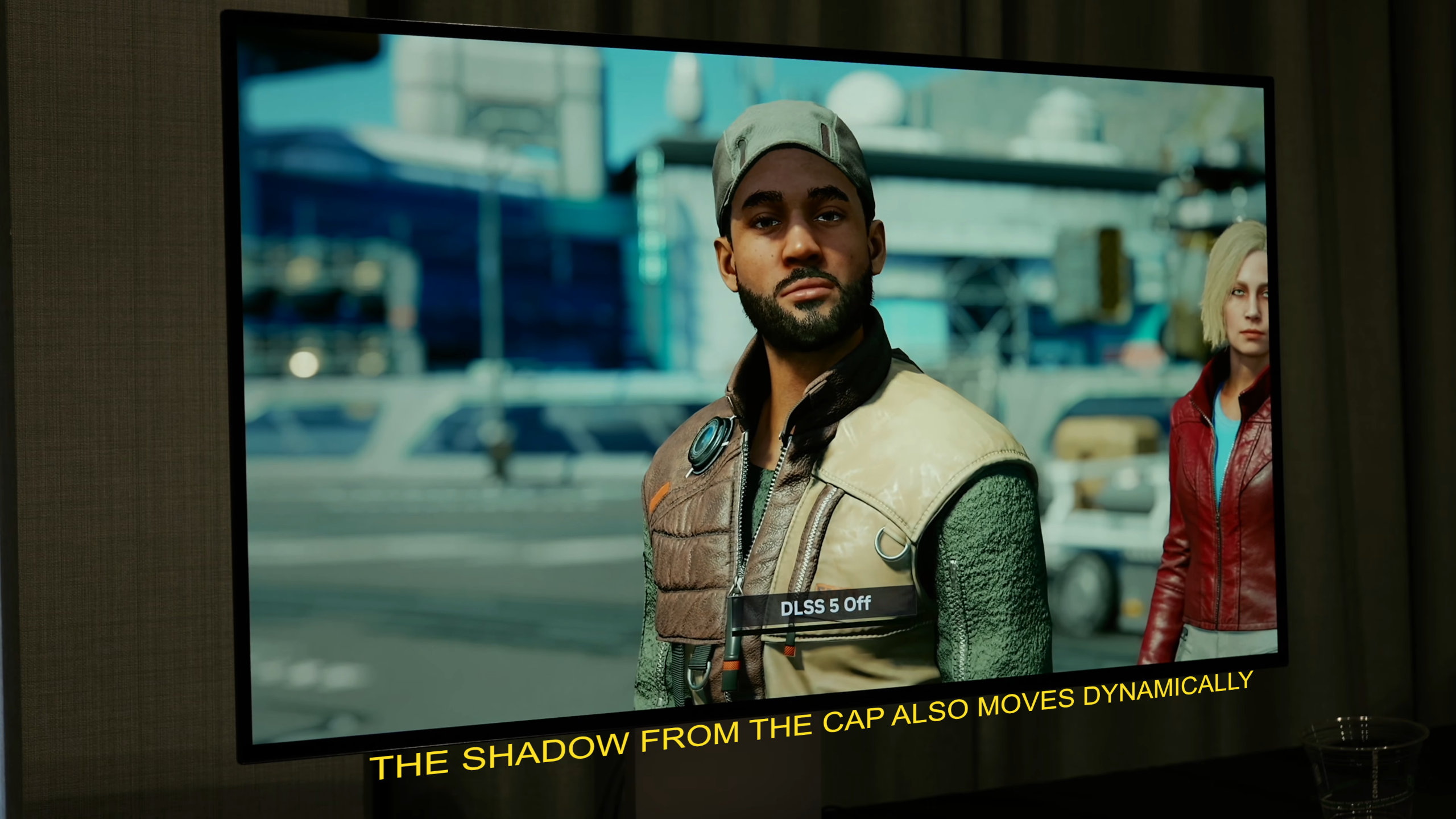
Unlike all other forms of DLSS, it was clear that this new technique was operating with a different goal to the rest. In trying to “deliver a new level of photoreal computer graphics previously only achieved in Hollywood visual effects” DLSS 5 does give each shot a certain level of added perceived depth and realism – but it does so (in my opinion) in a way which can take away from the game’s intended art design and aesthetics.

While an oversimplification, this new “AI-Powered Breakthrough“ is trying to do something which none of the other forms of DLSS have. With DLSS Super Resolution, machine learning was used in order to take a lower-res frame and make it appear higher resolution. Luckily, NVIDIA already knows what a higher-res version of the frame would look like, because resolution is scalable and so the model can be trained on the exact game running at 4K or greater.

The same applies to DLSS Frame Generation. Outside of the odd outlier, we already know what a game running at 120fps and beyond should look like, so the inserted frames don't look out of place. 

DLSS 5 on the other hand reaches outside of the confines of the game, and uses an external model in order to approximate what a game with more evolved lighting could look like. This desire to go beyond can be seen throughout NVIDIA’s press release, claiming that the technology “infuses pixels with photoreal lighting and materials. Bridging the divide between rendering and reality.”

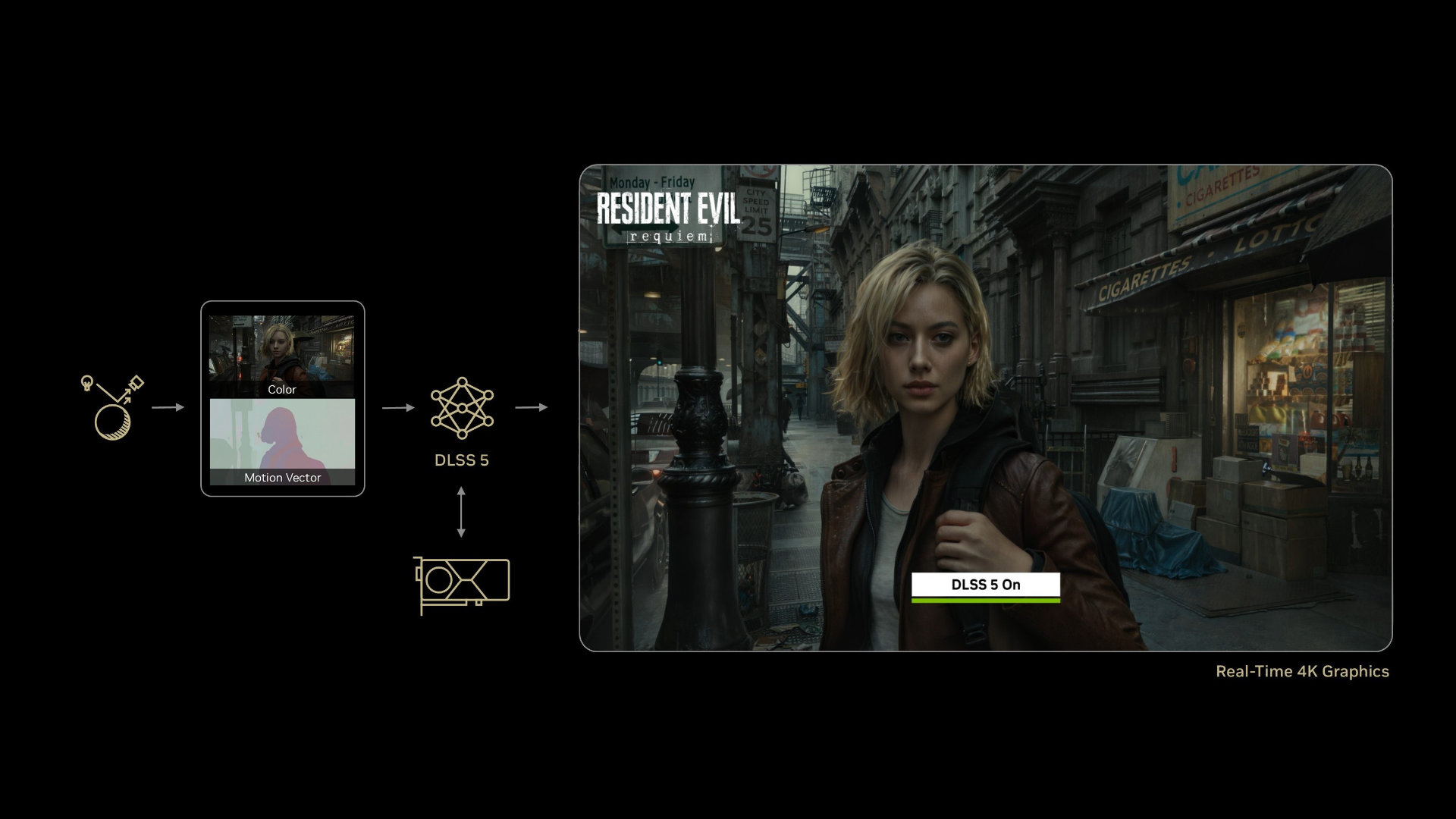
The company states that the tools are able to be tweaked by developers in order to create a final result which aligns with their own vision, utilising “a game’s color and motion vectors for each frame as input, and uses an AI model to infuse the scene with photoreal lighting and materials that are anchored to source 3D content and consistent from frame to frame”. Assuming this to be the case, and that developers do go in and personalise the variables, DLSS 5 is still attempting to operate in an entirely different ballpark than prior DLSS features.

A game’s internal lighting model could have its own issues with fidelity and consistency, but at the very least it is weaved into the game itself and as such has an understanding of its role within the engine pipeline. In the examples shown so far, DLSS 5's guesswork approach here seems to deliver an uncanny end result and to me, it does look jarring. 

A majority of the shots shared so far focus on close-ups of faces and slowly panning camera sweeps; two relatively static experiences and yet even at its best the end result feels somewhat uninviting. All this is without going into the whole yass-ification of each character, looking to me like they’ve just come fresh out of a beauty salon.

As mentioned, this is all relatively early technology and so I can’t judge too much but, as a layman, the opening quote from NVIDIA CEO Jensen Huang told me pretty much all I needed to know: “DLSS 5 is the GPT moment for graphics”. Whether I agree or not with its intentions, DLSS 5 is going in a different direction to the rest of NVIDIA’s efforts.

If nothing else, perhaps a move away from the ‘DLSS’ framework of branding could make for greater clarity in what this new technology is and how it differs on a fundamental level. We will have to wait and see as and when NVIDIA’s DLSS 5 DLSL (Deep Learning Super Lighting) gets closer to a public release.

KitGuru says: What was your initial reaction to DLSS 5? Do you see any benefits to the technology?

The post KitGuru Games: DLSS 5 misses the point first appeared on KitGuru.

ASML machines could yield 50% more chips by 2030

24 February 2026 at 08:00

ASML has reportedly achieved a critical breakthrough in its EUV lithography technology, boosting the power of its light source to 1000W. This leap from the current 600W standard is projected to increase per-machine chip output by 50% by the end of the decade, enabling foundries to process approximately 330 wafers per hour, up from the 220-wafer limit of today's systems.

Generating EUV light remains one of the most complex engineering feats in modern manufacturing. In ASML's laser-produced plasma (LPP) system, microscopic droplets of molten tin are fired through a vacuum and struck by a CO₂ laser. According to Reuters, to achieve the 1,000W threshold, ASML implemented two significant architectural changes: droplet acceleration, which enables the system to fire roughly 100,000 droplets per second (twice the current rate), and two-pulse laser shaping, which uses two smaller laser bursts instead of the single pulse currently in use.

ASML's roadmap suggests this is just the beginning, with internal targets already set for 1500W and, eventually, 2000W. Assuming the same ratio, that would triple the current production rate.

By scaling the power of the 13.5 nm light beam, ASML aims to directly lower the cost-per-chip for advanced AI and logic processors while extending the economic viability of the sub-2 nm era.

KitGuru says: The “photon bottleneck” has long been the primary limiter for EUV economics. By hitting the 1000W mark, ASML is effectively telling the world that it can keep Moore's Law alive through raw power scaling. For companies like TSMC, a 50% increase in wafer production without expanding their footprint is certainly welcome news.

The post ASML machines could yield 50% more chips by 2030 first appeared on KitGuru.

ASML Set to Boost Chip Output 50% by 2030, Ramping EUV Light Source Power to 1 Kilowatt & Hoping to Ease AI Supply Bottlenecks

23 February 2026 at 15:29

ASML Believes Global Semiconductor Markets Will Reach $1 Trillion Valuation By 2023, Driven By Huge AI Demand 1

ASML plans to enable fab manufacturers to aggressively increase production through its latest breakthrough in EUV, as the Dutch chipmaker ramps up its light-source capabilities. ASML's Enhanced EUV Light Source Projected to Bring in a Huge Increase in Fab Output, Only With Equipment Upgrades The semiconductor industry is currently in a supercycle driven by demand from fabless manufacturers, not just for consumer products but also for enterprise/AI. We have extensively reported on how chip giants like TSMC are under significant supply constraints, and one way the supply chain is addressing this is by building an extensive fab network. However, ASML […]

Read full article at https://wccftech.com/asml-set-to-boost-chip-output-by-ramping-euv-power-to-a-kilowatt/

❌
❌