Normal view

There are new articles available, click to refresh the page.
Before yesterdayMain stream

WD Bets 8x Bandwidth Beats More Terabytes as 40TB UltraSMR Starts Shipping

6 August 2026 at 21:01
Western Digital HAMR drive platter stack with the headline 8x, the High Bandwidth Drive throughput target for 2030, and 40TB UltraSMR shipping now Western Digital HAMR drive platter stack with the headline 8x, the High Bandwidth Drive throughput target for 2030, and 40TB UltraSMR shipping now

Western Digital started shipping its next-generation ePMR nearline platform at up to 40TB per drive during the quarter that ended July 3, and told investors on August 5 that its 44TB HAMR drive remains on track for the first half of calendar 2027. The company shipped 231 exabytes in the quarter, 209 of which were nearline, and expects the 40TB platform to account for more than half of nearline exabytes by the third quarter of calendar 2027. That is a lot of roadmap for a single earnings call, and it comes against Seagate, which is already shipping the capacity point that WD is still qualifying.

WD Q4 FY2026 highlights slide showing $3.75B revenue, 54.4% non-GAAP gross margin, and the start of next-gen ePMR shipments at up to 40TB per drive WD Innovation Day demo stations showing 30TB CMR ePMR, WD 40TB UltraSMR ePMR, and HAMR drives running side by side

40TB ePMR and UltraSMR, Shipping Now

The 40TB drive is not a HAMR product. It combines ePMR with UltraSMR, WD’s shingled implementation, and it is the drive the company previewed at its Innovation Day in February, when it was described as in customer qualification with volume production targeted for the second half of calendar 2026; it arrived on schedule.

Two adoption targets came with it. WD expects the 40TB platform to exceed 50% of nearline exabytes by Q3 calendar 2027, and UltraSMR across all capacities to reach roughly 60% of nearline exabyte shipments by the end of fiscal 2027. The second number is interesting. Shingled media buys capacity without new recording physics, but it does so by making track rewrites more expensive, which is why UltraSMR adoption has always been gated by how much of a hyperscaler’s fleet can tolerate the write behavior. Sixty percent of nearline exabytes would be the highest share WD has committed to publicly.

44TB HAMR: 4TB Per Platter, 11 Disks

WD’s HAMR drive reaches 44TB with 4TB per platter across an 11-disk stack, and the company’s stated design goal is that customers see performance interchangeable with ePMR so the two can be deployed side by side. Management said qualifications are progressing with positive customer feedback and reiterated the first half of calendar 2027 for shipment. Seagate reaches the same 44TB with 10 disks at roughly 4.4TB each, which means Seagate is running a higher areal density per platter, and WD is closing the gap with an extra disk in the stack.

WD Innovation Day slide showing the HAMR drive anatomy at 4TB per platter and 44TB per drive across an 11-disk stack

The Path Past 44TB

WD’s published roadmap runs two capacity lines in parallel through 2032. HAMR goes 40TB in 2026, 44TB in 2027, 60TB in 2028, and 100TB in 2029 with a dotted continuation past that. ePMR runs 40TB in 2026 and 60TB in 2028, which is compelling: WD says it can take a non-HAMR recording technology to 60TB by borrowing HAMR-derived media and firmware work, moving to 14 platters, and holding power flat.

For the 100TB target, WD’s stated components are its own laser technology in place of a conventional edge-emitting laser, areal density supporting up to 10TB per platter, and a 14-disk stack. Fourteen platters at 10TB each would be 140TB, so the 100TB figure implies roughly 7.1TB per platter and leaves headroom in the stated ceiling. Whether that headroom survives contact with yield is a future WD question.

WD Road to 100TB slide showing its own laser technology, areal density up to 10TB per platter, and a 14-platter stack
Calendar Year HAMR ePMR
2026 40TB 40TB (UltraSMR, shipping)
2027 44TB (H1) n/a
2028 60TB 60TB
2029 100TB n/a

Source: Western Digital Innovation Day, February 3, 2026, and Q4 FY2026 earnings call, August 5, 2026. Vendor-stated figures.

High Bandwidth Technology

WD said its High Bandwidth Drive technology is now sampling with five customers, offering up to 8x throughput with no corresponding increase in power. The company demonstrated 2x at Innovation Day and targets 8x by 2030.

Current nearline drives run roughly 250 to 275MB/s sustained; Seagate’s 44TB Mozaic 4+ is rated around 300MB/s. A 2x HBD drive clears 500MB/s. At 8x the theoretical range, it runs past 2,000MB/s, which puts a single spindle withing range of NVMe SSD territory for sequential work while keeping the HDD cost structure. WD frames the goal as maintaining a 6-10x cost advantage over QLC flash as capacities climb.

Sitting behind HBD on the roadmap is Dual Pivot, a second independently operating actuator set that WD says doubles transactions per second, something we’ve seen riffs on before. It is a lab technology today, with availability targeted for 2028, and it stacks with HBD.

WD Dual Pivot technology slide showing a second independent actuator that doubles transactions per second

The reason this matters more than another 4TB of capacity: AI training pipelines are increasingly bottlenecked on how fast data moves out of the capacity tier during ingestion and preparation, not on how much of it fits. Per-drive sequential bandwidth has been flat for years while capacity kept climbing, which quietly made every large-capacity fleet slower to rebuild and slower to drain. If WD ships 500MB/s-plus nearline drives at anything like current cost, that could change the arithmetic on where the warm tier ends and flash begins.

Power-optimized drives, due to start customer qualification in 2027, trade 5-10% performance for a 20% power reduction and 10% more capacity, aimed at the gap between warm and cold tiers. An intelligent platform layer combining SSD, HDD, and software-defined abstraction is targeted for 2027 for customers operating at 200PB and up.

Where This Leaves the Seagate Comparison

Specification Western Digital Seagate
Capacity and Technology
Highest capacity shipping 40TB ePMR / UltraSMR 44TB HAMR (Mozaic 4)
Per-disk capacity at top node 4TB (44TB HAMR, 11 platters) 4+TB (Mozaic 4; platter count not disclosed)
44TB status H1 CY2027, in customer qualification Shipping since March, ramped through June quarter
HAMR share of nearline exabytes Not disclosed About 40% exiting the fiscal year
Next capacity node 60TB (44TB goes straight to 60TB on the published roadmap) Mozaic 5 at 5+TB per disk, qualification shipments late CY2027
Fiscal Q4 2026, quarter ended July 3
Revenue $3.747B, up 44% YoY $3.629B, up 48.5% YoY
Fiscal year revenue $12.919B $12.195B
Non-GAAP gross margin 54.4% 52.7%
Total exabytes shipped 231EB, up 22% YoY 218EB, up 34% YoY
Data center exabytes 209EB nearline, up 5% sequentially 195EB, up 11% sequentially
Data center share of revenue 90% 89%
Blended revenue per terabyte $16.22 $16.65
Q1 FY2027 revenue guidance $4.1B +/- $100M $4.1B +/- $100M

Sources: Western Digital Q4 FY2026 earnings deck and press release (August 5, 2026) and Innovation Day (February 3, 2026); Seagate fiscal Q4 2026 press release and earnings call (July 28, 2026); Toshiba nearline HDD sampling announcement (March 30, 2026). Blended revenue per terabyte is our own calculation from each company’s reported quarterly revenue and total exabytes, and mixes nearline with non-nearline, so treat it as directional. Both companies ended their fiscal year on July 3, 2026.

Seagate is ahead in the field on HAMR, and Toshiba is not close. Toshiba began sampling its highest-capacity nearline drives, 30 to 34TB, in late March, and those use FC-MAMR with shingled recording rather than HAMR; its CMR models top out at 28TB with sample shipments slated for the third quarter of 2026. Toshiba says HAMR products are planned for “upcoming quarters,” which puts it a full recording generation behind both rivals while it is still sampling capacities the other two shipped years ago. CEO Dave Mosley told investors that HAMR-based products represented roughly 40% of Seagate’s nearline exabyte shipment run rate exiting the year, and CFO Gianluca Romano confirmed the company hit its 40% milestone by June. Mozaic 4, the platform that carries Seagate toward 100TB, supports up to 44TB per drive and began shipping in March. WD gets to that capacity a year later on HAMR but is not conceding capacity in the meantime, because UltraSMR closes most of the gap at 40TB without requiring a new recording technology to yield at volume.

The two roadmaps converge on economics rather than capacity. Both companies guided next-quarter revenue to exactly $4.1B plus or minus $100M, both ended the June quarter with data center at roughly 90% of revenue, and both are selling every drive they can build. So the question is not who wins the capacity race, since neither is supply-constrained by demand, but who converts capacity into margin faster.

One caveat on the “Seagate is a year ahead” framing: WD’s own roadmap places a 40TB HAMR product in calendar 2026, and the company has not disclosed what share of its nearline exabytes ships on HAMR today. Its Q4 shipping disclosure was the ePMR drive. Until WD gives a HAMR mix number the way Seagate does, the comparison is between a disclosed figure and an unknown one. The exabyte trend cuts the other way, though: Seagate grew total exabytes 34% year over year against WD’s 22%, and lifted data center exabytes 11% sequentially, where WD managed 5%. Whatever HAMR is costing Seagate in yield, it is not costing it volume.

What to Watch

The capacity race gets the headlines, and on that count, Seagate is ahead: 44TB drives in production, roughly 40% of nearline exabytes already on HAMR, and a 5TB-per-disk platform lined up behind it. WD’s answer is that it doesn’t have to win that race on Seagate’s terms. UltraSMR closes most of the gap at 40TB without new recording physics, and the ePMR line runs to 60TB in 2028, which means WD can defer full HAMR dependence considerably longer than a side-by-side capacity chart suggests.

The bet worth watching has nothing to do with terabytes, though. Every drive on both roadmaps still reads at roughly 250 to 300MB/s. At that rate, a 100TB drive takes more than four days to read end to end, and a 60TB drive takes two and a half. Rebuild windows, ingestion throughput, and how long a pipeline waits on the capacity tier are what increasingly decide whether hard drives stay in the AI data path at all, and none of those improve when the only thing that grows is areal density. High Bandwidth Drive is the one item on either company’s public roadmap aimed squarely at that problem. WD has demonstrated 2x and is targeting 8x by 2030, which would pull that 100TB full-drive read down from four days to about half a day.

That said, It’s also the least proven thing WD showed. HBD is sampling with five customers, not shipping broadly, and Dual Pivot is a lab technology with a 2028 target. If they release as expected, the capacity ladder becomes a secondary question, and the warm tier argument may win out. If they slip, both vendors spend the rest of the decade building larger drives that take proportionally longer to fill and empty, and flash keeps eating into the capacity tier regardless of who reaches 100TB first.

Western Digital Ultrastar Data Center Drives

The post WD Bets 8x Bandwidth Beats More Terabytes as 40TB UltraSMR Starts Shipping appeared first on StorageReview.com.
Seagate is hosting a webinar to teach you all about NAS

22 May 2026 at 08:42

We live in an age where we all need more storage than ever, especially if you like to back up your media libraries and other data locally. In an upcoming webinar, Seagate will deliver an easy-to-follow guide on building a dependable NAS set-up for home users and creators.

The webinar, which is free for anyone to view and join, will take place on the 10th of June from 11AM to 12PM UK time, hosted by Seagate and UGREEN, along with special guest Robbie from NAS Compares.

The session will cover:

  • How NAS systems support expanding storage needs
  • Why hard drive reliability is essential for always‑on storage
  • What makes Seagate drives a strong fit for NAS environments
  • How Mozaic 3 technology helps deliver higher capacities with better value
  • What this means for performance, longevity, and price

You can register to participate, HERE.

KitGuru Says: Will you be tuning in to the Seagate NAS webinar next month?

The post Seagate is hosting a webinar to teach you all about NAS first appeared on KitGuru.

Western Digital Adds Post-Quantum Cryptography to Ultrastar UltraSMR HDDs

21 May 2026 at 15:48
WD PQC disk lock graphic WD PQC disk lock graphic

Western Digital has announced post-quantum cryptography (PQC) support for its latest Ultrastar UltraSMR hard disk drives, marking one of the first deployments of NIST-approved quantum-resistant algorithms in production storage hardware. The new drives are currently undergoing qualification with multiple hyperscale customers as cloud and AI infrastructure operators begin evaluating long-term cryptographic resilience at the storage layer.

The company positions the move as a response to the changing nature of AI infrastructure, where data persistence is becoming as important as compute performance. Large AI data lakes supporting training, inference, and analytics workloads are expected to remain in service for years, creating new security concerns around future quantum-based attacks.

WD PQC disk lock graphic

Western Digital said the new implementation focuses on protecting the device root of trust, firmware integrity, and cryptographic key management rather than encrypting data at rest. The goal is to harden storage infrastructure against future threats such as “harvest now, decrypt later” (HNDL) attacks, where encrypted data collected today could eventually be decrypted once sufficiently capable quantum systems emerge.

Long-Lifecycle Infrastructure Creates Quantum Risk

Enterprise HDD infrastructure often remains in place for five years or more, potentially overlapping with the emergence of cryptographically relevant quantum computing systems. That long service window creates exposure for storage platforms relying solely on traditional public-key cryptography schemes such as RSA and ECC.

Western Digital noted that firmware-level attacks represent a growing concern in modern storage environments. A sufficiently advanced quantum adversary could theoretically forge firmware signatures or compromise trust chains, allowing malicious firmware updates to appear legitimate. As infrastructure operators increasingly automate fleet management and remote servicing, maintaining trusted firmware validation becomes critical.

PQC Implementation Details

The company’s PQC rollout debuts on the Ultrastar DC HC6100 UltraSMR platform. Western Digital said the implementation is designed to secure device trust chains throughout manufacturing, deployment, and field servicing workflows.

The implementation uses ML-DSA-87, the NIST FIPS 204 standardized algorithm derived from CRYSTALS-Dilithium, for high-assurance code signing. Western Digital is also using a dual-signing model combining ML-DSA-87 with RSA-3072 to maintain compatibility with existing infrastructure while introducing quantum-resistant protections.

The company also deployed PQC-capable public key infrastructure (PKI) and hardware security module (HSM) workflows to support key issuance, lifecycle management, and rotation. Operational safeguards include rollback protections and dual-signing support intended to simplify deployment across mixed hardware fleets without disrupting current enterprise workflows.

Western Digital CTO and SVP Dr. Xiaodong “Carl” Che said the rapid pace of quantum computing development is driving the need for updated infrastructure security models, particularly for AI-driven environments that manage long-lived and increasingly valuable data sets. He added that the company’s implementation aligns with emerging standards efforts, including NIST guidance and CNSA 2.0 recommendations.

Western Digital expects to expand PQC support across additional enterprise HDD product families over time as quantum-safe infrastructure requirements become more common in hyperscale and enterprise environments.

The post Western Digital Adds Post-Quantum Cryptography to Ultrastar UltraSMR HDDs appeared first on StorageReview.com.

Seagate IronWolf Pro 32TB Review: Top-of-Stack Capacity for Multi-Bay NAS

12 May 2026 at 18:35

The Seagate IronWolf Pro 32TB is the NAS-tuned member of Seagate’s first 32TB CMR generation, announced alongside matching 32TB Exos and SkyHawk AI variants in 2026, and has been shipping through Seagate’s channel since January. The drive is built on the Mozaic3+ platform, which uses heat-assisted magnetic recording (HAMR) to push areal density past 3TB per disk while still presenting to the host as a conventional magnetic recording (CMR) device. Inside the helium-sealed enclosure, ten platters and twenty heads deliver 32TB of capacity via a SATA 6Gb/s interface and a 7200RPM spindle, with the ST32000NT000 targeting SMB collaboration, creative media workflows, and on-premises AI storage use cases.

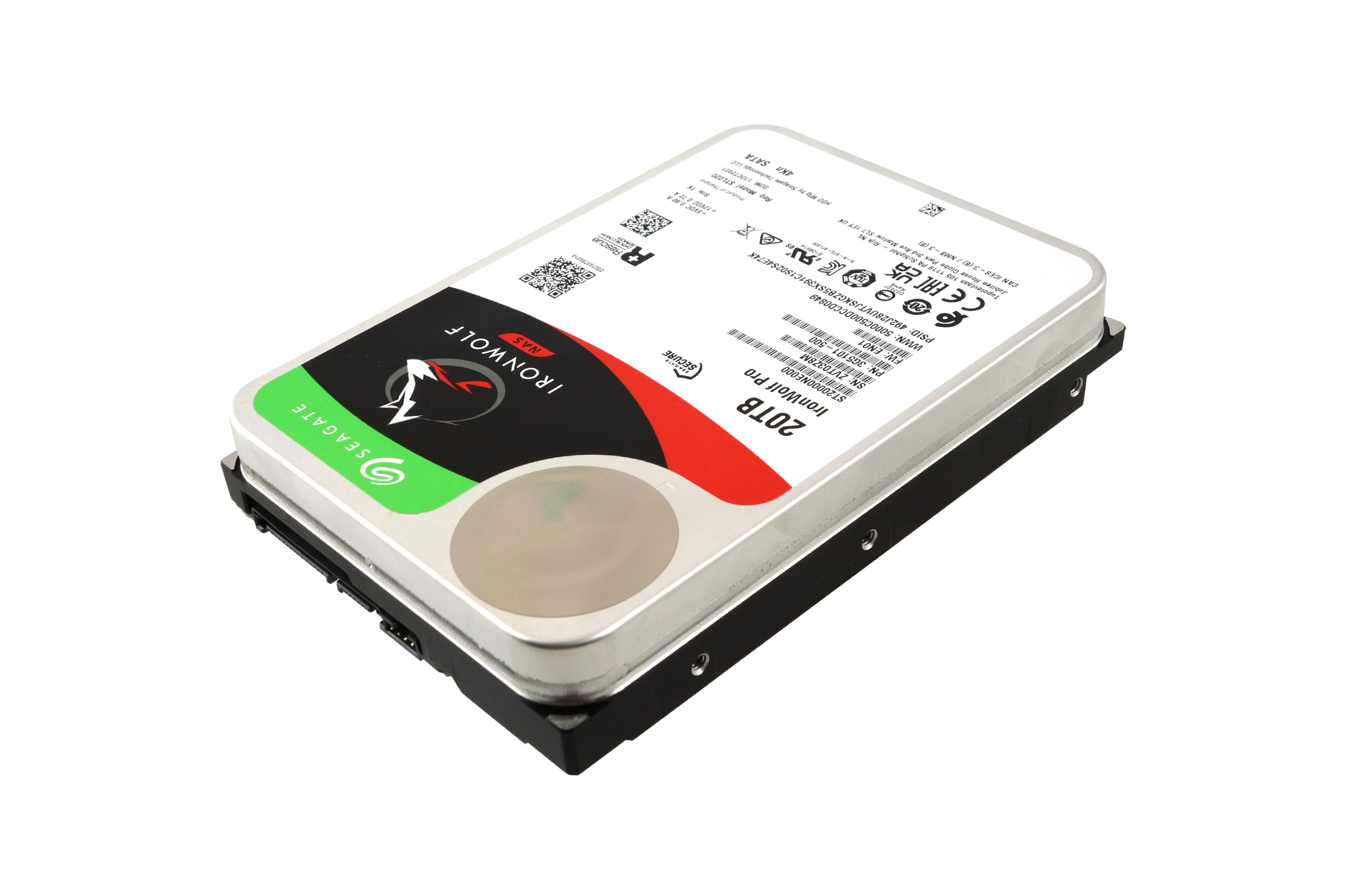
Seagate IronWolf Pro 32TB front

Seagate IronWolf Pro 32TB Features

This is the same drive used in our recent LaCie 8big review, where the higher per-drive capacity substantially increased the total enclosure capacity without changing the physical footprint. The same density story applies in multi-bay NAS systems, where Seagate pairs the platform with AgileArray firmware (dual-plane balancing, time-limited error recovery, and rotational vibration tolerance), built-in RV sensors, and IronWolf Health Management for predictive maintenance and recovery guidance in supported NAS platforms. The drive carries a 550 TB/year workload rating, a 2.5 million-hour MTBF, and is designed for continuous use in multi-user deployments.

Seagate IronWolf Pro 32TB rear

Sustained transfer rate at the outer diameter is listed as up to 285MB/s, paired with a 512 MB cache to handle bursty I/O for large file transfers, backups, media libraries, and shared project data. Power consumption averages 6.8W idle and 8.3W operating, both worth tracking when sixteen, twenty-four, or more drives share a chassis. Acoustics are rated at 28dBA idle and 32dBA seek.

The IronWolf Pro 32TB currently sits around $1,159.99 direct from Seagate, with retail varying by region and reseller. The drive ships with a five-year limited warranty and three years of Rescue Data Recovery Services.

Seagate IronWolf Pro 32TB Specifications

Specification Seagate IronWolf Pro 32TB
Overview
Standard Model Number ST32000NT000
Interface SATA 6Gb/s
Features
Drive Bays Supported Unlimited
Recording Technology CMR
Drive Design (Air or Helium) Helium
Workload Rate Limit (WRL) 550TB/year
Rotational Vibration (RV) Sensors Yes
Cache (MB) 512MB
Reliability/Data Integrity
Mean Time Between Failures (MTBF) 2,500,000 hours
Nonrecoverable Read Errors per Bits Read, Max 1 per 10E15
Power-On Hours (per year) 8760
Sector Size (Bytes per Logical Sector) 512e
Rescue Data Recovery Services (years) 3
Limited Warranty (years) 5
Performance
Spindle Speed (RPM) 7200RPM
Interface Access Speed (Gb/s) 6.0, 3.0, 1.5
Max Sustained Transfer Rate OD (MB/s) 285
Rotational Vibration (10–1500 Hz, rad/s) 12.5
Power Consumption
Startup Current, Typical (12V, A) 2.0A
Idle Power, Average (W) 6.8W
Average Operating Power (W) 8.3W
Standby Mode, Typical (W) 1.2W
Sleep Mode, Typical (W) 1.2W
Power Supply Requirements +12V and +5V
Environmental/Temperature
Operating Temperature (ambient, min) 10°C
Operating Temperature (drive reported, max) 60°C
Nonoperating Temperature (ambient, min) -40°C
Nonoperating Temperature (ambient, max) 70°C
Environmental/Acoustics
Vibration, Nonoperating (10Hz to 500Hz, Grms) 2.27
Acoustics, Idle (typical, dBA) 28
Acoustics, Seek (typical, dBA) 32
Environmental/Shock
Shock, Operating 2ms (Read/Write) 30/30 Gs
Shock, Nonoperating (1ms and 2ms) 200 Gs
Physical
Height (mm/in, max) 26.11mm / 1.028in
Width (mm/in, max) 101.85mm / 4.01in
Depth (mm/in, max) 146.99mm / 5.787in
Weight (g/lb, typical) 695g / 1.53lb
Carton Unit Quantity 20
Cartons per Pallet / Cartons per Layer 40 / 8

Seagate IronWolf Pro 32TB Performance

Before diving into the benchmarks, here’s a list of comparable capacity HDDs used to evaluate the performance of the Seagate IronWolf Pro 32TB.

Seagate IronWolf Pro 32TB sata connection

The high-performance test rig we used for storage benchmarking includes:

Peak Synthetic Performance

The FIO test is a flexible and powerful benchmarking tool used to measure the performance of storage devices, including SSDs and HDDs. It evaluates metrics such as bandwidth, IOPS (Input/Output Operations Per Second), and latency under different workloads, like sequential and random read/write operations. This test helps to assess the peak performance of storage systems, making it useful for comparing different devices or configurations. We measured the peak burst performance for this test, limiting the workload to a 10GB footprint on all tested HDDs.

The Seagate IronWolf Pro 32TB delivered performance that largely tracked the middle of the comparison group in the FIO workload tests. In sequential workloads, the drive posted 284MB/s read and 283MB/s write throughput, keeping it very close to the Seagate x24 24TB, WD Gold 24TB, and Exos 30TB drives, with only a relatively small spread separating the top-performing models in the stack.

For random 4K reads, the IronWolf Pro 32TB reached 203 IOPS with 156.87ms latency, again aligning closely with the majority of the tested drives. Random write performance came in at 315 IOPS with 101.40ms latency, placing it ahead of the IronWolf Pro 30TB but behind drives like the Seagate x24 24TB and WD Gold 24TB, which posted significantly stronger small-block write throughput in this burst-oriented test.

FIO Test (higher MB/s/IOPS is better) Sequential 128K Read (1T/64Q) Sequential 128K Write (1T/64Q) Random 4K Read (16T/32Q) Random 4K Write (16T/32Q)
Seagate Exos 30TB 292MB/s (28.72ms) 289MB/s (29.04ms) 205 IOPS (155.58ms) 341 IOPS (93.79ms)
Seagate IronWolf Pro 30TB 287MB/s (29.23ms) 267MB/s (31.39ms) 205 IOPS (155.74ms) 301 IOPS (105.95ms)
Seagate x24 24TB 285MB/s (29.42ms) 285MB/s (29.42ms) 210 IOPS (152.03ms) 749 IOPS (42.70ms)
Seagate IronWolf Pro 32TB 284MB/s (29.53ms) 283MB/s (29.59ms) 203 IOPS (156.87ms) 315 IOPS (101.40ms)
WD Gold 24TB 283MB/s (29.66ms) 286MB/s (29.36ms) 214 IOPS (148.98ms) 651 IOPS (49.11ms)
WD Red Pro 22TB 271MB/s (31.00ms) 276MB/s (30.37ms) 214 IOPS (149.17ms) 421 IOPS (75.92ms)
WD Ultrastar DC HC590 26TB 268MB/s (31.28ms) 280MB/s (30.00ms) 198 IOPS (161.18ms) 663 IOPS (48.23ms)

Average LLM Load Time

The Average LLM Load Time test evaluated the load times of three different LLMs: DeepSeek R1 7B, Meta Llama 3.2 11B Vision, and DeepSeek R1 32B. Each model was tested 10 times, and the average load time was calculated. This test measures how quickly each drive can load large language models into memory, which is important for AI workflows where faster model loading can reduce wait times and improve responsiveness.

The Seagate IronWolf Pro 32TB landed toward the lower end of the stack in the Average LLM Load Time test, though the overall spread between drives remained relatively tight. In the DeepSeek R1 7B model, the drive posted an average load time of 48.78 seconds, placing it behind the Seagate Exos 30TB and WD Gold 24TB, which led the group at roughly 46.4 and 46.7 seconds, respectively.

With the larger Meta Llama 3.2 11B Vision and DeepSeek R1 32B models, the IronWolf Pro 32TB continued to trend toward the slower side of the comparison set, recording 73.24 seconds and 73.89 seconds, respectively. That positioned it near the Seagate x24 24TB, while drives like the WD Gold 24TB and WD Ultrastar DC HC590 26TB maintained somewhat lower load times.

Average LLM Load Time (lower is better) DeepSeek R1 7B Meta Llama 3.2 11B Vision DeepSeek R1 32B
Seagate Exos 30TB 46.4424s 68.7064s 72.7249s
WD Gold 24TB 46.7133s 68.8183s 68.9720s
WD Ultrastar DC HC590 26TB 47.9877s 71.0063s 69.7892s
Seagate IronWolf Pro 30TB 48.4175s 69.9071s 72.3803s
Seagate IronWolf Pro 32TB 48.7773s 73.2398s 73.8927s
Seagate x24 24TB 48.6615s 71.4855s 73.8097s
WD Red Pro 22TB 49.0575s 71.4783s 71.1382s

3DMark Storage

The 3DMark Storage Benchmark measures gaming-focused storage performance, including game loading, saving progress, installing files, and gameplay recording. The benchmark reflects how well each drive handles modern gaming workloads.

In the 3DMark Storage Benchmark, the Seagate IronWolf Pro 32TB scored 175 points, placing it in the middle to lower range of the comparison group. It trailed the faster Seagate x24 24TB, Exos 30TB, and IronWolf Pro 30TB models, which led the chart with scores ranging from 223 to 234, but remained ahead of the WD Ultrastar DC HC590 26TB, WD Red Pro 22TB, and WD Gold 24TB drives.

The results show that while the IronWolf Pro 32TB is not tuned specifically for gaming-oriented workloads, it still delivered competitive performance relative to several other high-capacity HDDs in the stack. The lower score compared to some other Seagate drives likely reflects the trade-offs that come with pushing capacity higher, though the drive still maintained a solid position among the broader group of large-capacity disks.

3DMark Storage Benchmark (higher is better) Overall Score
Seagate x24 24TB 234
Seagate Exos 30TB 223
Seagate IronWolf Pro 30TB 231
Seagate IronWolf Pro 32TB 175
WD Ultrastar DC HC590 26TB 168
WD Red Pro 22TB 156
WD Gold 24TB 150

BlackMagic Disk Speed Test

The BlackMagic Disk Speed Test measures sequential read and write throughput and is commonly used to estimate performance for video editing and large media workflows.

In the BlackMagic Disk Speed Test, the Seagate IronWolf Pro 32TB delivered 253.4MB/s read and 228.3MB/s write throughput, placing it toward the lower end of the comparison group in both categories. The drive trailed the Seagate Exos 30TB and IronWolf Pro 30TB models, which posted some of the strongest write performance in the stack, as well as the WD Ultrastar DC HC590 26TB and WD Red Pro 22TB drives.

That said, the IronWolf Pro 32TB maintained sequential throughput well above 200MB/s, keeping it within the expected range for modern high-capacity HDDs. More importantly, this is a NAS-focused drive designed around high-capacity storage, reliability, and sustained multi-user environments rather than maximizing workstation or scratch-disk performance.

BlackMagic Disk Speed (MB/s, higher is better) Read MB/s Write MB/s
Seagate Exos 30TB 274.6 275.2
WD Gold 24TB 272.8 213.0
Seagate x24 24TB 271.0 164.4
Seagate IronWolf Pro 30TB 267.6 272.7
WD Ultrastar DC HC590 26TB 267.0 264.5
WD Red Pro 22TB 260.9 258.3
Seagate IronWolf Pro 32TB 253.4 228.3

PCMark 10 Storage

PCMark 10 Storage Benchmarks evaluate real-world storage performance using application-based traces. These tests measure how drives perform under practical desktop and workstation workloads.

In the PCMark 10 Data Drive benchmark, the Seagate IronWolf Pro 32TB posted a score of 609, placing it below the faster Seagate Exos 30TB, IronWolf Pro 30TB, and WD Ultrastar DC HC590 26TB drives, but comfortably ahead of the WD Gold 24TB and WD Red Pro 22TB models at the bottom of the stack. The results position the IronWolf Pro 32TB in the middle of the comparison group for mixed desktop-style workloads.

PCMark 10 Data Drive (higher is better) Overall Score
WD Ultrastar DC HC590 26TB 853
Seagate IronWolf Pro 30TB 771
Seagate Exos 30TB 769
Seagate x24 24TB 671
Seagate IronWolf Pro 32TB 609
WD Gold 24TB 397
WD Red Pro 22TB 380

Conclusion

The Seagate IronWolf Pro 32TB landed mid-to-lower in our comparison group across the LLM Load Time, 3DMark Storage, BlackMagic, and PCMark 10 runs, generally trailing both the Exos 30TB and the prior-generation IronWolf Pro 30TB. The gap is small in absolute terms, with sequential reads at 253.4MB/s and sustained throughput rated at 285MB/s, which is the relevant figure for the streaming and shared-file workloads NAS systems actually run. Single-drive benchmarks tend to undersell this class of drive, since the value in a NAS deployment shows up in RAID consistency, vibration tolerance, and sustained performance across many drives rather than peak throughput on a single drive.

Seagate IronWolf Pro 32TB top view.

On the platform side, the IronWolf Pro 32TB stands out. The Mozaic3+ HAMR base delivers 32TB inside the same 3.5-inch helium-sealed envelope, and the NAS-specific feature set, including AgileArray, IronWolf Health Management, built-in RV sensors, a 550TB/year workload rating, a 2.5 million-hour MTBF, a five-year limited warranty, and three years of Rescue Data Recovery Services, is what SMBs and creative teams are paying for. For a multi-bay NAS or a DAS like the LaCie 8big we tested recently, the per-bay capacity jump from what they’re using today to 32TB lets builders pack much more usable storage into the same chassis without revisiting compatibility, vibration, or power budgets.

The trade-off is price, and that’s an industry issue, not specific to Seagate. At an $849.99 launch MSRP and current direct-from-Seagate pricing closer to $1,159.99, the IronWolf Pro 32TB isn’t inexpensive. For buyers who need the NAS feature stack and the long warranty, that premium is the cost of getting Seagate’s newest high-capacity HAMR platform in NAS trim. Even so, your workload either benefits from the density and related benefits or it does not. For those who have a strong business case for these drives, the 32TB drive density will be easy to monetize.

Product Page – Seagate IronWolf Pro 32TB

The post Seagate IronWolf Pro 32TB Review: Top-of-Stack Capacity for Multi-Bay NAS appeared first on StorageReview.com.

Microsoft Calls 16 GB RAM A Compromise And 32 GB The New “No Worries” Standard

1 May 2026 at 14:46

A close-up of RGB-lit RAM sticks with a Windows logo inside a PC case, next to large illuminated text reading '32 GB'.

The bar has been raised and the 16 GB is no longer the "recommended" RAM capacity for PC gaming, at least as per Microsoft. Microsoft Recommends 32 GB for No-Compromise Gaming Experience; Calls 16 GB RAM as "Baseline" Nearly 10 years ago, 8 GB RAM would be sufficient for gaming systems, but as games, apps, and OS became more memory hungry, the bar was raised to 16 GB. 16 GB RAM is still a decent capacity for most gaming PCs, considering such systems don't have many problems with executing background tasks while more intensive tasks, such as games, are running […]

Read full article at https://wccftech.com/microsoft-calls-32-gb-the-new-no-worries-standard/

❌
❌