Login
Login
AMD expands AI portfolio with EPYC 9006, Instinct MI400 and new physical‑AI hardware
AMD has announced new additions to its data‑centre portfolio at Advancing AI 2026, introducing both the 6th Gen EPYC 9006 Series server CPUs and the Instinct MI400 Series GPUs, aimed at next-generation AI infrastructure.
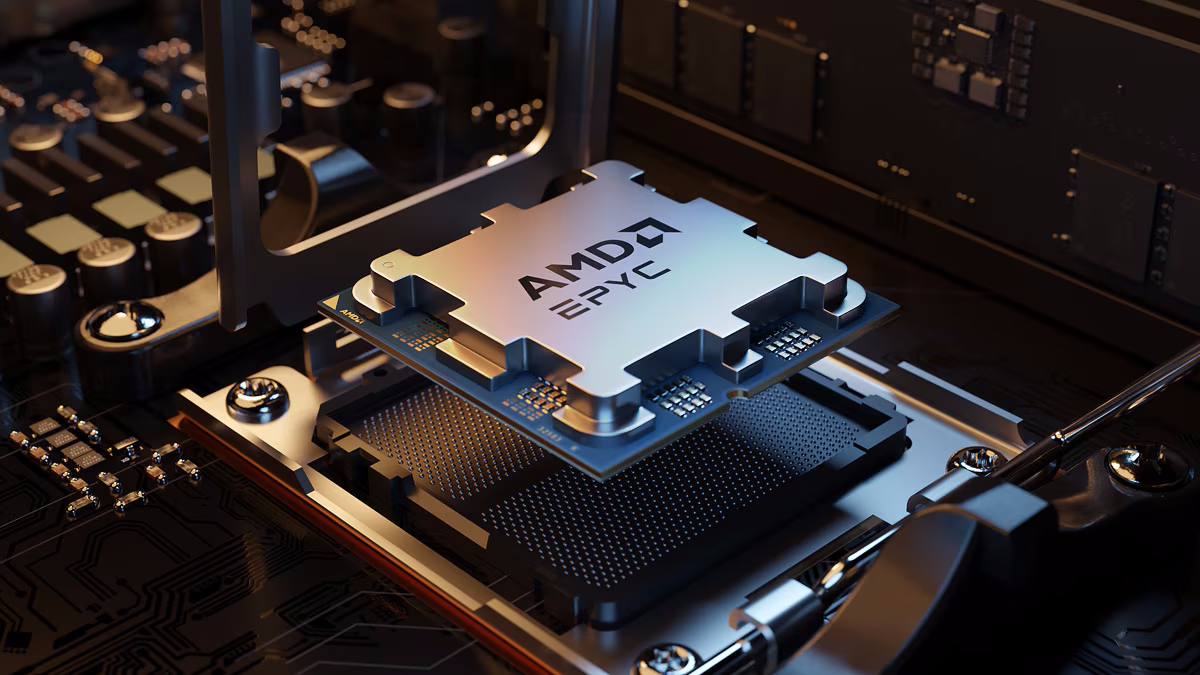
The EPYC 9006 Series is described by AMD as a workload‑optimised CPU lineup built to support agentic AI, where CPUs take on a larger share of work by running agents, coordinating tasks and managing data flows. AMD claims the new generation is designed to handle this increased load through higher core counts, expanded memory bandwidth and support for next‑generation I/O standards such as PCIe Gen 6 and MRDIMM.
The EPYC 9006 Series consists of four CPU families. The SP7 tier is the maximum‑density option, with core counts up to 256 cores and 512 threads, along with high‑frequency variants reaching up to 5GHz. SP8 models focus on efficiency, offering up to 128 core configurations designed for enterprise, edge and power‑constrained deployments. For HPC and memory‑sensitive workloads, AMD points to the SP7X variants, which it says offer triple the L3 cache per core compared to SP7. The LP tier serves as an AI host‑node CPU, using LPDDR memory and higher frequencies to keep accelerators supplied with data in multi-GPU racks.
On the GPU side, AMD introduced the Instinct MI400 Series, split between the MI455X for frontier‑scale AI deployments and the MI430X for sovereign AI and HPC. The MI455X is AMD's highest‑end accelerator for large‑model training, fine‑tuning and high‑volume inference, while the MI430X is aimed at workloads requiring numerical accuracy. AMD says the MI430X can deliver up to 288 TFLOPS of FP64 performance, alongside HBM4 memory and high‑bandwidth interconnects to support larger models.
The MI400 Series also incorporates security and system‑level features for sensitive AI and HPC environments, including SecureBoot, encrypted GPU‑to‑GPU links and hardware‑based protections. These GPUs support AMD’s ROCm software stack for AI development, which is also receiving updates this week through ROCm.ai – a new AI‑native developer environment that adds a unified CLI, AMD‑authored guidance for coding assistants and AI‑driven workload optimisation.
Finally, AMD is also expanding into physical AI and robotics, introducing new Ryzen AI Embedded X100 processors and Kria AI system‑on‑modules for autonomous machines and industrial systems. These platforms combine Zen 5 CPU cores, integrated RDNA graphics and an NPU, with shared access to memory to reduce latency in real‑time workloads.
KitGuru Says: What do you think of AMD's push into the AI space?
The post AMD expands AI portfolio with EPYC 9006, Instinct MI400 and new physical‑AI hardware first appeared on KitGuru.