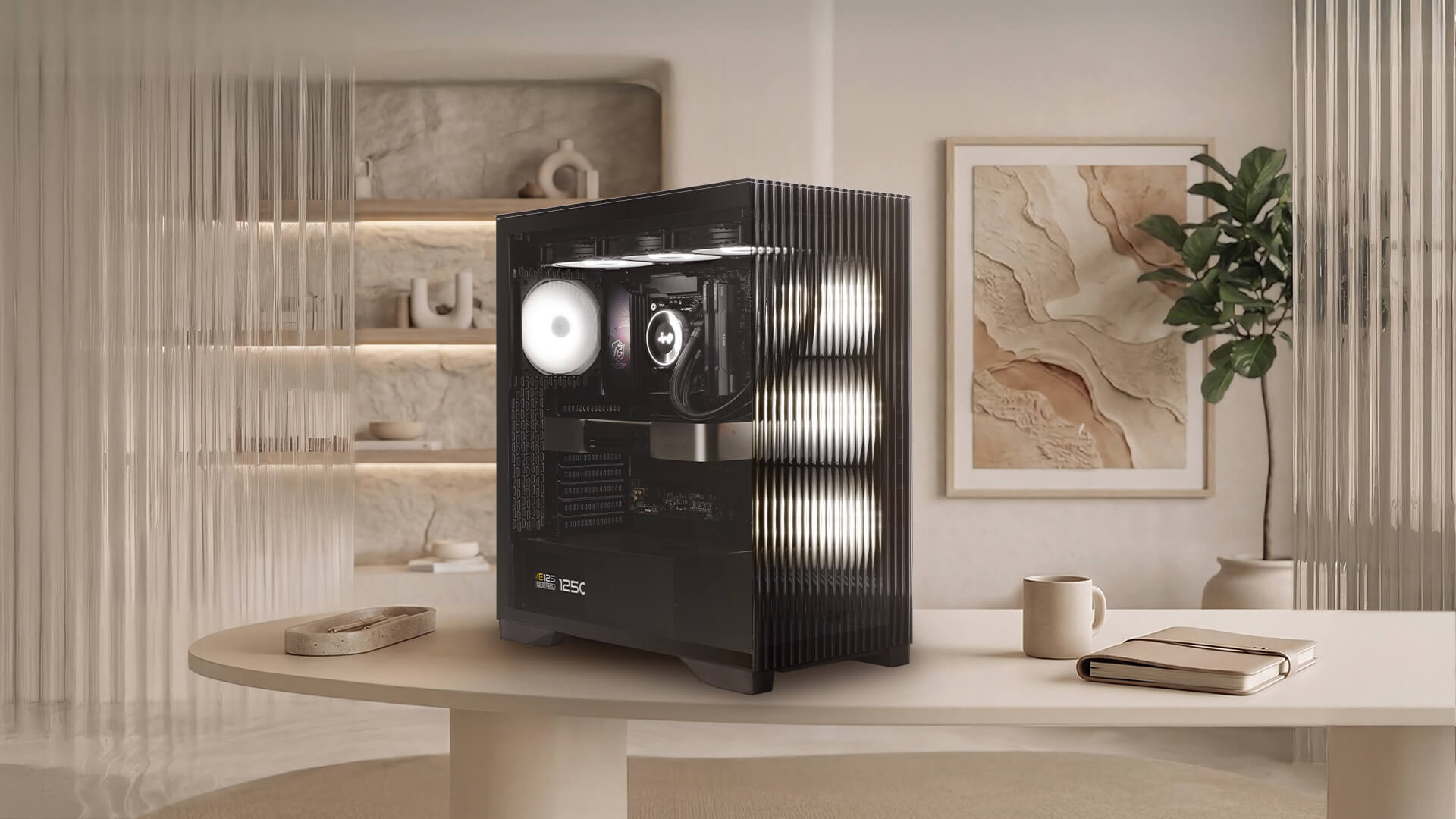
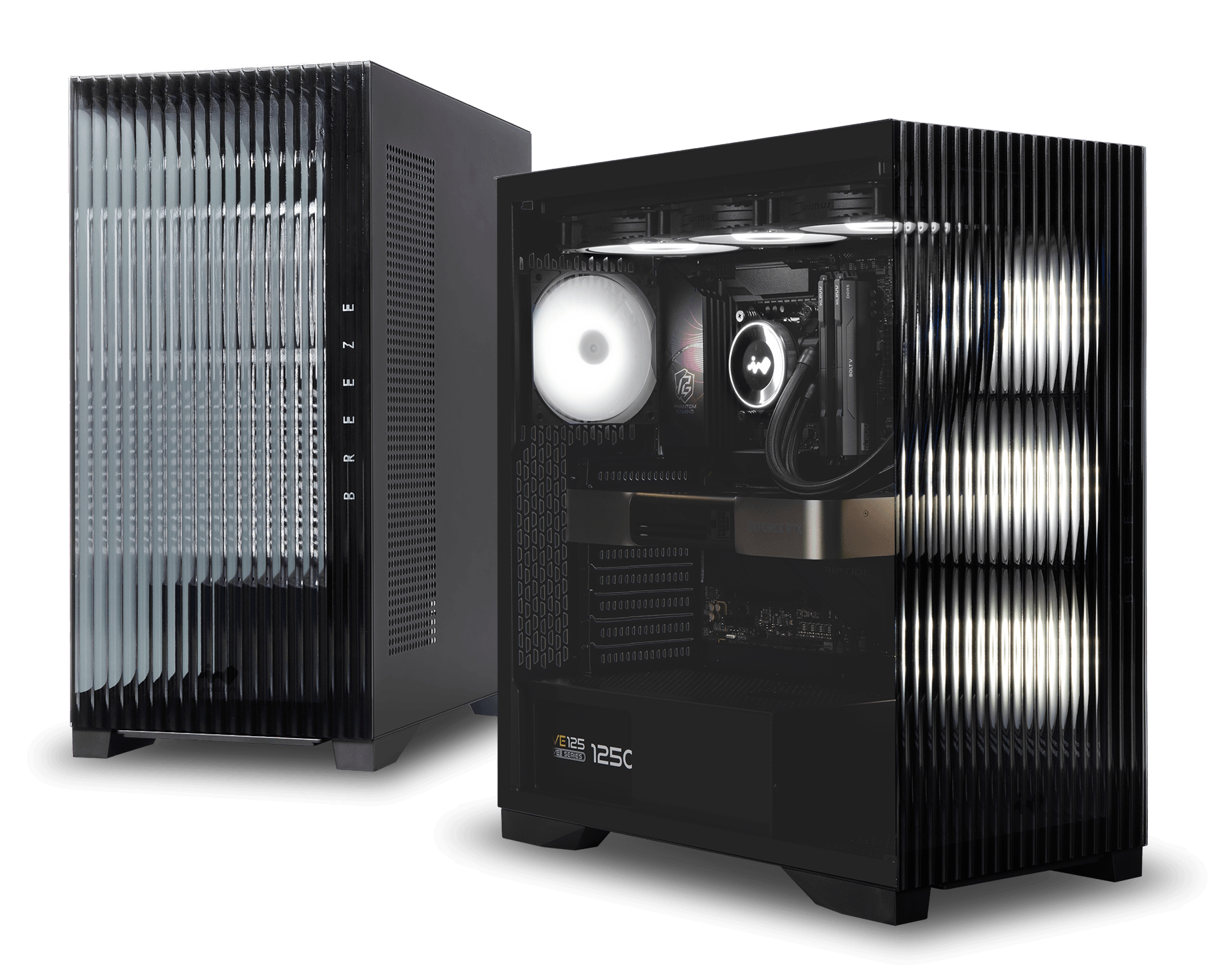
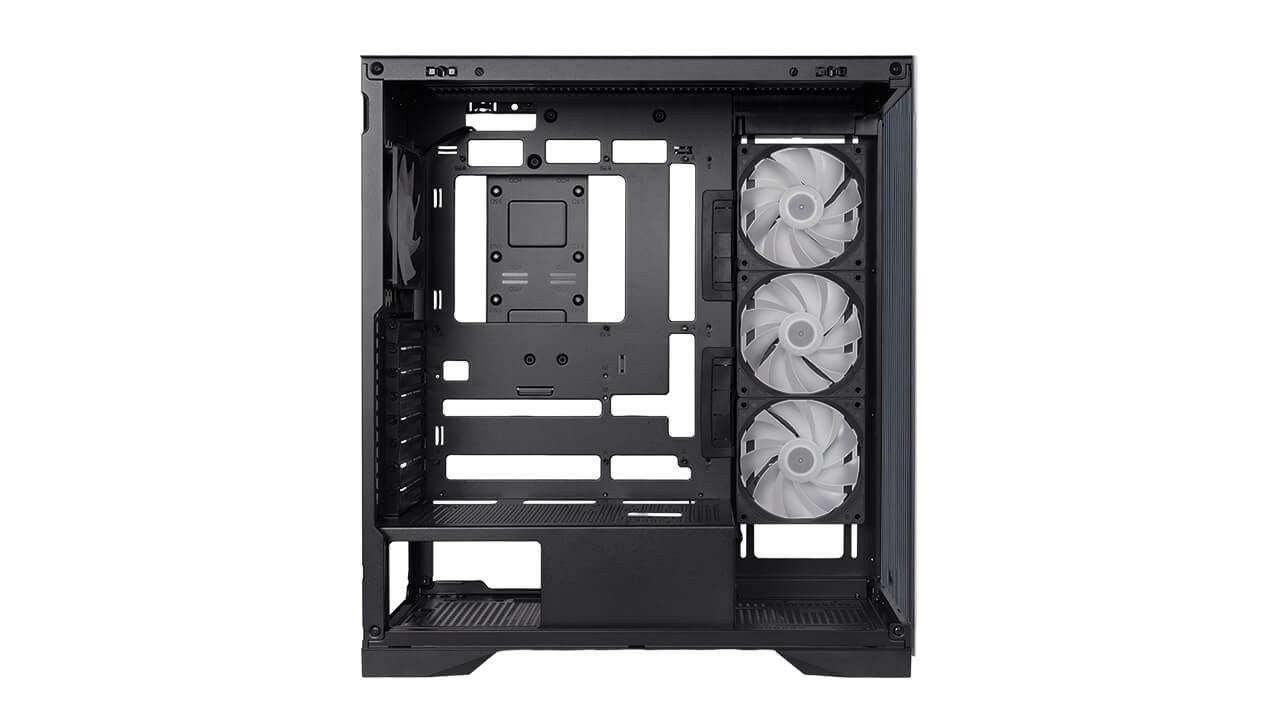
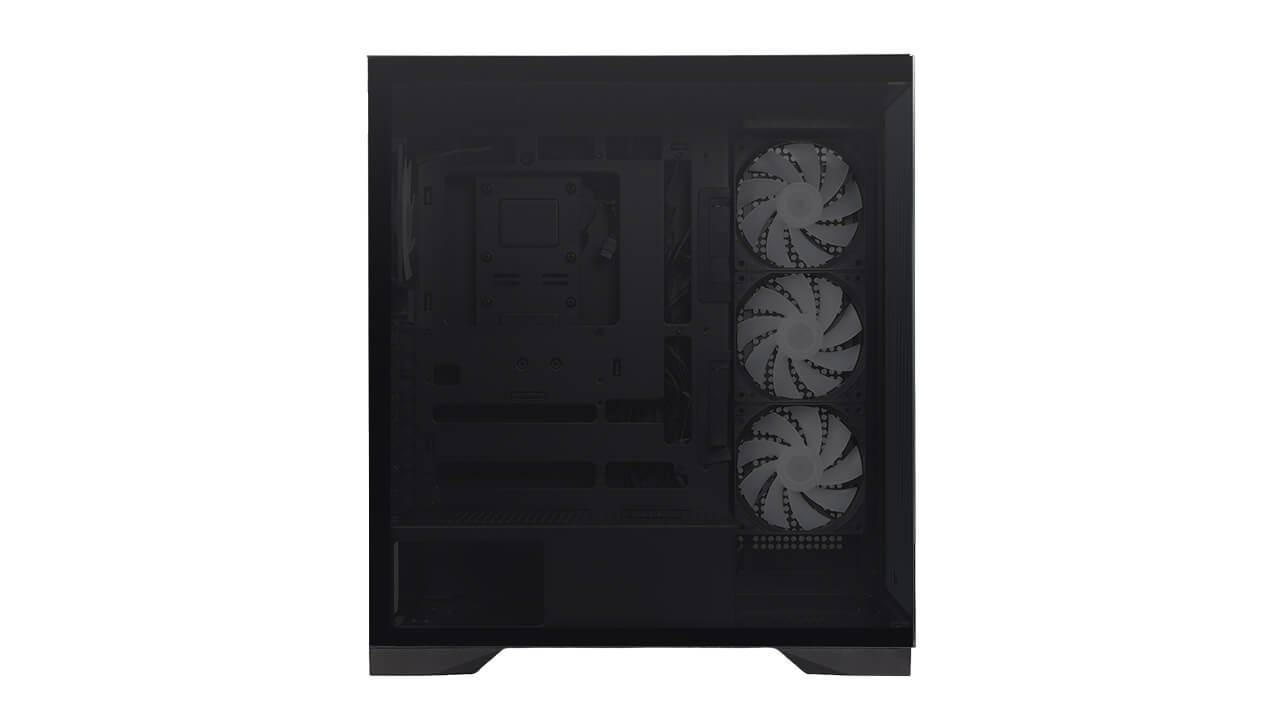
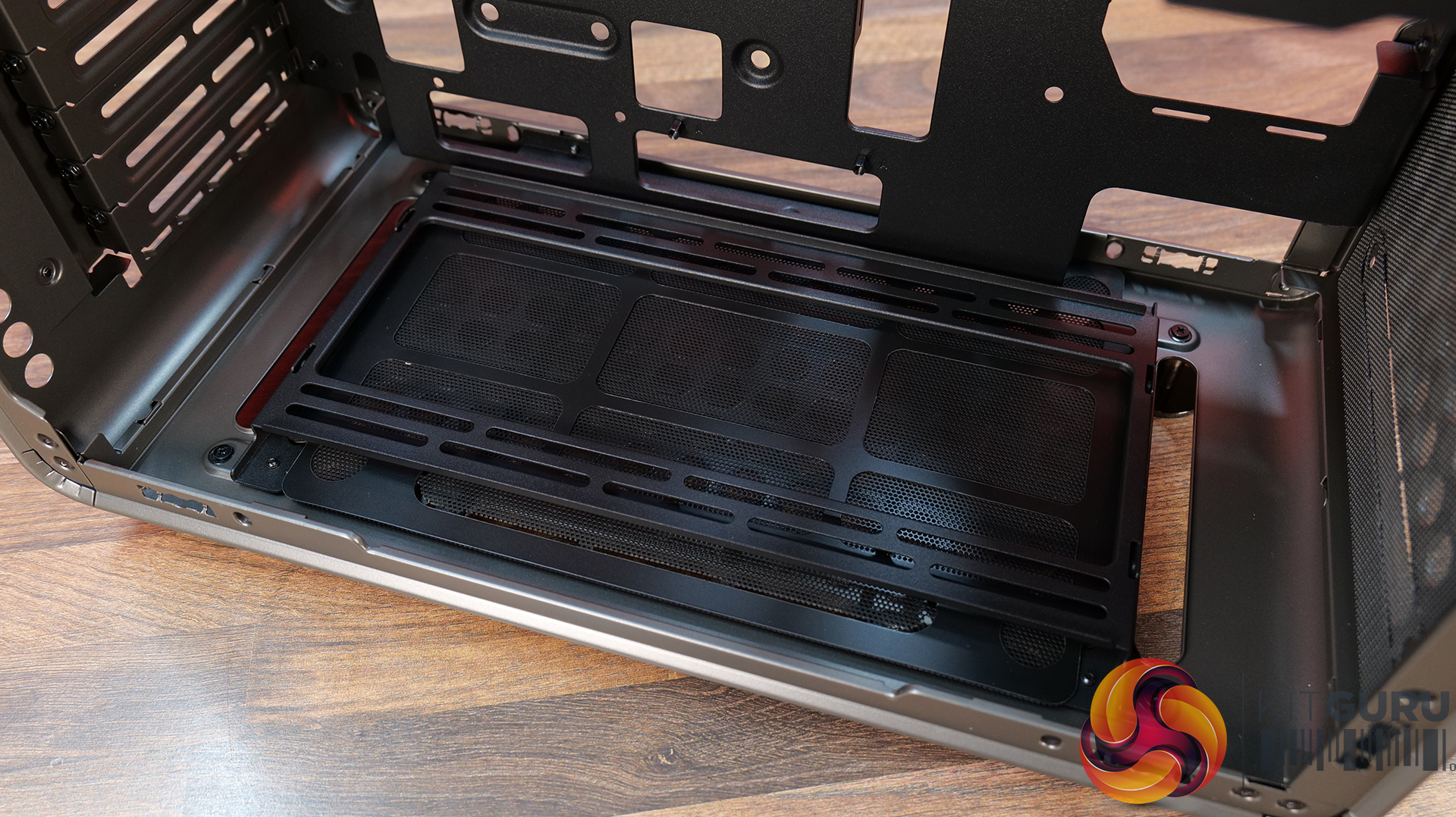
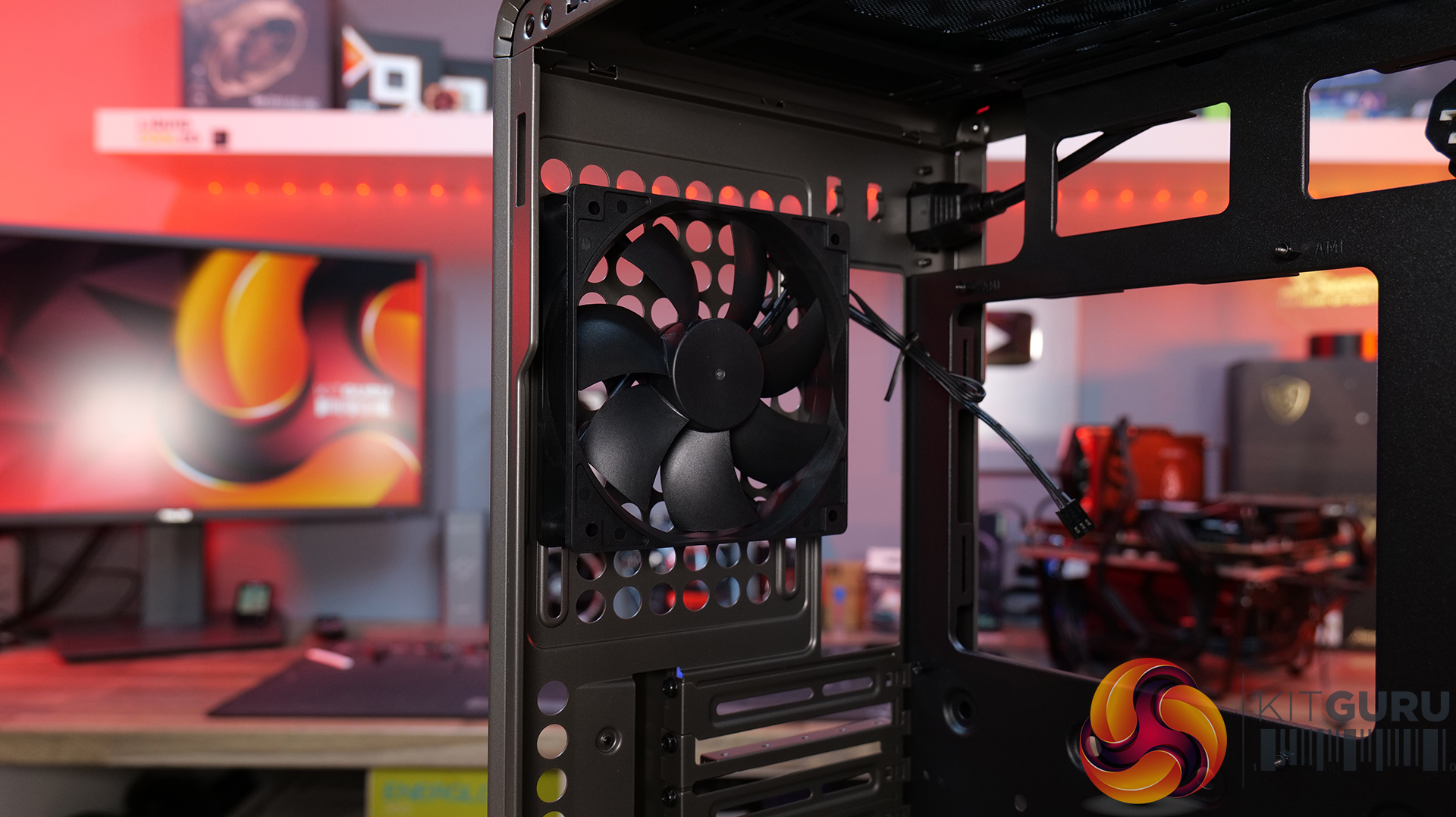
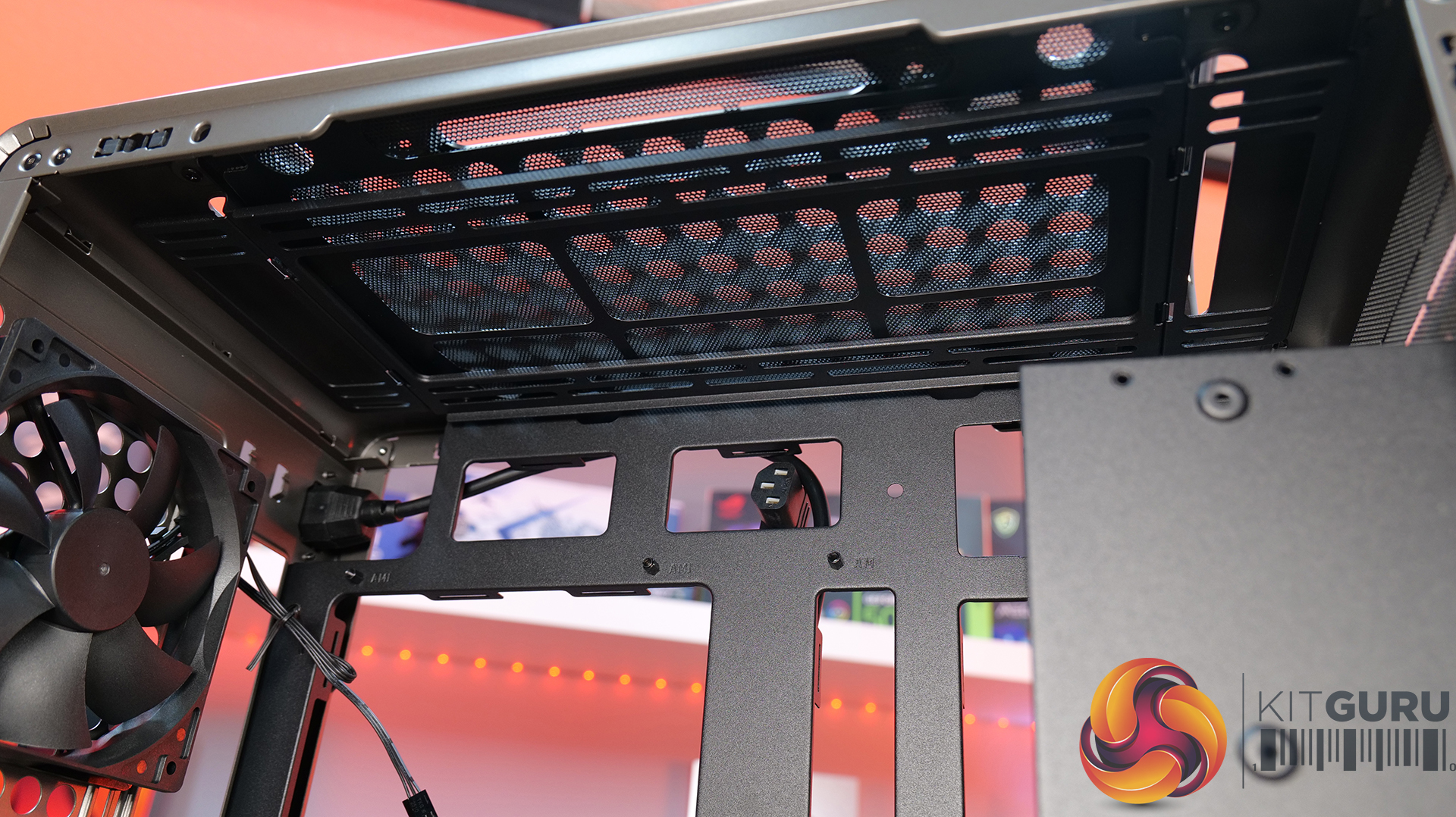
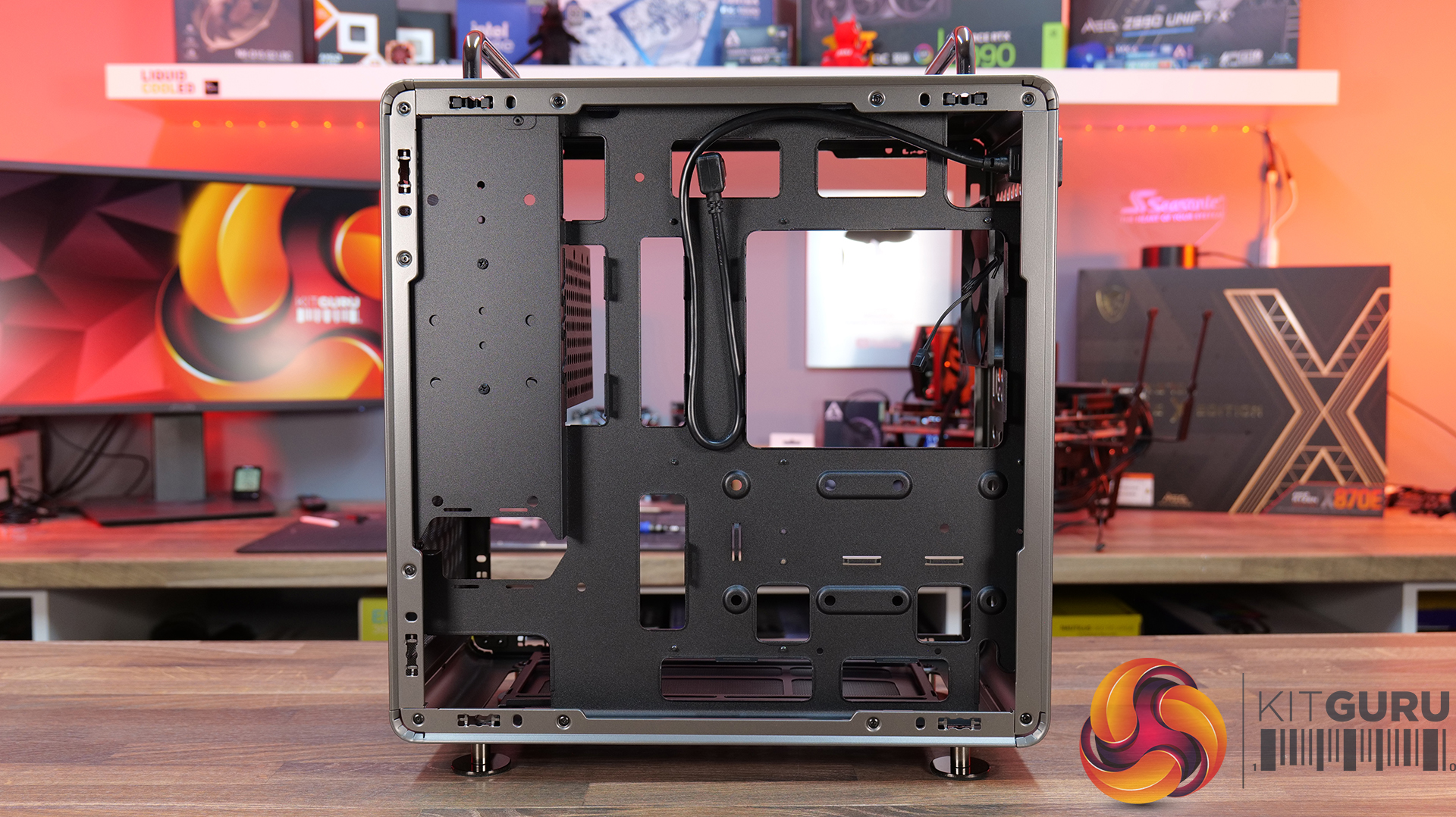
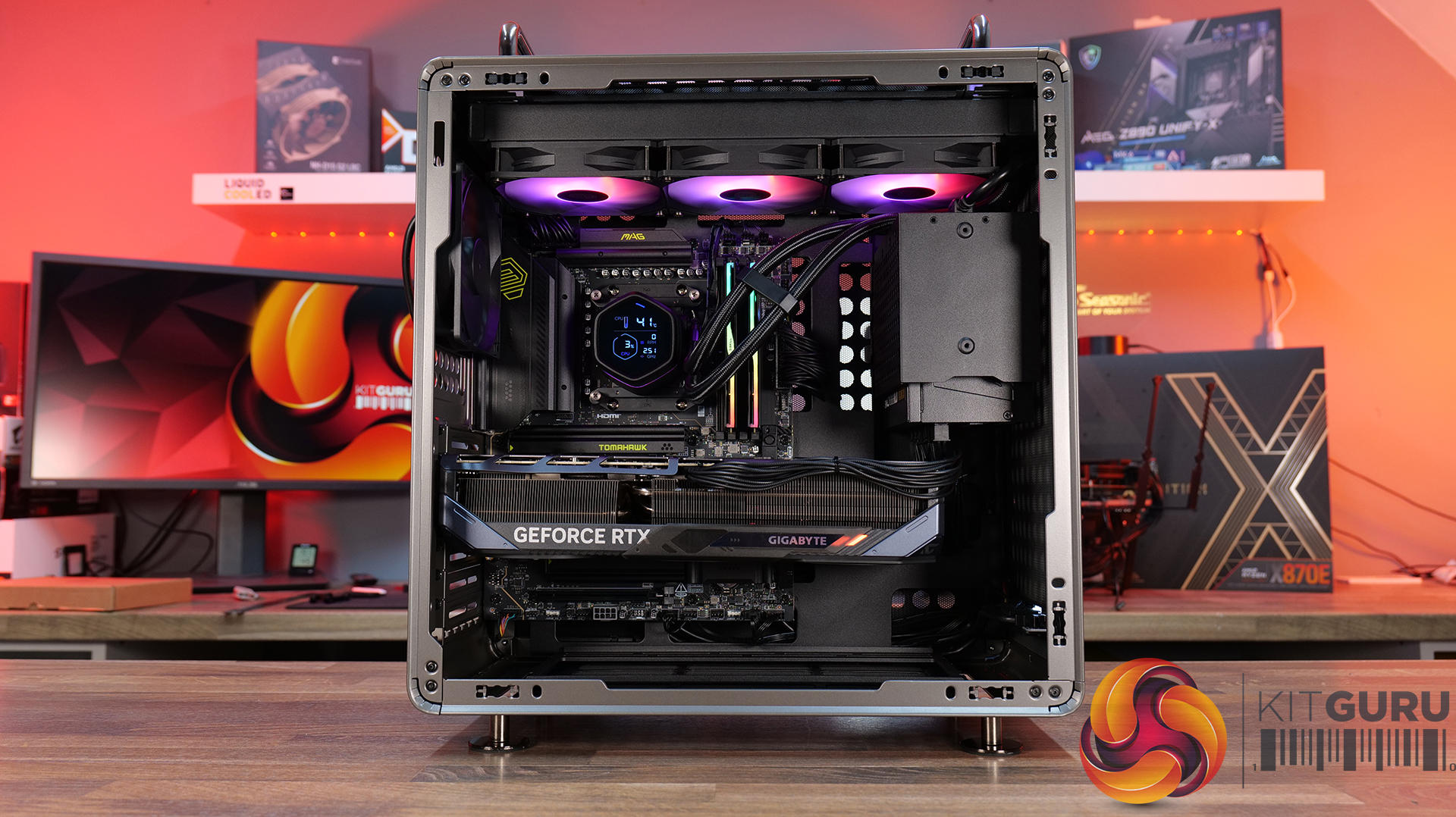
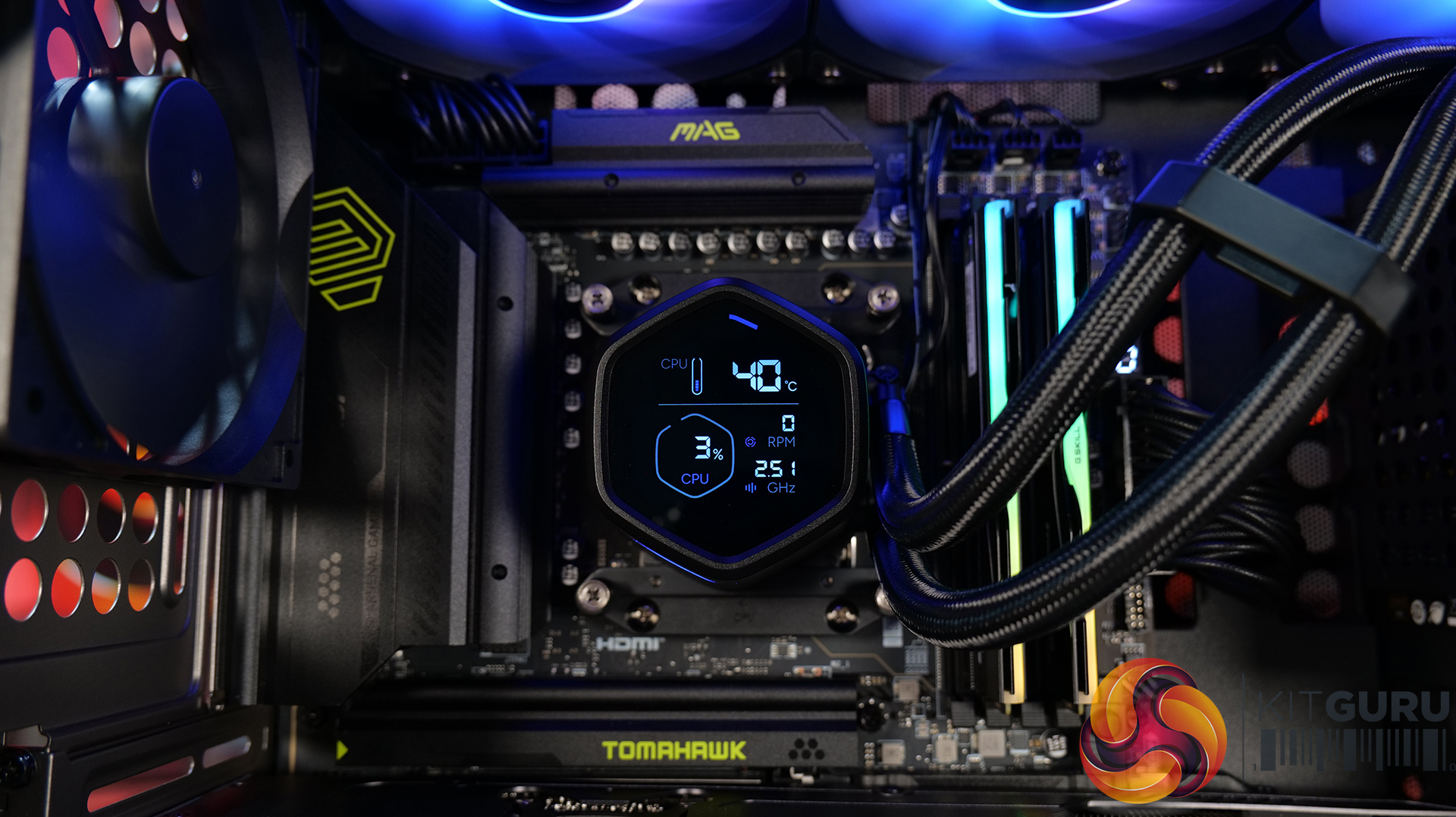
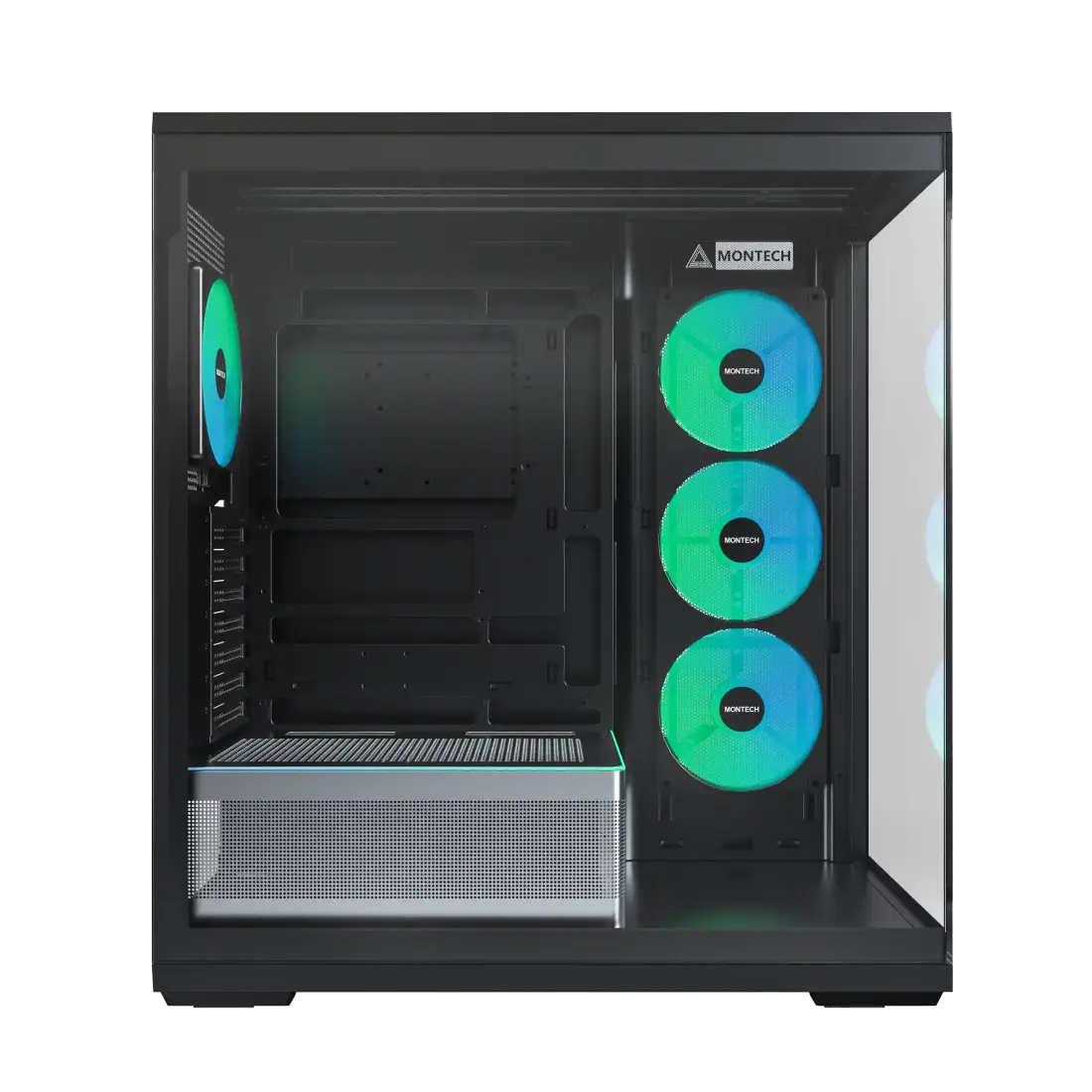
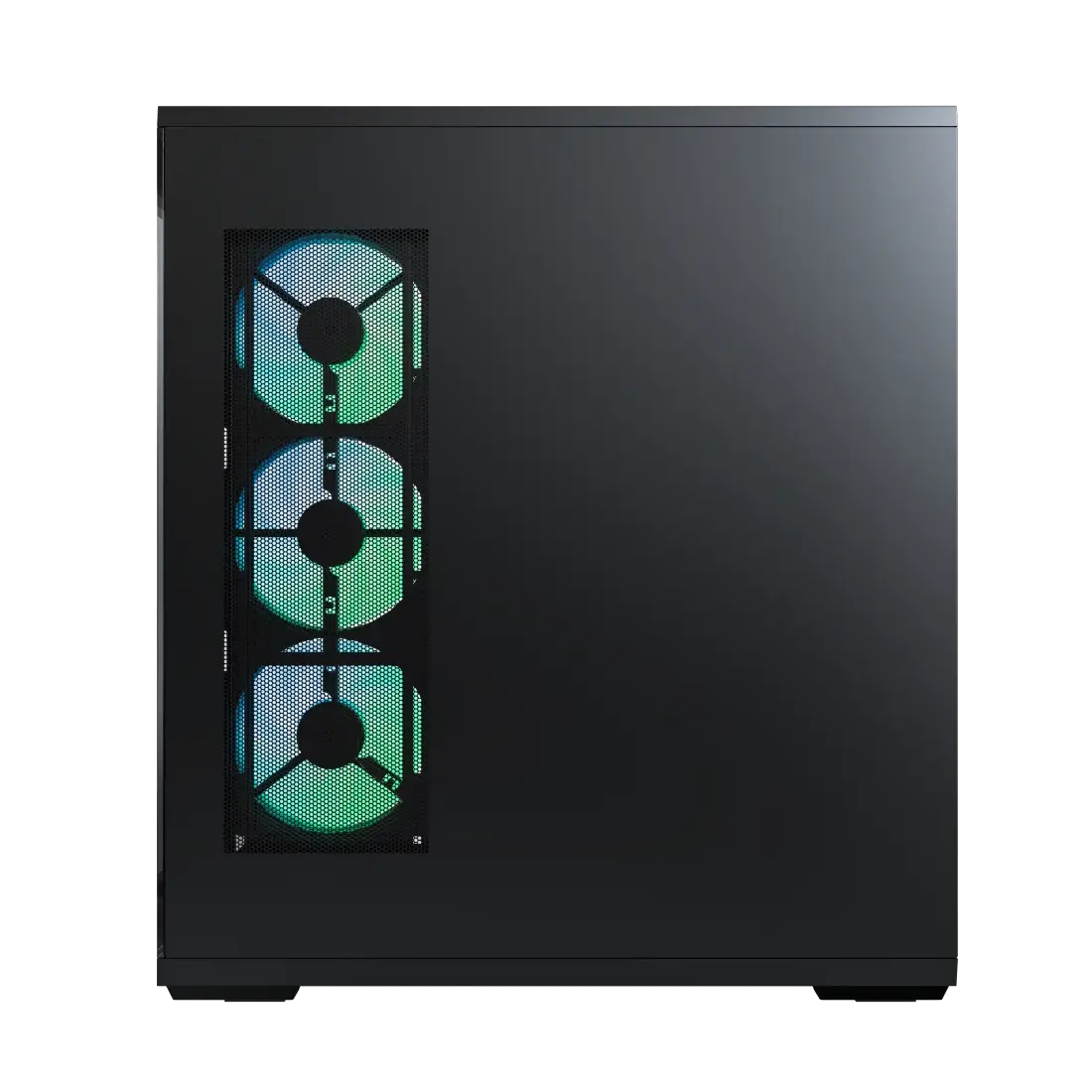
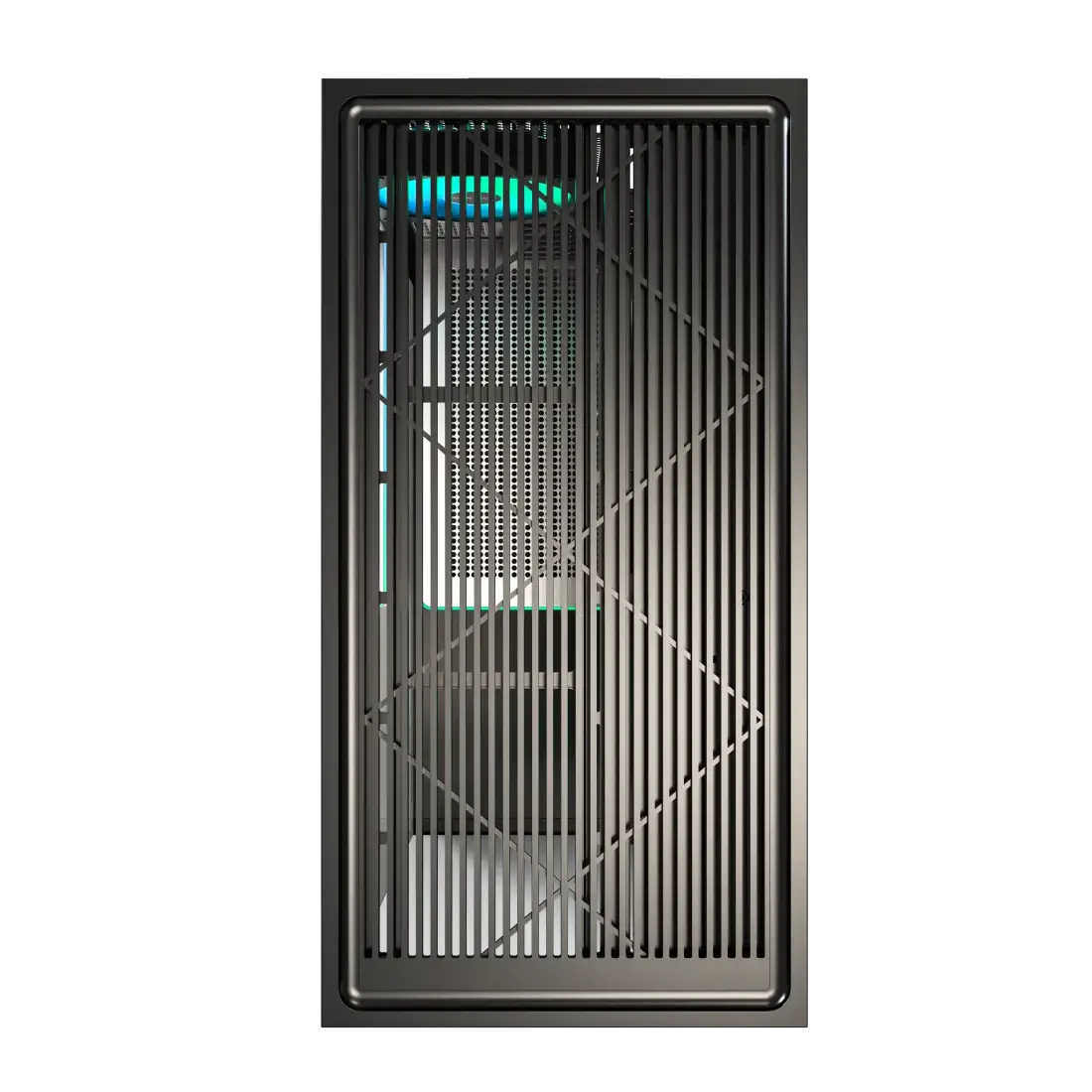
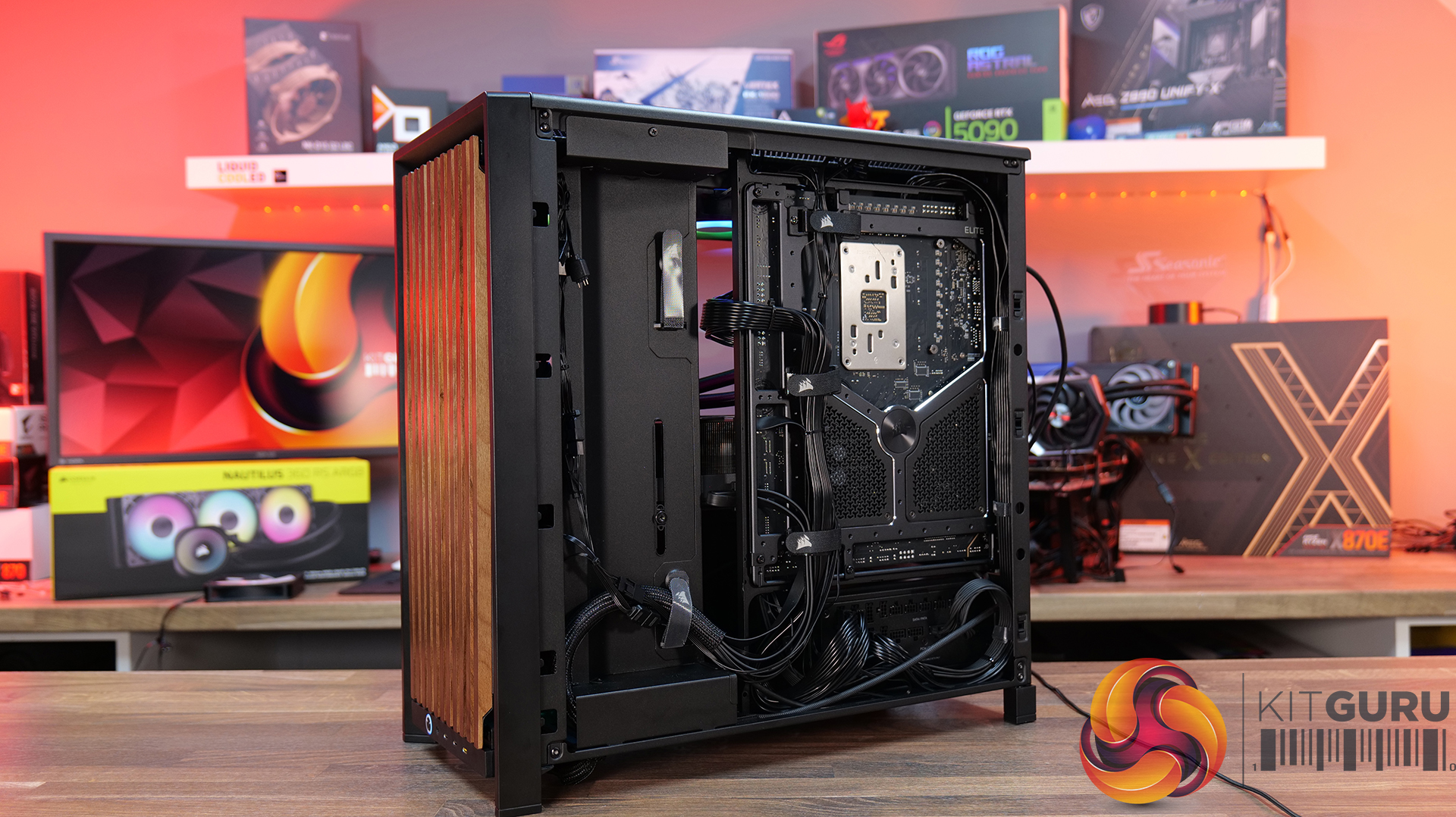
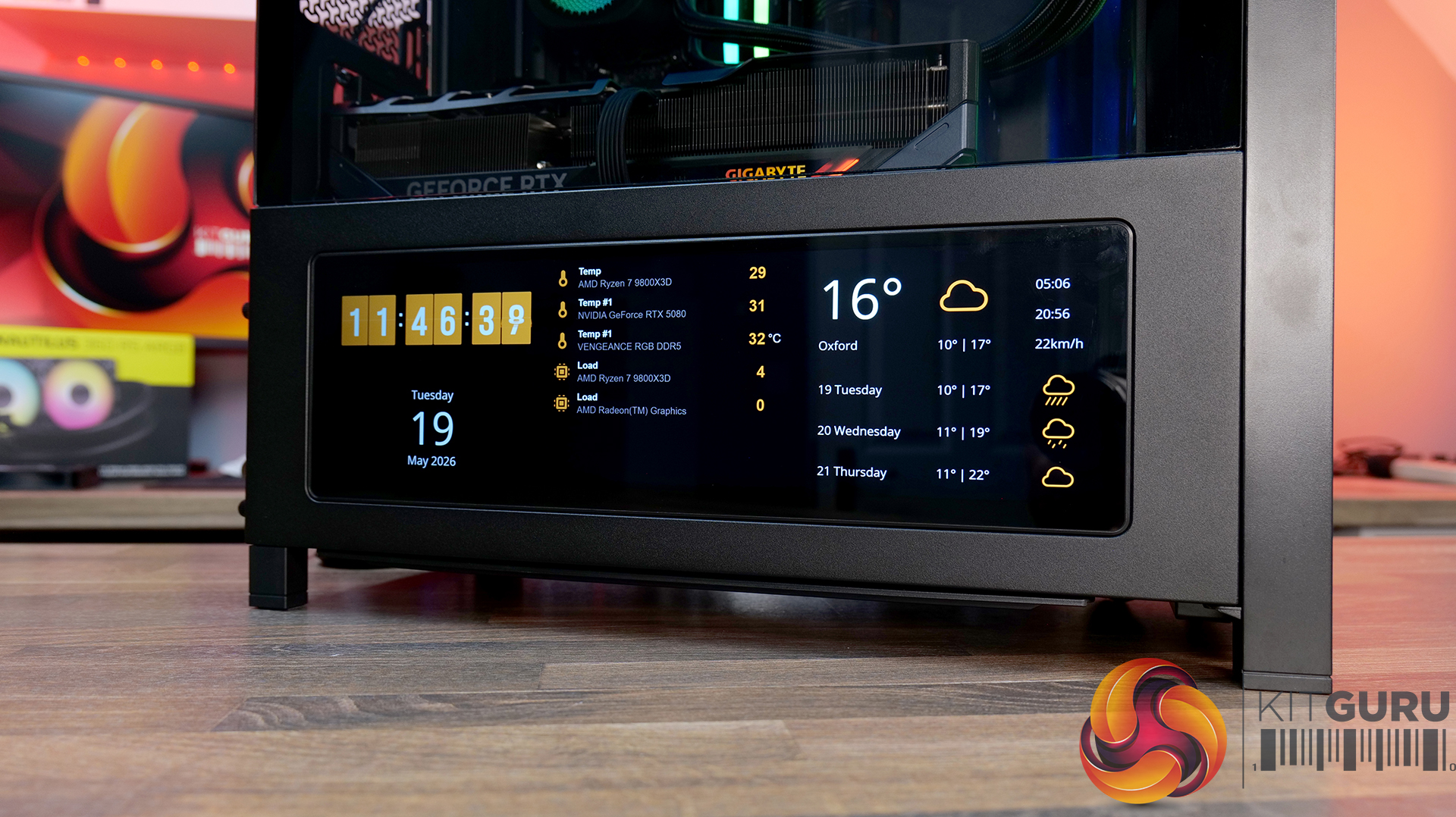
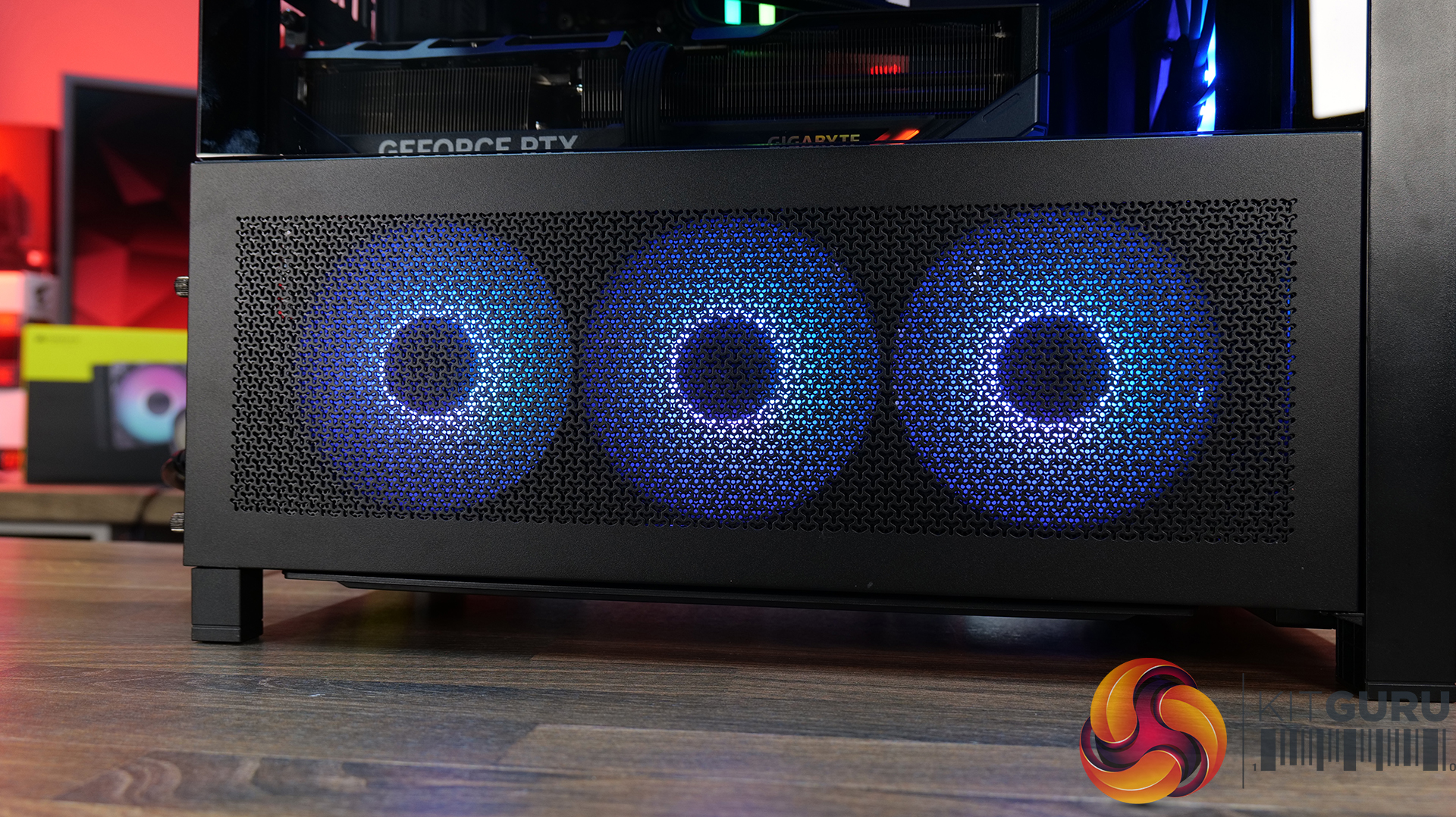
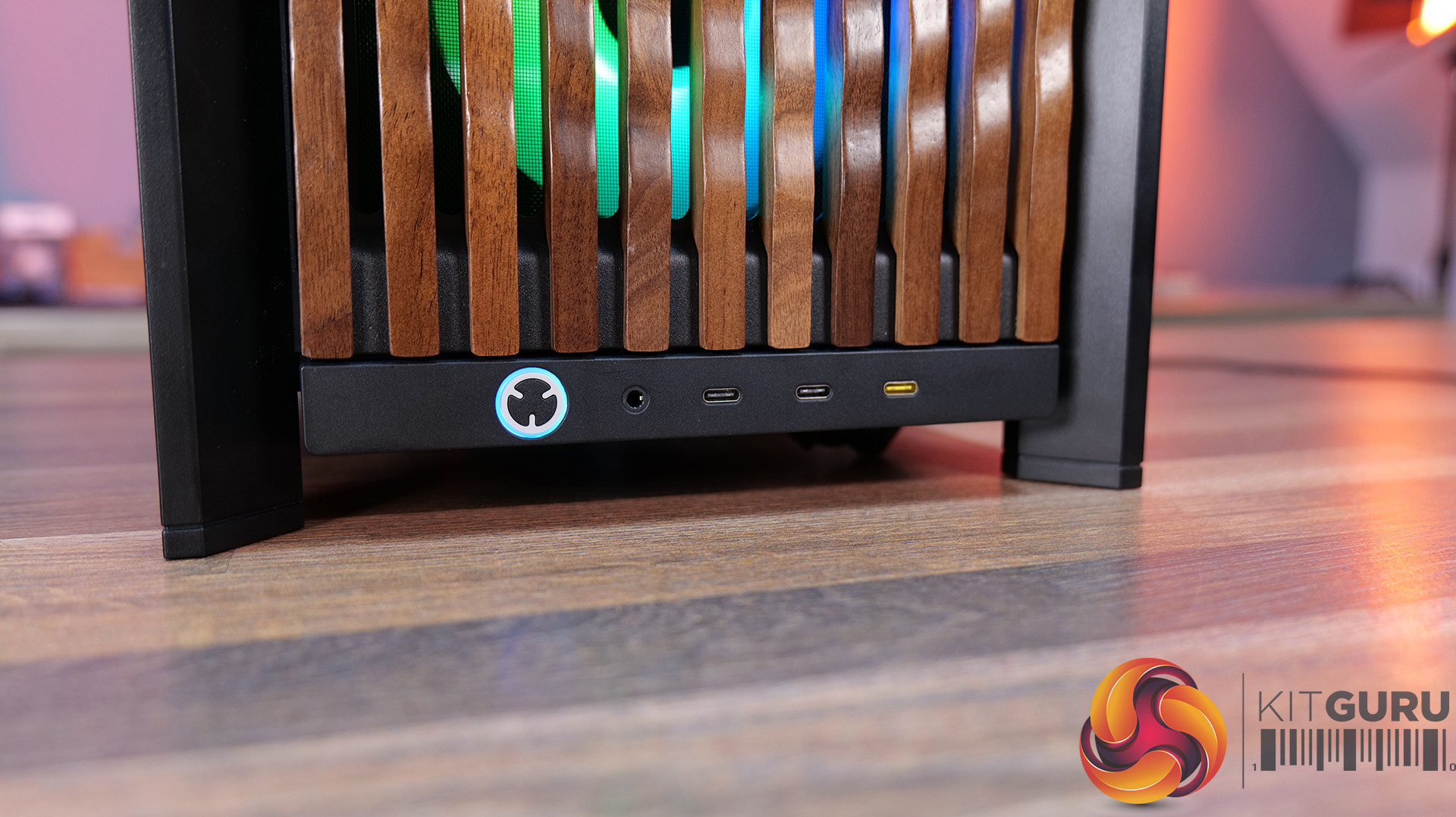
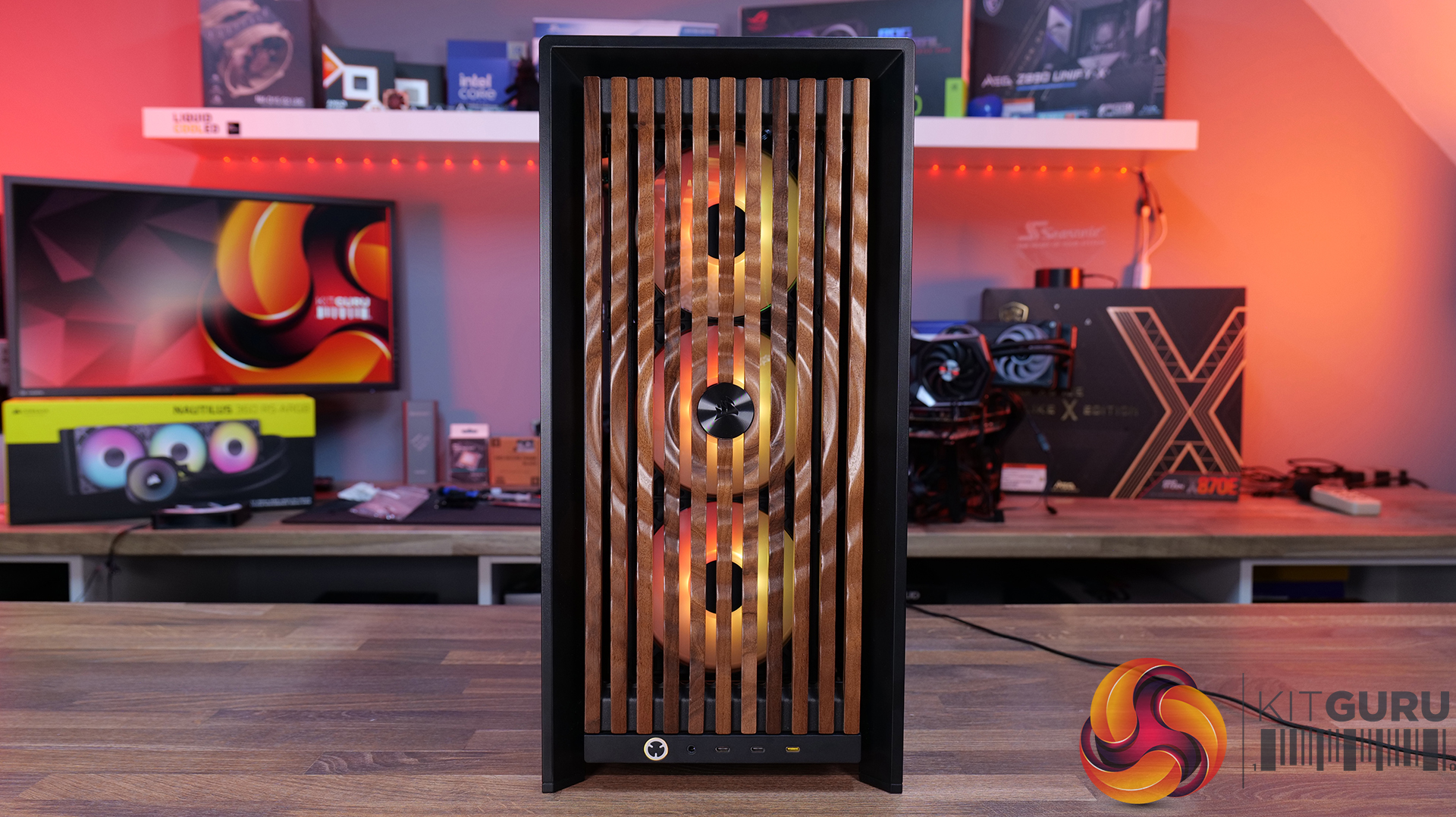
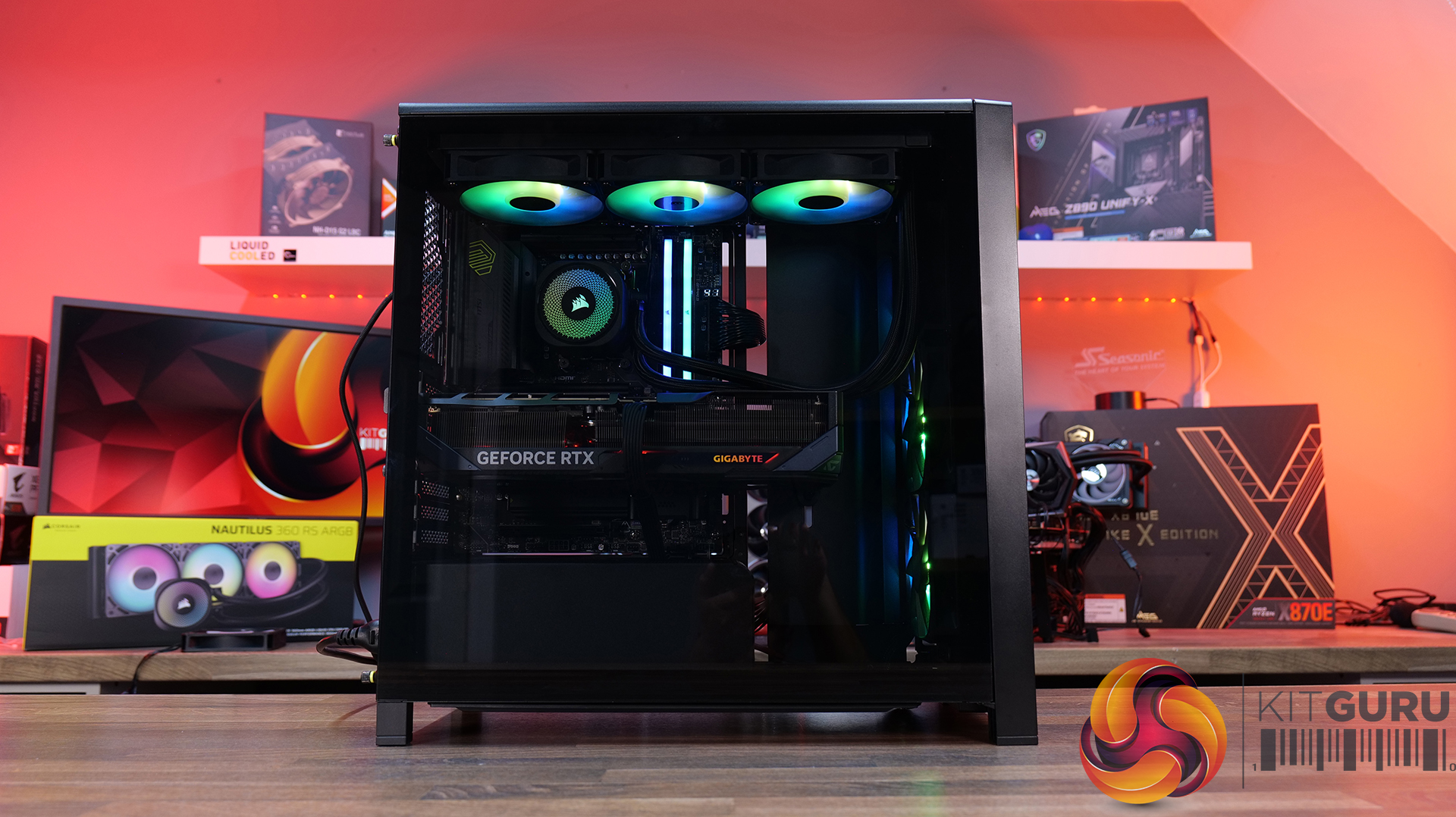
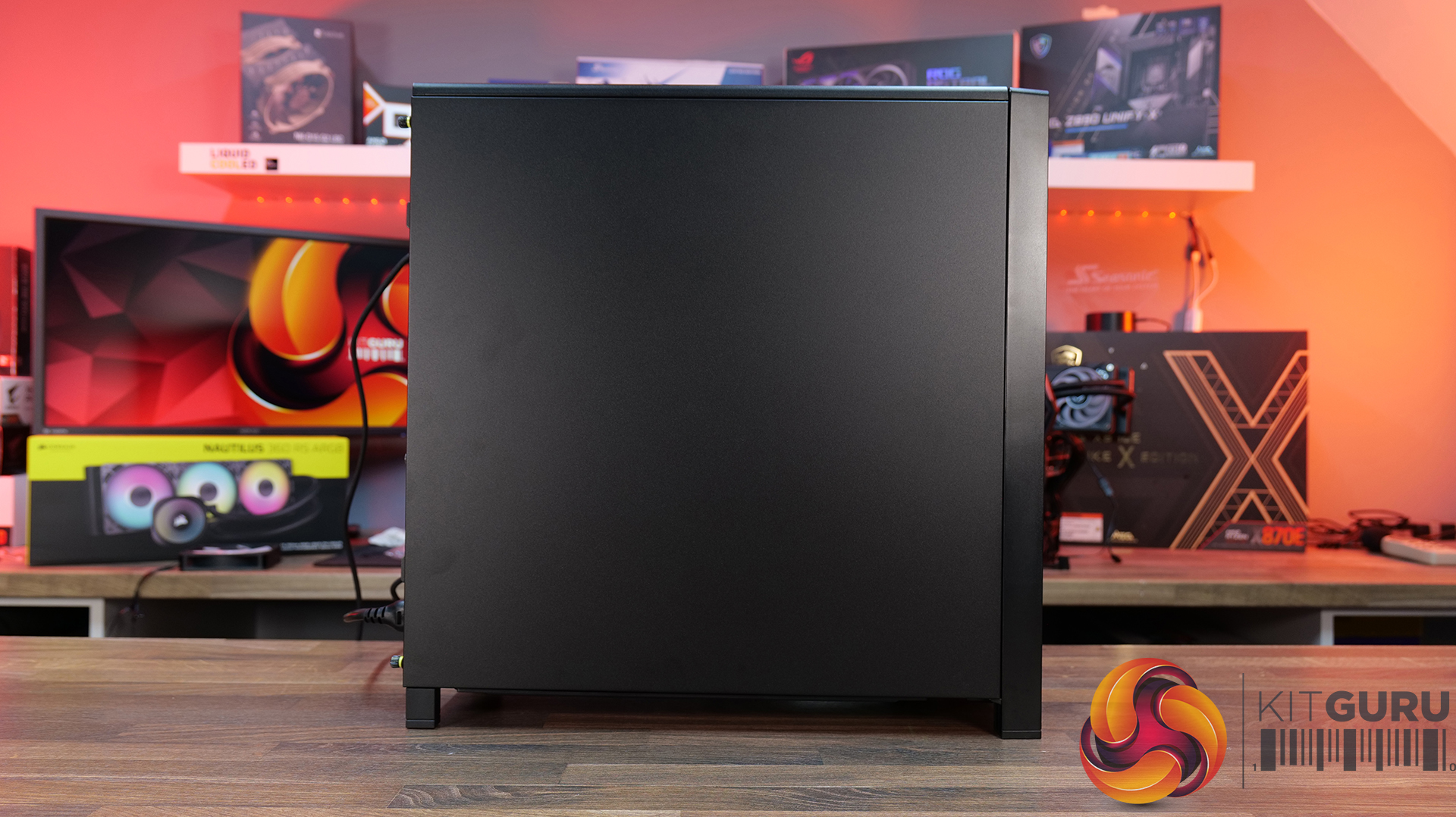
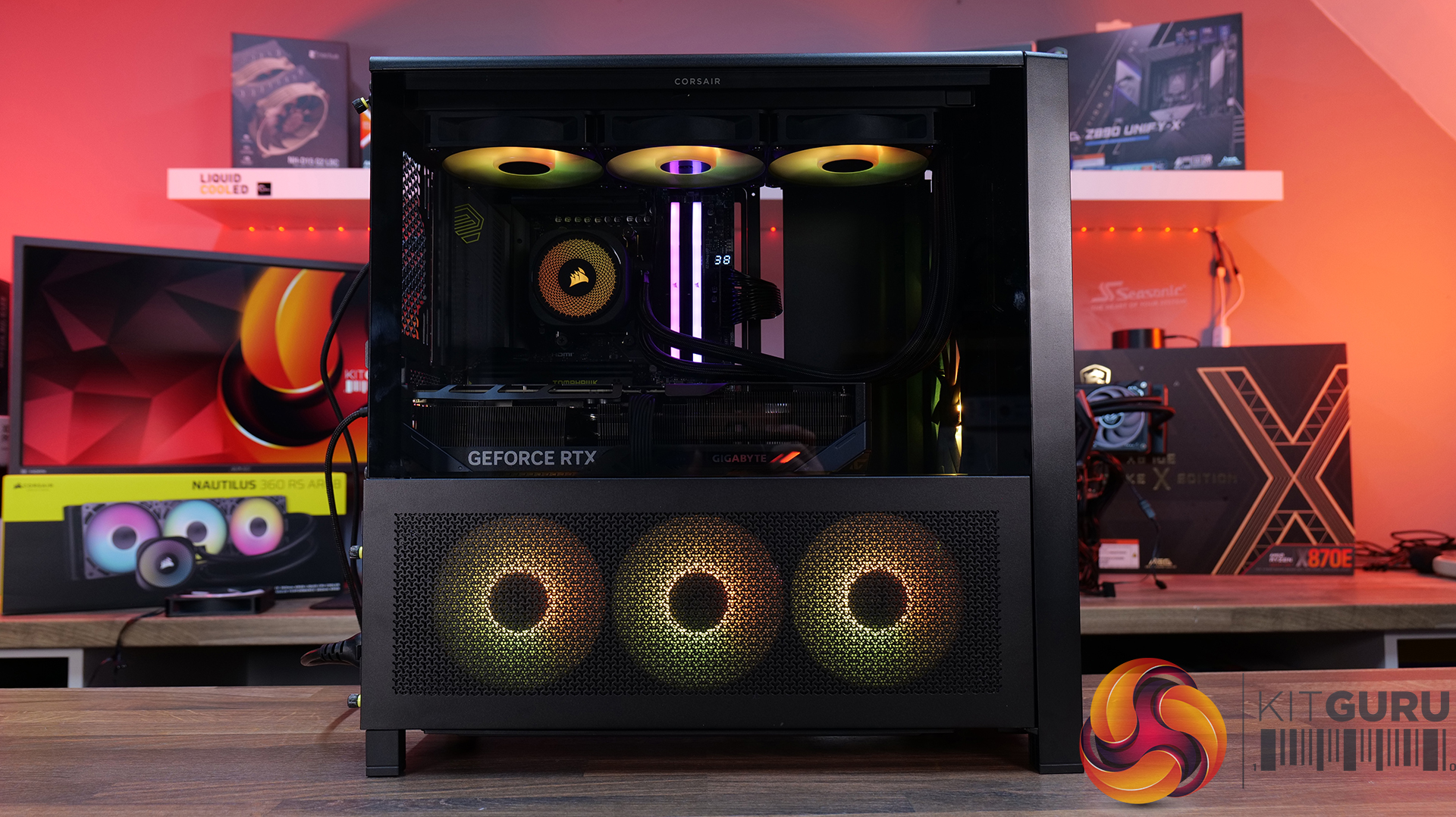
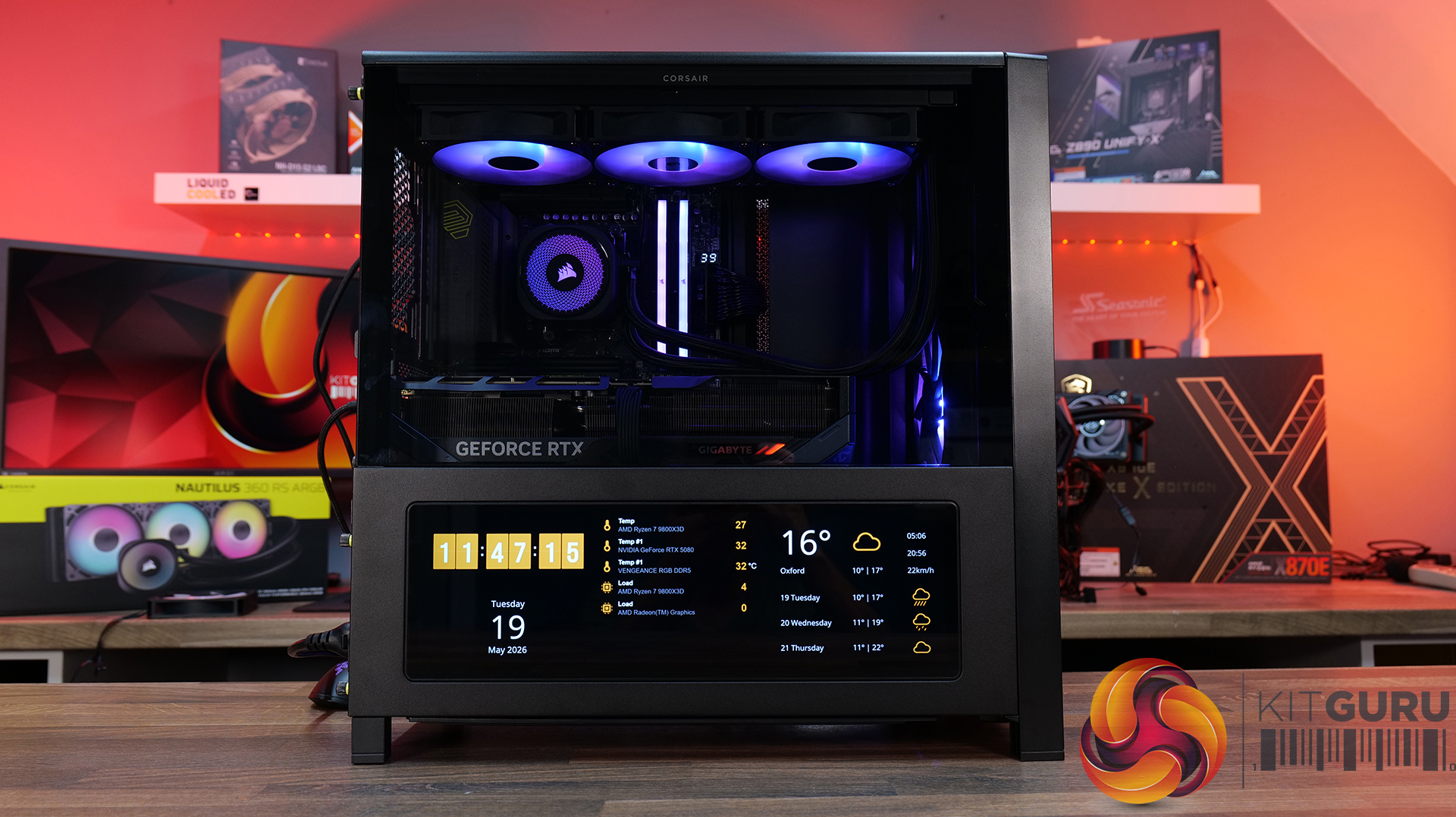
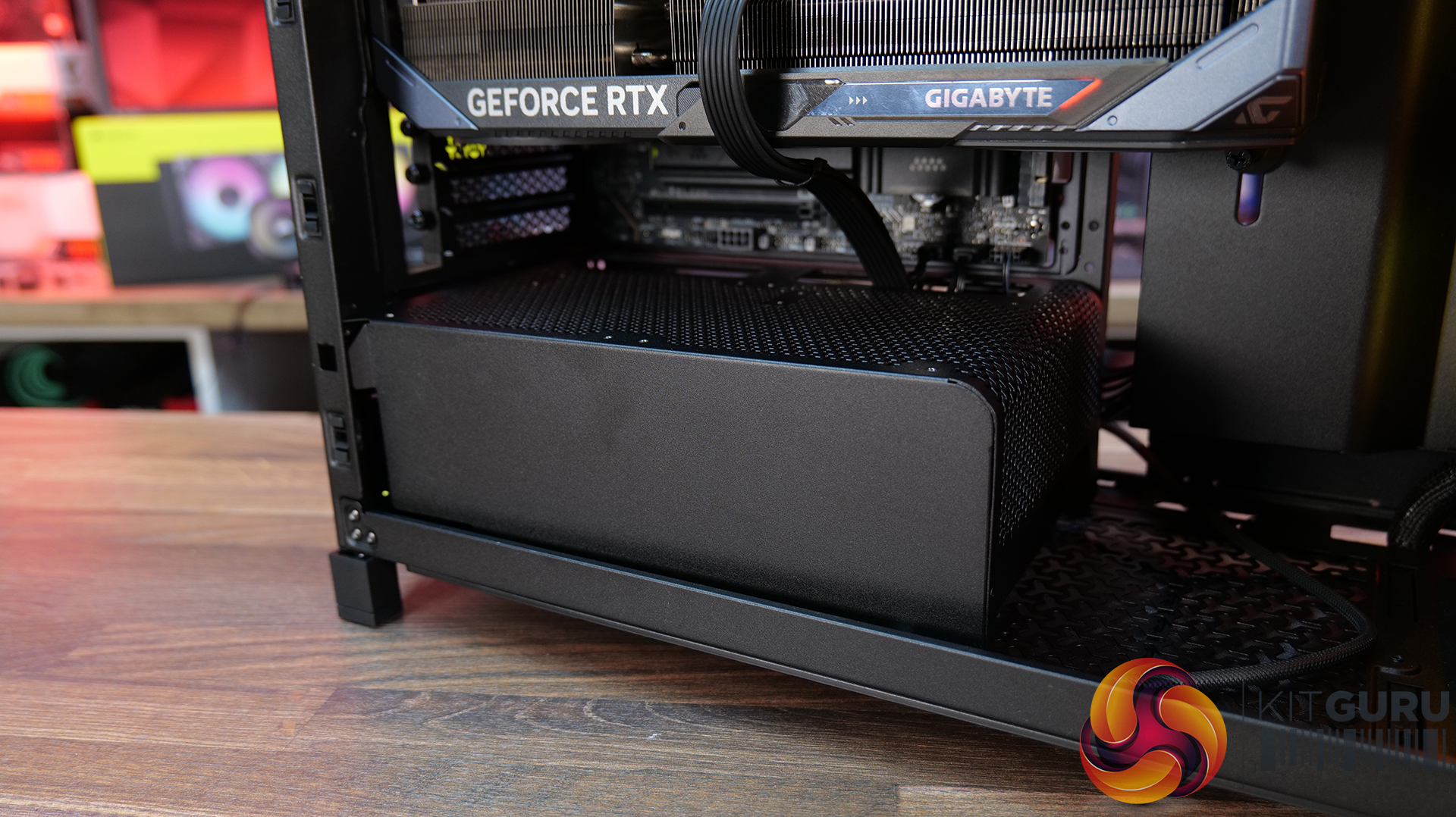
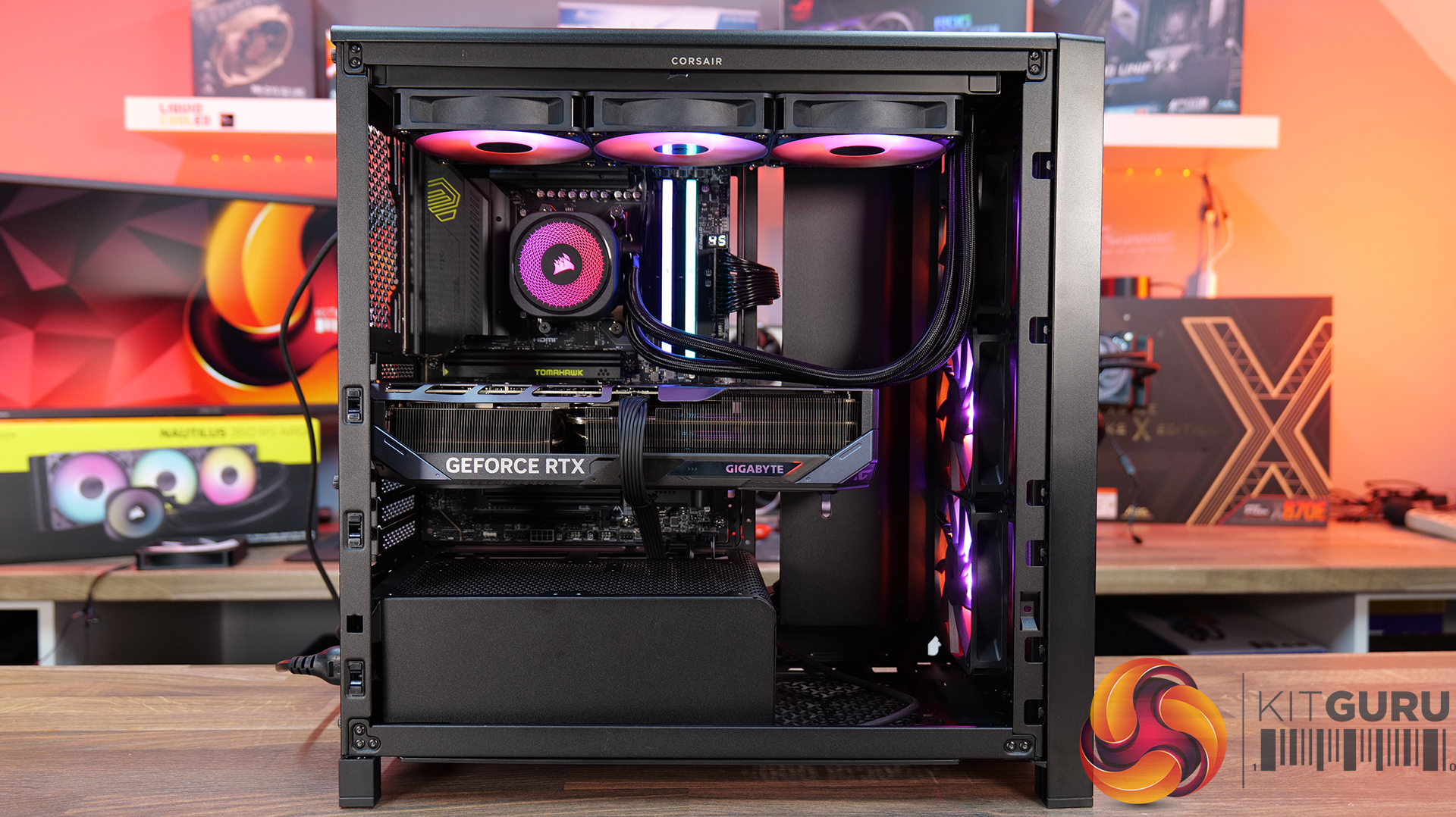
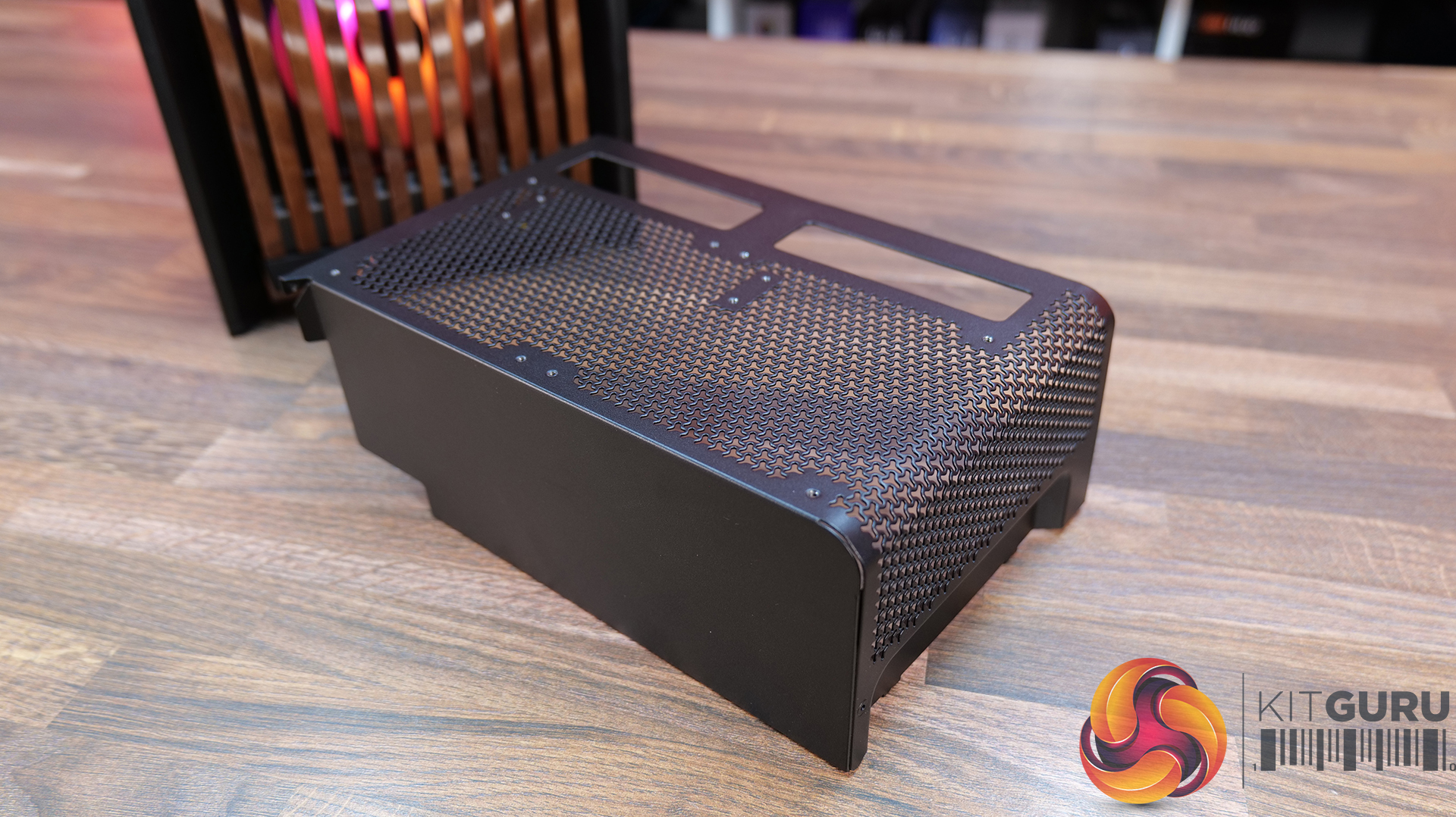
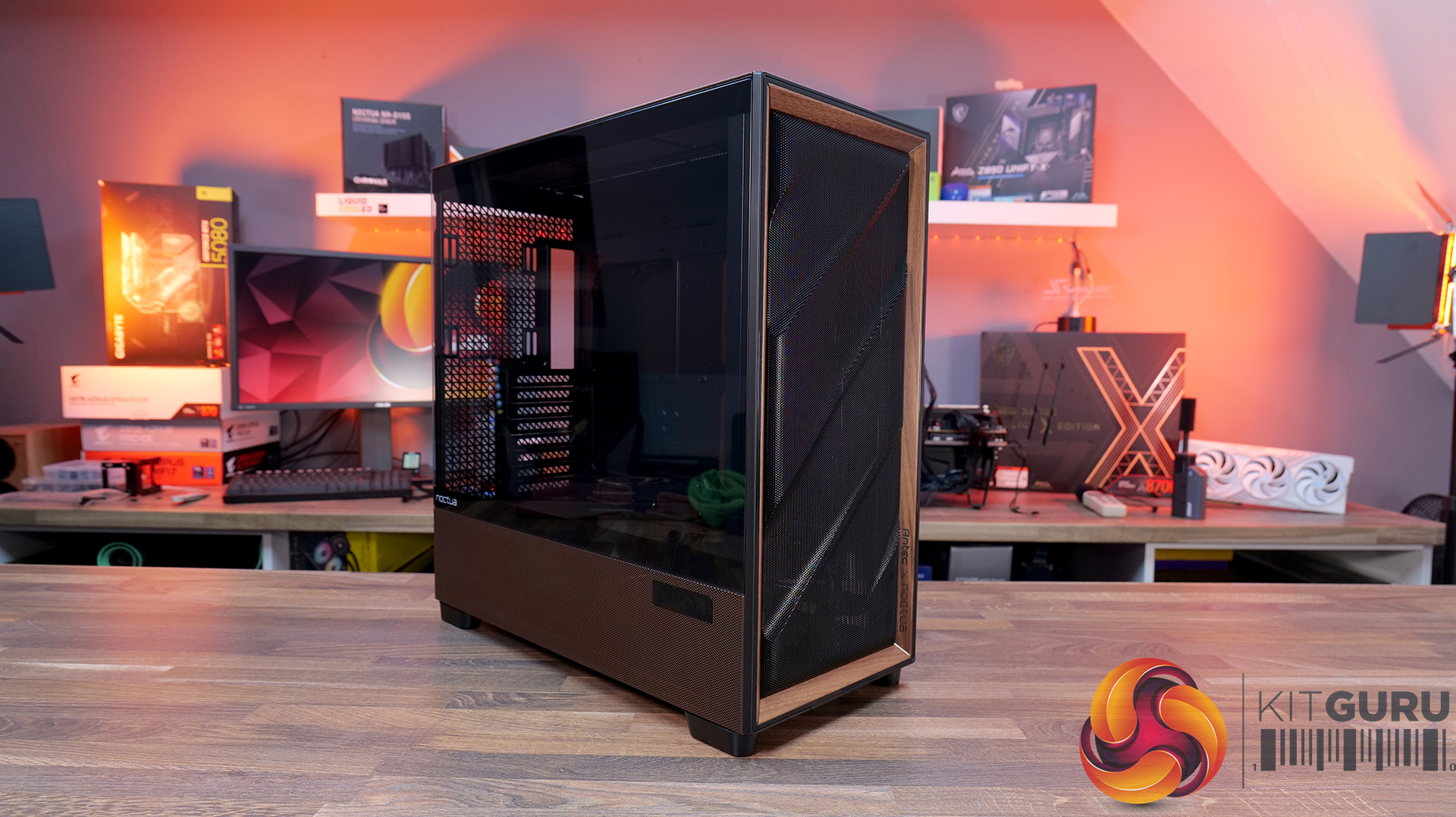
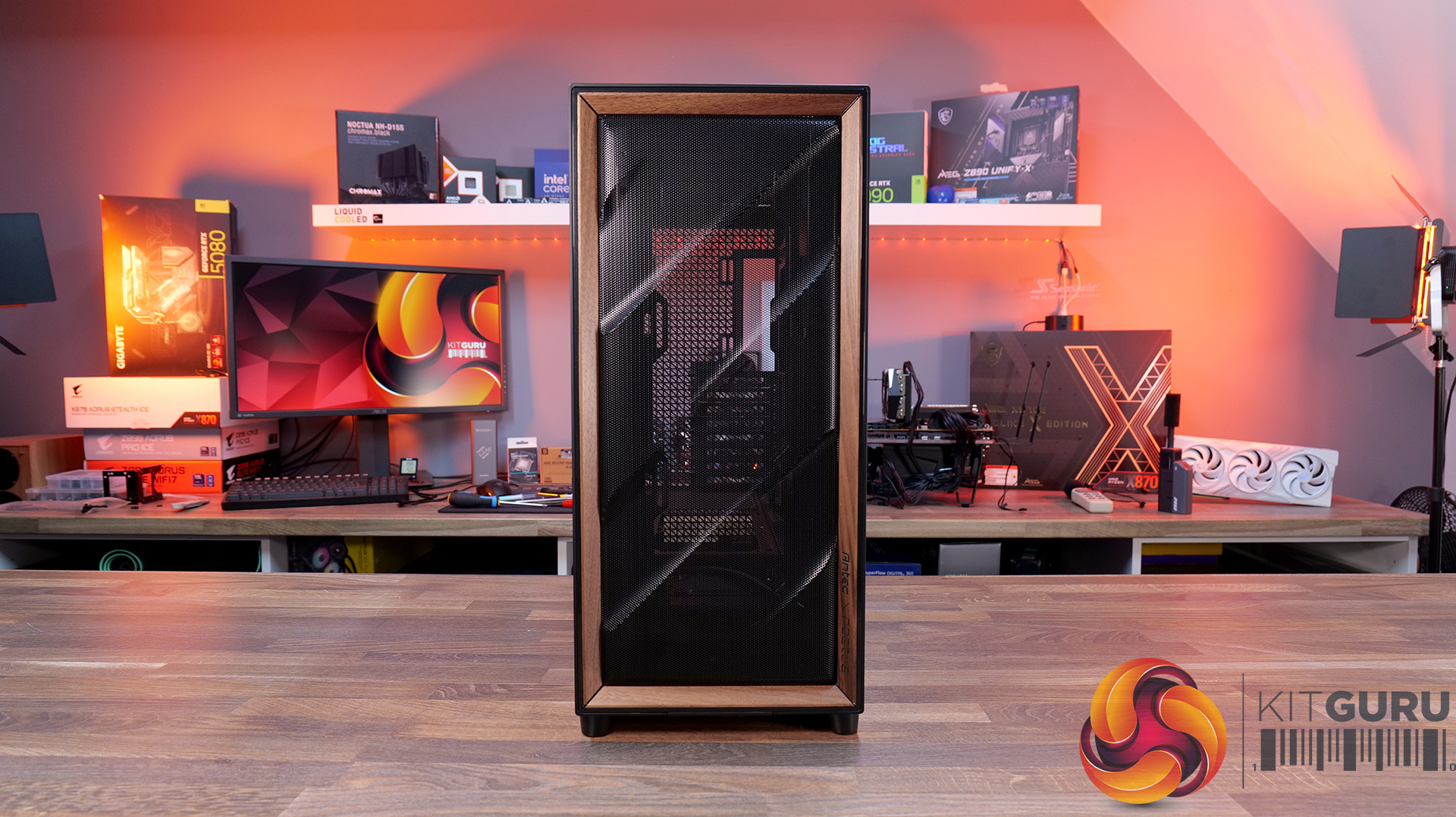
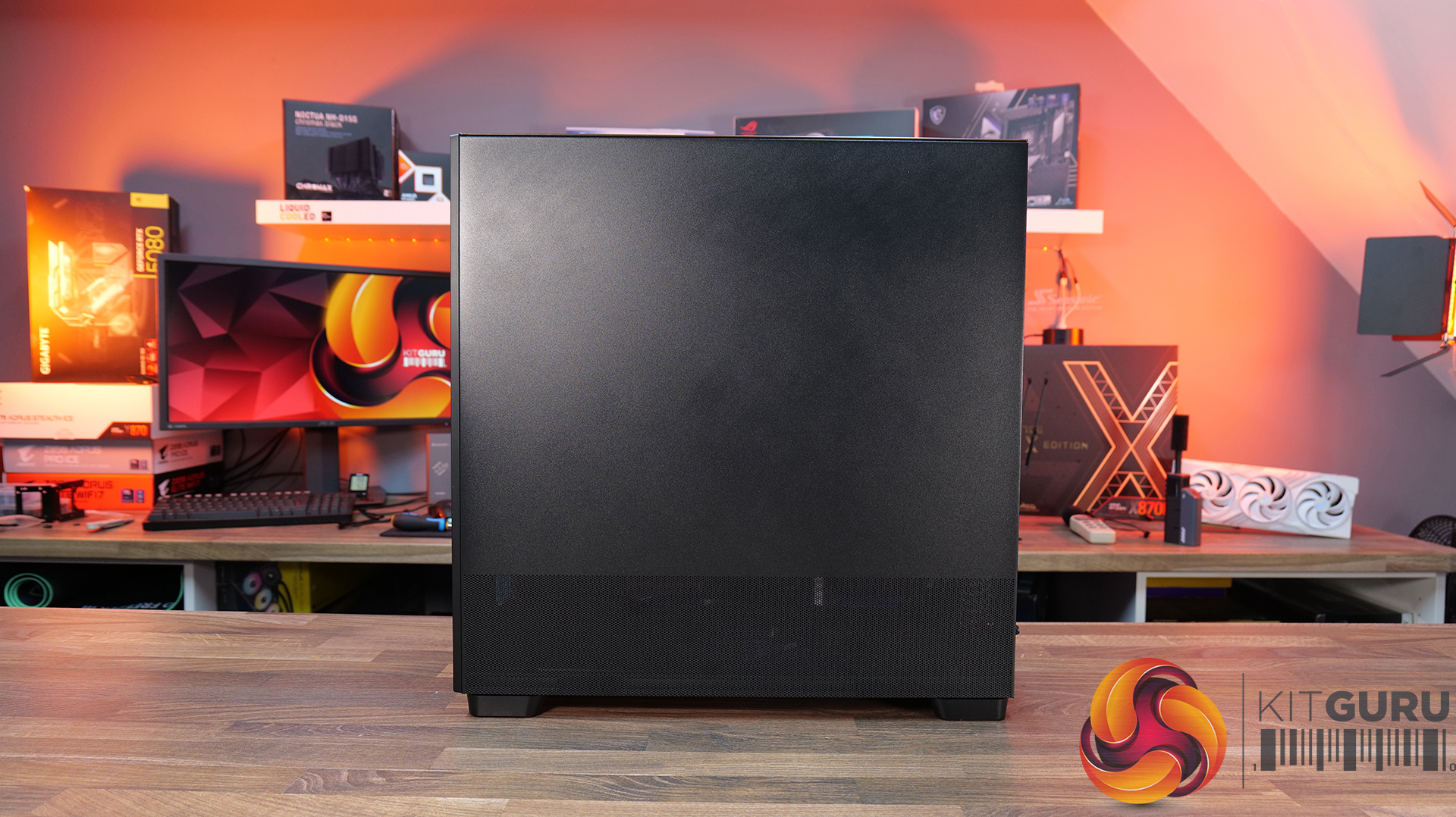
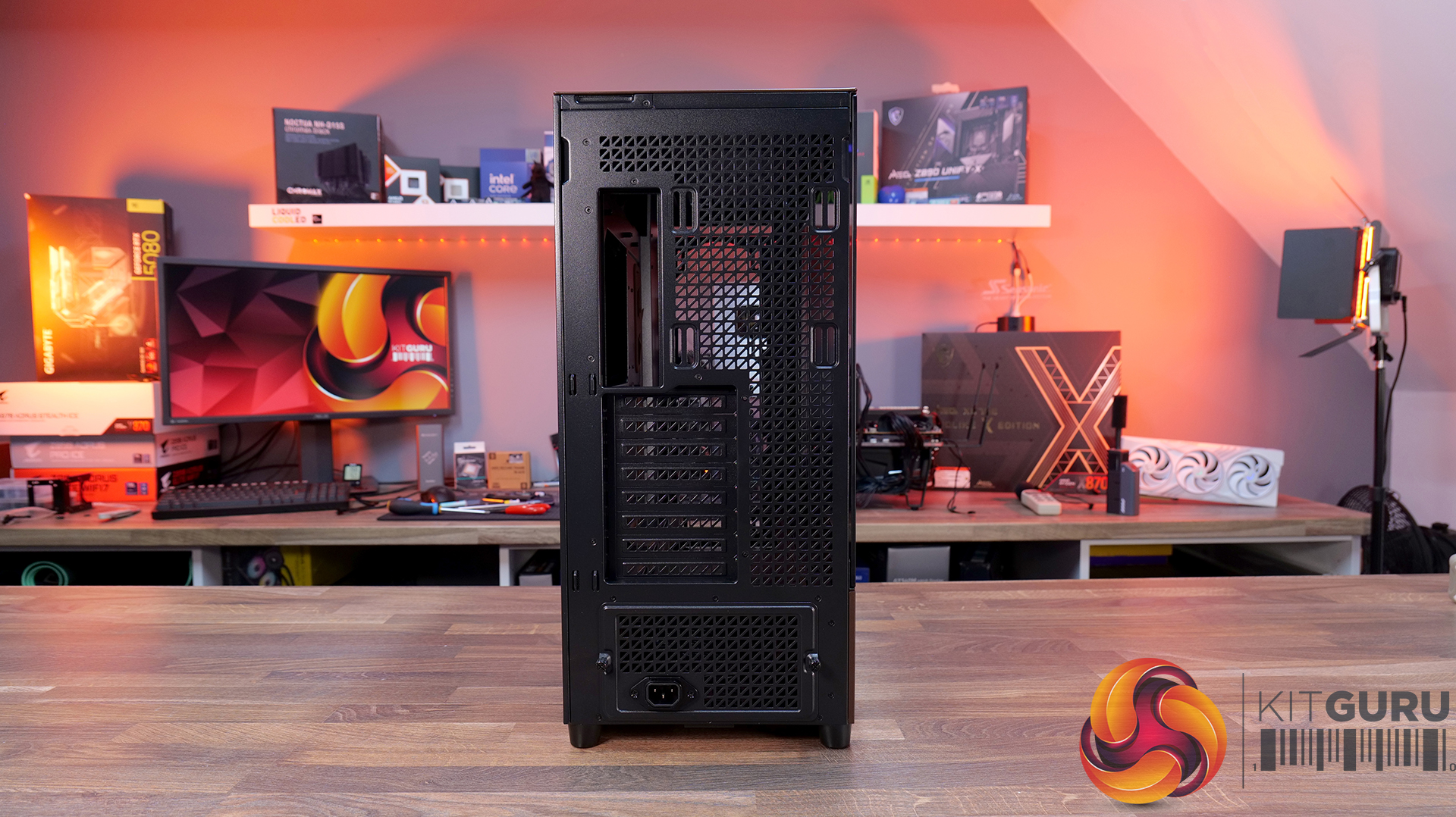
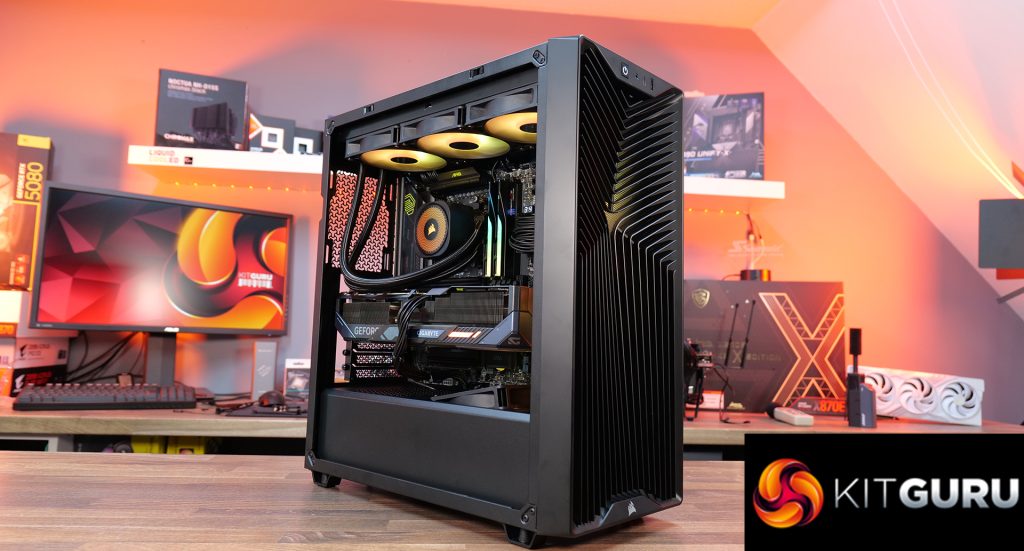
In Win has introduced the L50 Breeze, a new PC chassis featuring a reeded glass front panel and back-connect motherboard support. The enclosure moves away from traditional ARGB illumination by adopting the company's new AWWA PureTone ambient lighting system, which uses addressable WWA LEDs to switch between cool white, warm white, and amber tones.
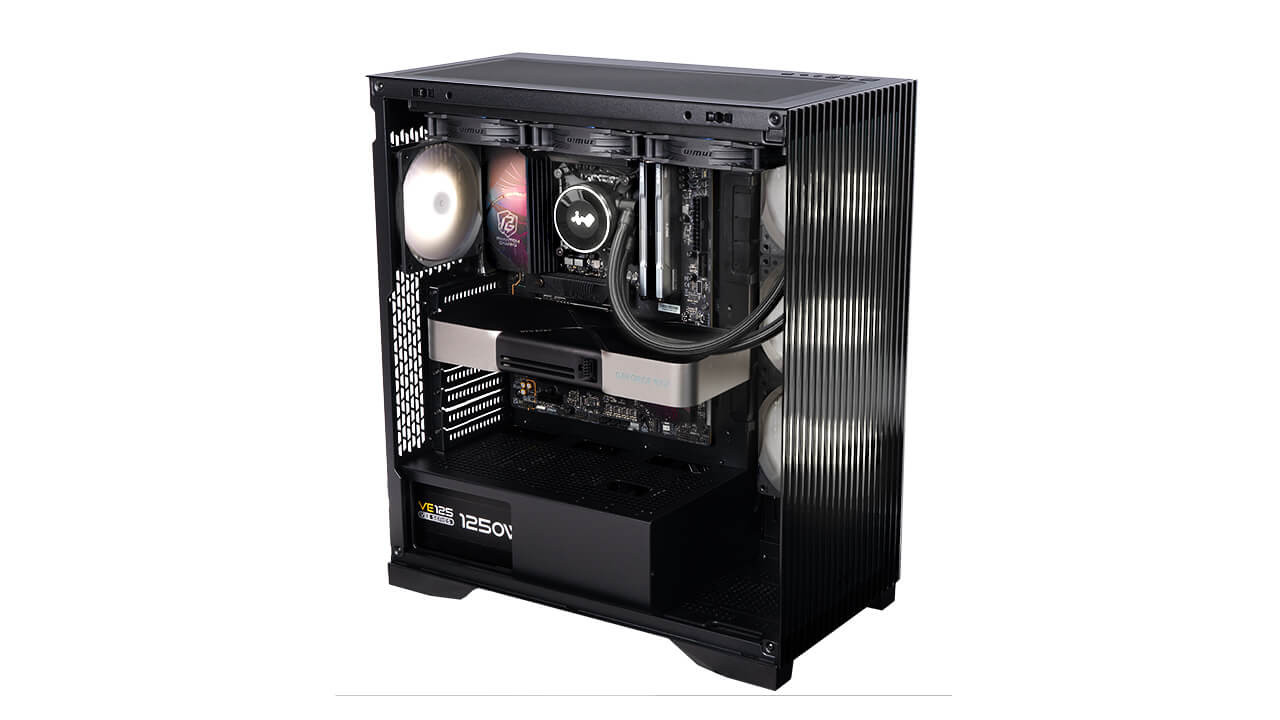
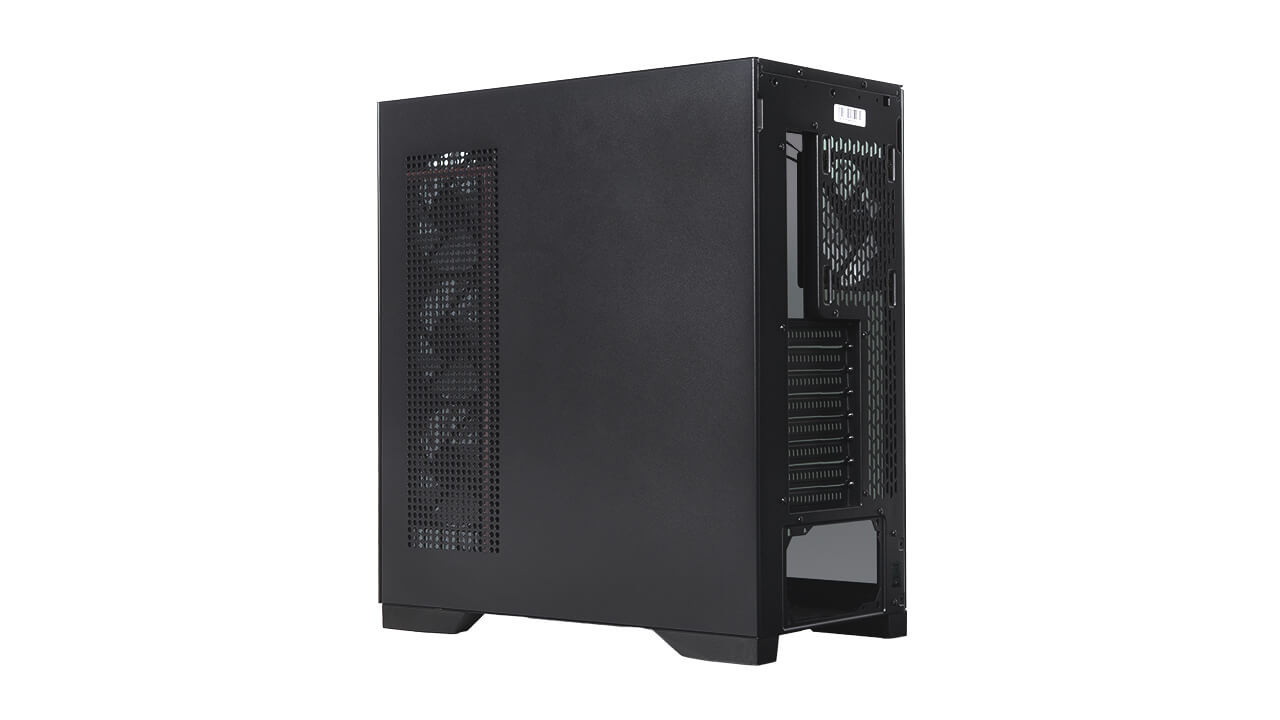
The L50 Breeze has a tinted tempered glass side panel alongside tool-free removable exterior panels to simplify system maintenance. In Win includes 15 built-in lighting effects with motherboard synchronisation, alongside two illumination modes. These include a 25-minute Pomodoro Technique mode and a Meditation mode modelled after the 4-7-8 breathing method.
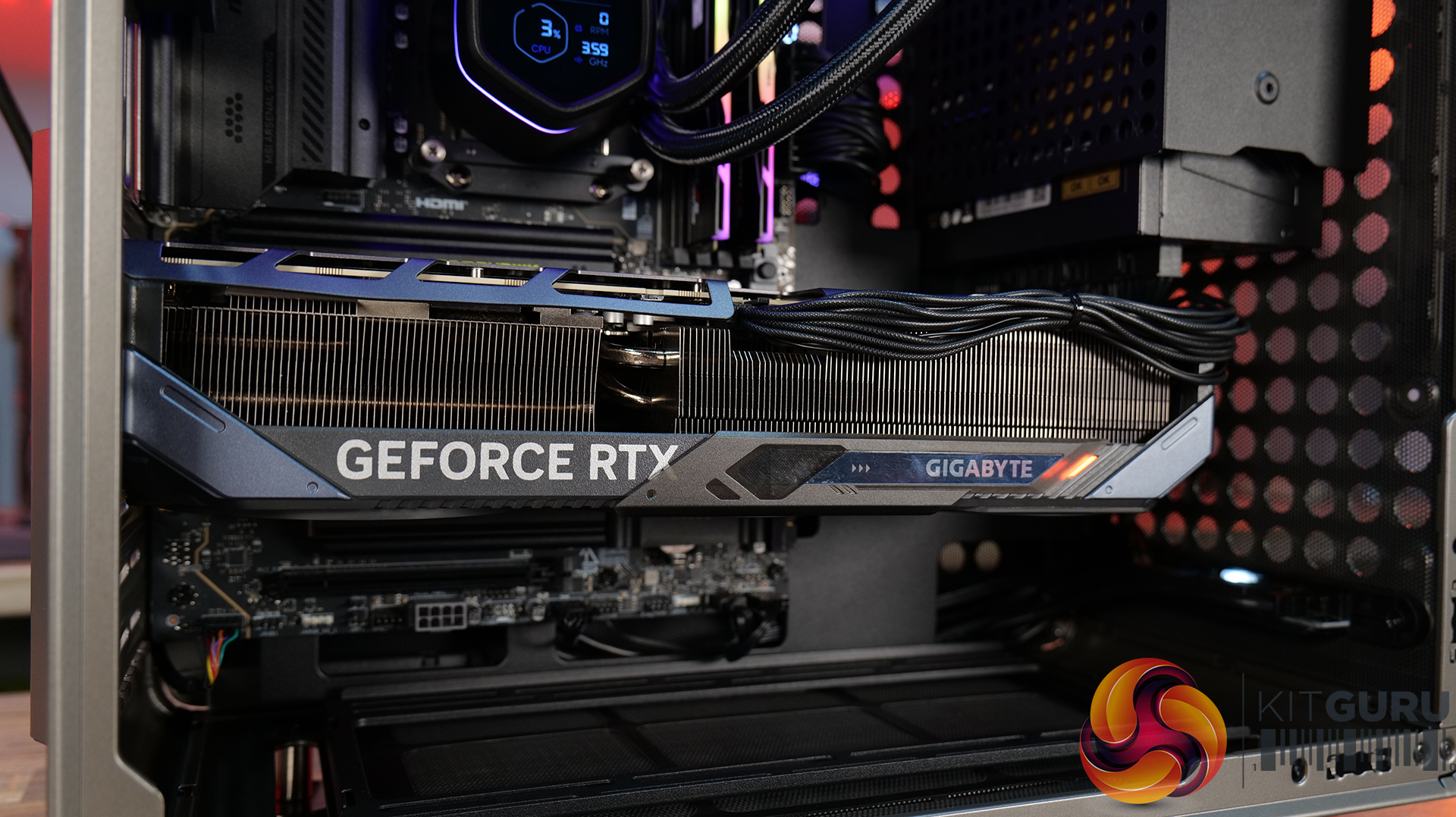
Hardware compatibility includes E-ATX motherboards up to 305x277mm, as well as ATX and mATX back-connect form factors. Builders can install graphics cards up to 435mm in length and CPU coolers up to 175mm tall. Dedicated routing channels for GPU cables and support bracket mounting points are also integrated into the interior frame.
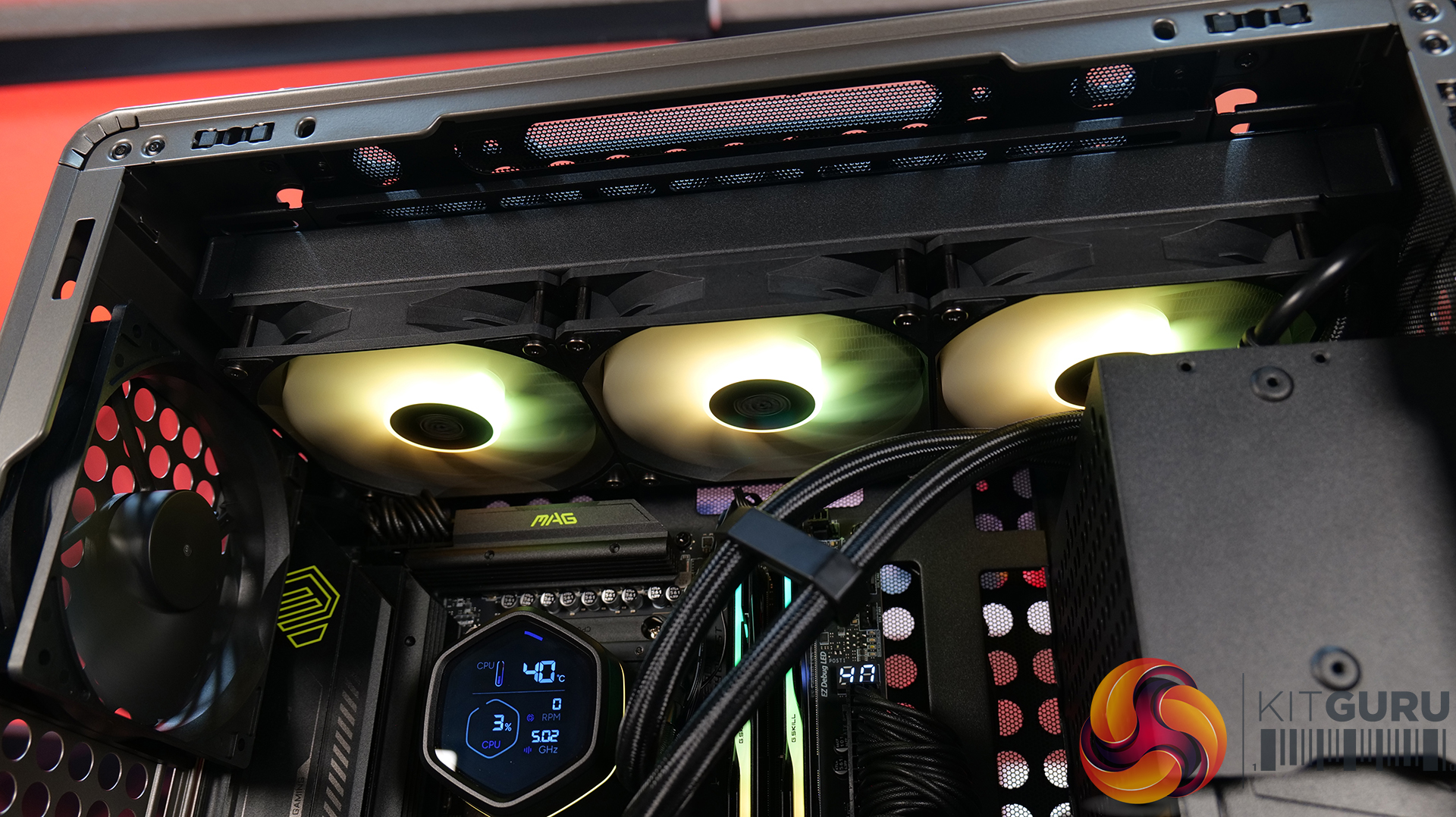
Cooling configurations accommodate up to nine 120mm fans. In Win ships the enclosure with four pre-installed Lumia 120 fans, comprising three LM120-RB reverse-blade models and a single LM120 rear fan. Liquid cooling setups can utilise radiators up to 360mm on both the top and side mounting locations.
KitGuru says: For those tired of the gaming aesthetics that have flooded the market for over a decade, cases such as the L50 Breeze, with their home décor-inspired styling, are a good-looking alternative.
InWin has officially launched the Aeon, marking the company's 12th Signature Series chassis. First showcased at CES 2026, the premium full-tower enclosure features mirrored stainless steel, a seamless glass exterior, and an expandable frame design to accommodate high-end hardware.
The Aeon uses mirrored stainless steel panels treated with an anti-fingerprint coating, creating dynamic reflections that can be further enhanced by the case's and internal components' lighting. For structural rigidity, the foundation relies on a one-piece aluminium base manufactured by sand casting. Taking inspiration from the manufacturer's Tòu series, the enclosure incorporates five 5mm tempered glass panels bonded through UV-curing technology.
Component support is extensive, accommodating E-ATX motherboards, dual-PSU configurations, up to 8 PCIe expansion slots, and large graphics cards. Liquid cooling hardware options support radiators up to 420mm. To streamline system assembly and component replacement, builders can take advantage of a pull-out motherboard tray and an expandable chassis structure that opens up to 90º.
Interactive elements include an RFID-enabled security system requiring a dedicated card for operation. An integrated LED display module handles multimedia playback and outputs real-time system monitoring metrics. Ambient lighting options round out the package, allowing users to choose between warm white and standard RGB illumination profiles.
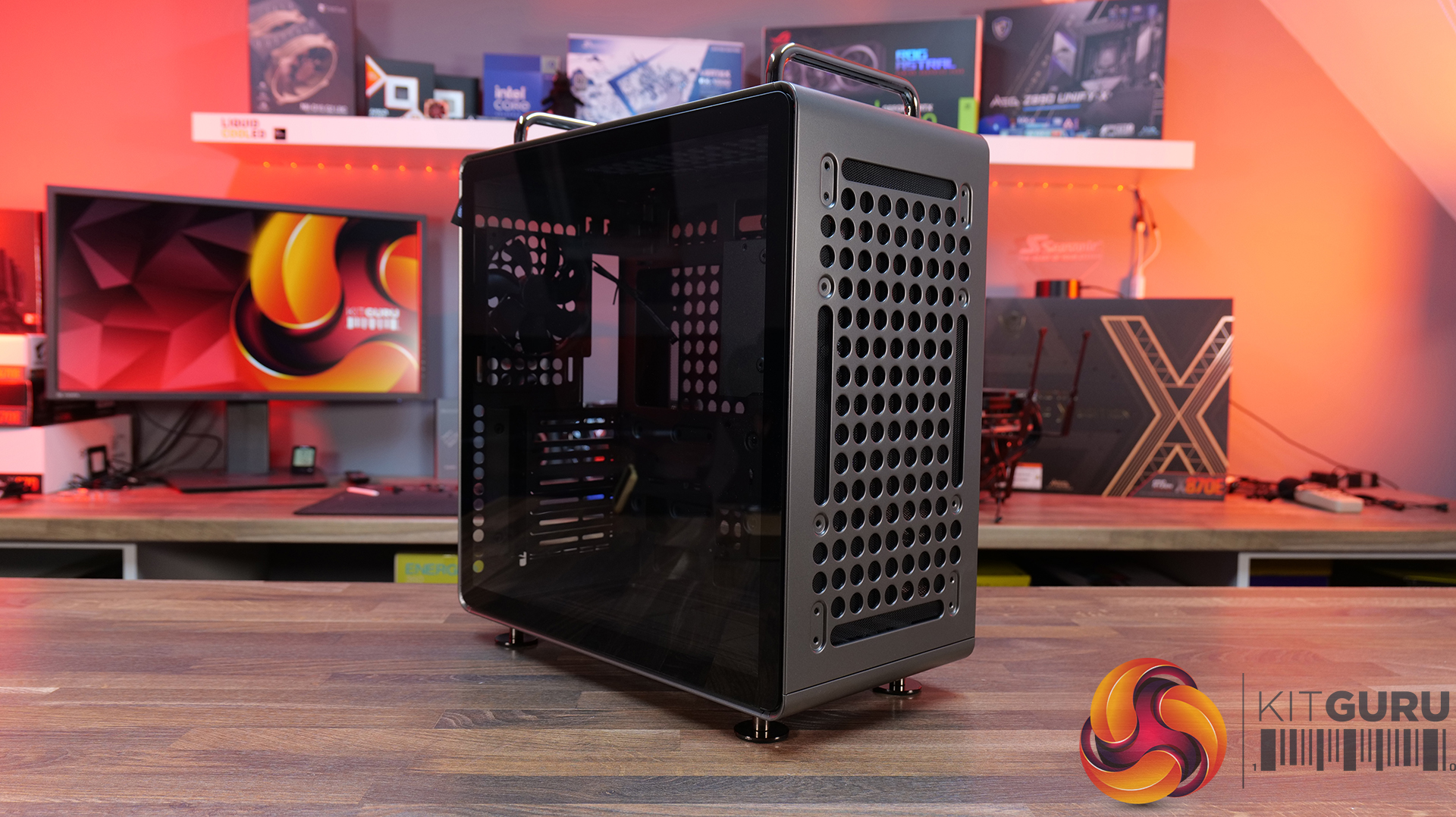
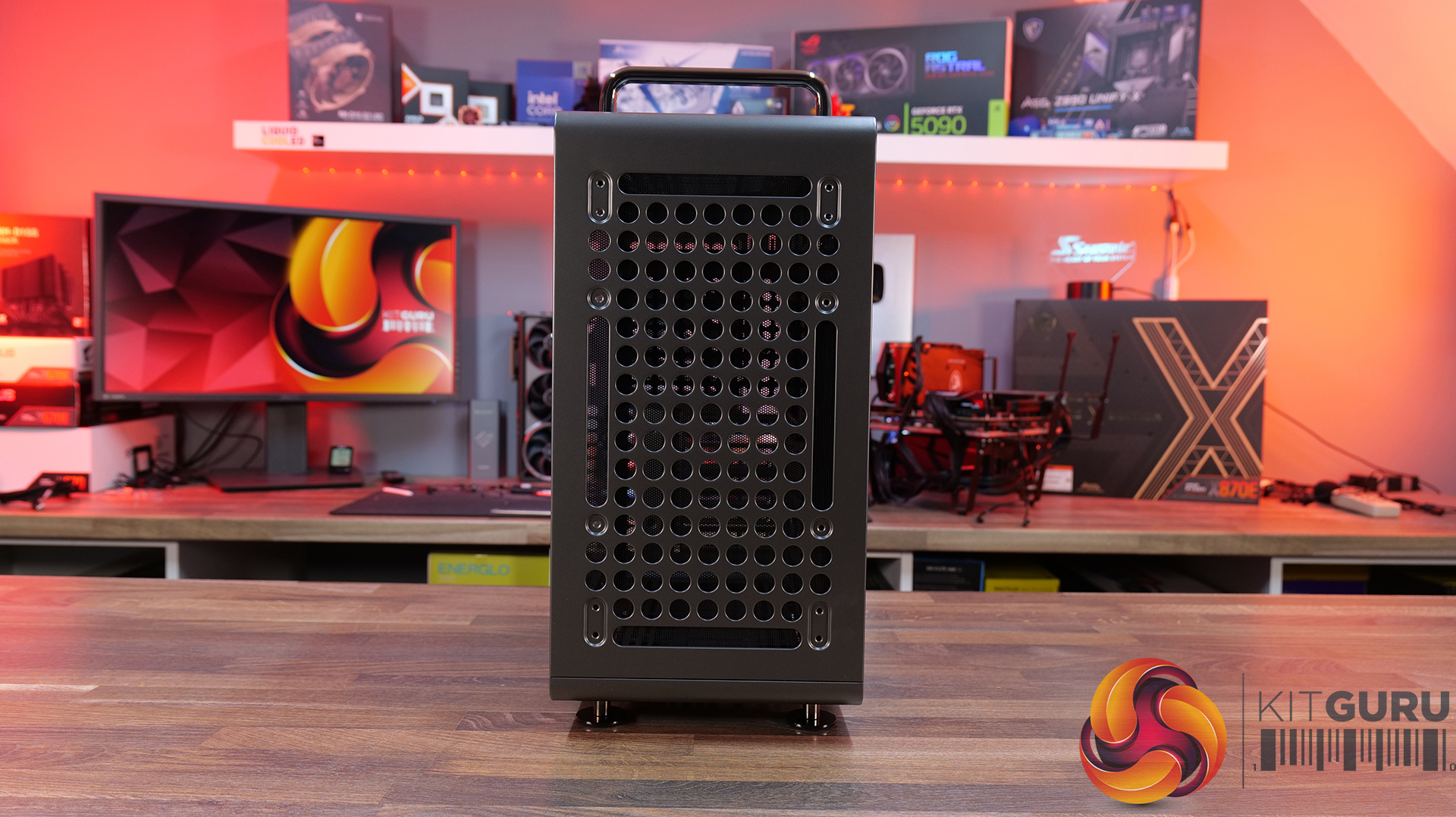
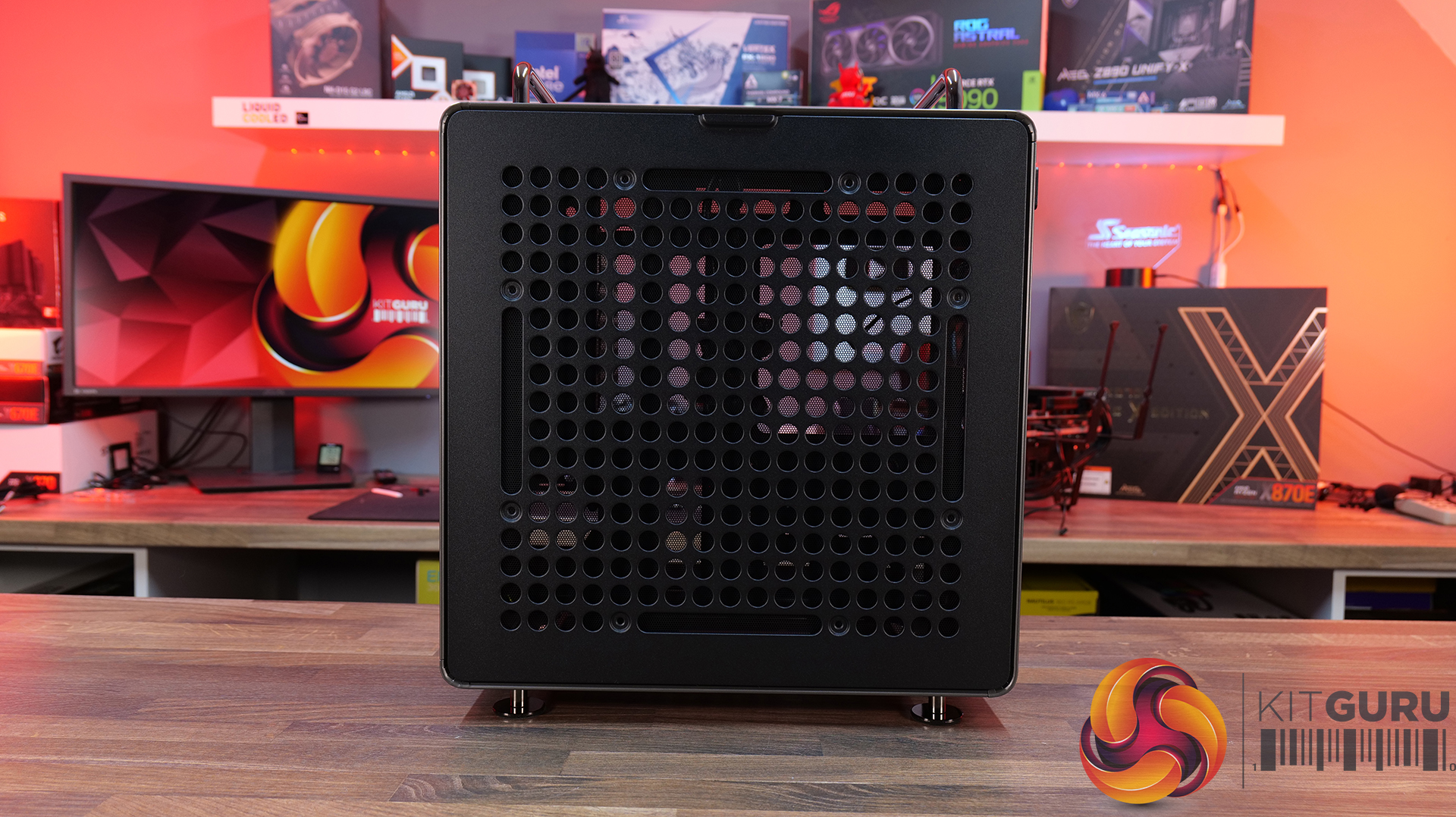
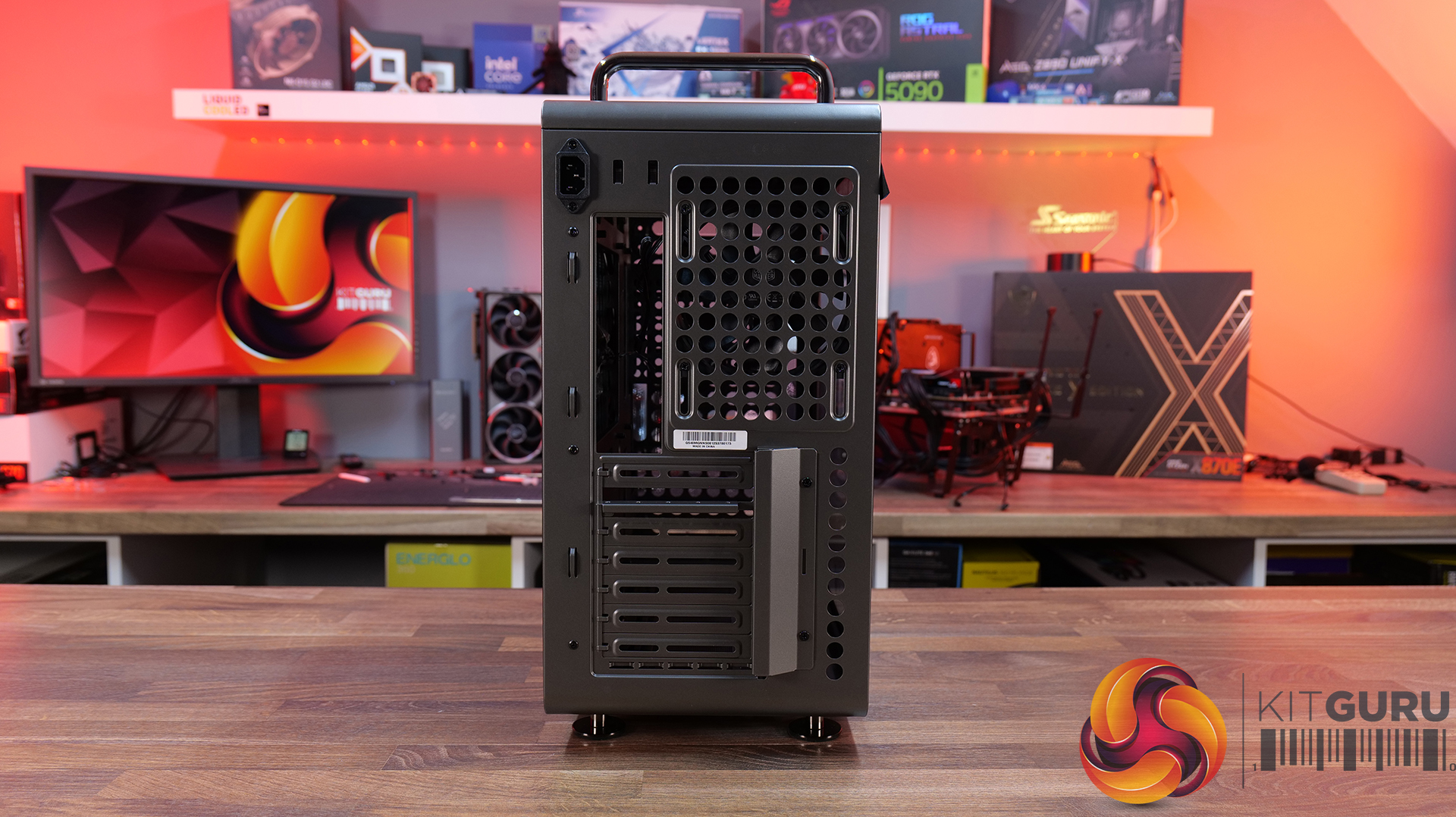
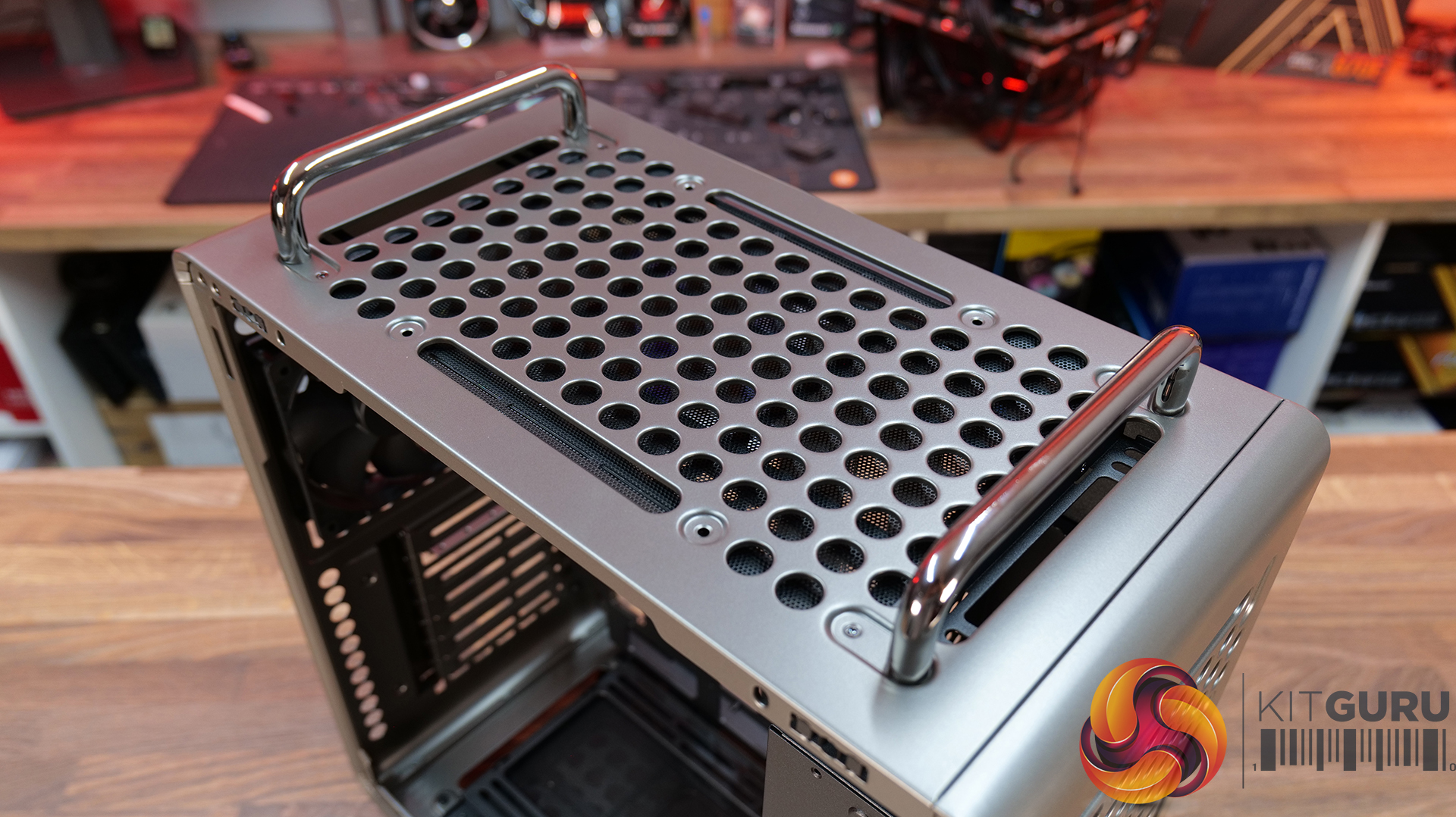
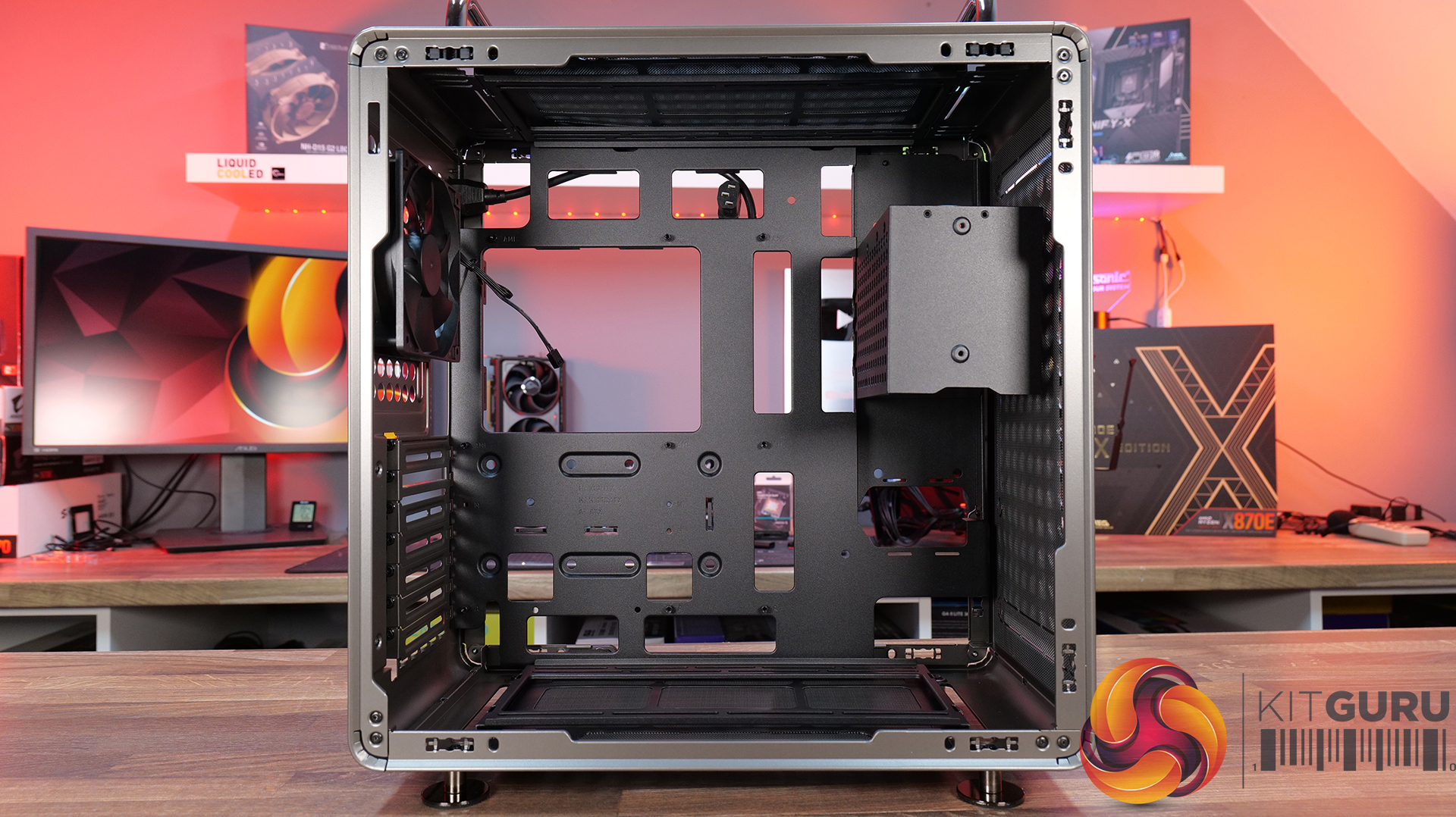
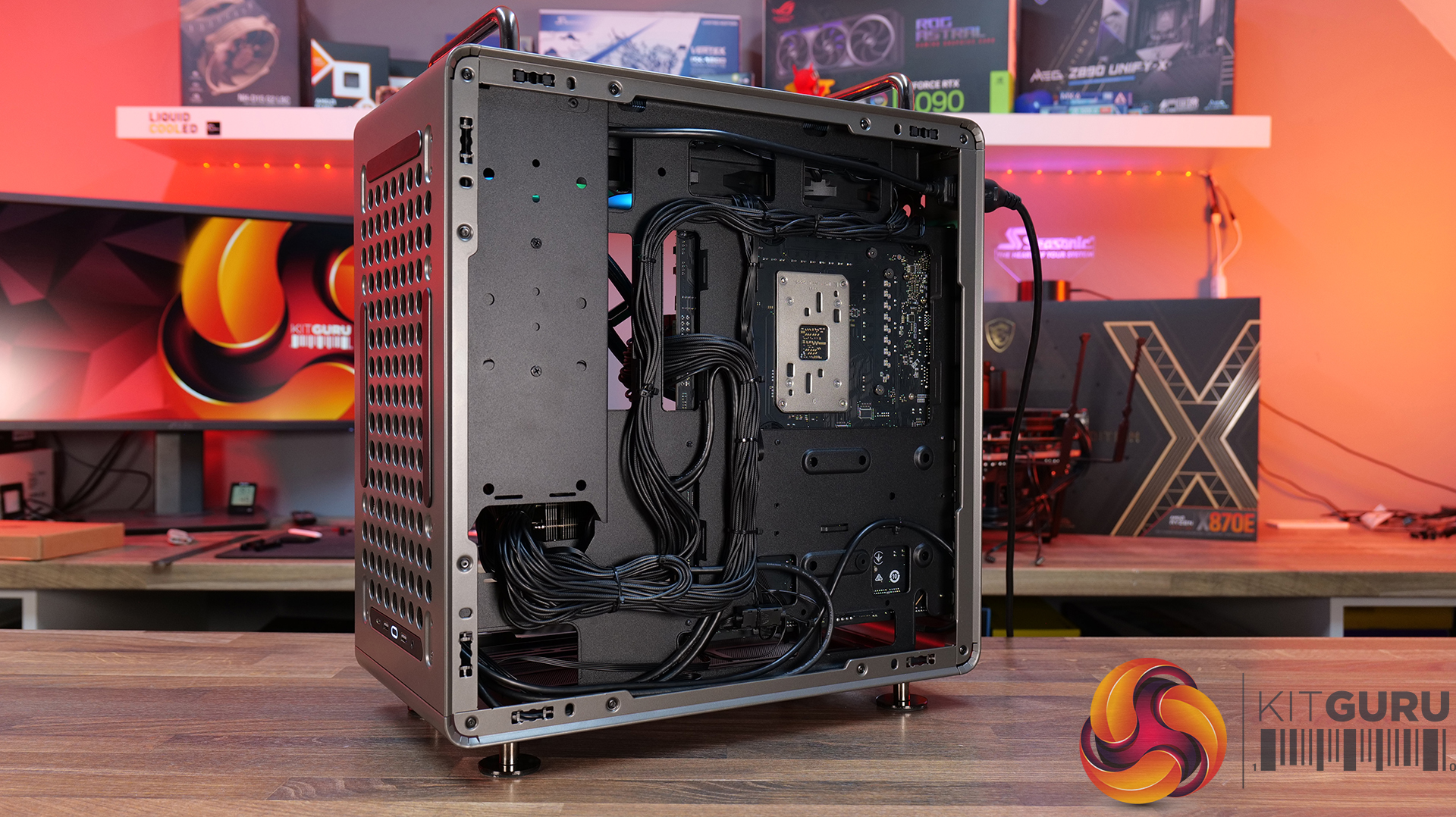
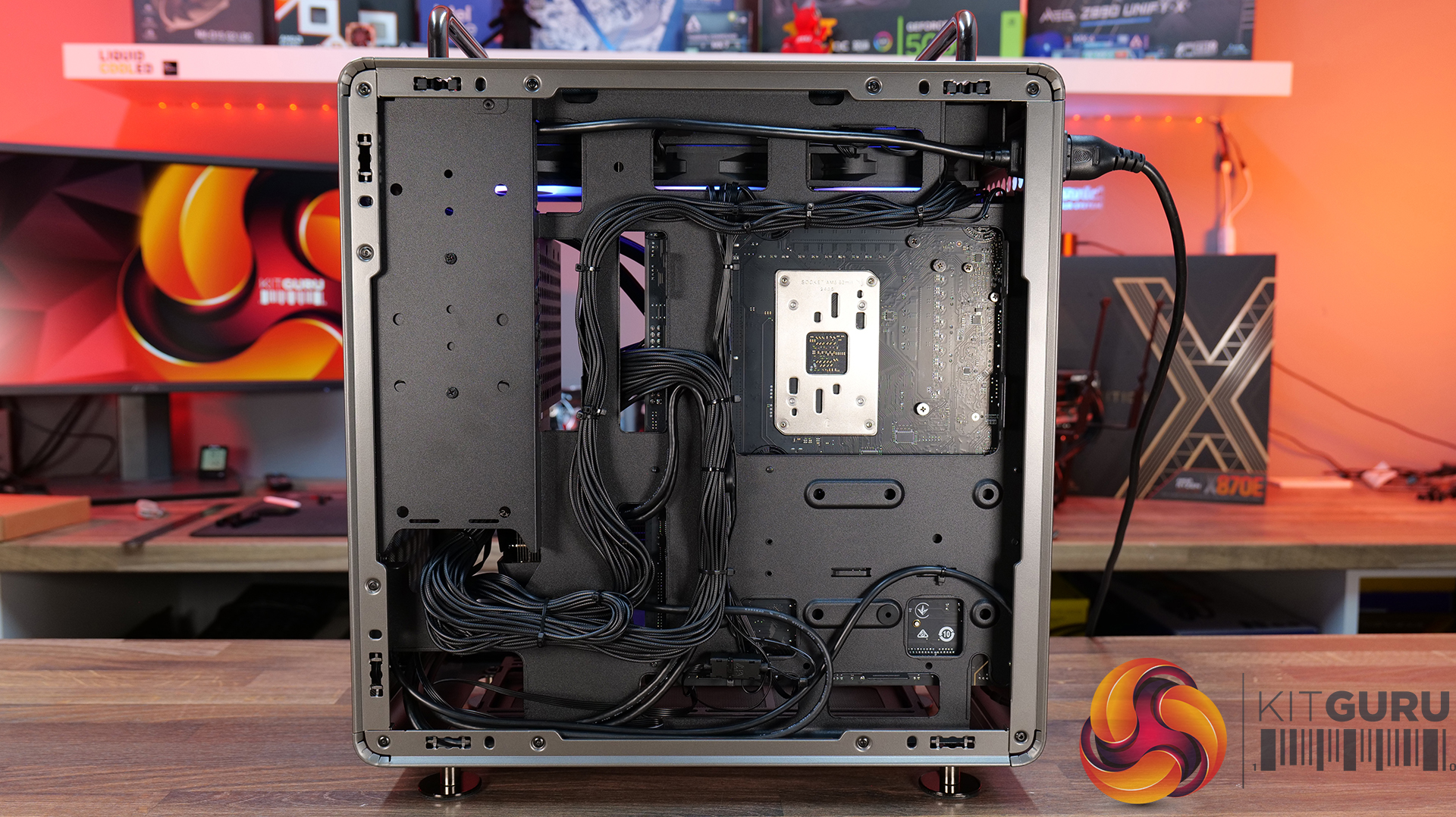
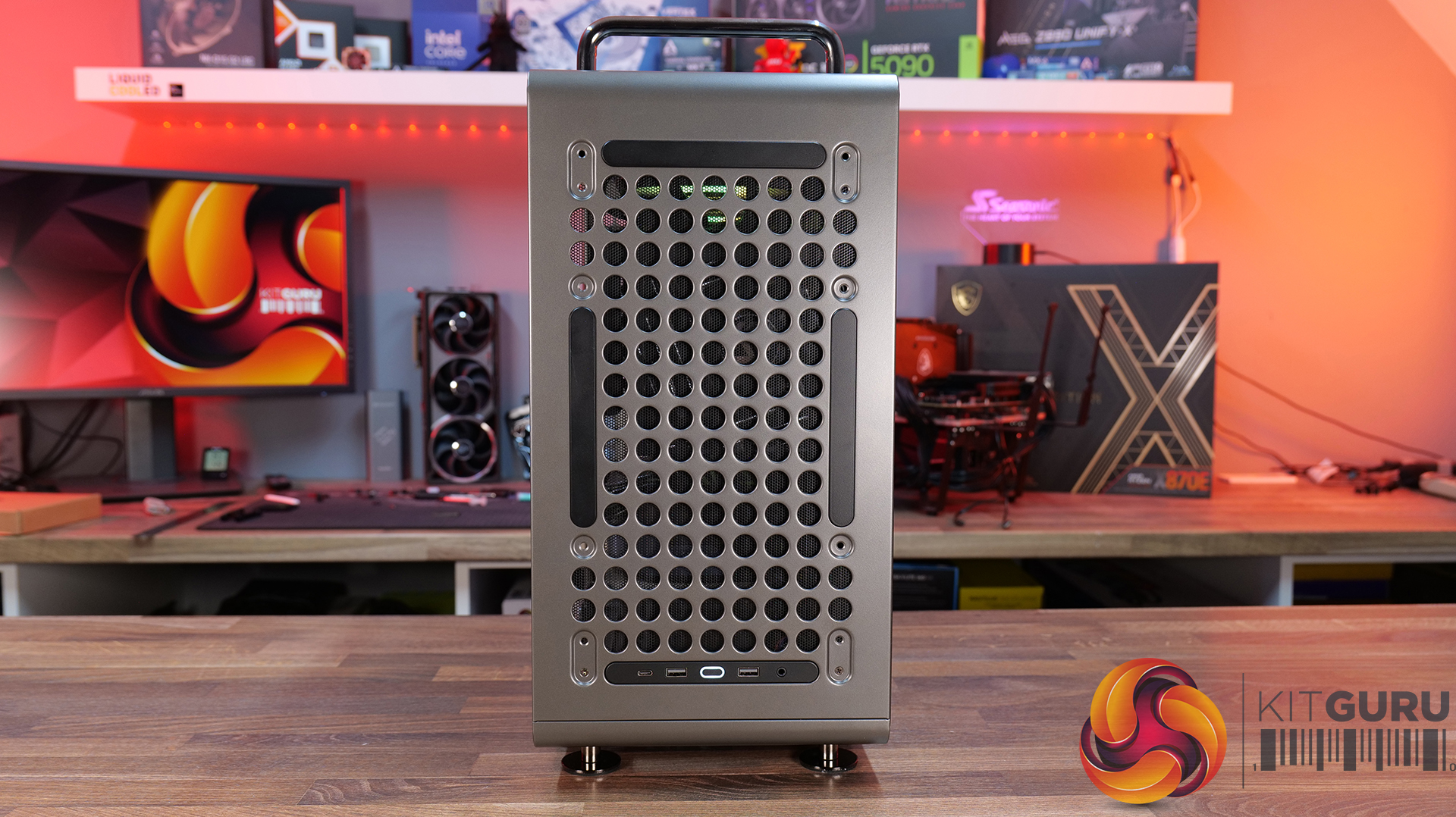
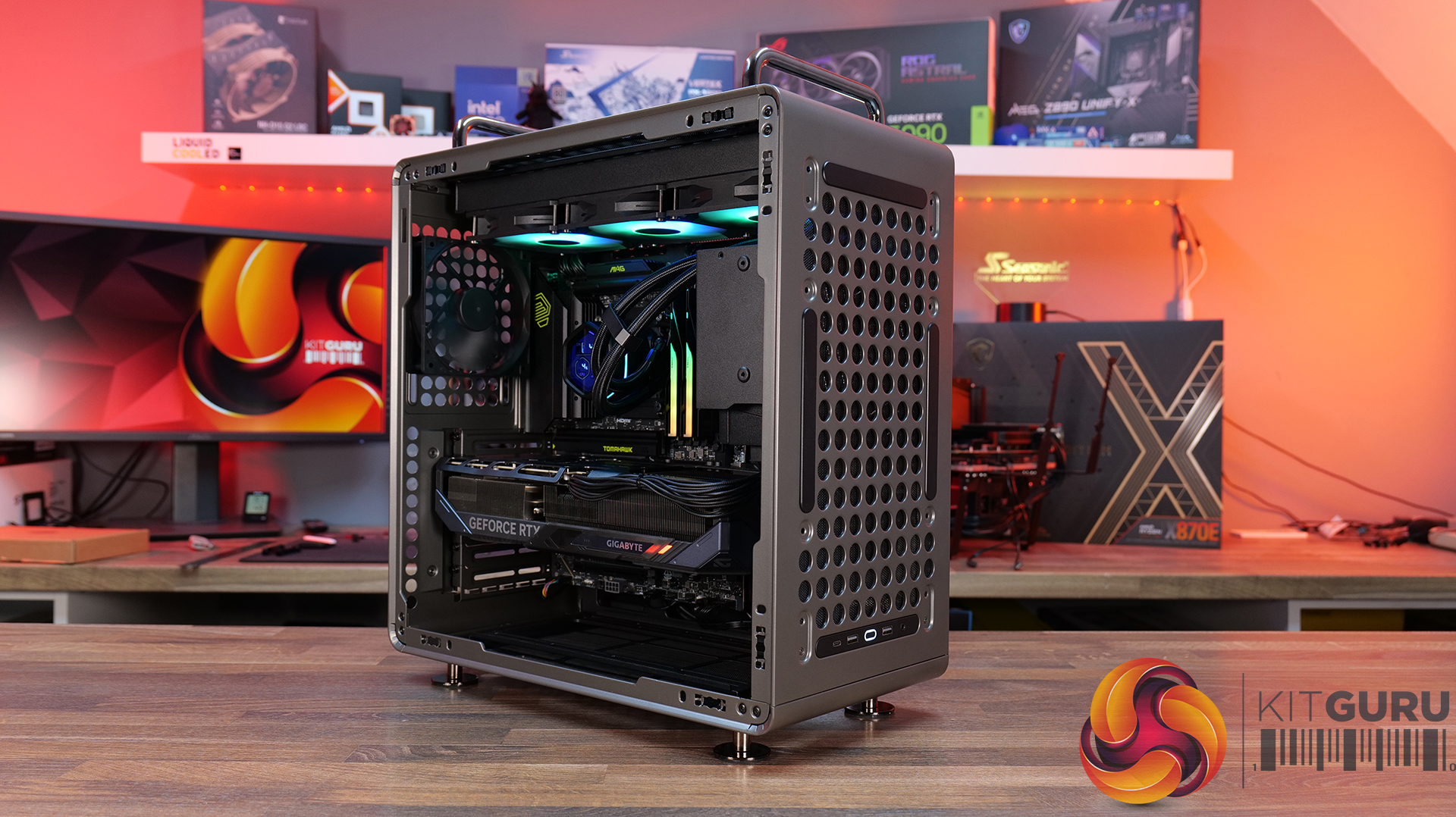
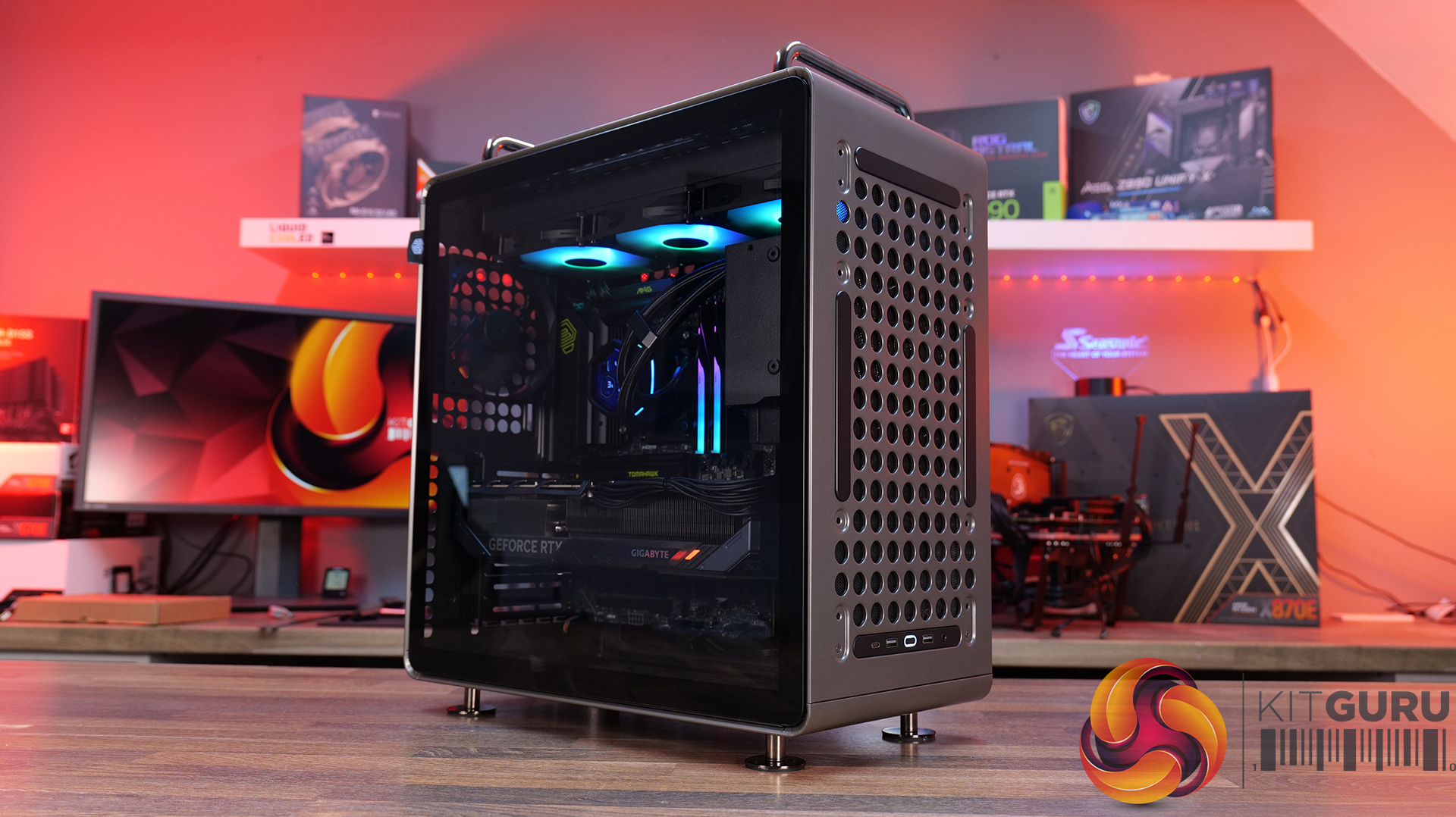
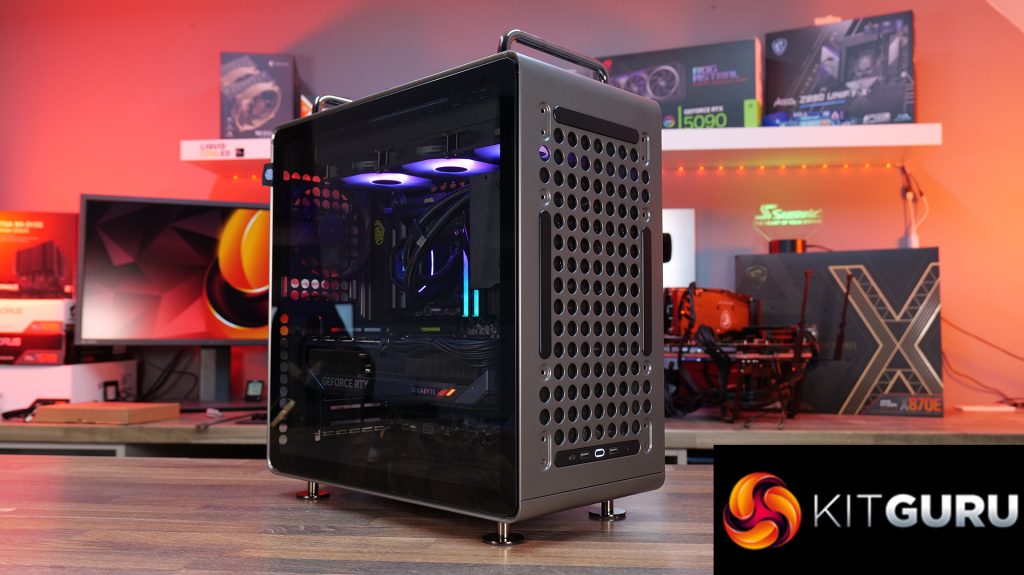
Today we're looking at the Cooler Master QUBE 540 — an ATX case that's all about flexibility and customisation. Despite its unique layout, it supports graphics cards up to 415mm long, 360mm radiators, and even E-ATX motherboards, featuring a modular design that lets you switch orientations, relocate the I/O panel and handles, and even configure the internal layout to suit your build. Cooler Master is positioning the QUBE 540 as a case for creators, gamers and DIY builders. In this review, we’ll find out if all that flexibility translates into a genuinely great PC case, or not. Let's get into it.
Timestamps:
00:47 Details / Pricing / Hardware Support
02:44 Front I/O
02:59 Removing Panels / Dust Filters
05:04 Radiator / Cooling Support
07:43 Hardware (Mobo/GPU/Storage) Support
09:05 Rear of the case
09:49 Right hand side / Cable Management
11:27 Bottom of the case
12:20 Accessories > Customisation
13:47 Thermal and Noise Testing
15:55 Smoke test
16:34 Installation thoughts
18:58 Closing Thoughts
Features:
Highly Modular Design – The QUBE 540 can be configured in multiple ways, including horizontal or vertical orientation, with repositionable handles and I/O panel locations to suit different build setups.
Built for DIY Customisation – The case is designed around flexibility, with extensive fan and radiator support, removable panels and adaptable internal layouts that allow builders to tailor the system to their own requirements.
Exceptional Hardware Compatibility – There’s Support for motherboards up to E-ATX, graphics cards up to 415mm long and multiple 360mm radiator mounting positions, so there's plenty of room for high-performance hardware.
Specifications:
Case Type: Mid Tower
Dimensions (LxWxH):5 x 225 x 492.1mm
Volume: 64L
Materials: Steel, Glass
Motherboard Support: Mini-ITX, Micro-ATX, ATX, E-ATX (Up to 280mm wide)
Reverse Connector motherboard support: No
Expansion Slots: 7
Storage bays: 3.5” x 1, 2.5” x 2
Max GPU Length: Up to 415mm (without front fan)
Max CPU Cooler Height: Up to 172mm
PSU Type: ATX/SFX Up to 200mm
Cable Routing Space: 27mm clearance behind the motherboard tray
Supplied Fans: 1 x 120mm Rear
Fan Support: Up to 3 x 120mm or 2 x 140mm (without I/O panel) (Top), Up to 3 x 120mm or 2 x 140mm (without I/O panel) (Front), 1 x 120mm (Rear), Up to 3 x 120mm or 2 x 140mm (Bottom)
Font I/O: 2 x USB 3.2 Gen 1 Type-A, 1 x USB 3.2 Gen 2×2 Type-C, 1 x 3.5mm headset combo jack
LCD Screen: N/A
Thermal Performance Testing
To simulate thermal demand, we run the Cinebench R23 multi-thread benchmark and 3DMark Speed Way stress test simultaneously in a loop for 30 minutes to load the system fully. This gives the CPU and GPU enough time to reach constant steady-state temperature. With this data, we can compare how the system handles the thermal demand and measure peak noise levels.
Thermal performance is measured with the case in various configurations, such as the default, with the tempered glass left-hand side panel removed and with the front panel removed to see how these configurations affect the CPU and GPU temperature. During testing, only stock case fans are used unless otherwise specified. All water pumps are set to maximum RPM and fans are set to a custom RPM curve by the Motherboard software/BIOS.
All temperature measurements are presented as Deltas – meaning the ambient temperature has been deducted from the CPU temperature, giving us a Delta. Data shown in the charts represents the average component temperature over the length of the test as measured by HWiNFO, and then the last 15 minutes of the data are calculated to get the average. The ambient temperature during thermal tests is between 19-20⁰C.
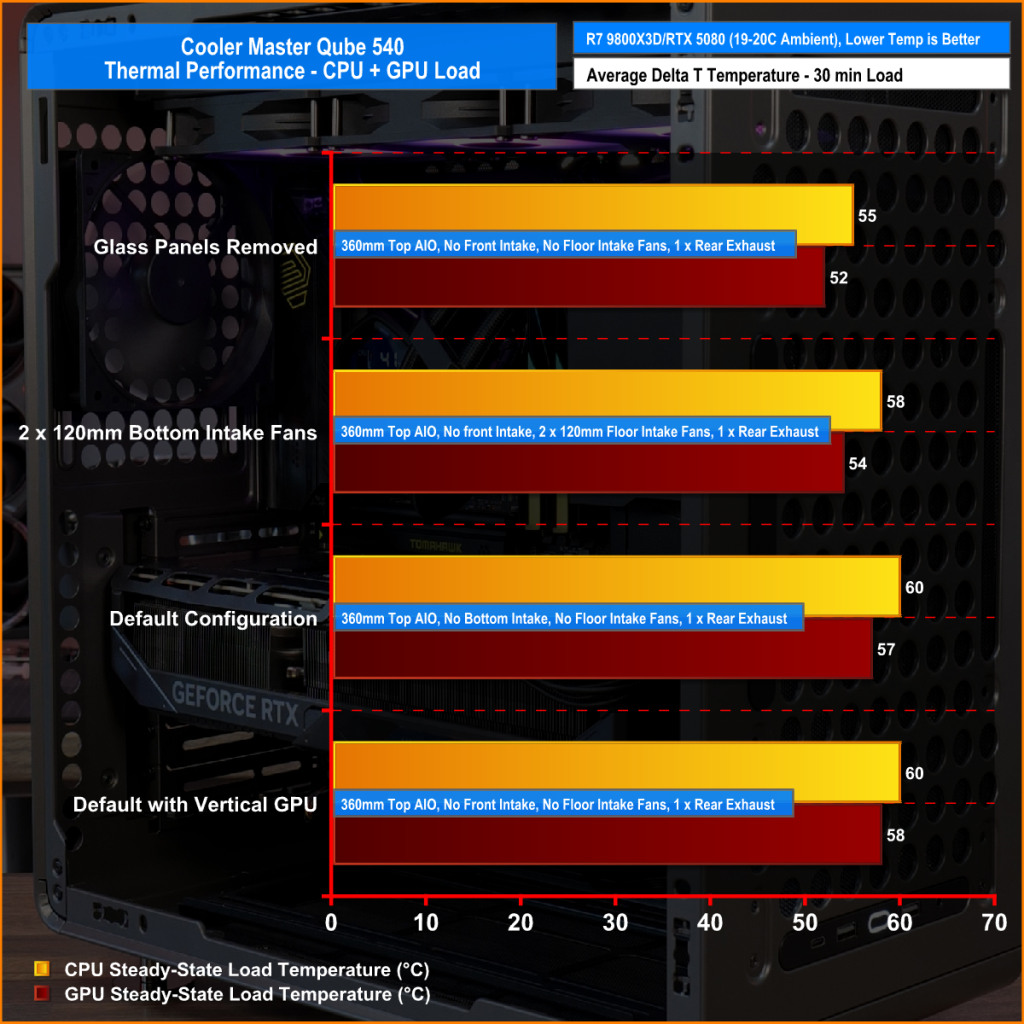
We test case thermals using a 360mm AIO as exhaust at the top and with the case in several different fan configurations. The default configuration shown in the charts is with the top 360mm AIO cooler, a single 120mm rear exhaust fan and with all case panels installed.
The QUBE 540 delivers respectable results overall, although airflow is restricted compared to a fully high-ariflow configuration. Removing the glass side panel from our test system records the lowest temperatures of 55°C over ambient on the CPU and 52°C on the GPU while running the case in its default configuration sees temperatures rise slightly to 60°C over ambient for the CPU and 57°C for the GPU, which is still a solid result.
Adding a pair of 120mm bottom intake fans shaved 2 – 3°C from both CPU and GPU temperatures, suggesting there is some benefit in adding bottom fans, though the gains are quite small. Switching to a vertical GPU has no impact on CPU thermals, while GPU temperature increases by just 1°C
Noise Output
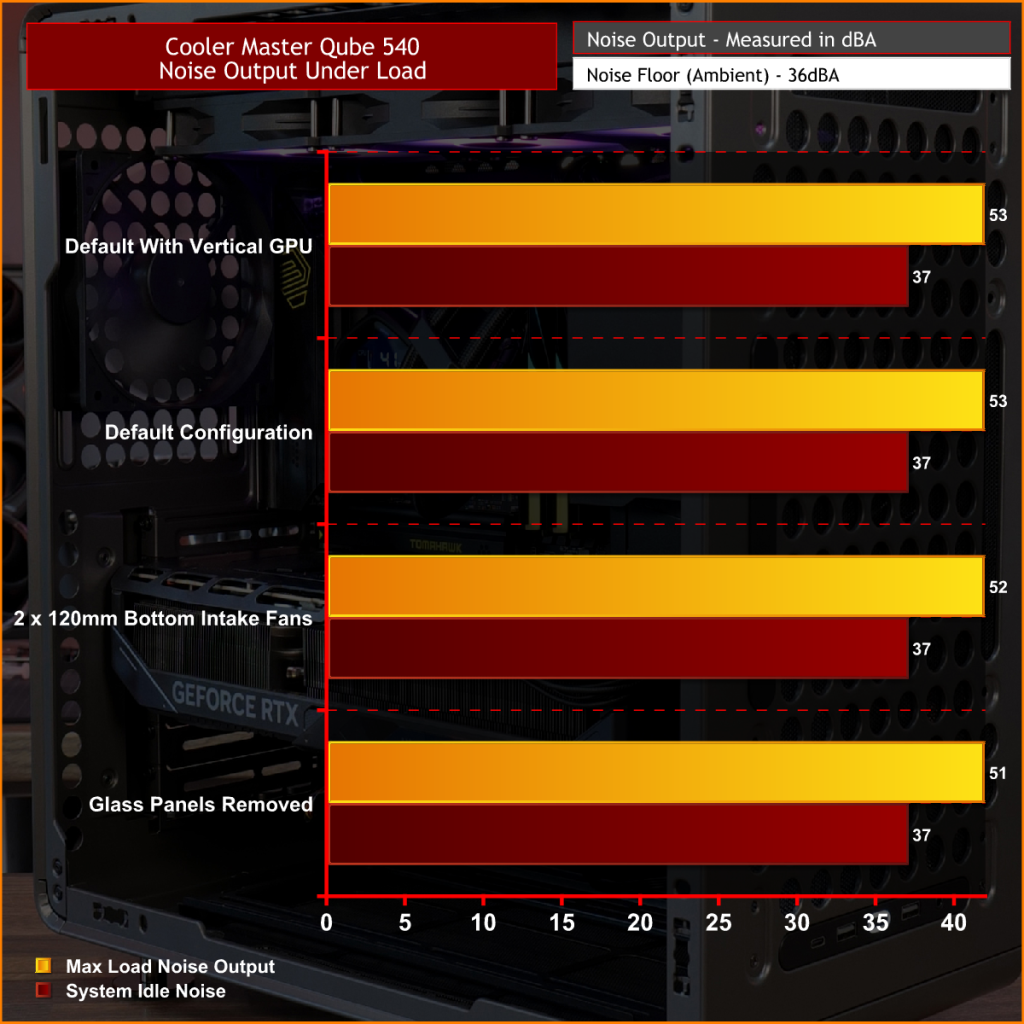
At idle, noise output remains unchanged at 37dBA regardless of fan layout or GPU orientation. Under full load, the default configuration and vertical GPU setup both record 53dBA max noise, while adding a pair of 120mm bottom intake fans reduces noise output to 52dBA. Removing the glass panels yields the lowest recorded figure of 51 dBA due to cooler temperatures and lower fan speed, though the difference is small enough that it would be difficult to notice in normal use.
Overall, the results suggest that the QUBE 540 has a good balance between cooling performance and acoustics.
The Cooler Master QUBE 540 is a refreshing addition to the PC case market that currently feels overcrowded by high-airflow mesh-fronted towers or glass-covered dual-chamber “fish tank” designs. Rather than challenging either of those styles, Cooler Master has created something that feels genuinely different. The QUBE 540 combines a compact ATX footprint with an industrial-inspired look with an emphasis on flexibility, resulting in a chassis that stands out from the crowd while still appealing to mainstream enthusiasts.
The biggest selling point is customisation. Few cases on the market offer this level of configurability, with internal layout options, horizontal or vertical orientations, repositionable I/O panels, and support for a range of 3D-printable accessories. It encourages customisation, allowing builders to tailor the case to their exact needs. Whether you're looking to optimise airflow, create a unique showcase system or simply just build something different, the QUBE 540 provides options that most mainstream cases in this price range do not.
Hardware compatibility is impressive too. Despite its unorthodox layout, the QUBE 540 supports large E-ATX motherboards, graphics cards up to 415mm long, 360mm radiators and multiple fan layouts, making it suitable for high-end gaming or workstation builds. Thermal performance is decent too, it can keep temperatures well under control across most configurations. It's not a class-leading airflow case, but cooling is more than adequate for modern high-performance hardware.
There are some compromises, however. Front intake options are somewhat limited compared to traditional high airflow designs, and the PSU location creates a few restrictions when it comes to internal layout, GPU installation and airflow optimisation. Even so, these are minor drawbacks. Cooler Master deserves credit for bringing something genuinely interesting to a market saturated by the usual high airflow and dual-chamber designs. For users who value flexibility, customisation and a distinctive look over outright thermal performance, the QUBE 540 is an easy case to recommend.
The Cooler Master QUBE 540 is available to purchase now from Amazon UK Priced at £82.92 HERE.
Pros:
A refreshing change from the usual all-mesh or glass-front cases.
Loads of configuration and customisation options.
Good hardware support, even with the slightly unorthodox layout.
Very easy to swap layouts and orientation.
Cons:
Front fan intake is limited.
There are some compromises depending on the PSU position.
KitGuru says: Even though the QUBE 540 is a relatively simple design, the ease of changing layouts and orientations, great hardware support and the massive customisation and distinctive looks make it a refreshing change for PC builders.
Lian Li has announced the B4-mATX, a 21.3-litre small form factor chassis co-developed with Dan Cases. Now available, the compact enclosure supports mATX motherboards and can be oriented either horizontally as a desktop unit or vertically as a space-saving tower.
The B4 case rotates 90º into a vertical orientation, reducing the desktop footprint by 30%. A rotatable AC inlet adjusts to both configurations, turning outward for cable access or inward to absorb excess length. A swivelling cable bracket below the PCIe slots keeps the rear I/O flush against the case, offering up to 52mm of connector clearance. Lian Li provides front-panel options in mesh or real wood (walnut or beech) across black or white finishes.
The chassis ships with two pre-installed 120x120x15mm slim exhaust fans on a removable bracket. It supports graphics cards up to 358mm across four expansion slots, and CPU coolers up to 162mm tall, or 168mm tall with the side bracket removed. Dedicated brackets fit an SFX or a 140mm ATX power supply. Using an SFX unit enables side radiator compatibility up to 360mm, while an ATX model limits it to 240mm. Drive options support a 3.5-inch HDD or 2.5-inch SSD at the bottom, plus a 2.5-inch SSD at the front.
An optional B4-mATX Vertical AeroDeck accessory adds tempered glass panels and expands capacity by up to three 120mm or two 140mm fans. Pricing starts at $69.99/€69.99 for the black Mesh version and ranges up to $89.99/€89.99 for the white Wood model. The AeroDeck costs $29.99/€29.99.
KitGuru says: The dual-orientation design, relatively low price, and inclusion of real wood aesthetic options make the B4-mATX a highly versatile entry into the SFF case market.
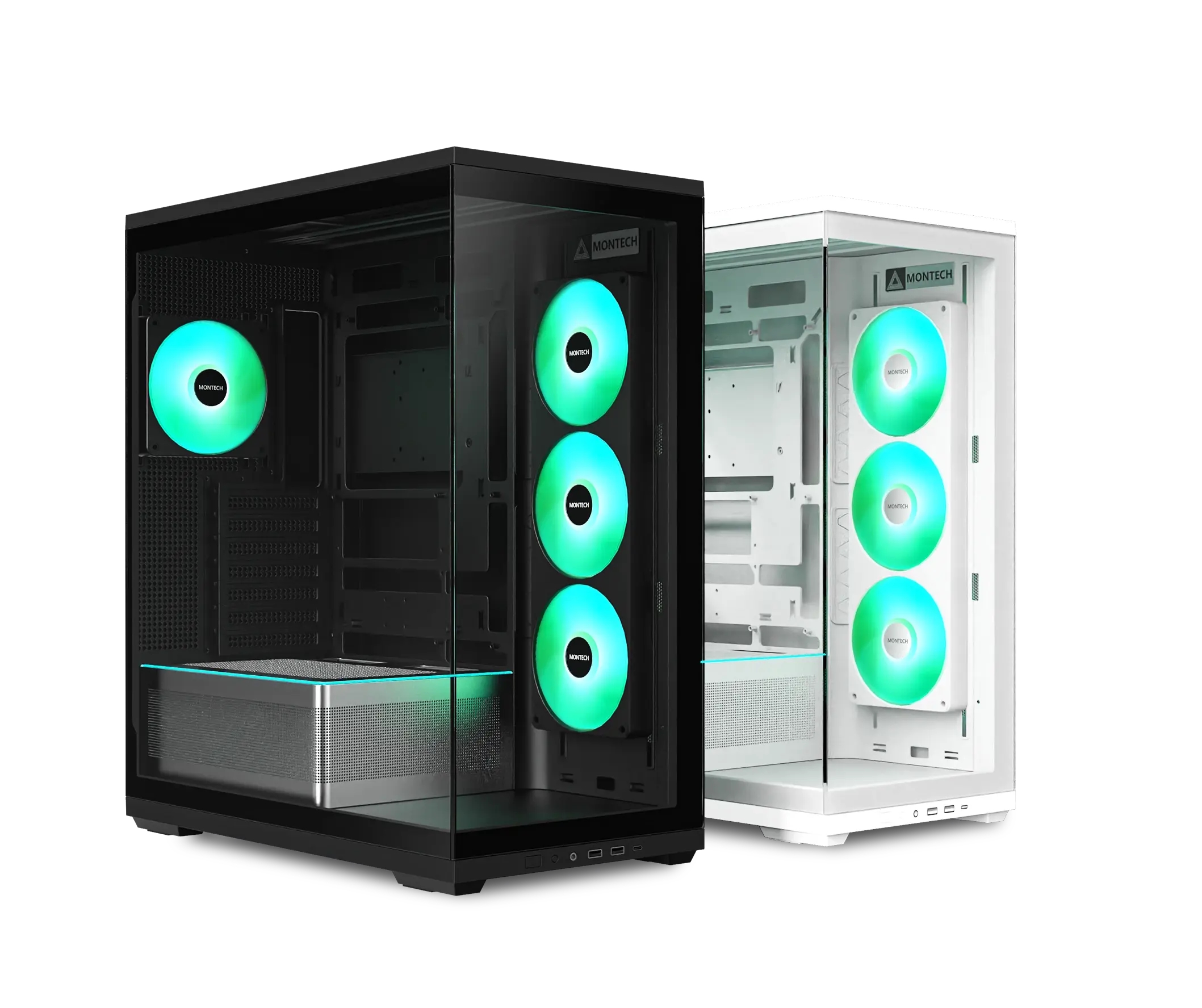
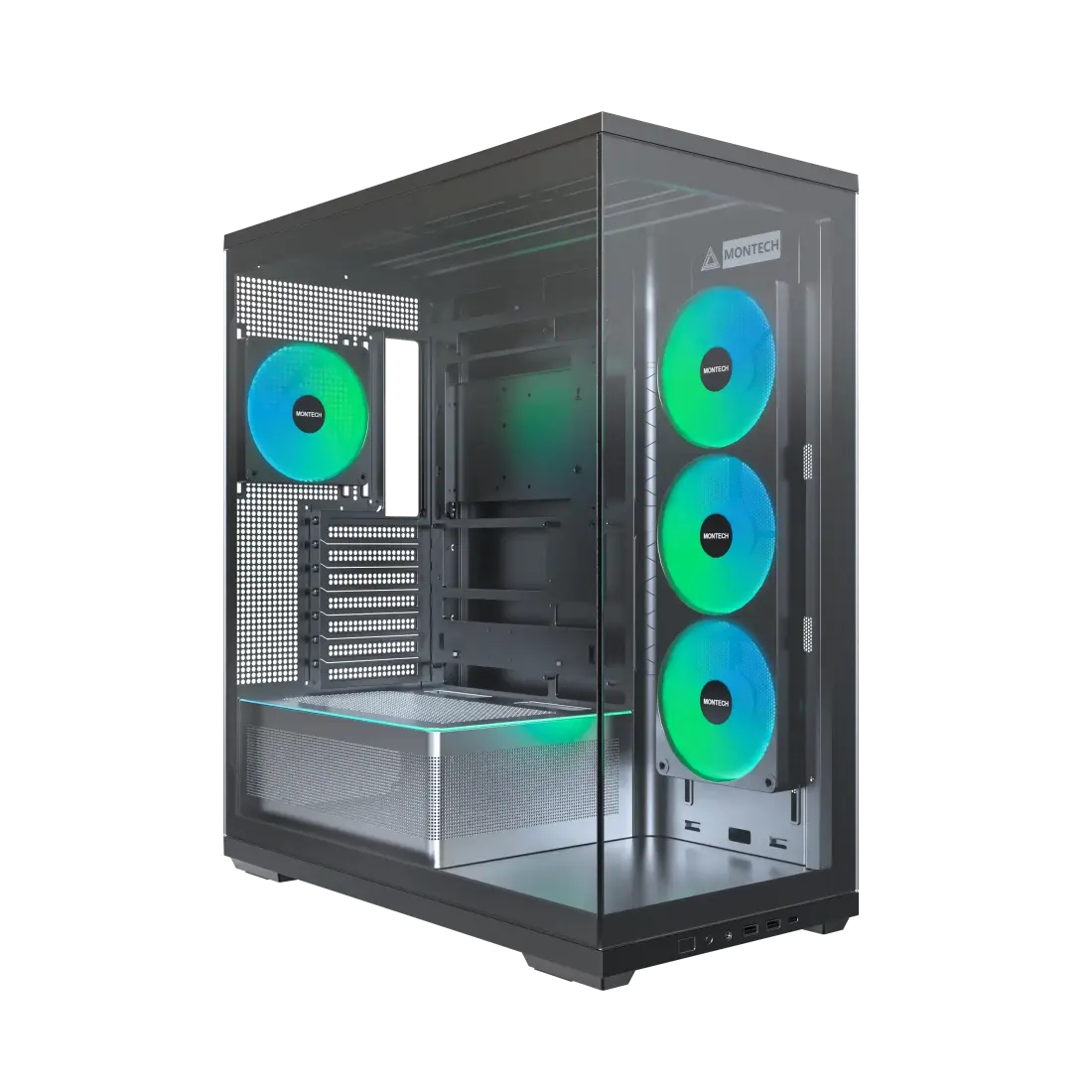
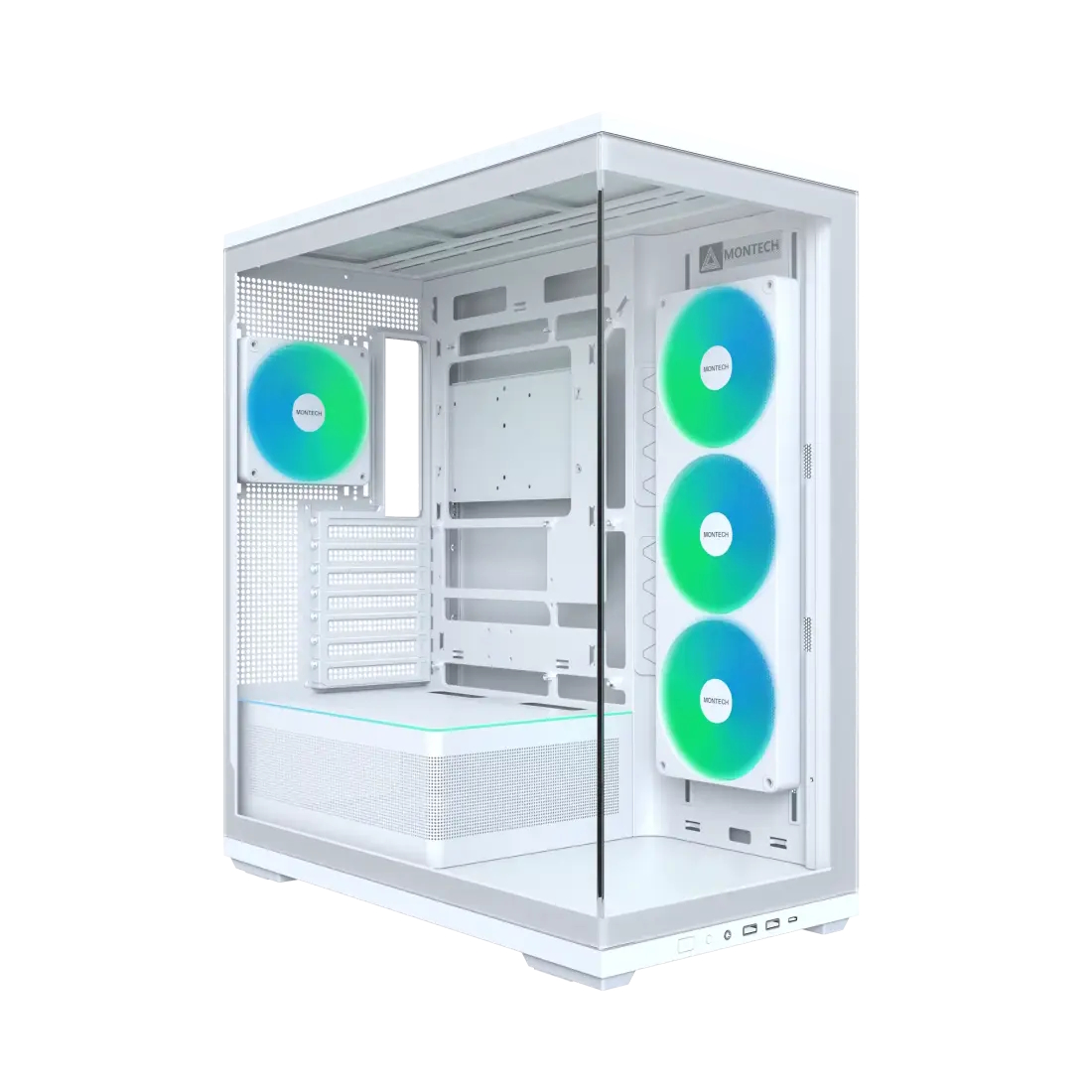
Montech has launched the TG3, a budget-friendly ATX fish-tank style case featuring a tiered bottom layout, back-connect motherboard support, and pre-installed unibody fans.
This new TG3 case comes in black or white finishes and is tailored for performance systems with a minimalist exterior design. It includes a spacious interior that offers clearance for GPUs up to 430mm long and compatibility with back-connect motherboards. Ambient ARGB lighting (28 LEDs) is also integrated directly into the PSU shroud to enhance the build's overall visual footprint.
Cooling out of the box relies on a pre-installed Montech GF360 U REV side intake and a GF120 U rear exhaust (140mm fans are also compatible). The side intake uses a unibody, single-frame design that should reduce resonance and simplify cable routing. Additionally, users can mount up to 3x 120/140mm fans on top and two 120mm fans on the PSU shroud. Radiator cooling is limited to 240mm on the side intake, but the top panel supports up to 280/360mm variants.
The front I/O is quite decent for such a cheap case, offering the typical power/reset buttons, 2x USB-A 3.0 ports, a USB-C port, and a headset audio jack. The Montech TG3 is now available for $59.
KitGuru says: Offering back-connect motherboard compatibility and unibody fans at such a low price point makes the TG3 a highly competitive option.
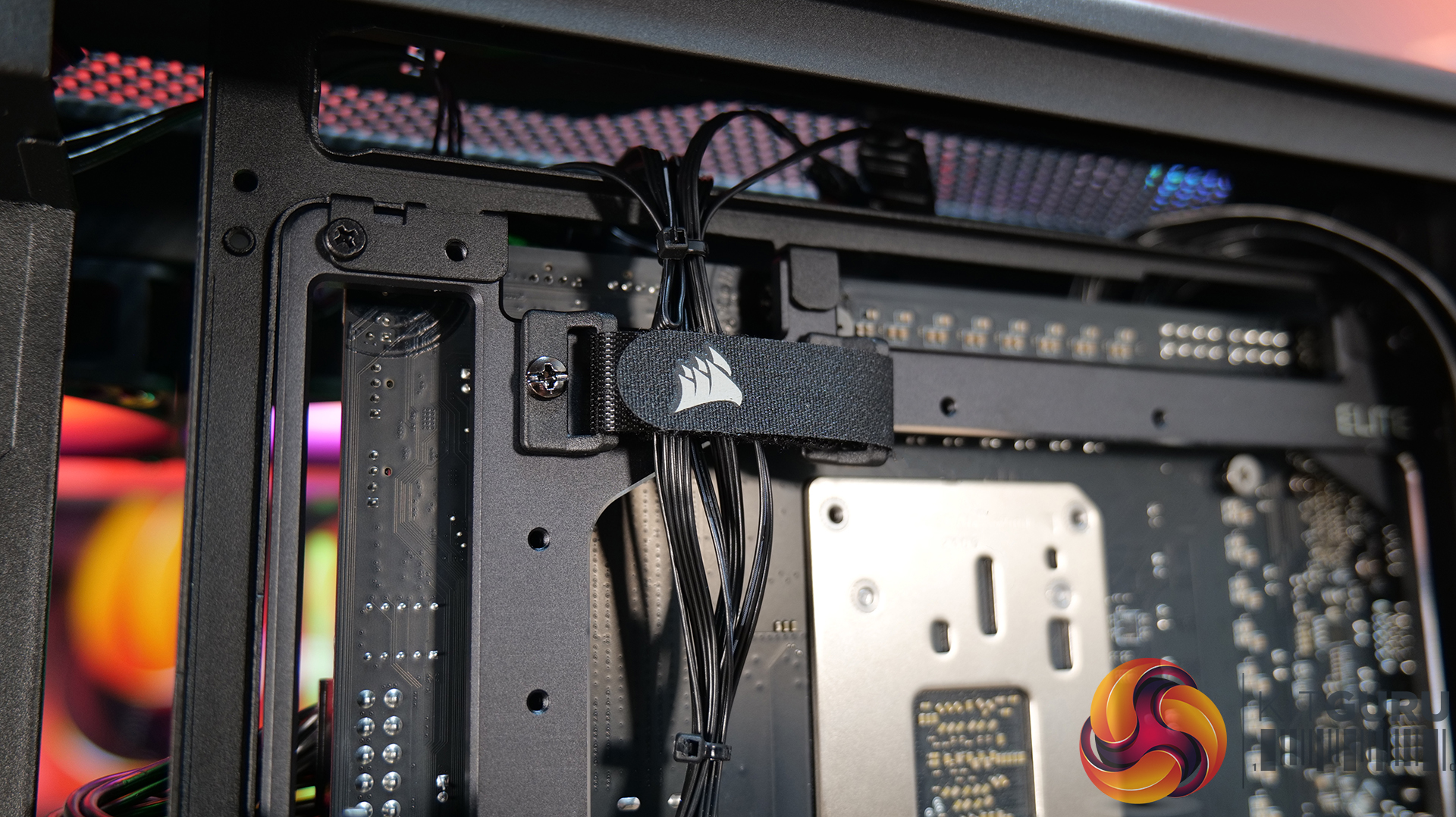
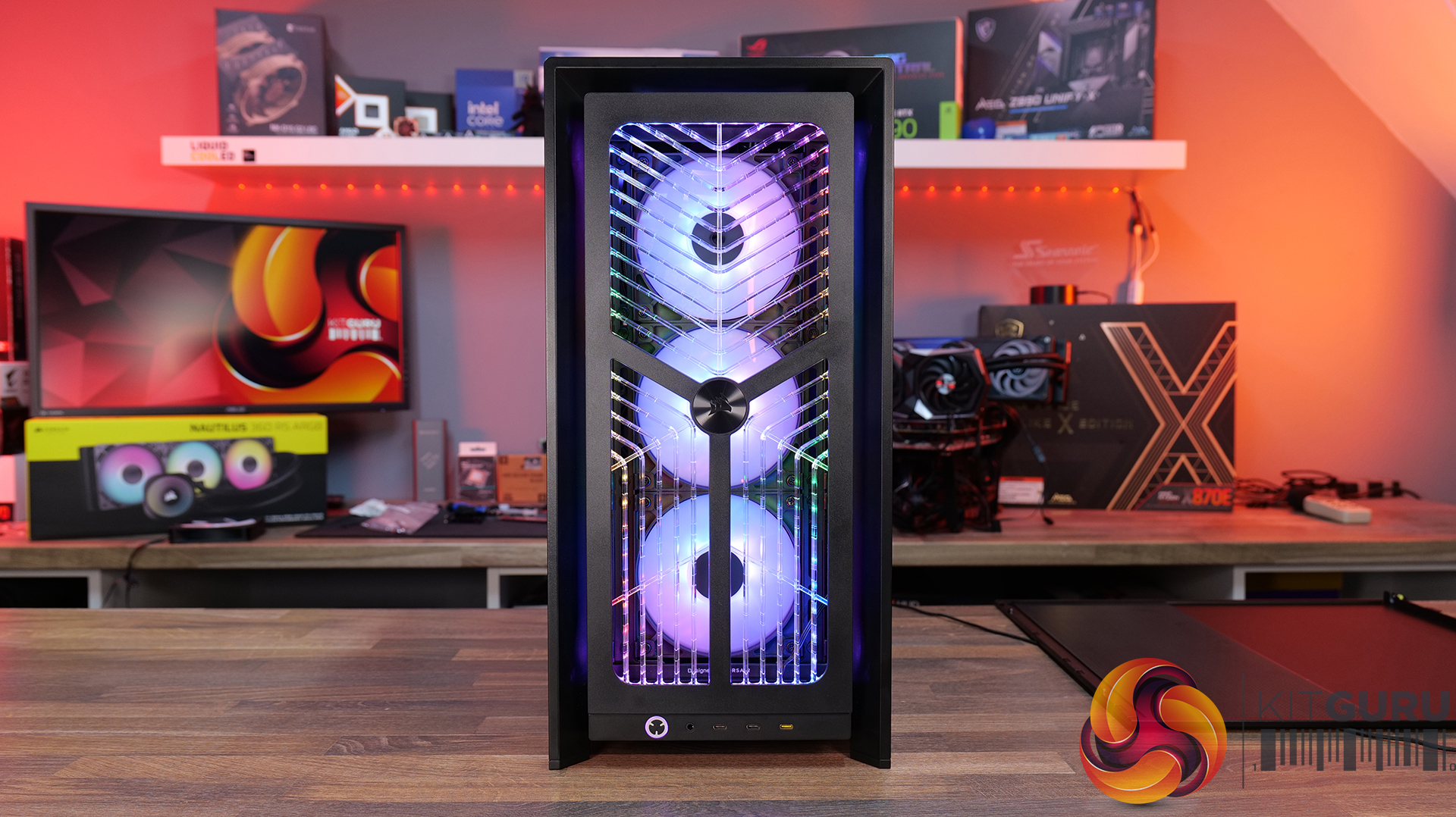
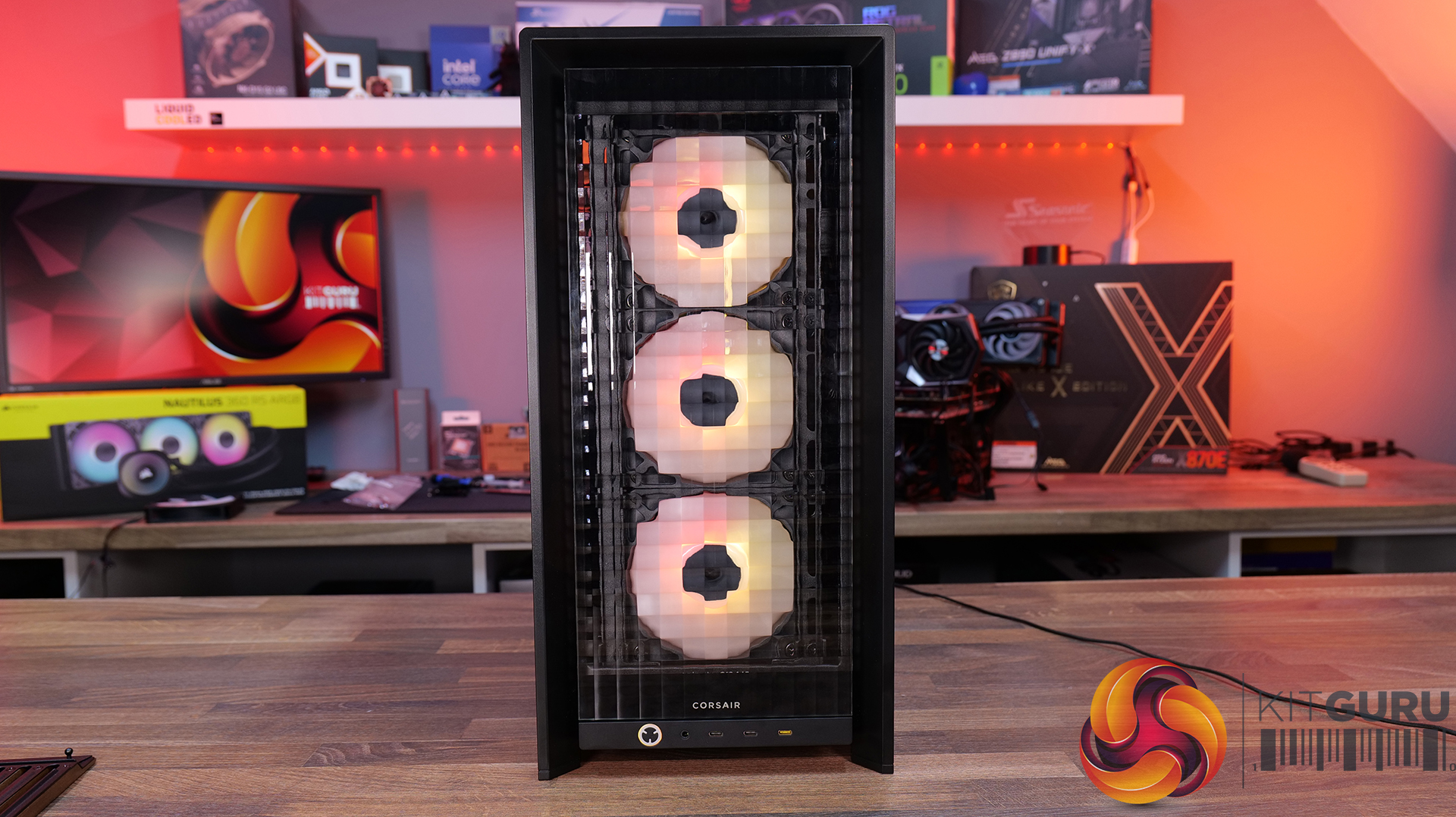
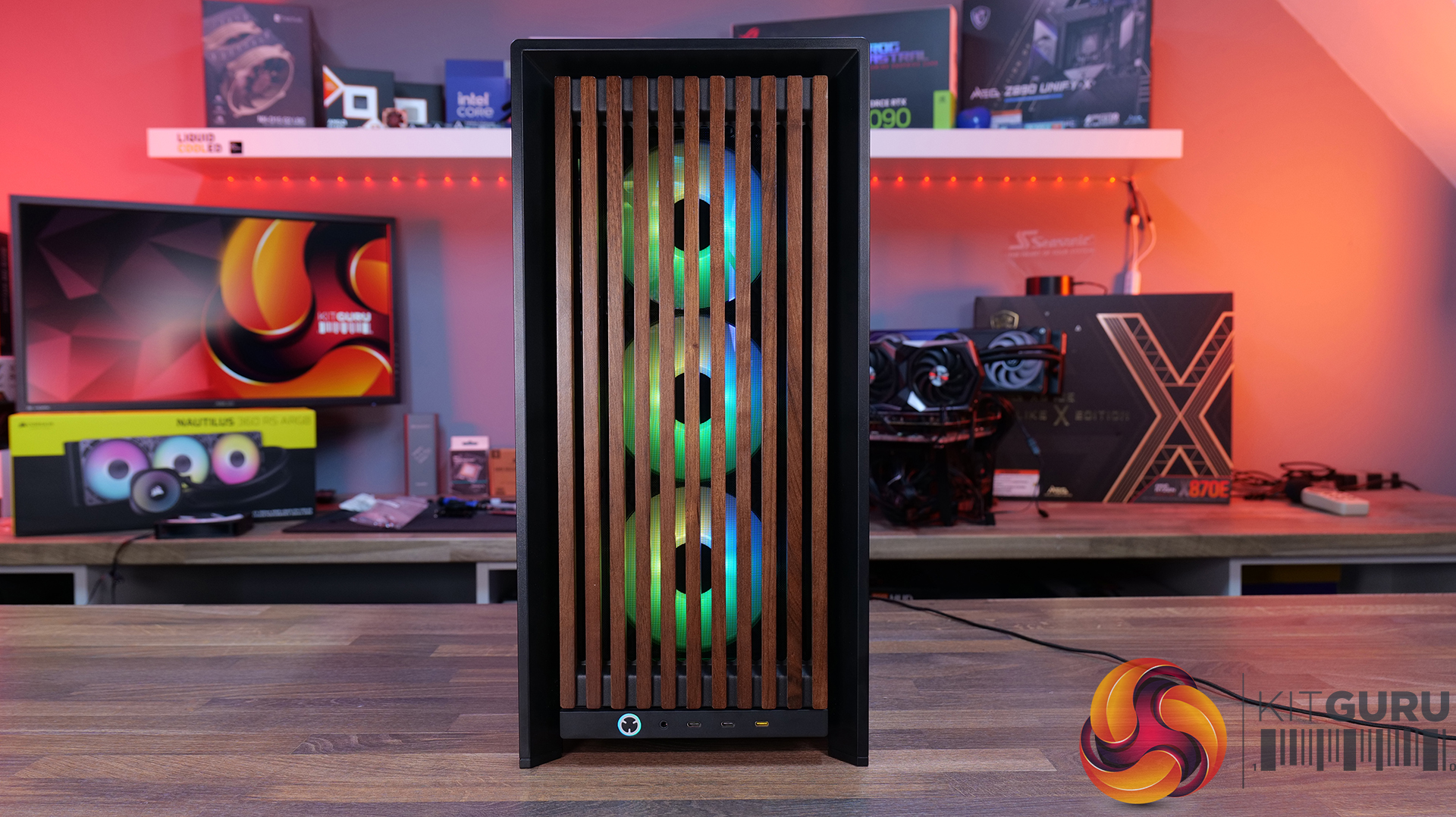
Today we’re looking at the new accessory ecosystem for the Corsair Frame 4000 case series. I reviewed theFrame 4000Dabout a year ago when Corsair first introduced its modular chassis design, now the company is expanding that idea with a range of upgrade parts and customisation options. New accessories include alternative front and side panels, replacement motherboard trays, a redesigned power supply shroud, plus an updated front I/O panel with improved USB connectivity. Corsair is clearly pushing the Frame platform as something you can maybe evolve rather than replace outright… but how useful are these upgrades, and are any of them worth buying? Let’s find out.
Timestamps:
00:00 Start
00:56 Accessories Overview
01:52 Alternative Motherboard Trays
03:33 Front Panel Options
08:18 Side Panel Options
13:43 Alternative Power Supply Shroud
14:27 Front I/O Panel (ELITE)
15:53 James' Thoughts
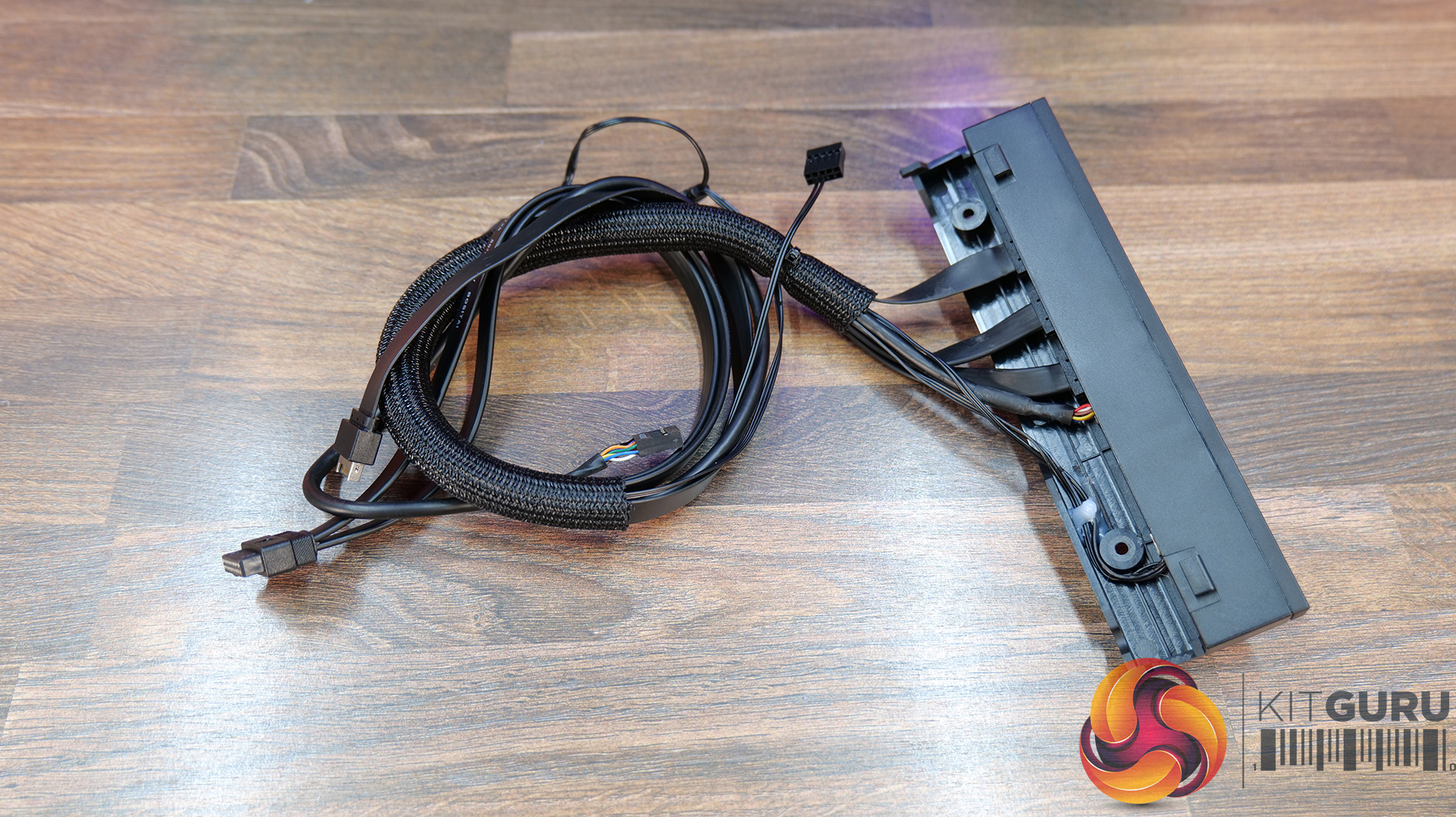
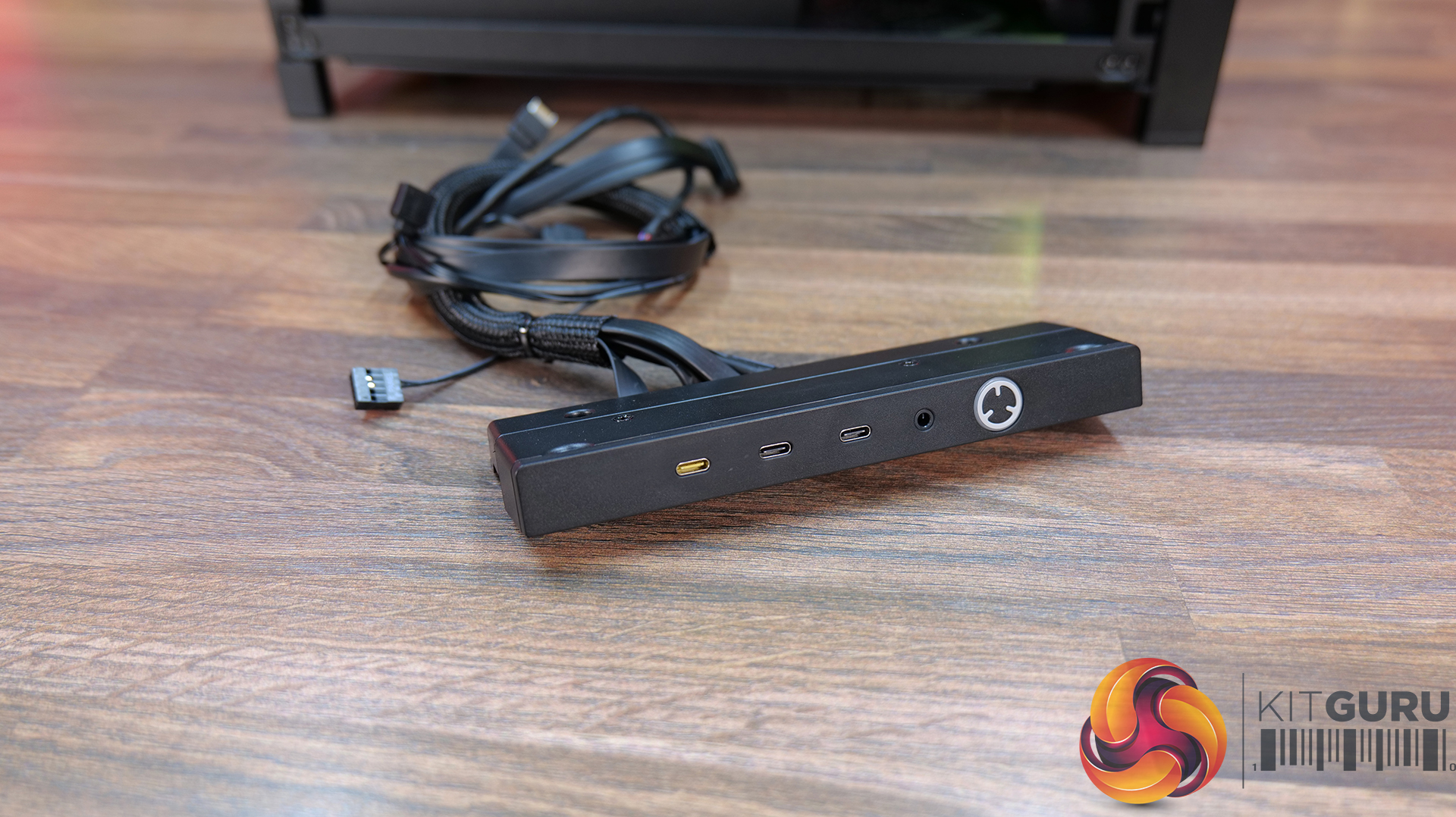
Elite Front Panel I/O: Comes with 3 x USB Type C Ports (1x USB 3.2 Gen 2×2 Type-C 20Gb/s port and 2x USB 3.2 Gen 1 Type-C 5Gb/s ports) and a swappable MX-Style Green mechanical power button. The standard Front I/O comes with 1 x USB Type-C port and 2 x USB Type-A ports.
Motherboard Tray Options:
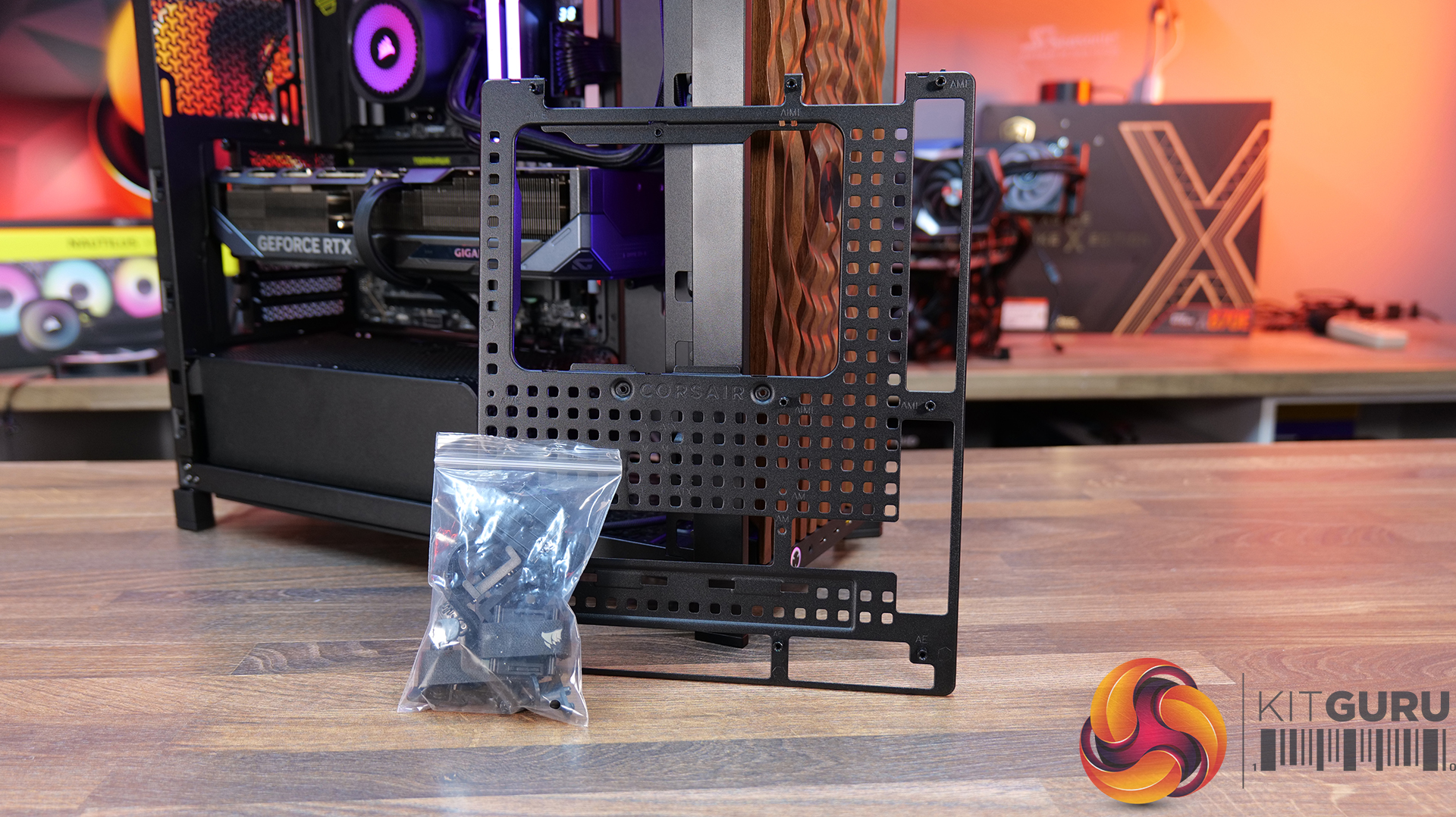
RapidRoute 2.0 Motherboard Tray – A Pegboard motherboard tray designed to make cable management easy, allowing the user to move and rotate the ratcheting cable ties for customised cable management.
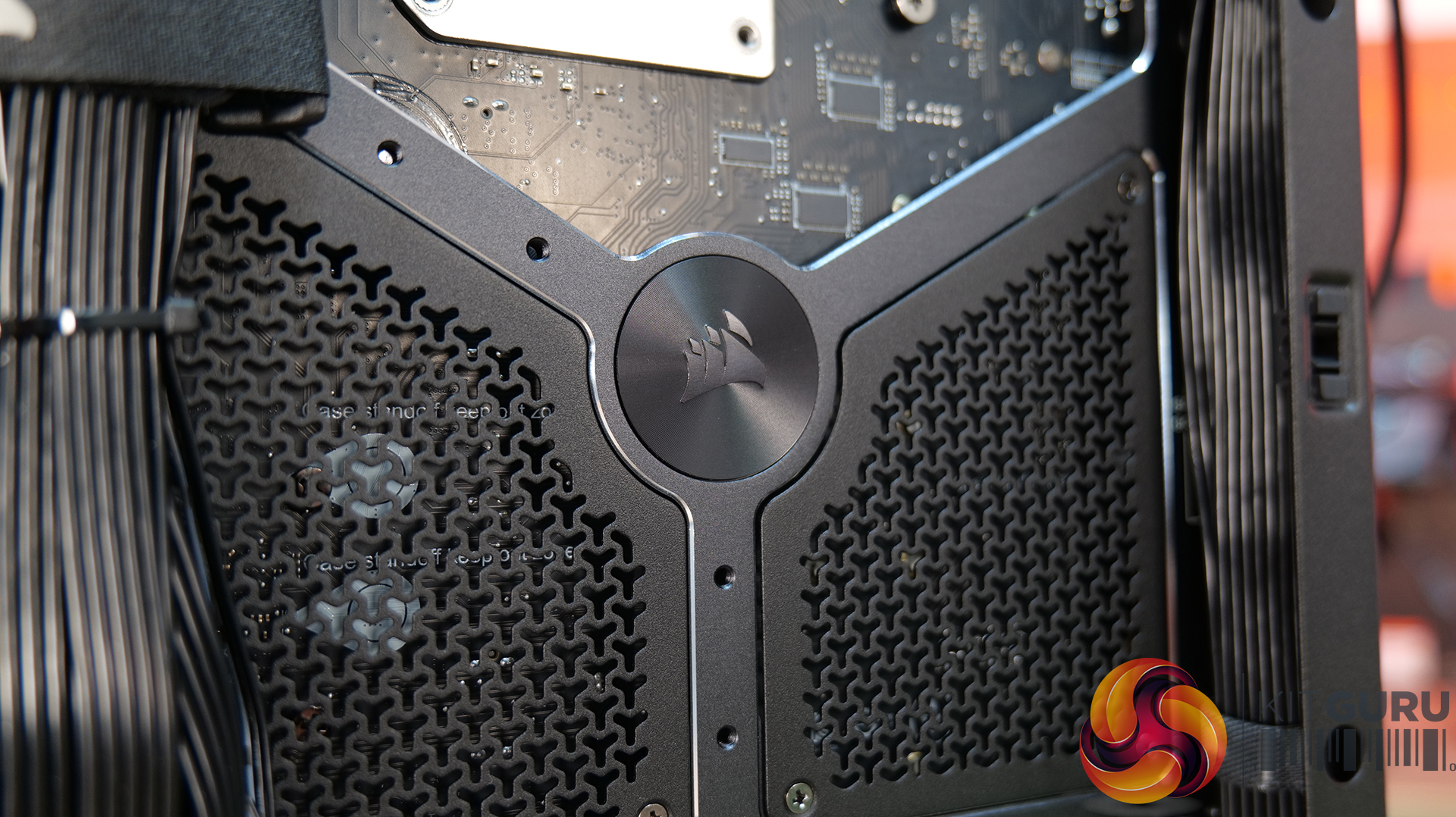
ELITE Motherboard Tray – Meteorite Aluminium – Premium motherboard tray made from a single piece of aluminium, high rigidity and light weight with diamond cut edges – Supports E-ATX, ATX, Micro ATX, including reverse connector boards.
Front Panel options:
RGB FLOW Front Panel – High air flow front panel with built-in RGB lighting -completely different look from the stock 3D-Y design.
Flat Glass Front Panel – Solid glass for showing off front fans.
Pixel Glass Front Panel – A full glass panel that allows unobstructed RGB lighting and creates a pixelated visual.
Wood Front Panel – Made using real FSC certified wooden slats for a natural look, but still retaining great airflow – available in black/walnut or white/oak.
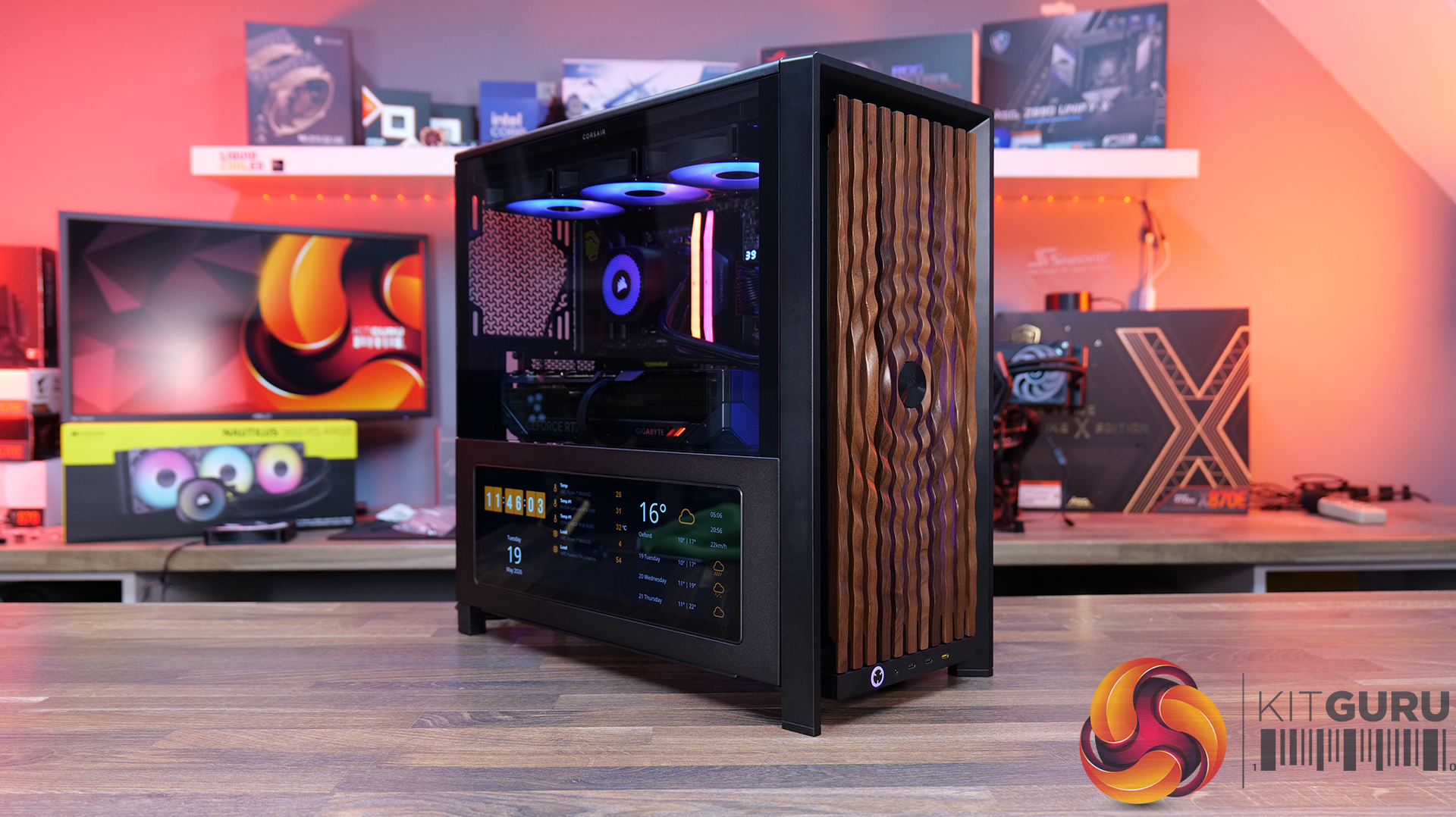
ELITE Wood Front Panel – again made from fsc certified wooden slats with a wavy parametric design and a central Corsair logo – also available in black/walnut or white/oak.
Side Panels Options:
Full Glass Side Panel – ideal if you want to show off your whole system; you can even run it with the PSU shroud completely removed for a more retro look and to show off your power supply.
Flat steel Side Panel – if you don’t want to see inside at all.
Cold Air Intake Kit – 2/3 glass and a fan bracket for 3 x 120mm fans.
LCD Mounting Kit – 2/3 glass and a slot to fit the Xenon Edge 14.5” LCD touchscreen – plus all cables for internal connectivity.
PSU Shroud:
Compact PSU Shroud – ideal for pairing with the tempered glass front panels to show off your build. Mesh design with 2 x 120mm fan mounts on top. The standard 4000D/X case comes with a full-length power supply shroud.
KitGuru says: There's a decent range of accessories to fit most users' budgets, but if you want the full high-end, premium look with the Xenon Edge display its going to work out quite expensive. But if your taste of PC cases is all about aesthetics, it might be a price worth paying?
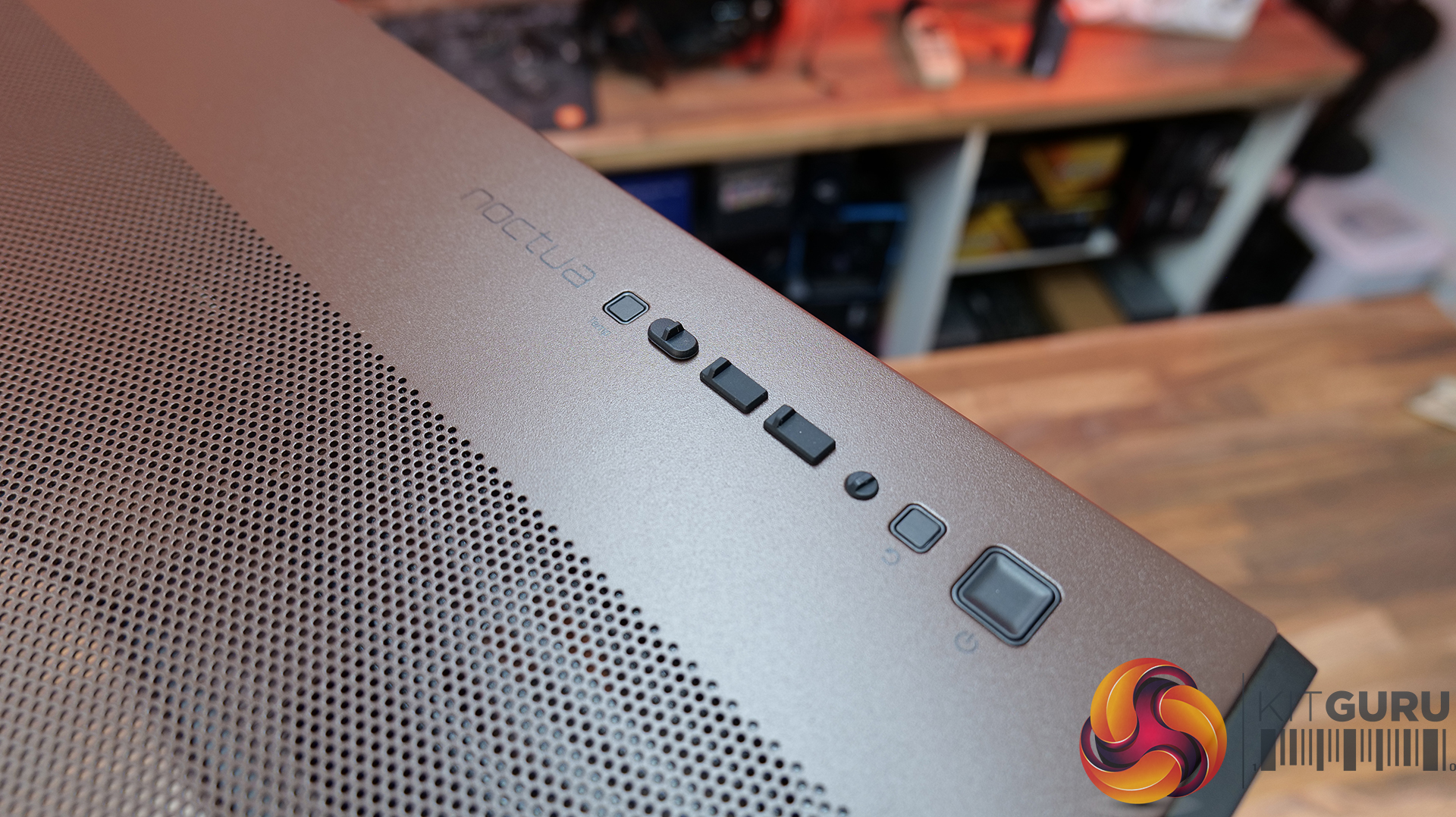
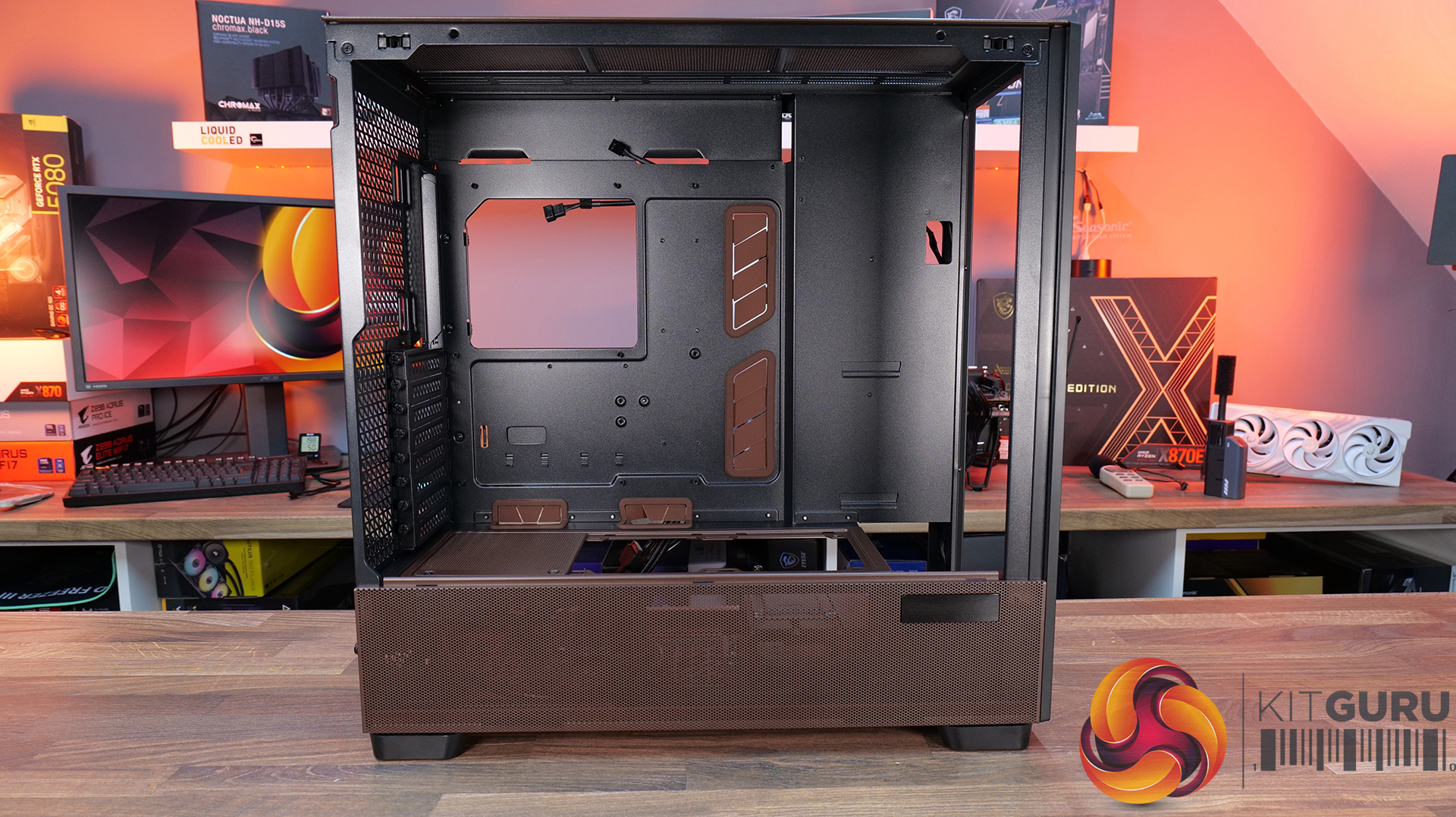
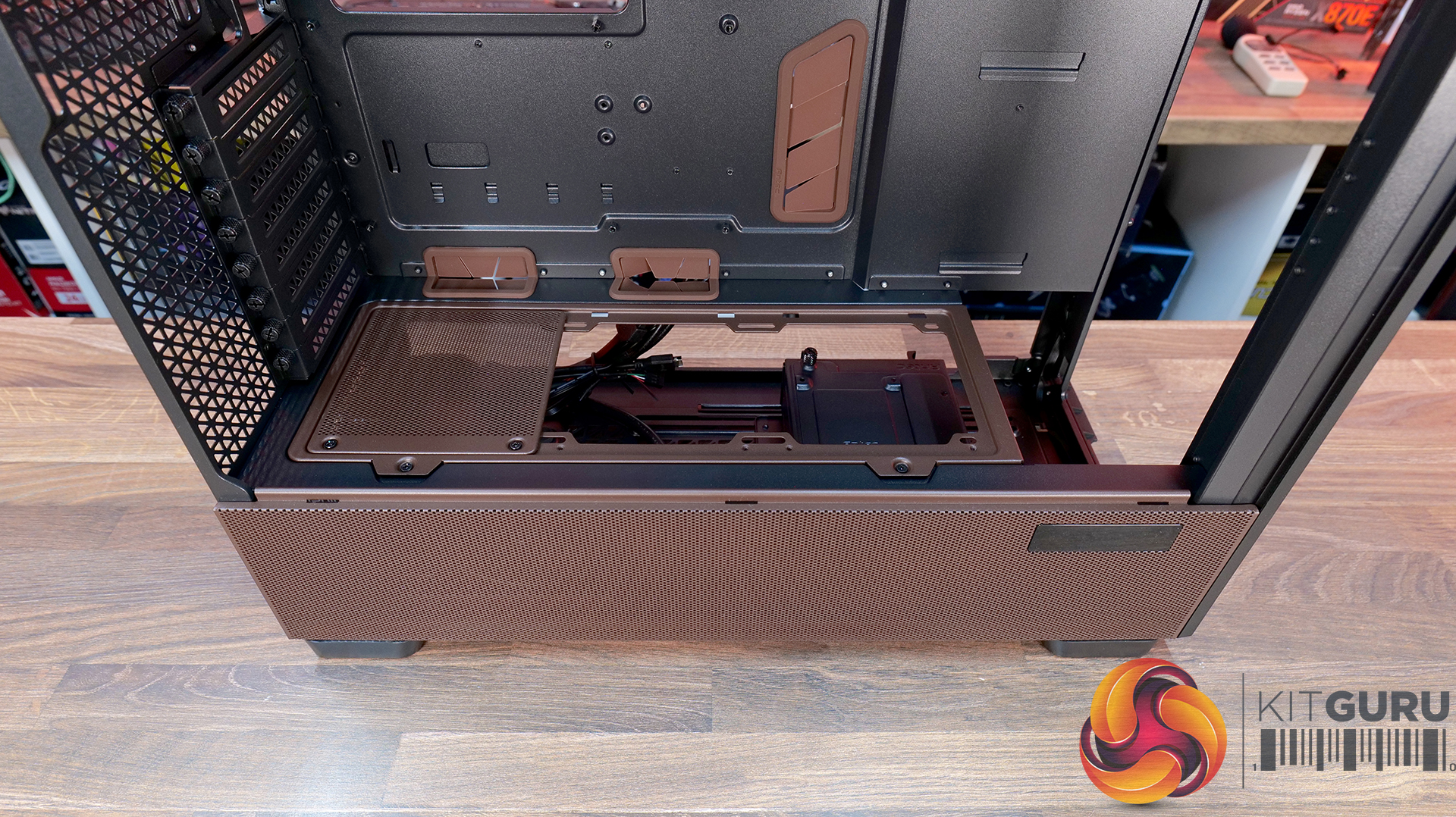
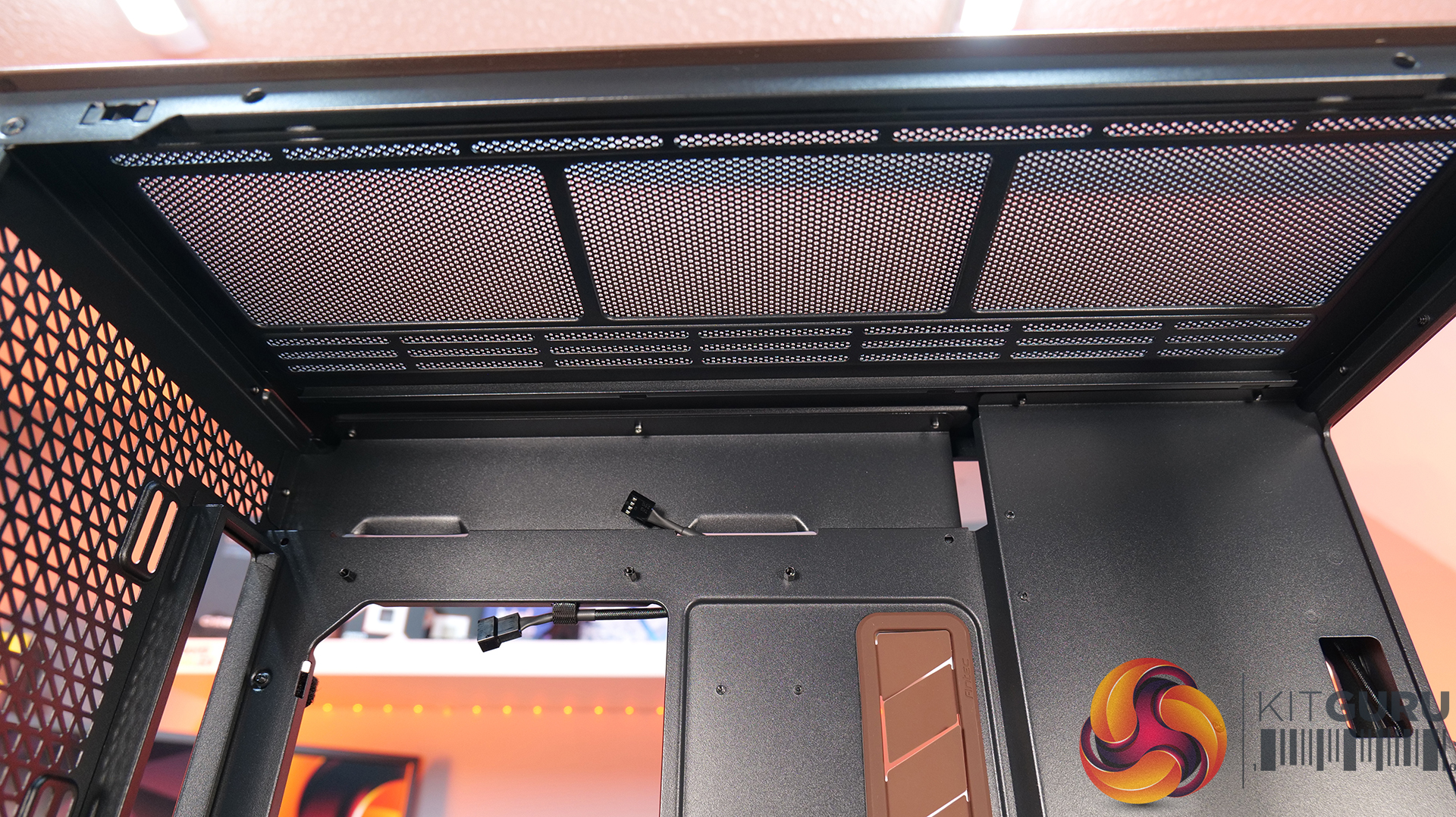
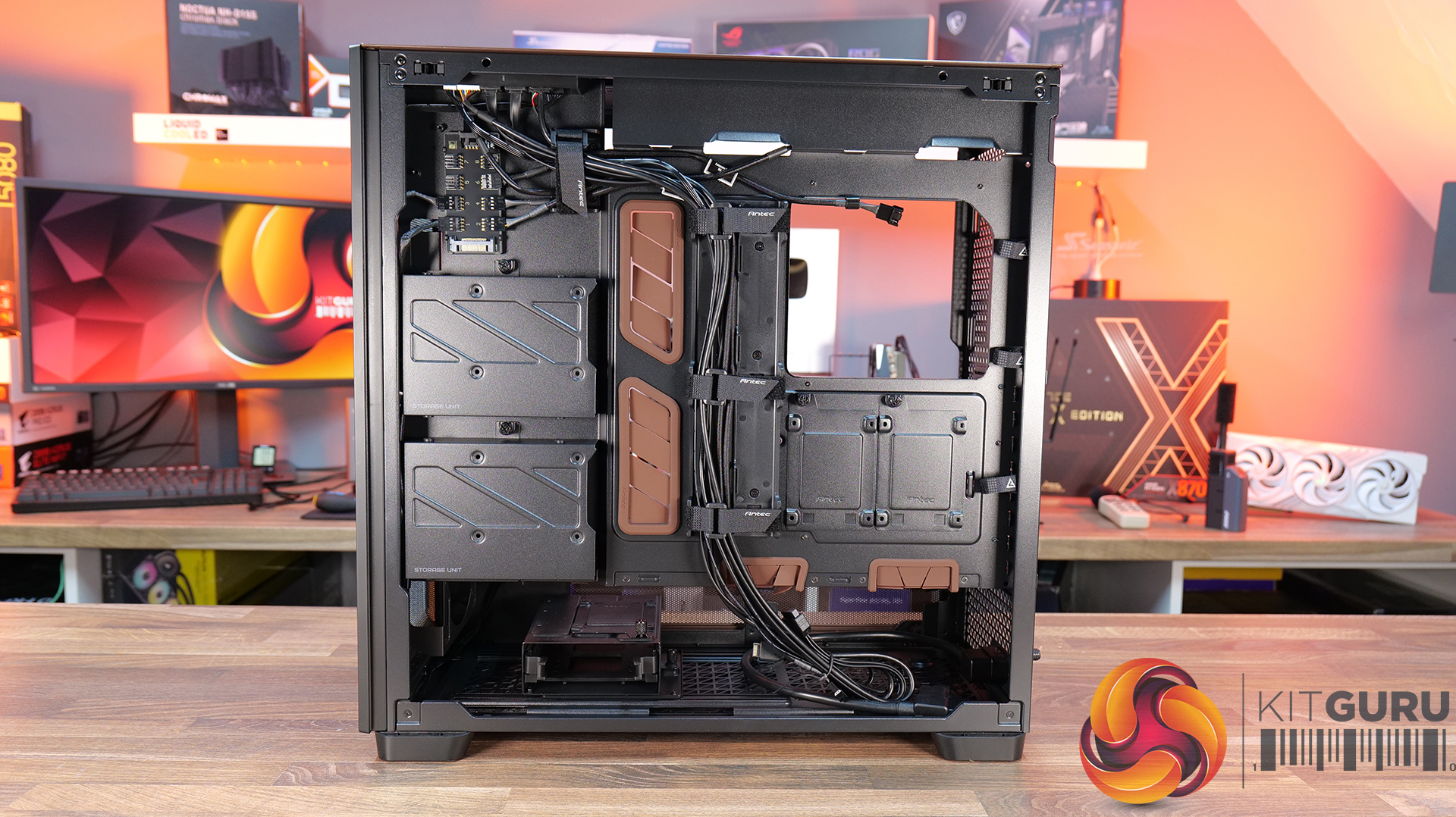
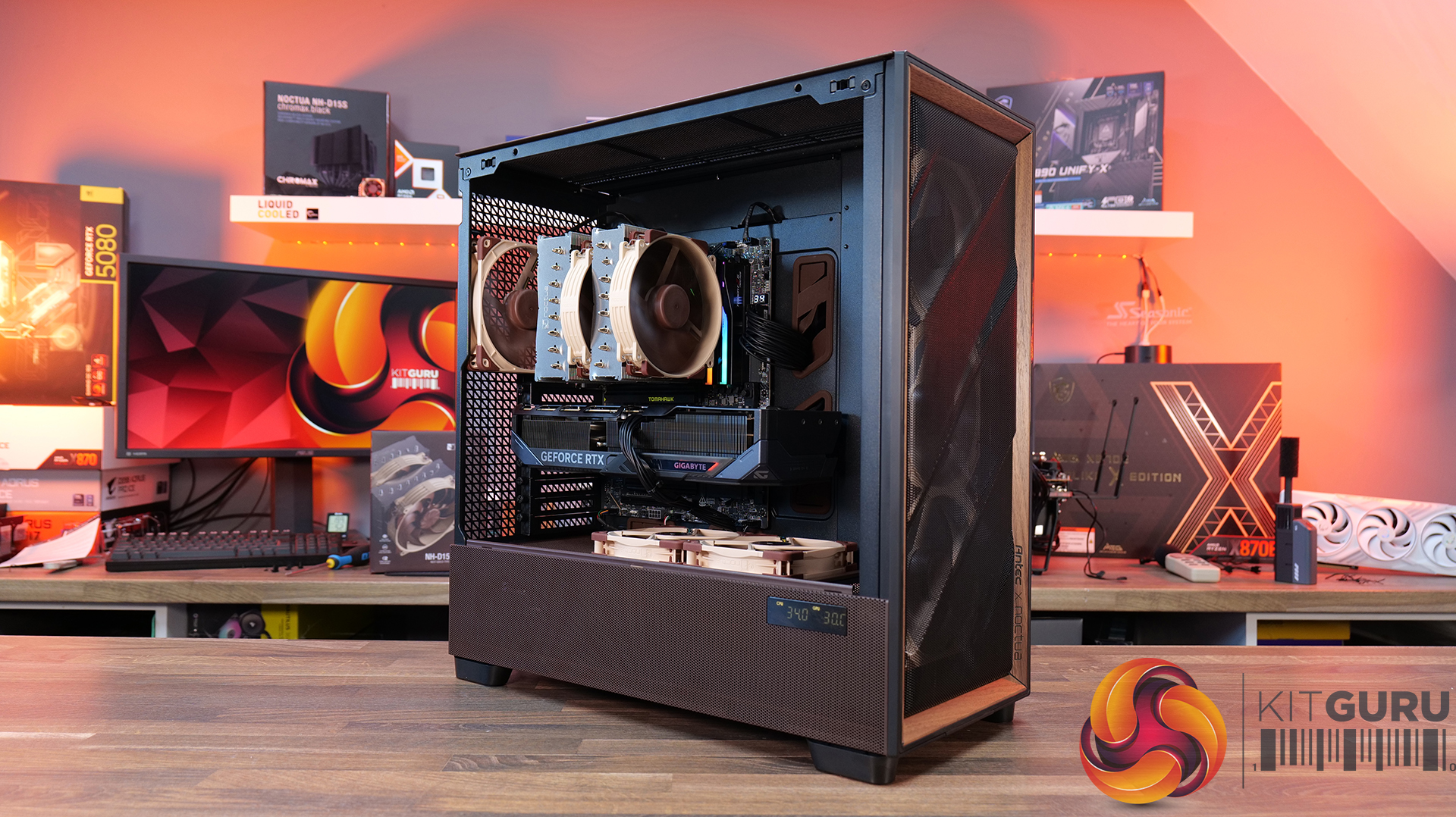
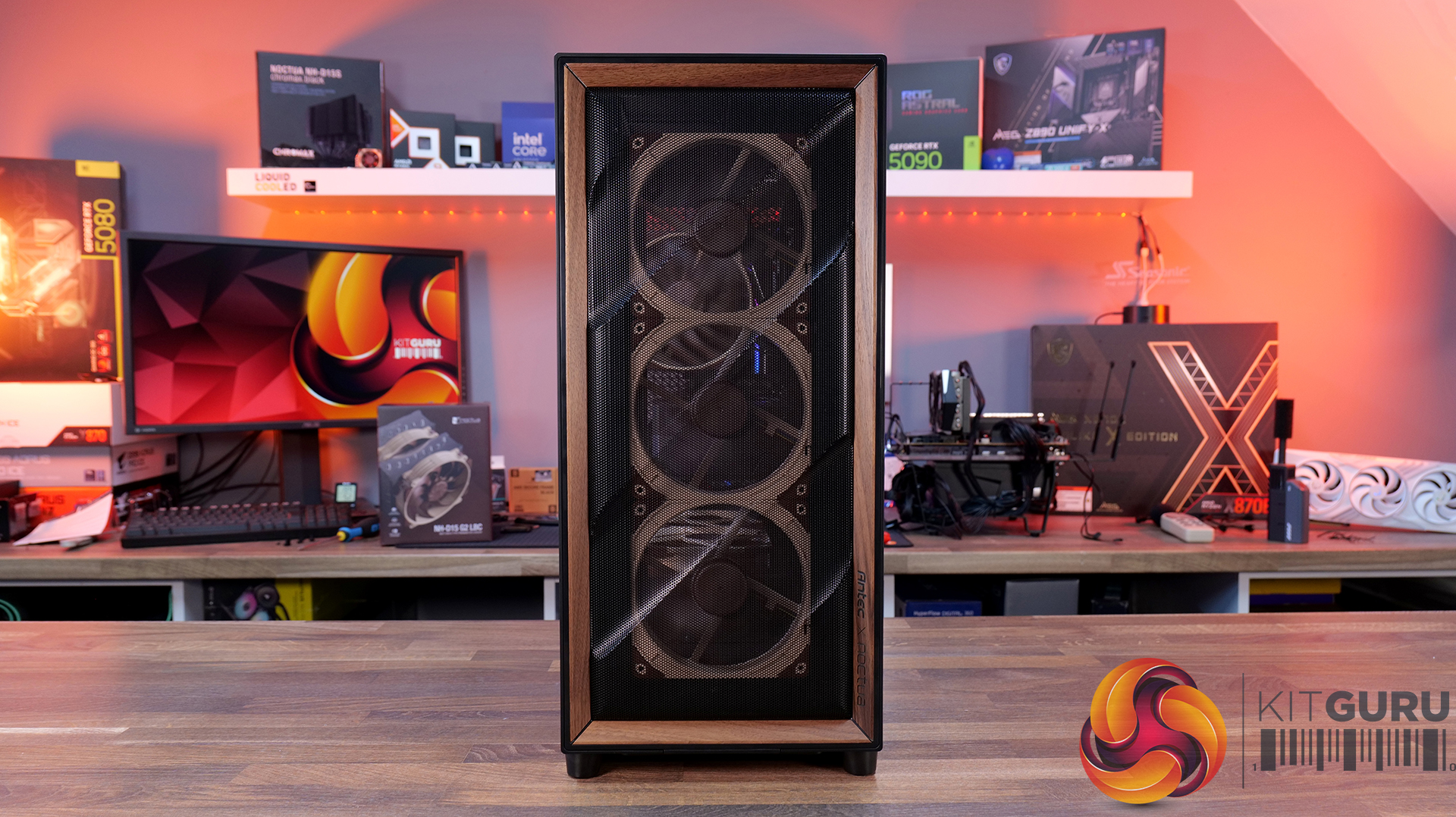
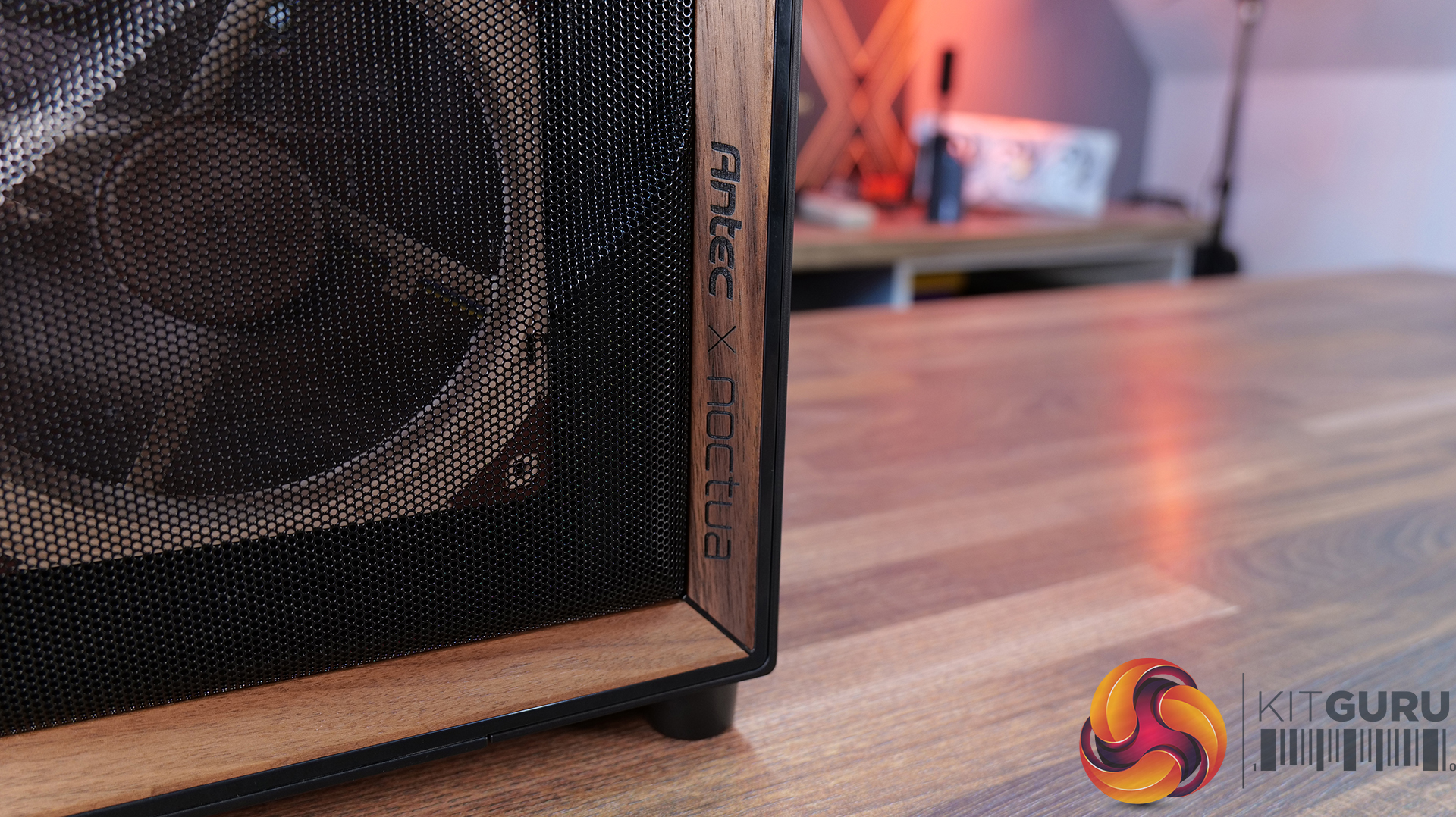
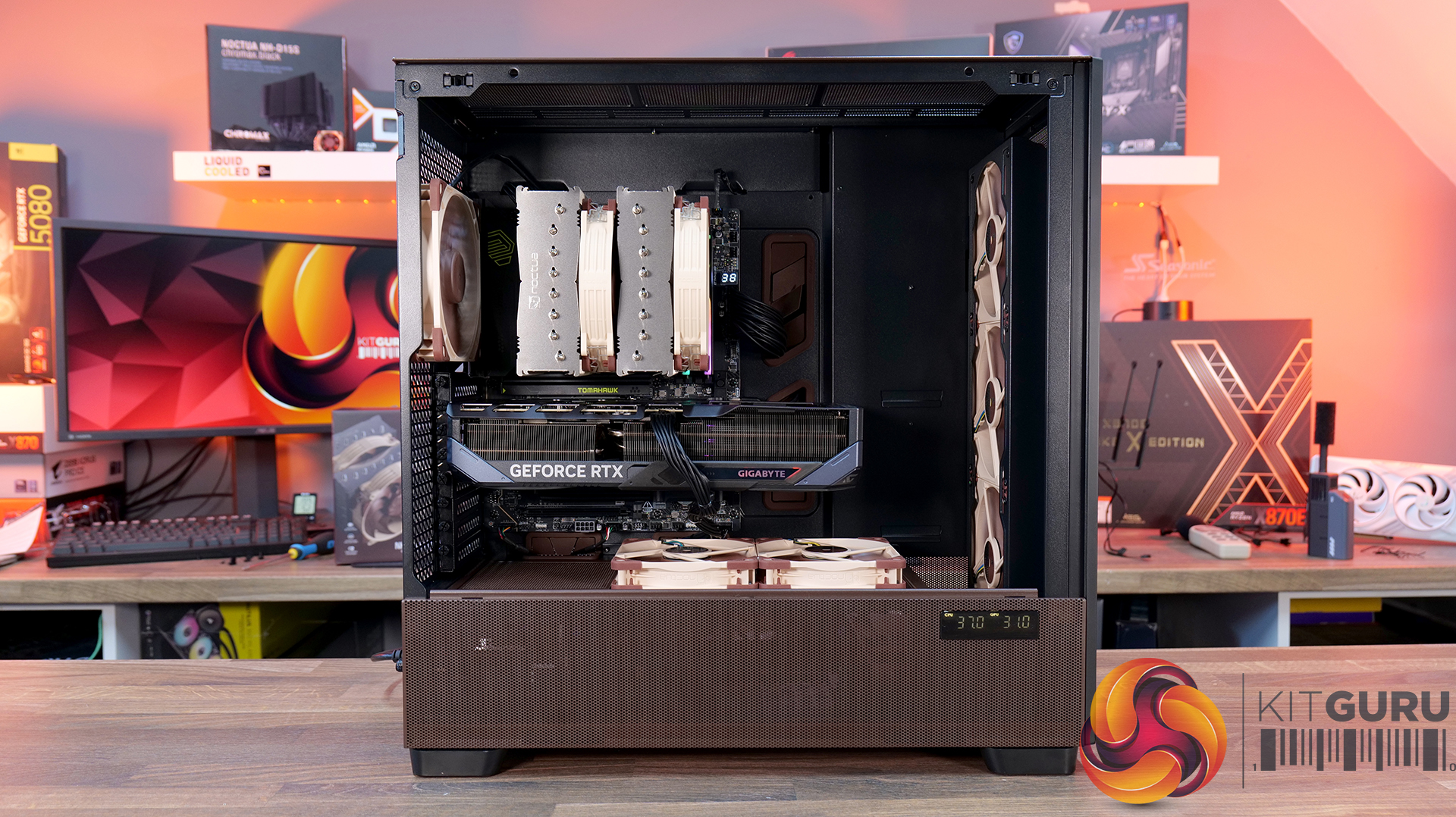
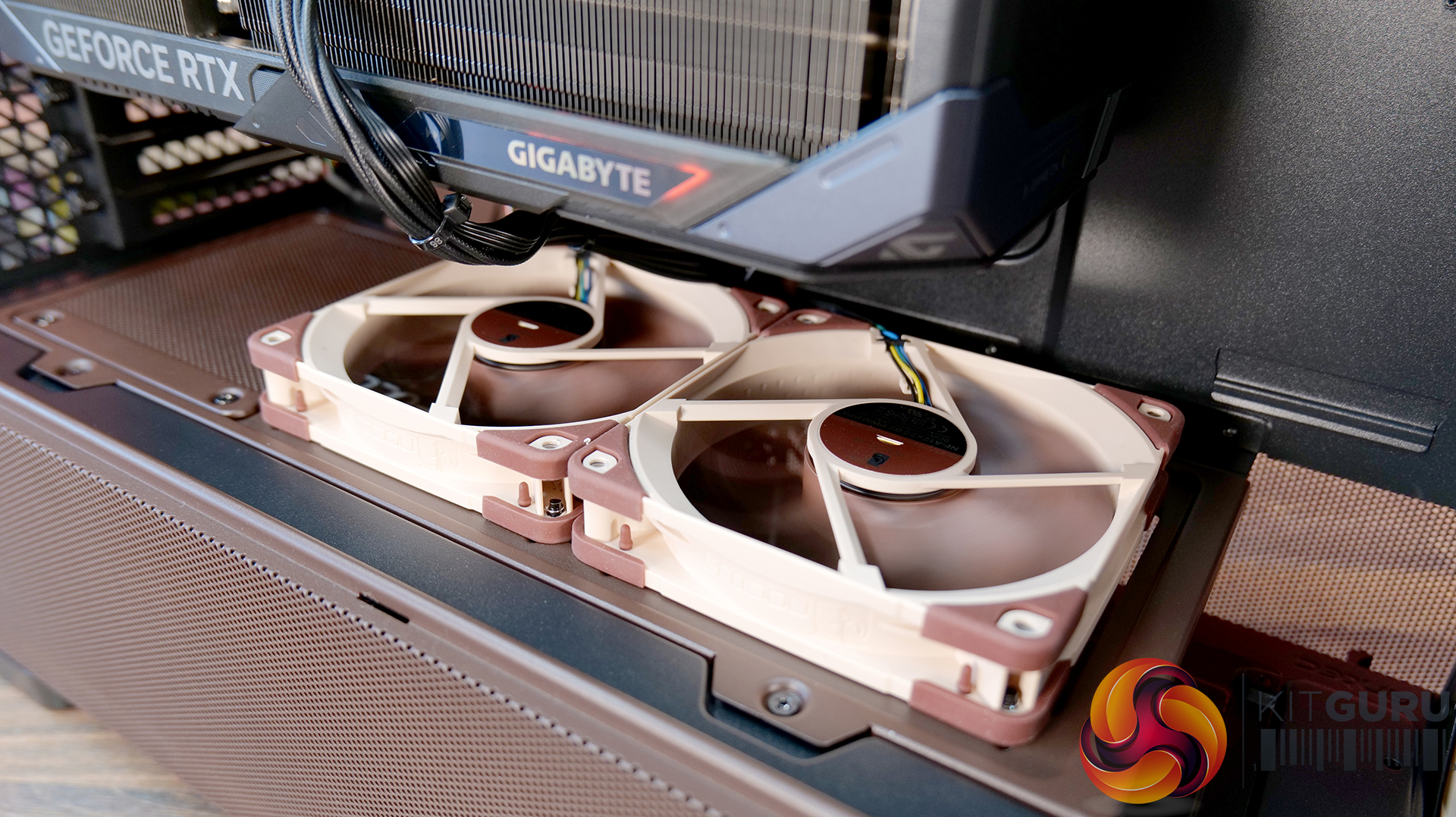
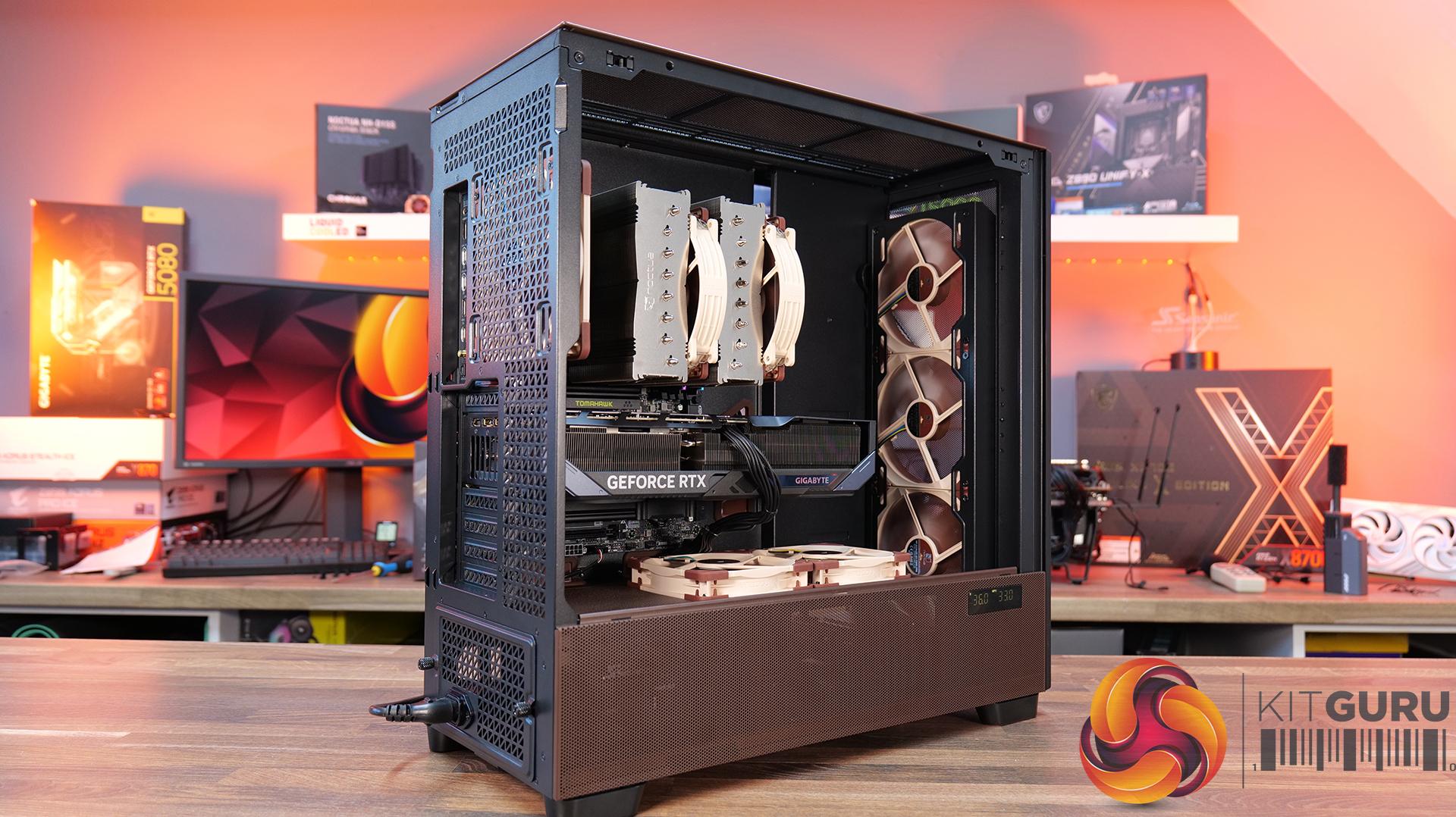
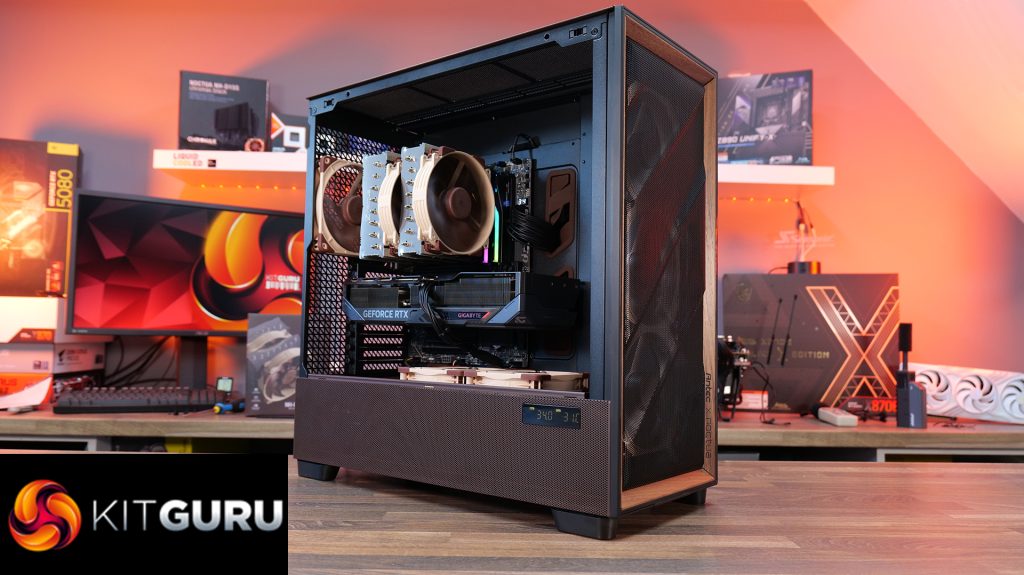
Today we’re taking a look at the Antec Flux Pro Noctua Edition, a full-tower case designed around high airflow and low-noise performance. It combines Antec’s Flux Pro chassis with a set of pre-installed Noctua G2 fans, tuned to deliver strong cooling with minimal acoustic impact. The case features extensive ventilation and support for large radiators, high-end GPUs, and oversized air coolers. In this review, we’ll be checking build quality, layout, and thermal performance to see how it stacks up.
Timestamps:
00:00 Start
00:44 Pricing / Costs
01:38 Accessories
02:02 Dimensions
02:14 Materials / Build
03:00 Recommended Fan Config
03:19 Front I/O (top)
03:47 Temperature display
04:27 Getting Inside the case / Colours
07:13 Install Options
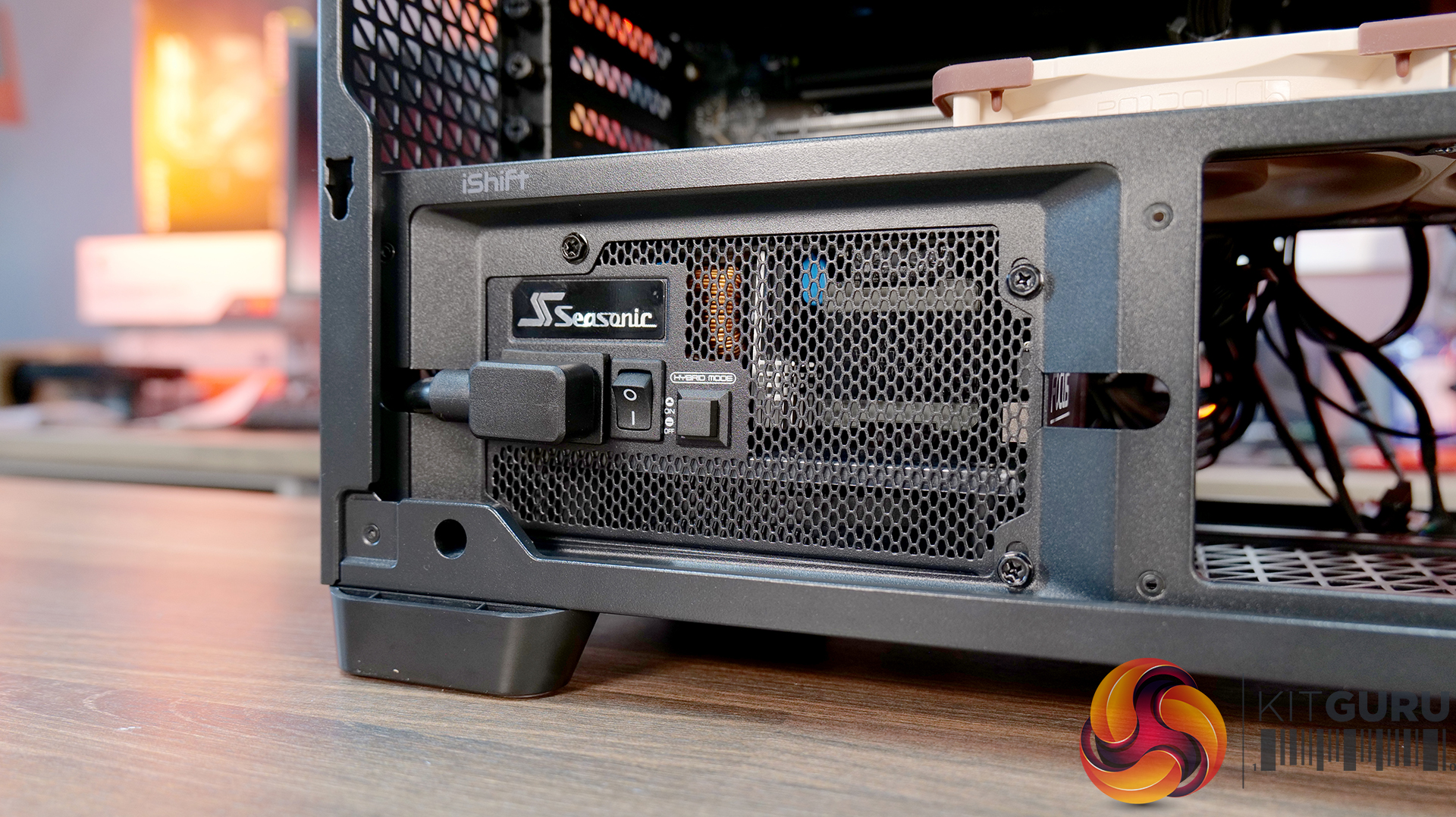
12:27 Rotated PSU Design
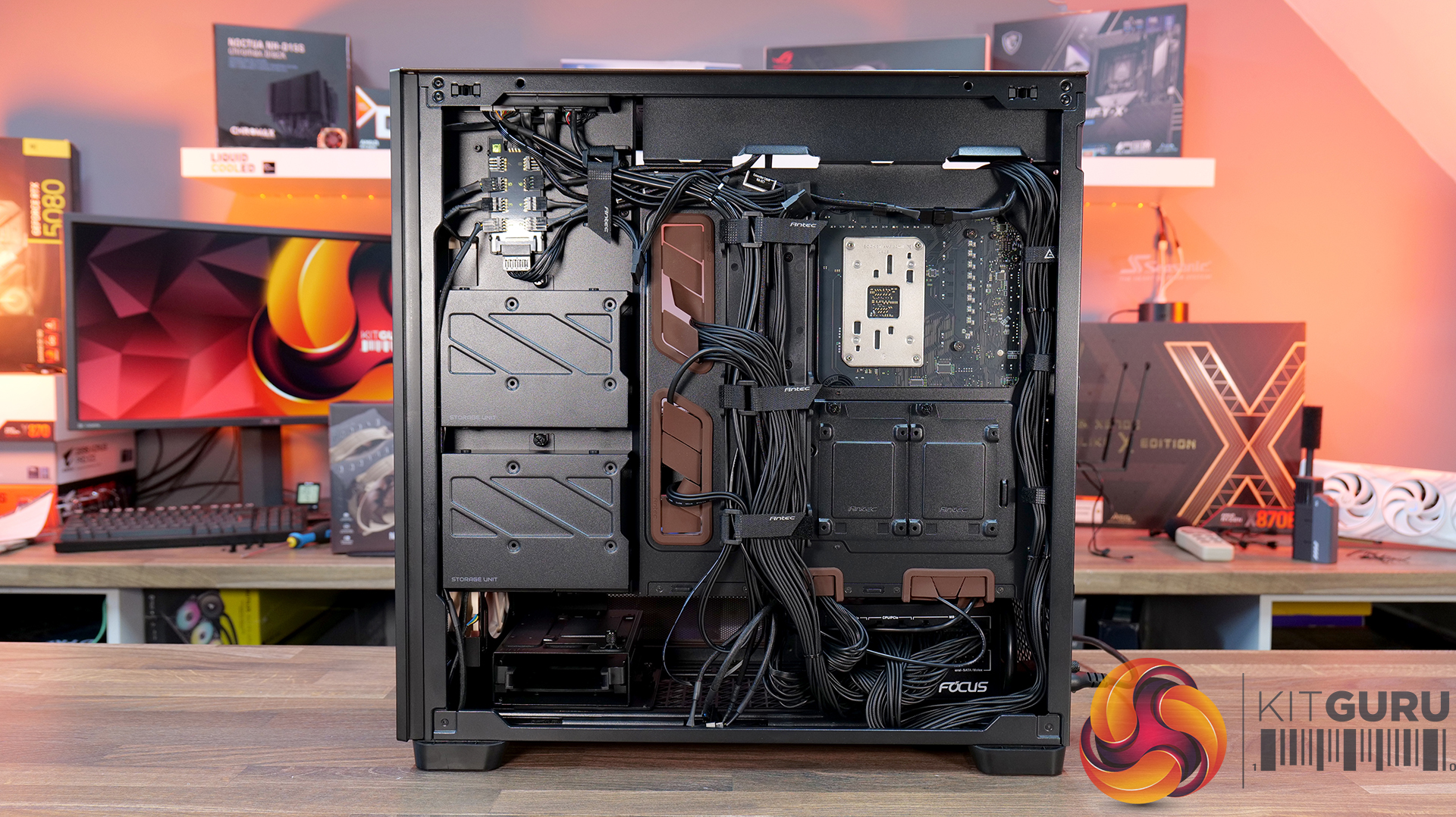
13:36 Right hand side / drive positions
17:10 Floor of the case
17:55 Testing Methodology
19:08 Thermal and Noise Performance
21:09 Visual Airflow demo and thoughts
23:22 Closing Thoughts
Features:
Pre-installed Noctua G2 fans – Includes four Noctua NF-A14x25 G2 and two NF-A12x25 G2 premium fans, delivering high-end airflow straight out of the box.
Optimised for low noise operation – Noctua’s Extensive lab testing and offset fan speeds are designed to reduce vibration and “beat frequency” hum for quieter performance.
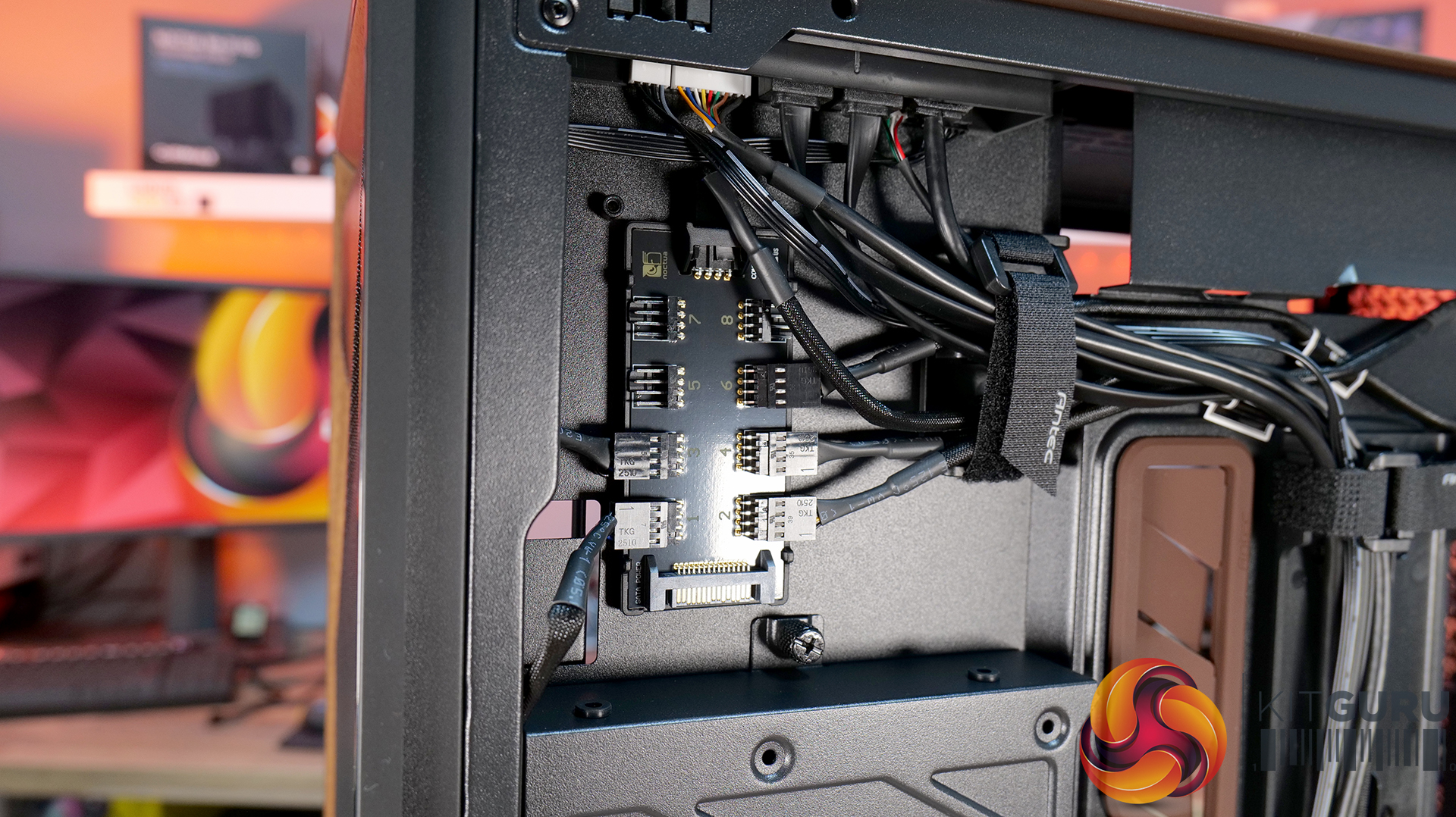
Integrated fan hub and clean wiring – It also comes with a pre-wired NA-FH1 fan hub for synchronised control and simplified cable management.
High-airflow Flux Pro chassis design – Flux Pro Noctua Edition is built on a low-airflow-resistance platform designed to maximise cooling efficiency for high-performance systems.
Fan Support: 3 x 120 / 3 x 140mm (Front), 3 x 120 / 3 x 140mm (Top), 2 x 120 / 2 x 140mm (Bottom), 1 x 120 / 1 x 140mm (Rear) 3 x 120mm (PSU Shroud)
Radiator Support: 120/140/240/280/360/420 mm (Front/Top), 120/140mm (Rear/Bottom), 120/240/360mm (PSU Shroud)
Dust Filters:
Font I/O: 1x USB-C 3.1 (10 Gbit/s), 2x USB-A 3.0 (5 Gbit/s), 3.5 mm headphone/mic combo jack, Power / Reset / Temperature / Display Switch
LCD Screen: Yes – Temperature Display
Thermal Performance Testing
To simulate thermal demand, we run the Cinebench R23 multi-thread benchmark and 3DMark Speed Way stress test simultaneously in a loop for 30 minutes to load the system fully. This gives the CPU and GPU enough time to reach constant steady-state temperature. With this data, we can compare how the system handles the thermal demand and measure peak noise levels.
Thermal performance is measured with the case in various configurations, such as the default, with the tempered glass left-hand side panel removed and with the front panel removed to see how these configurations affect the CPU and GPU temperature. During testing, only stock case fans are used unless otherwise specified. All water pumps are set to maximum RPM and fans are set to a custom RPM curve by the Motherboard software/BIOS.
All temperature measurements are presented as Deltas – meaning the ambient temperature has been deducted from the CPU temperature, giving us a Delta. Data shown in the charts represents the average component temperature over the length of the test as measured by HWiNFO, and then the last 15 minutes of the data are calculated to get the average. The ambient temperature during thermal tests is between 19-20⁰C.
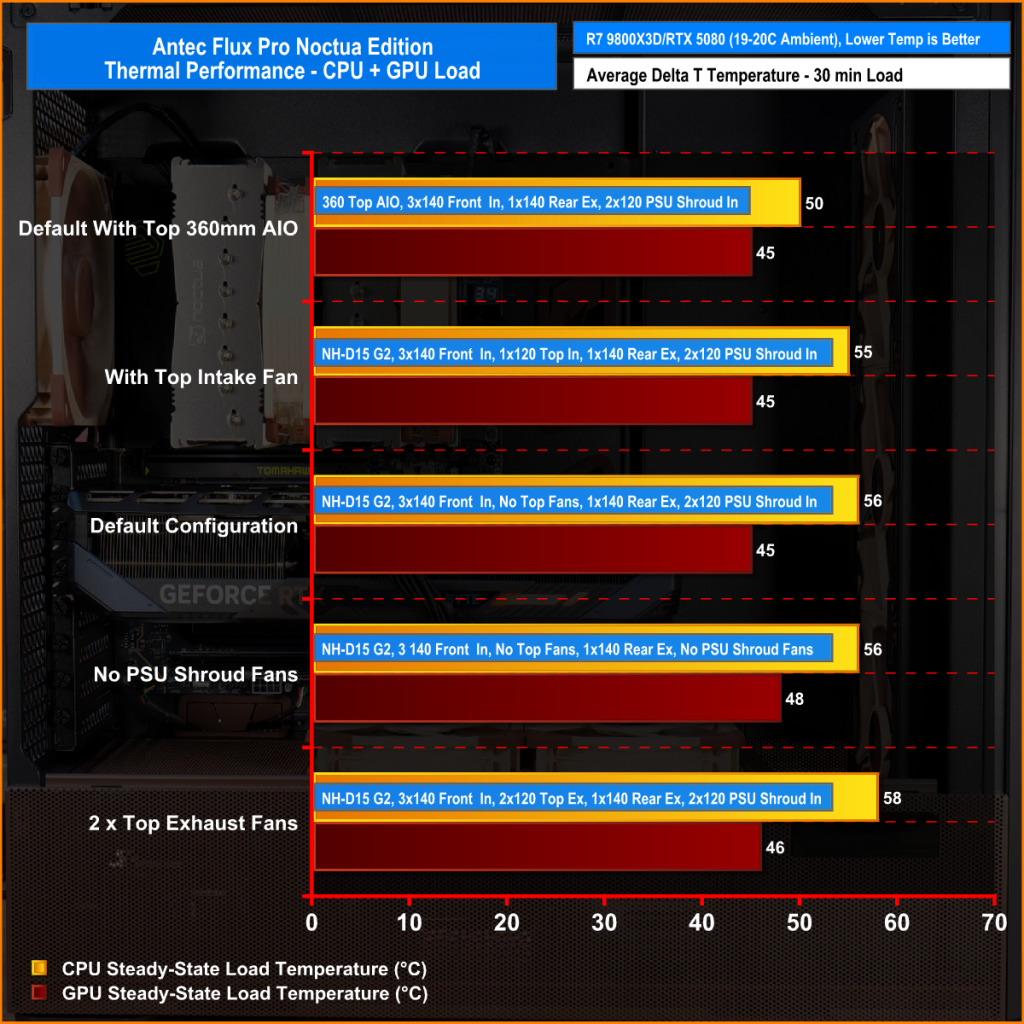
We tested the case thermals using a Noctua NH-D15 G2 LBC / 360mm AIO as the exhaust at the top and with the case in several different fan configurations. The default configuration shown in the charts is with the Noctua NH-D15 G2 LBC CPU cooler, 3 x 140mm front intake fans, 2 x 120mm PSU shroud intake fans, 1 x 140mm rear exhaust fan and with all panels installed.
Thermal performance from the Flux Pro Noctua Edition is generally very strong. In the default configuration, CPU temperatures average 56°C over ambient, with the GPU at 45 °C. There is a clear improvement over the air-cooled setup when using a top-mounted 360mm AIO. This is due to the AIO's increased cooling power rather than any limitation of the case.
However, in the air-cooled setup, adding top fans as exhaust negatively affects CPU thermals, raising temperatures to 58°C, suggesting an airflow disruption. Adding a 120mm top intake fan can have a minor improvement in CPU temperature, but GPU temperature is unchanged with both top fan configurations, so leaving top fans out completely is fine.
GPU temperature remains consistent across most setups at around 45°C over ambient, highlighting the effectiveness of the case’s airflow design in the recommended configuration. Removing the PSU shroud fans leads to a small increase in GPU temperature at 48°C. Overall, the results show that the case performs best with balanced airflow in the default configuration, delivering solid all-around thermal performance.
Noise Output
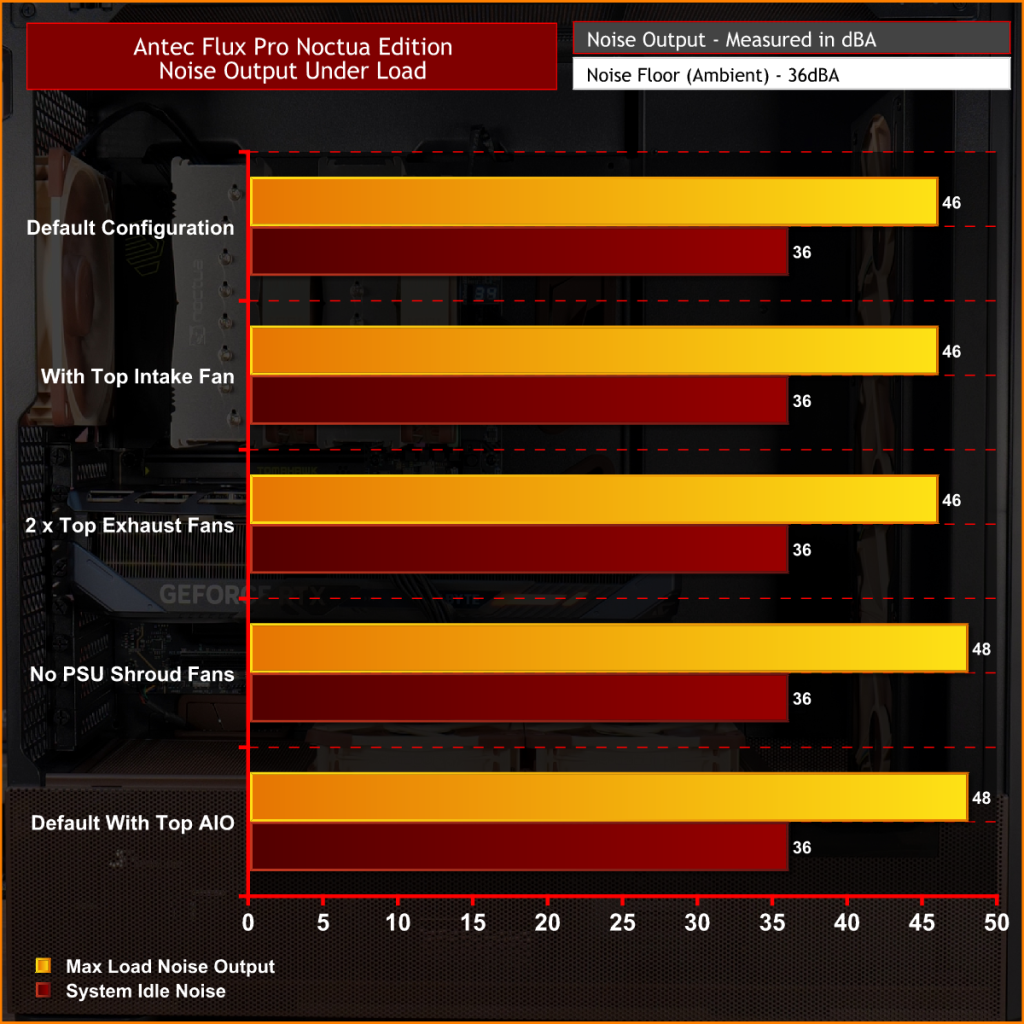
Noise performance is fairly consistent across test configurations, with load noise at 46 dBA in the default setup, which doesn’t really change whether you switch to top intake or add extra exhaust fans. Noise shifts slightly when you remove the PSU shroud fans or install a top-mounted AIO, increasing to 48 dBA under load, suggesting those configurations introduce a bit of fan noise from the GPU cooler and from the AIO compared with the default configuration and using the D15 G2 air cooler.
Idle noise, however, is rock solid across the board at 36 dBA. Overall, it’s a pretty well-balanced acoustic in any configuration, but clearly best optimised in the recommended Noctua configuration.
Closing Thoughts
The Antec Flux Pro Noctua Edition is a case that does exactly what it sets out to do — deliver strong airflow, great cooling and low noise performance. In testing, it handles both CPU and GPU thermals with ease, and more importantly, it manages to keep noise levels impressively low, not just at idle, but also under load. Something that case manufacturers don’t always get right with pre-installed fan configurations. However, the Noctua Fans are not pre-installed; this is the job of the user. They arrive in a separate box.
A big part of that comes down to the included Noctua fans. You’re getting a set of high-quality NF-A12x25 and NF-A14x25 G2 units, along with a Noctua fan hub, all designed to work together. Build quality is exactly what you’d expect from an Antec/Noctua partnership, and the colour scheme is carried throughout the case, giving it a very distinct look that suits the whole package very well and will no doubt please Noctua enthusiasts.
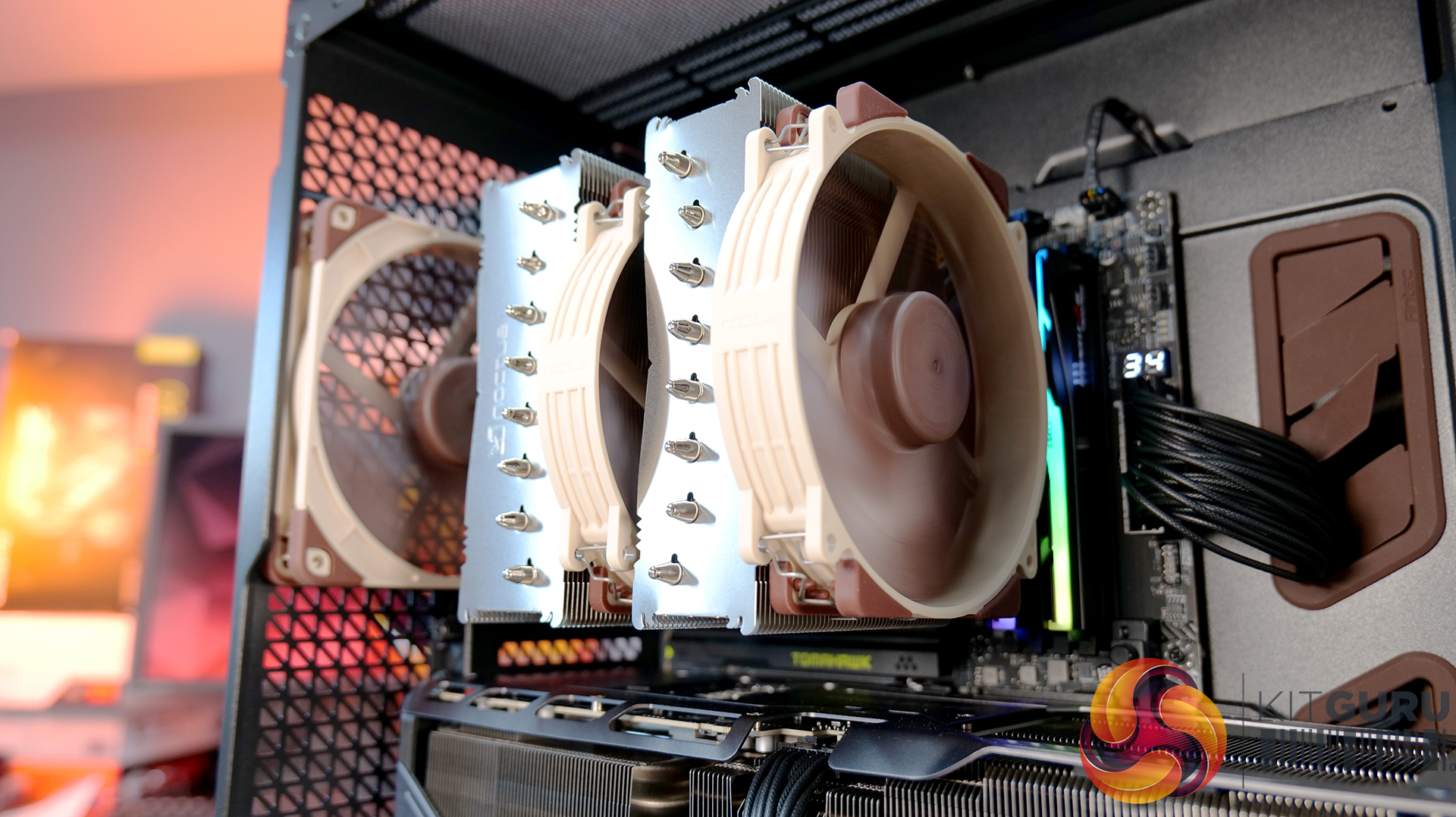
In terms of compatibility, there’s plenty to like here too, including support for dual 420mm radiator installation, as well as generous clearance for large air coolers such as the Noctua NH-D15 G2 and high-end graphics cards. So whether you’re building a high-performance air-cooled system or going all-in with liquid cooling, the Flux Pro has the space and layout to handle it. But this means the case is quite large with Full tower dimensions, not ideally suited to placement on top of the desk.
That said, it’s not without its downsides. At around £350, it’s a very expensive case; at that price, you start to expect a bit more in terms of features. There’s no integrated GPU support bracket, no back-connect motherboard support, and some of the internal panels — particularly the top and front fan mounting brackets could be more intuitive to remove. Even so, if your main priority is excellent cooling performance with low noise levels straight out of the box, the Antec Flux Pro Noctua Edition is a very capable, premium option.
The Antec Flux Pro Noctua Edition is available to purchase now from Amazon priced at £348.90 HERE.
Pros:
Great thermal performance and low noise.
Very high-quality fans included.
Built-in fan hub.
Cons:
Expensive.
Missing basic key features such as an integrated GPU support arm, tool-free parts, and back-connect motherboard support.
Fans are not pre-installed.
KitGuru says: If you have the cash to splash on a case and want a large chassis with great cooling and low noise, then this might be ideal, especially for Noctua enthusiasts. But in the current economic conditions, it could be money better spent on core system components.
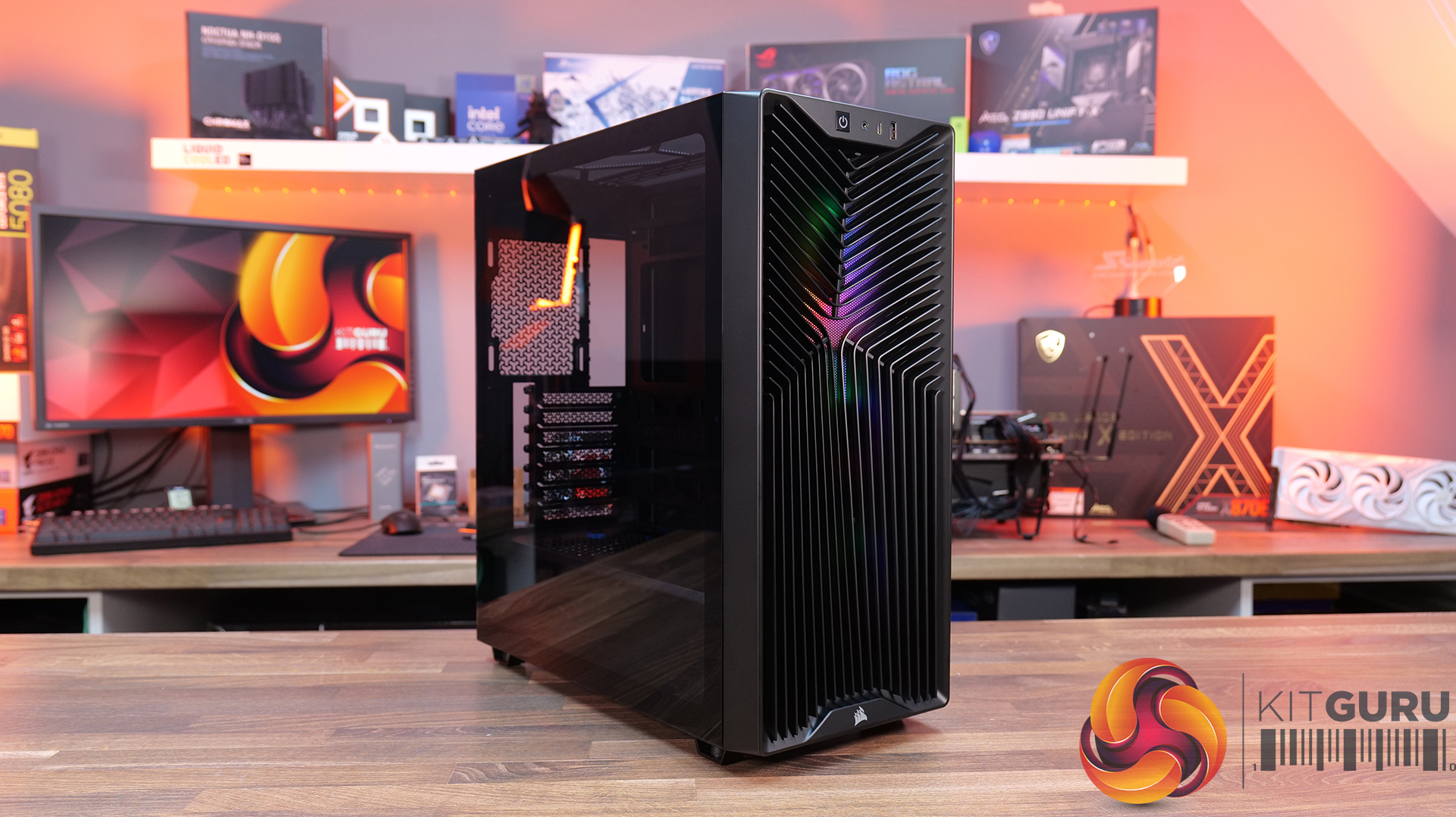
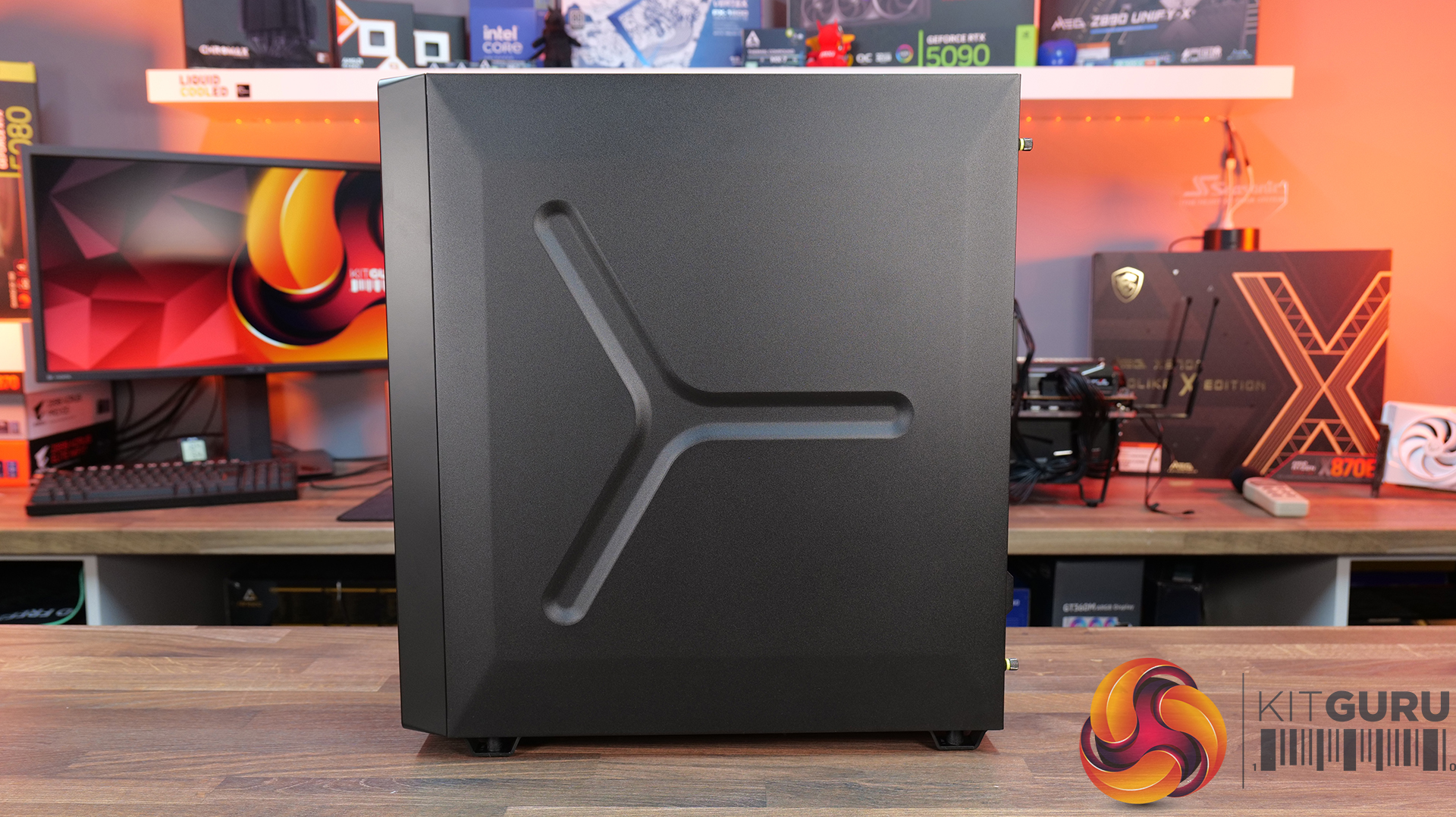
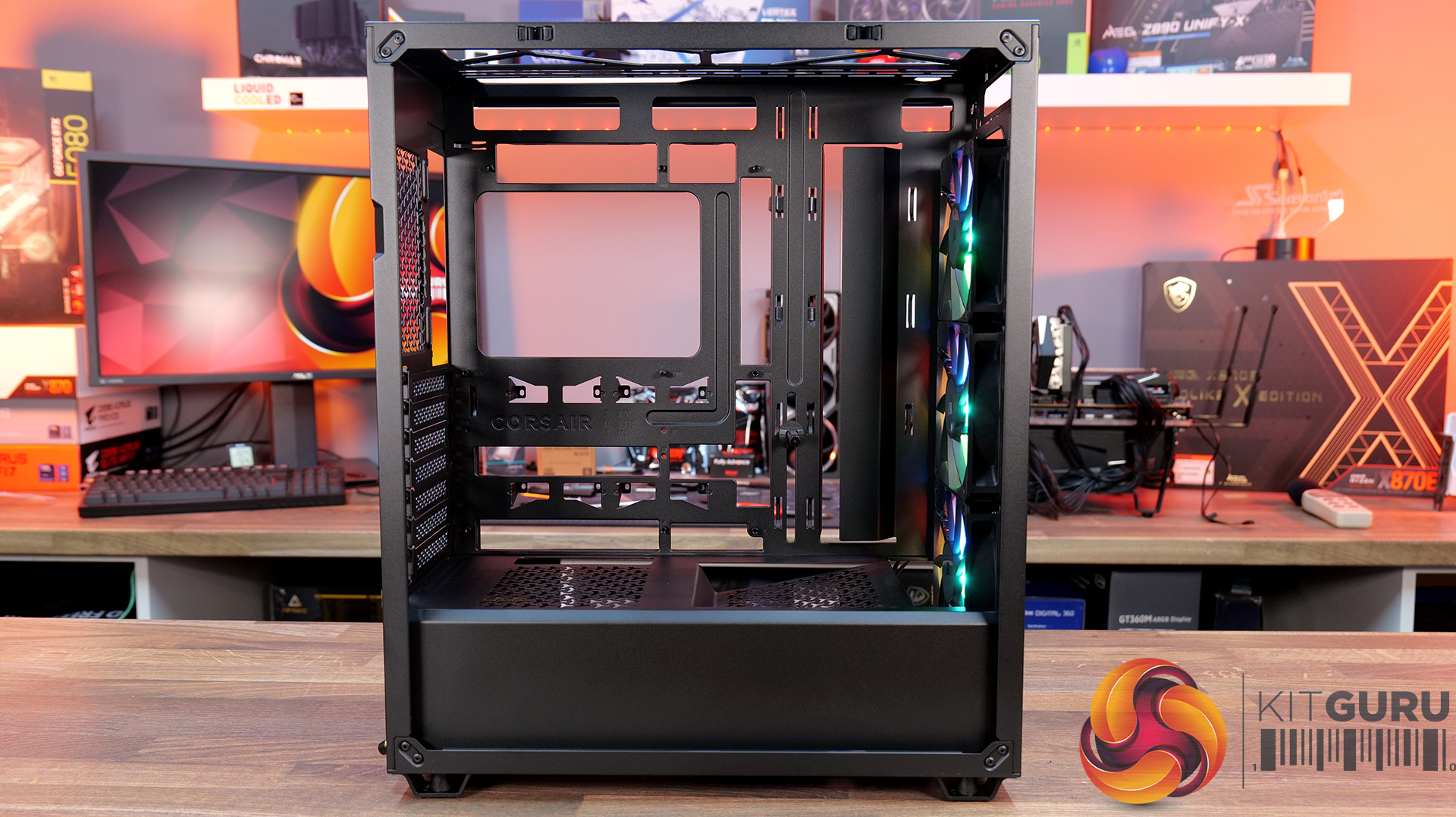
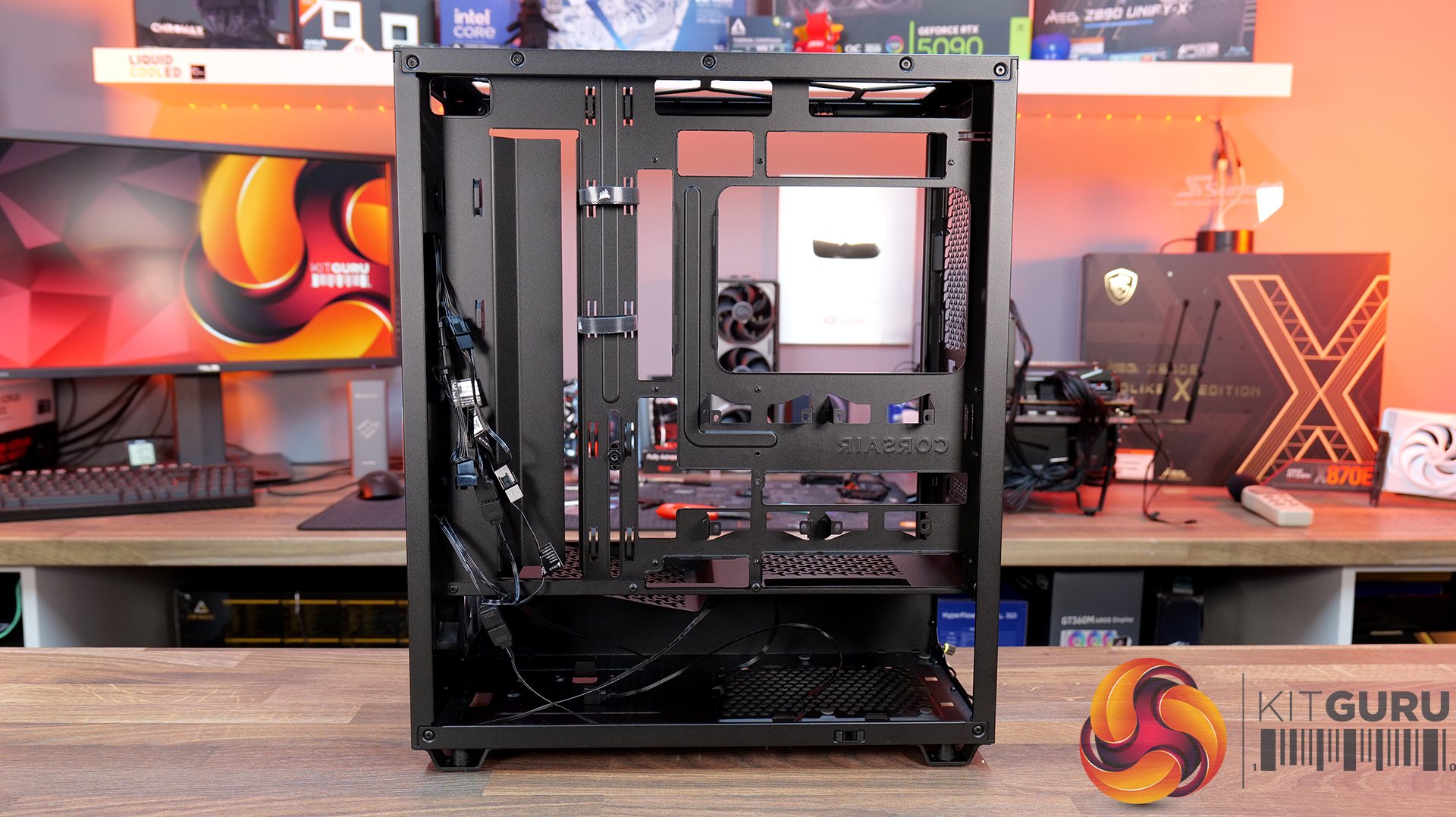
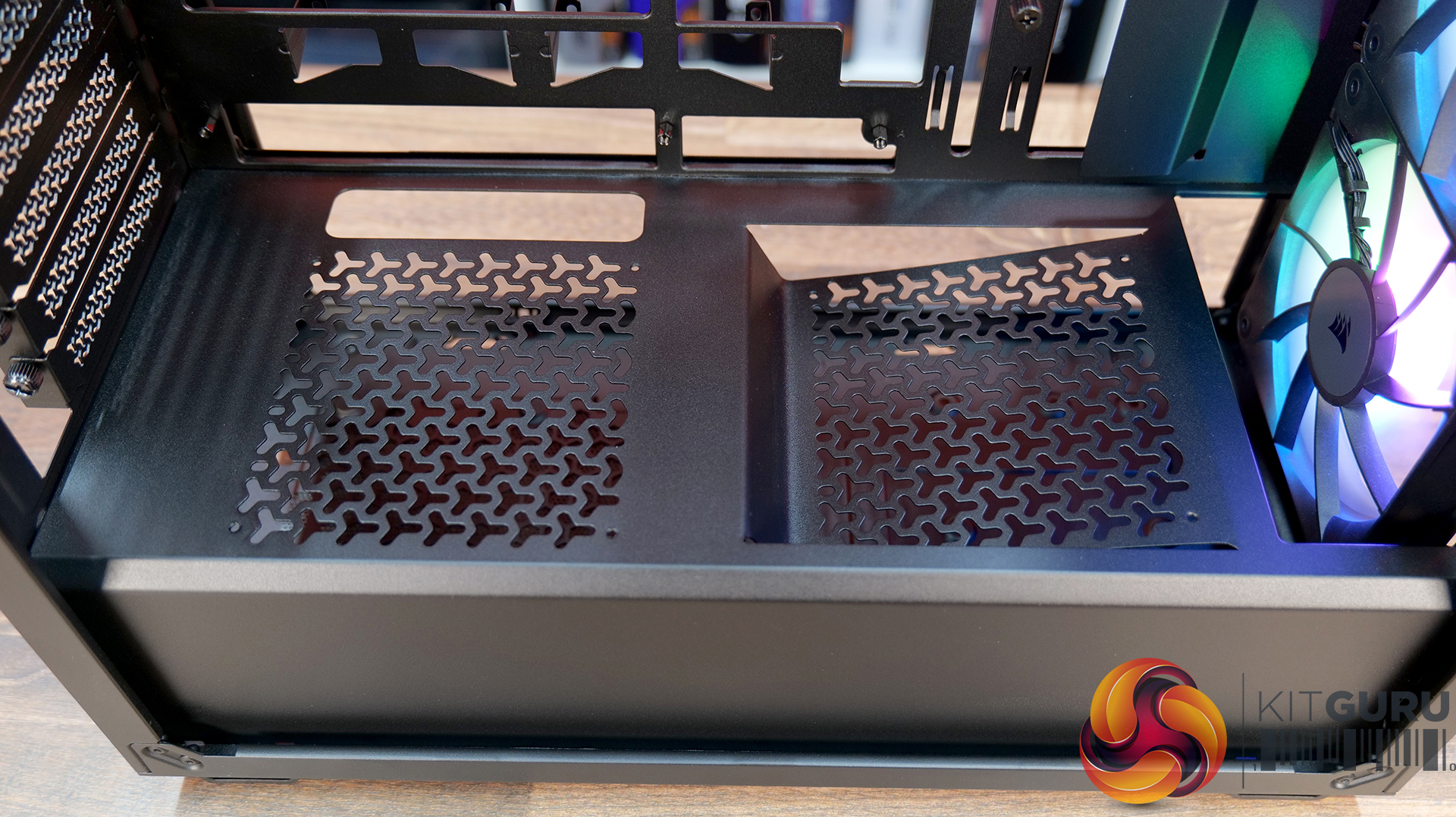
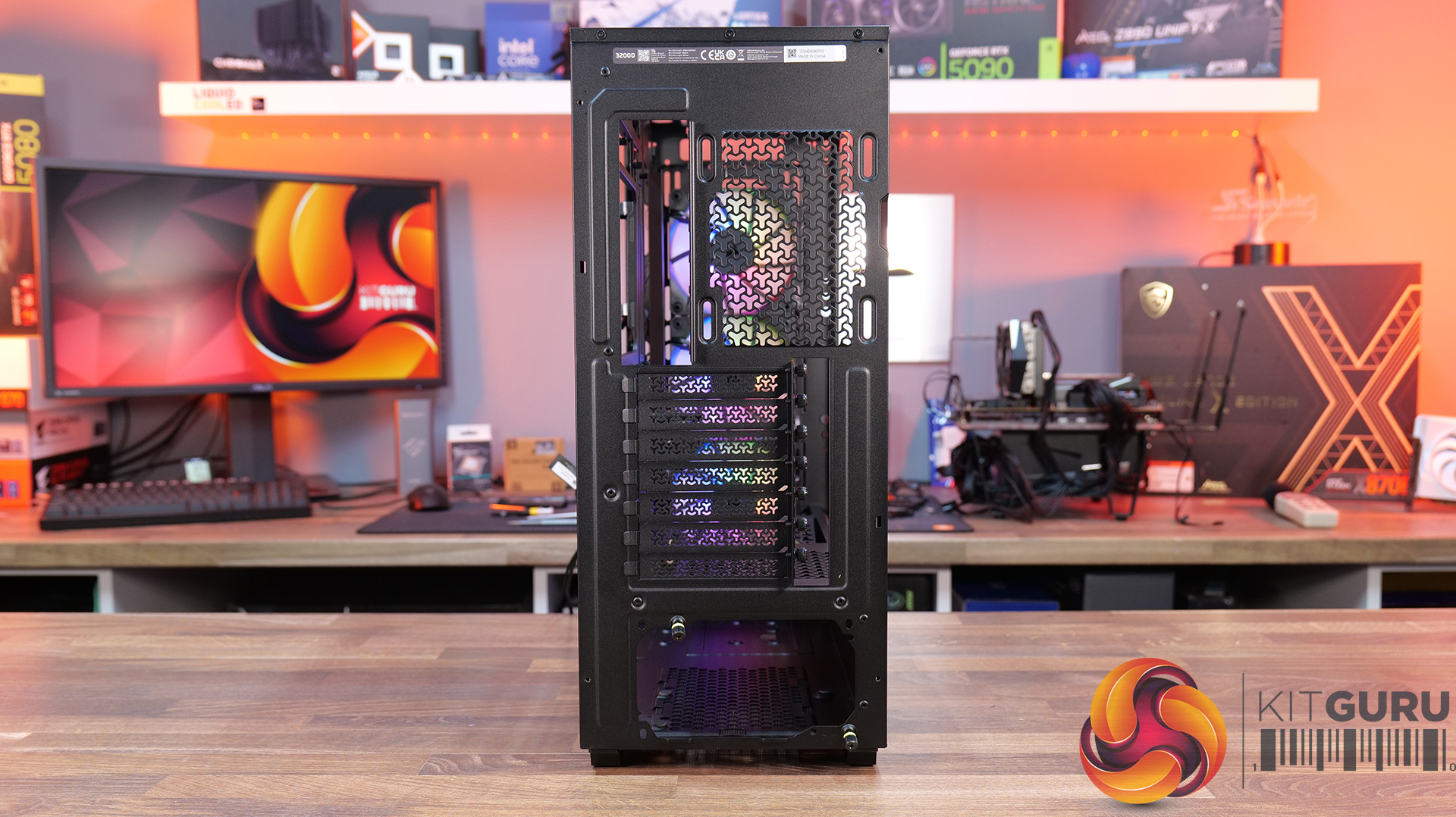
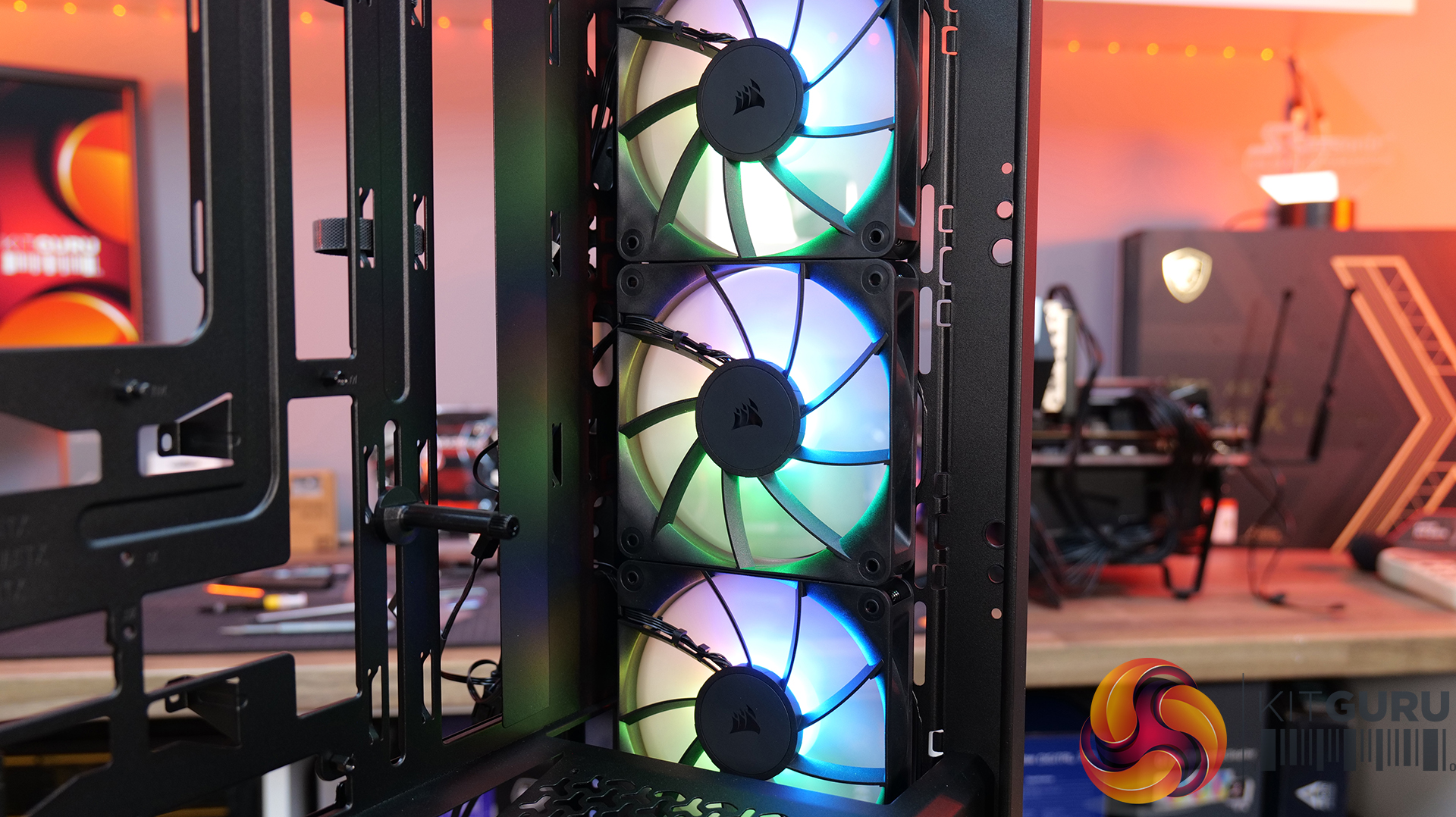
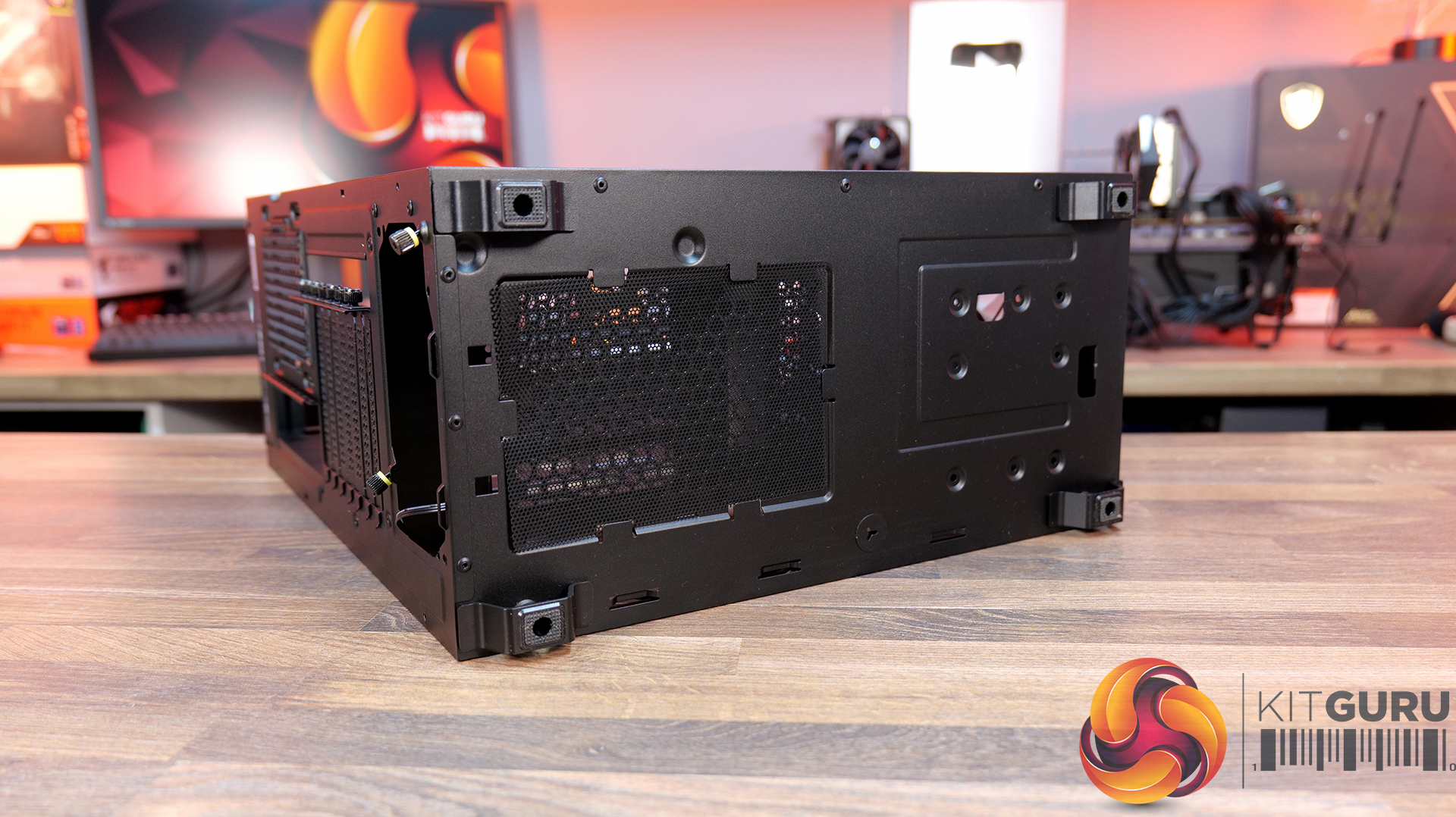
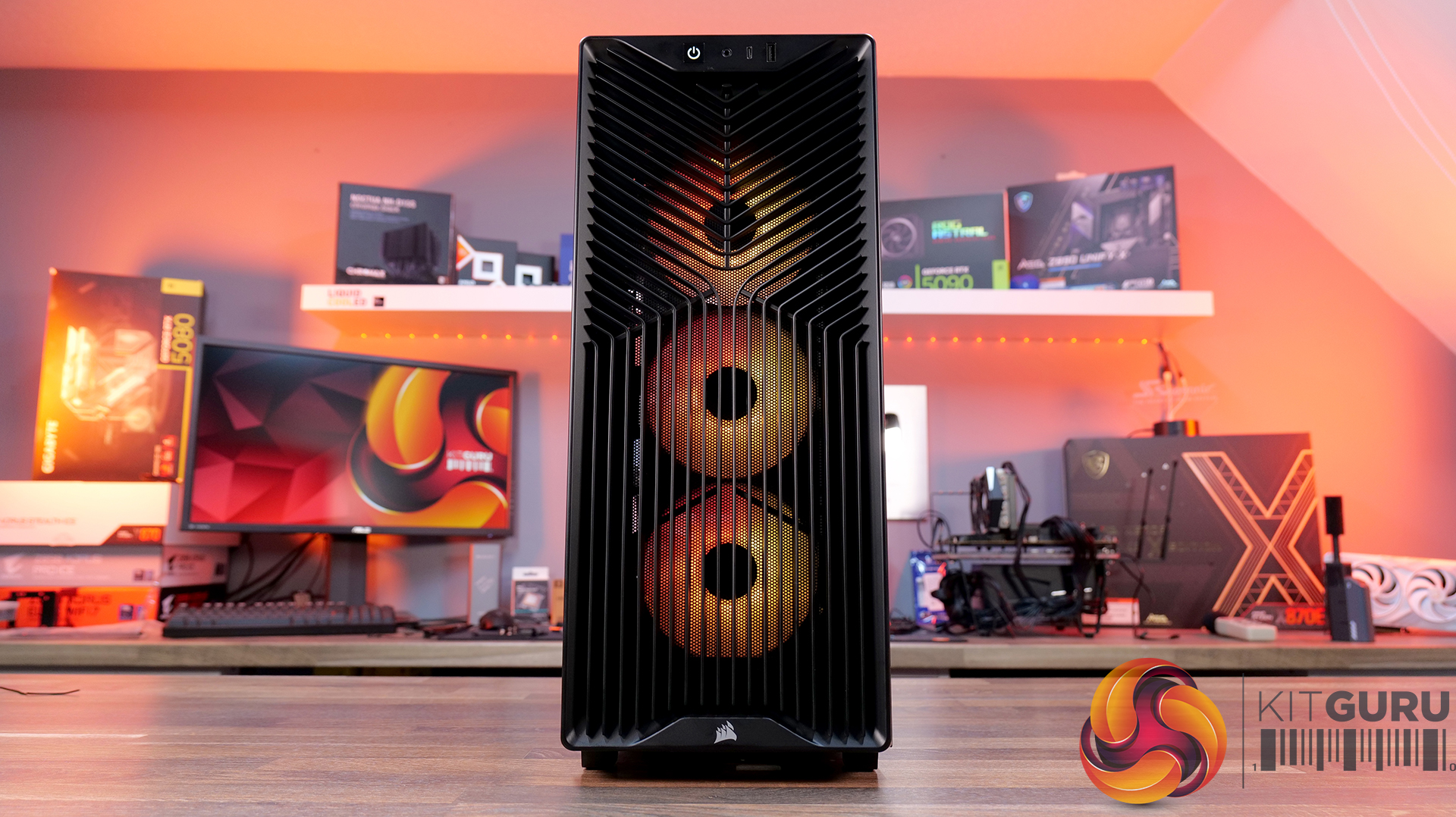
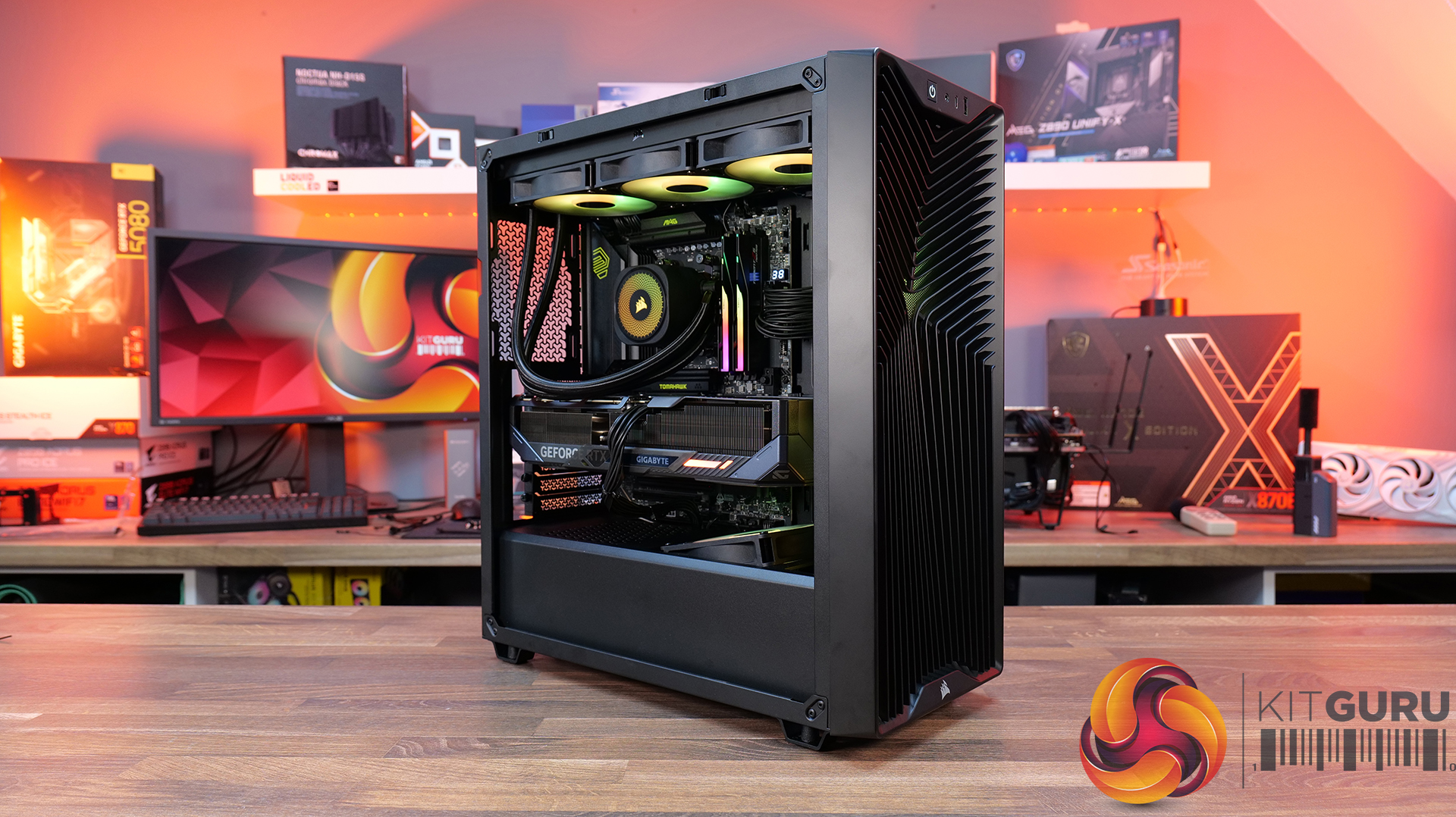
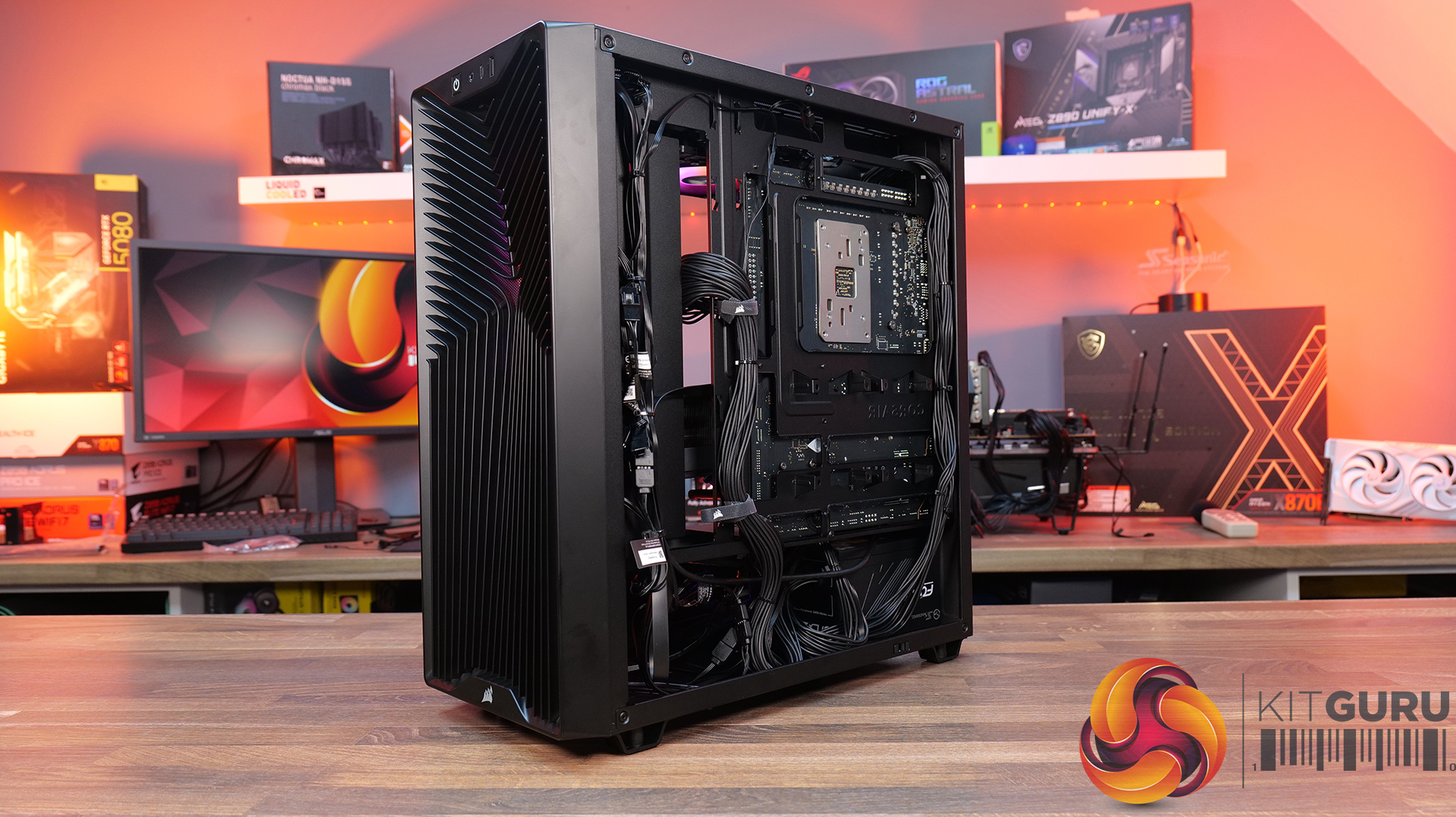
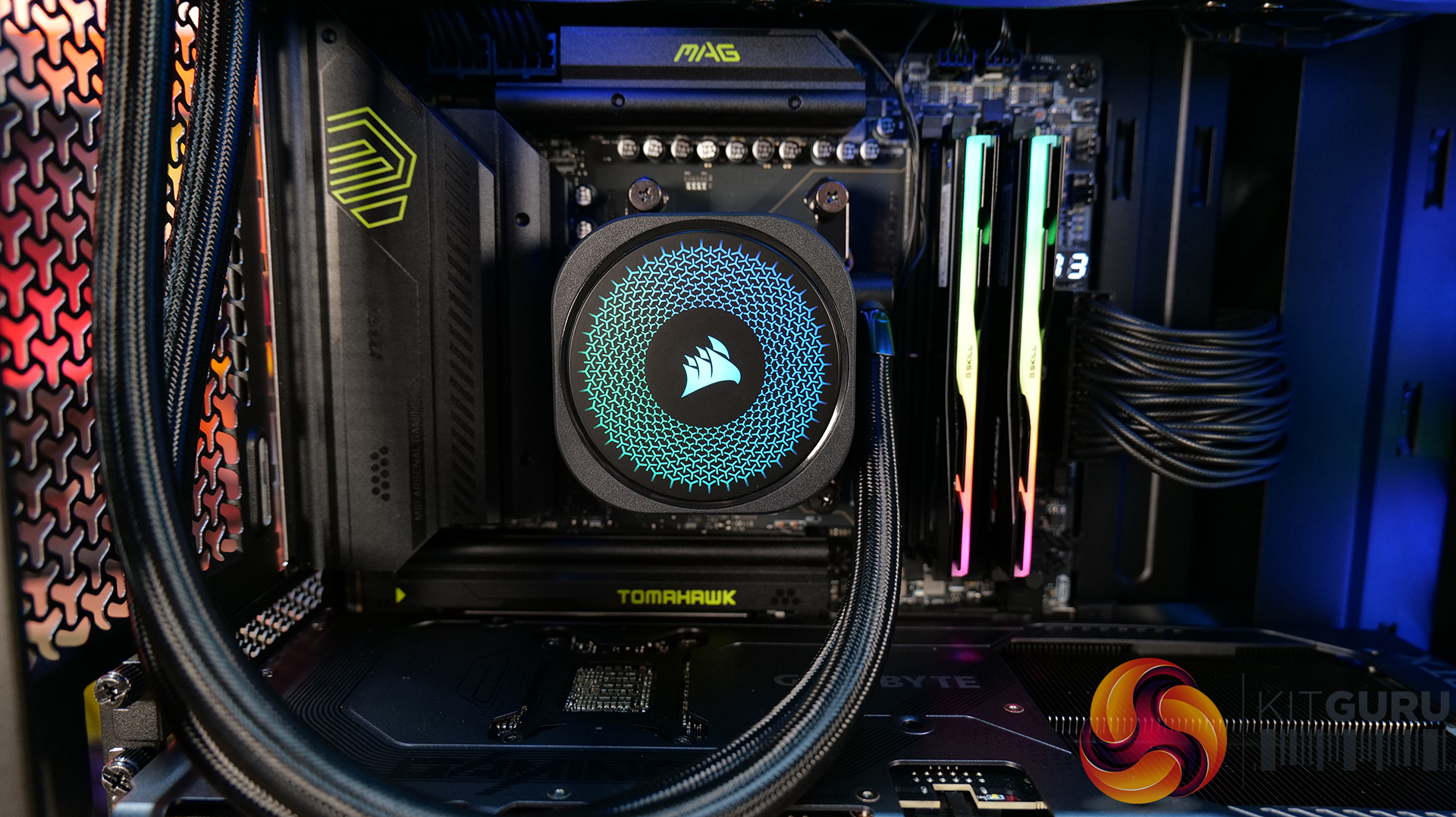
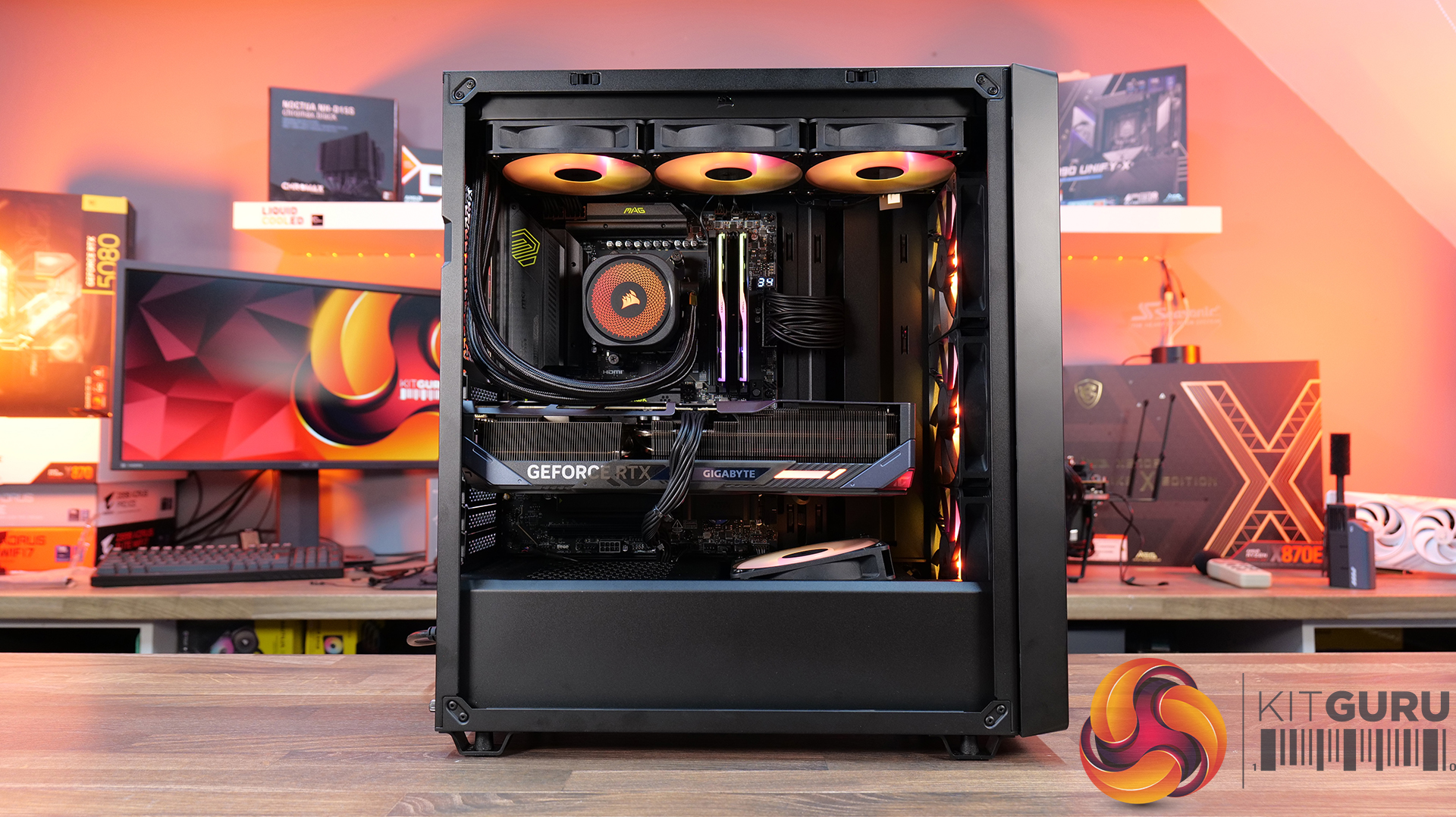
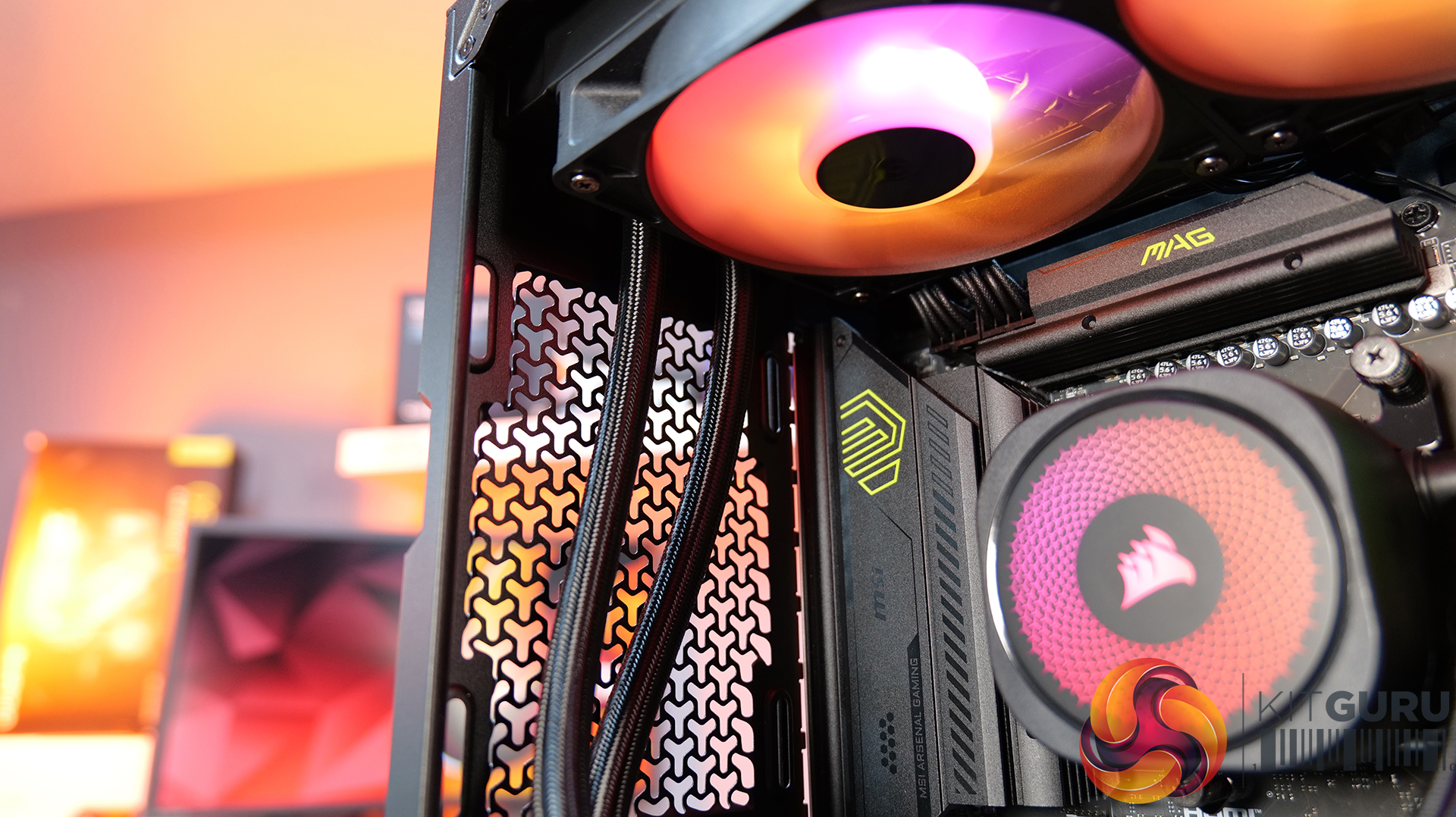
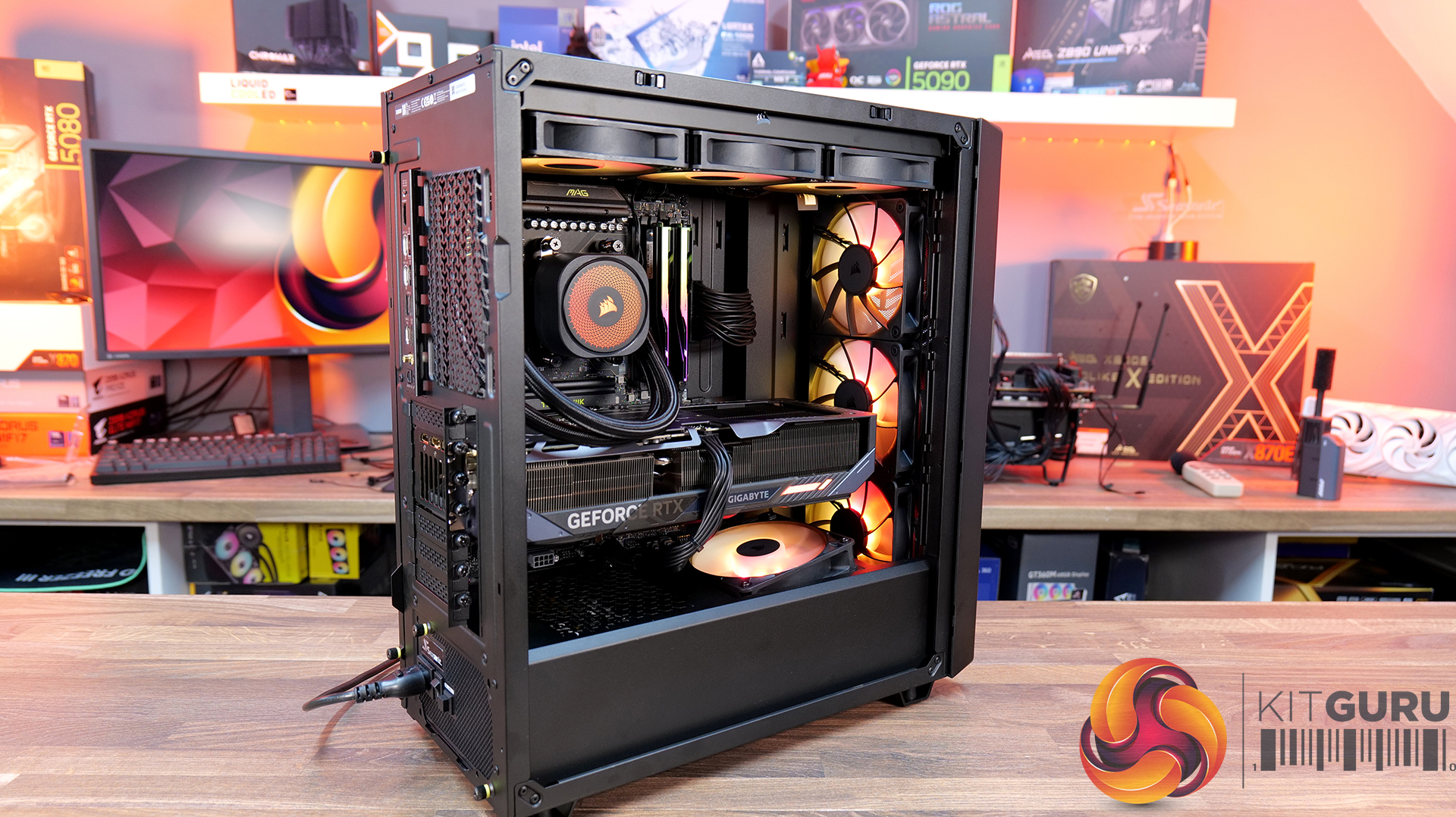
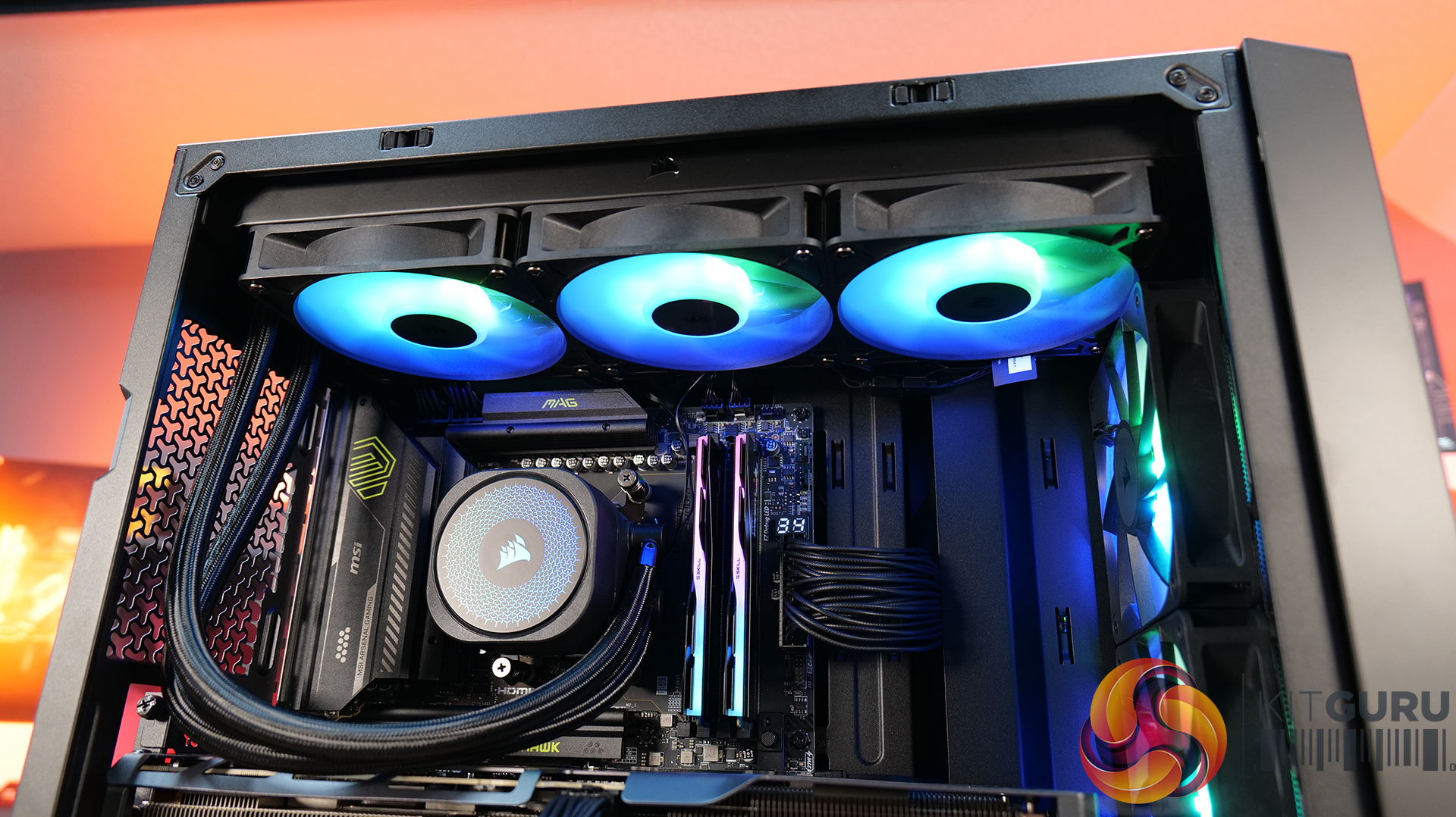
Today we’re checking out the new 3200D case from Corsair. It’s a compact mid-tower chassis aiming to combine strong airflow with the latest builder-friendly features, including support for 360mm radiators, reverse-connection motherboards, and graphics cards up to 370mm long. In this RS ARGB version, you also get three included fans, a tempered glass side panel, and a built-in GPU support bracket. But how well does it actually perform? Let’s find out.
Timestamps:
00:00 Intro
00:48 Meet the 3200D – pricing and variants
01:19 Key specs
03:08 Accessing internals
05:34 Cooling and hardware support
07:51 At the back of the case
08:22 Behind the mobo tray
11:02 The case floor
11:48 Accessories and setup
12:24 Thermals and noise
13:34 James’ thoughts so far
14:45 Some compromises made…
16:19 USB 2.0?! And a potential explanation…
19:24 Last minor negative
19:55 Closing thoughts
Features:
Strong Cooling Potential – Supports up to nine 120mm fans with three RS120 ARGB fans included out of the box and 360mm radiators are supported front and top.
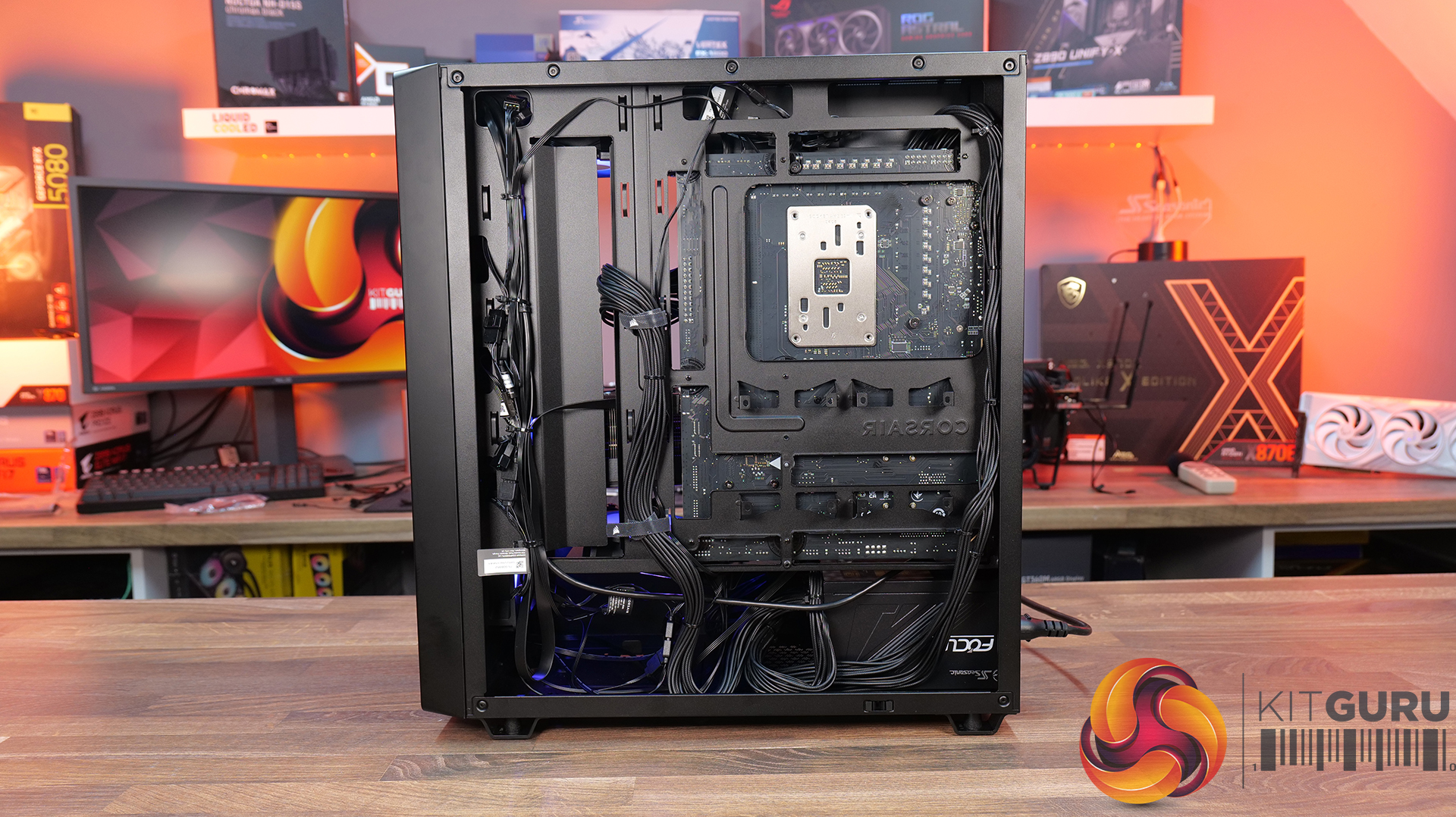
Reverse-Connector Motherboard Support – Compatible with reverse-connector motherboards, helping create clean builds with minimal visible cabling.
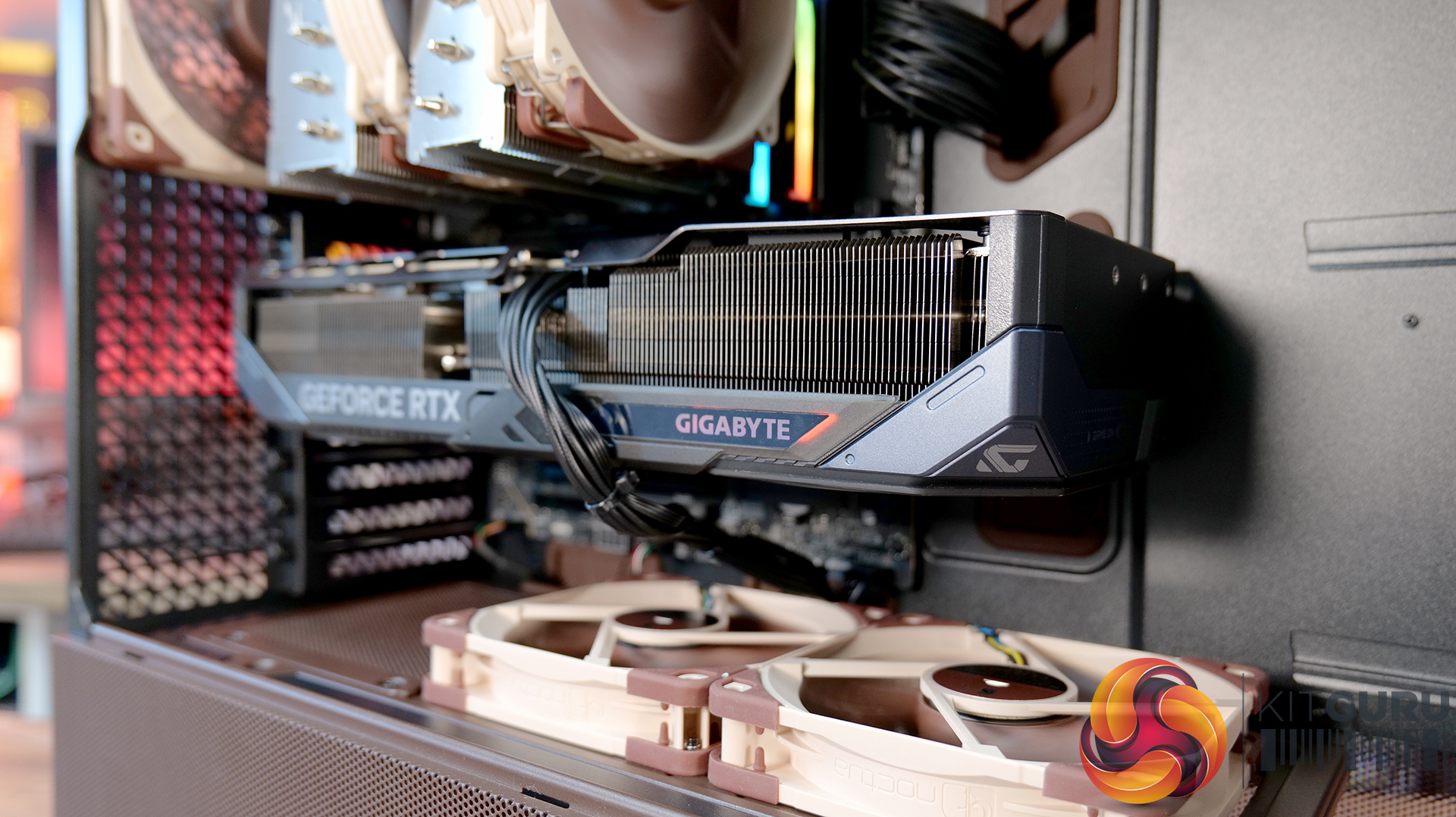
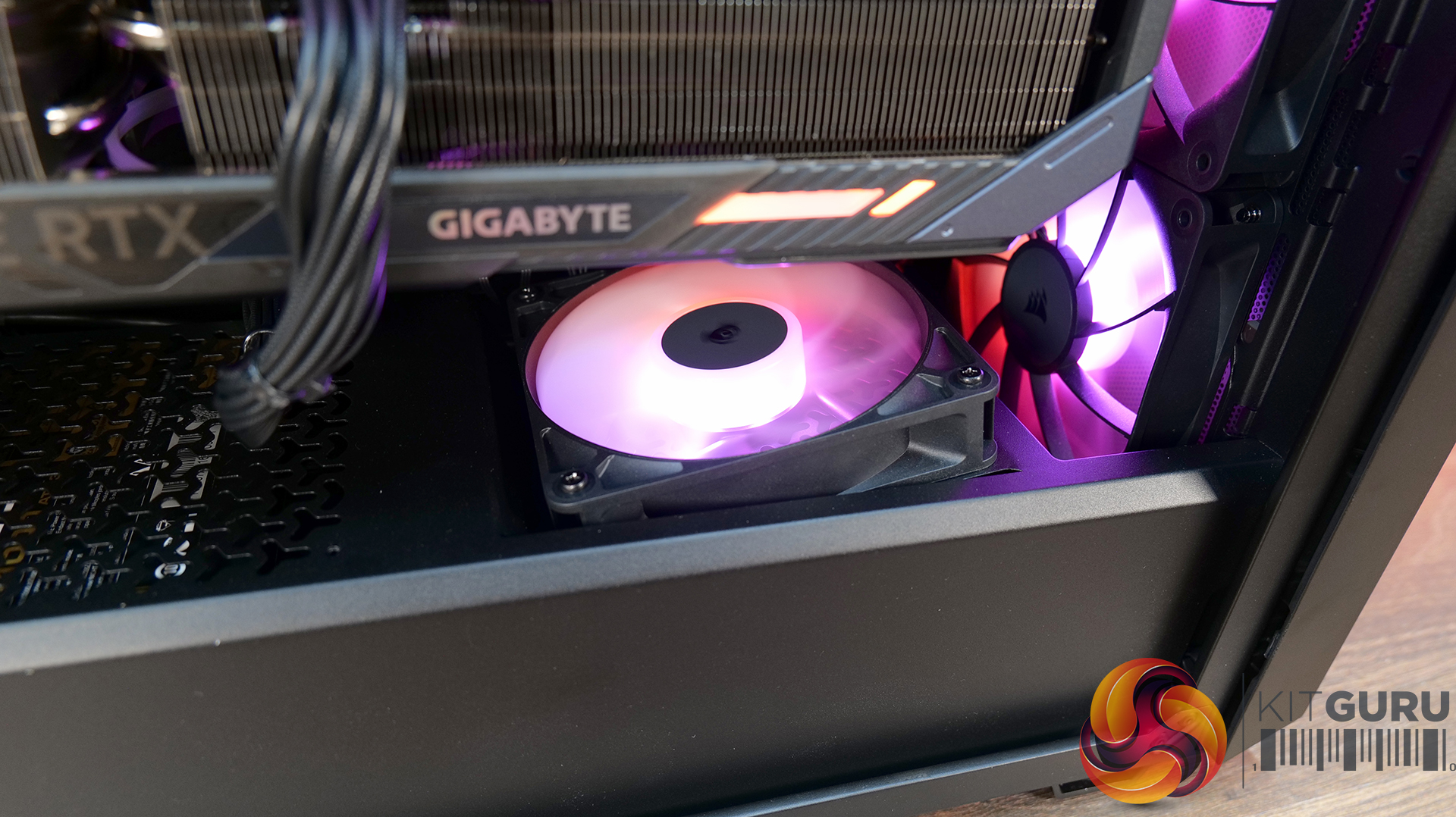
GPU-Focused Design – Includes a built-in GPU anti-sag stabilisation arm and angled PSU-shroud fan mount to direct airflow toward the graphics card.
Specifications:
Case Type: ATX Mid Tower
Dimensions (LxWxH): 476 x 214 x 446mm
Materials: Steel, Plastic, Tempered Glass
Motherboard Support: ATX / mATX, Mini-ITX
Back-connect motherboard support: Yes
Expansion Slots: 7
Storage bays: 2 x 2.5” / 1 x 3.5”
Max GPU Length: 370mm
Max CPU Cooler Height: 165mm
PSU Type: ATX up to 180mm
Pre-installed Fans: 3 x RS120 ARGB(Front)
Fan Support: 3 x 120 / 2 x 140mm (Top), 3 x 120 / 2 x 140mm (Front), 2 x 120mm (Bottom), 1 x 120mm (Rear)
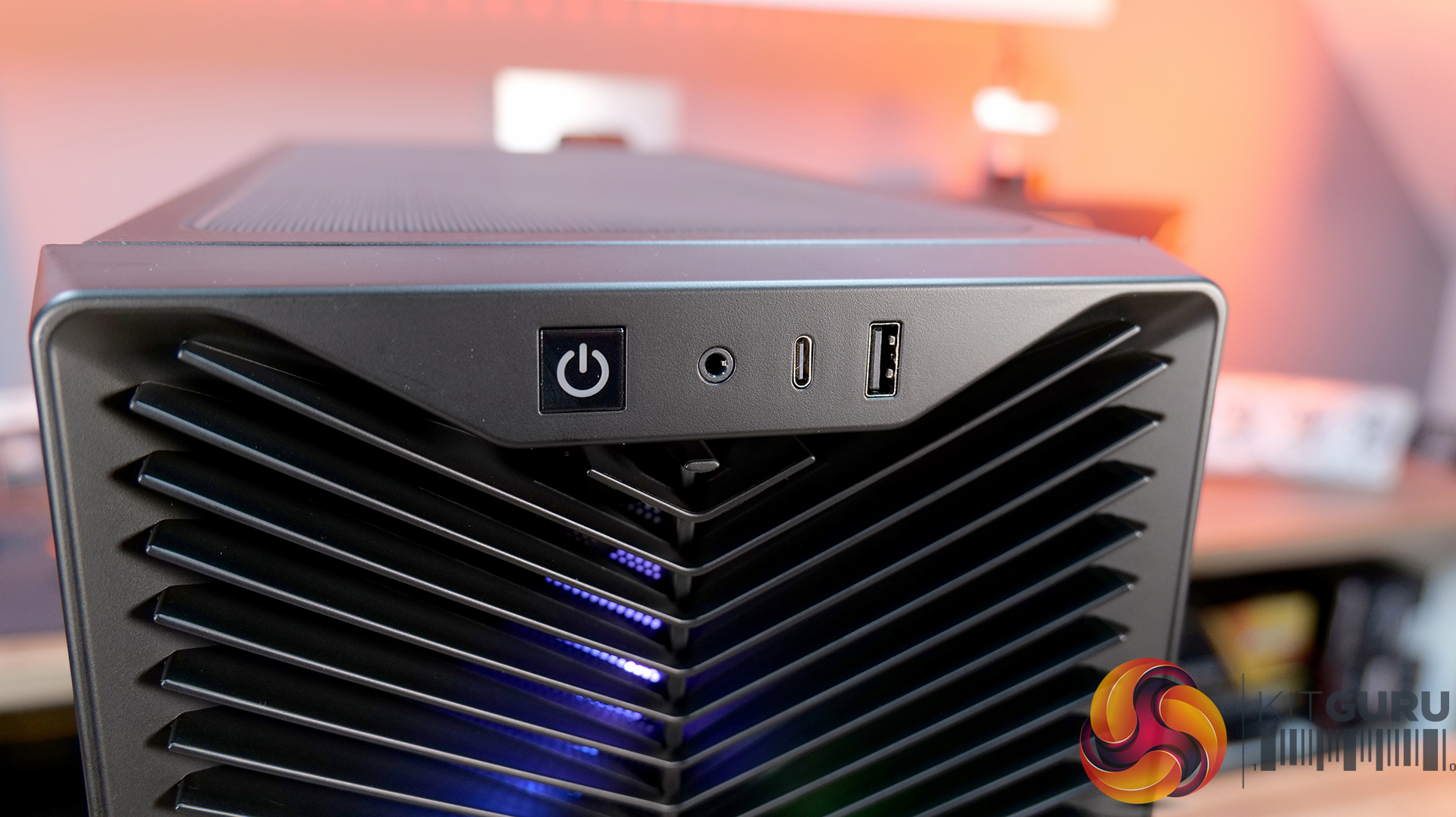
Front I/O: 1 x USB 3.2 Gen 2 Type-C (20Gbps), 1 x USB 2.0 Type-A, 3.5mm Audio and Mic Combo Jack, Power Button
LCD Screen: N/A
Thermal Performance Testing
To simulate thermal demand, we run the Cinebench R23 multi-thread benchmark and 3DMark Speed Way stress test simultaneously in a loop for 30 minutes to load the system fully. This gives the CPU and GPU enough time to reach constant steady-state temperature. With this data, we can compare how the system handles the thermal demand and measure peak noise levels.
Thermal performance is measured with the case in various configurations, such as the default, with the tempered glass left-hand side panel removed and with the front panel removed to see how these configurations affect the CPU and GPU temperature. During testing, only stock case fans are used unless otherwise specified. All water pumps are set to maximum RPM and fans are set to a custom RPM curve by the Motherboard software/BIOS.
All temperature measurements are presented as Deltas – meaning the ambient temperature has been deducted from the CPU temperature, giving us a Delta. Data shown in the charts represents the average component temperature over the length of the test as measured by HWiNFO, and then the last 15 minutes of the data are calculated to get the average. The ambient temperature during thermal tests is between 19-20⁰C.
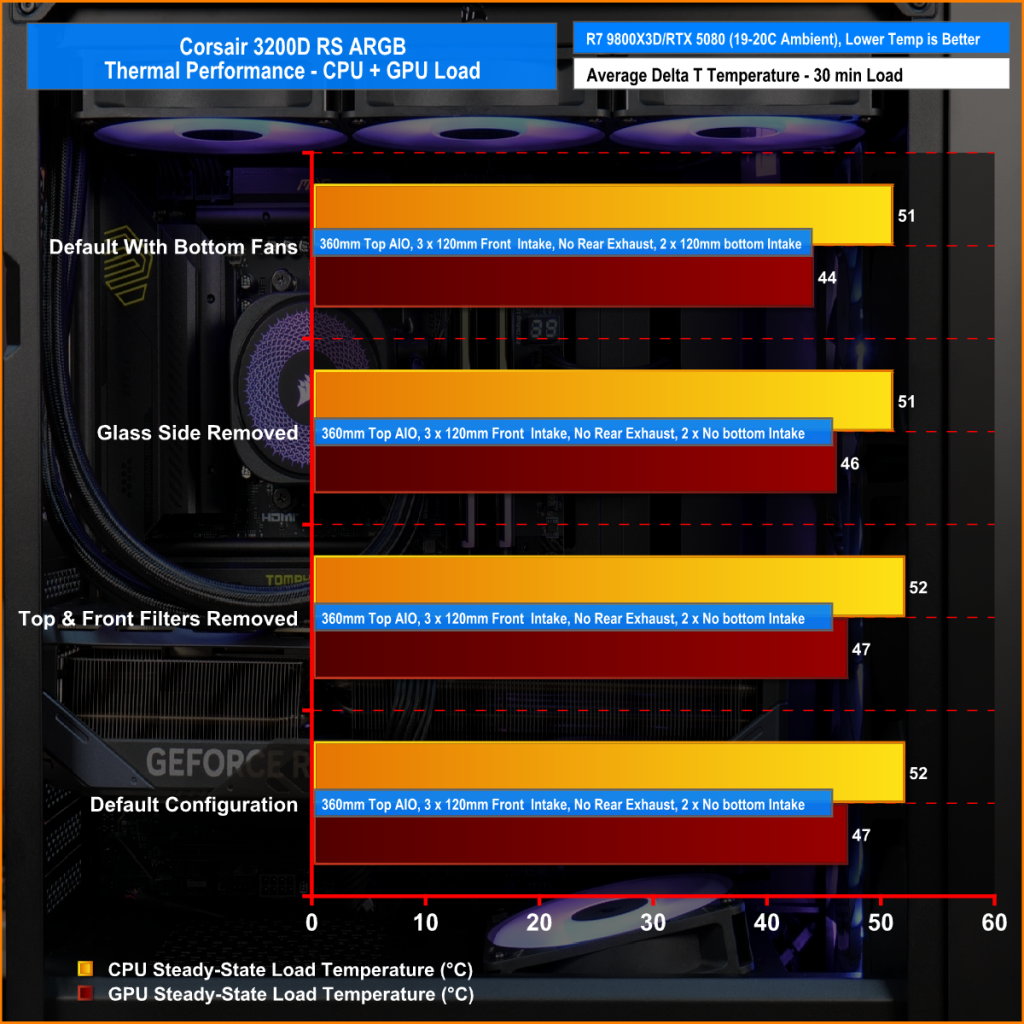
We tested the case thermals with a 360mm AIO as the exhaust at the top and in several different configurations. The default configuration shown in the charts is with the 360mm AIO at the top, 3 x 120mm RS ARGB fans at the front as intake and with all panels installed.
Looking at the thermal results, the 3200D performs consistently across all of our test configurations. With the case in its default setup, we saw CPU temperatures of 52°C and GPU temperatures of 47°C above ambient, which are solid out of the box results.
Removing the glass side panel or the dust filters doesn't make a meaningful difference, suggesting airflow through the chassis is already quite unrestricted by default. Interestingly, adding bottom fans shaves a few degrees off the GPU temperature, dropping it to 44°C, which shows that directing airflow toward the graphics card can provide a small benefit.
Noise Output
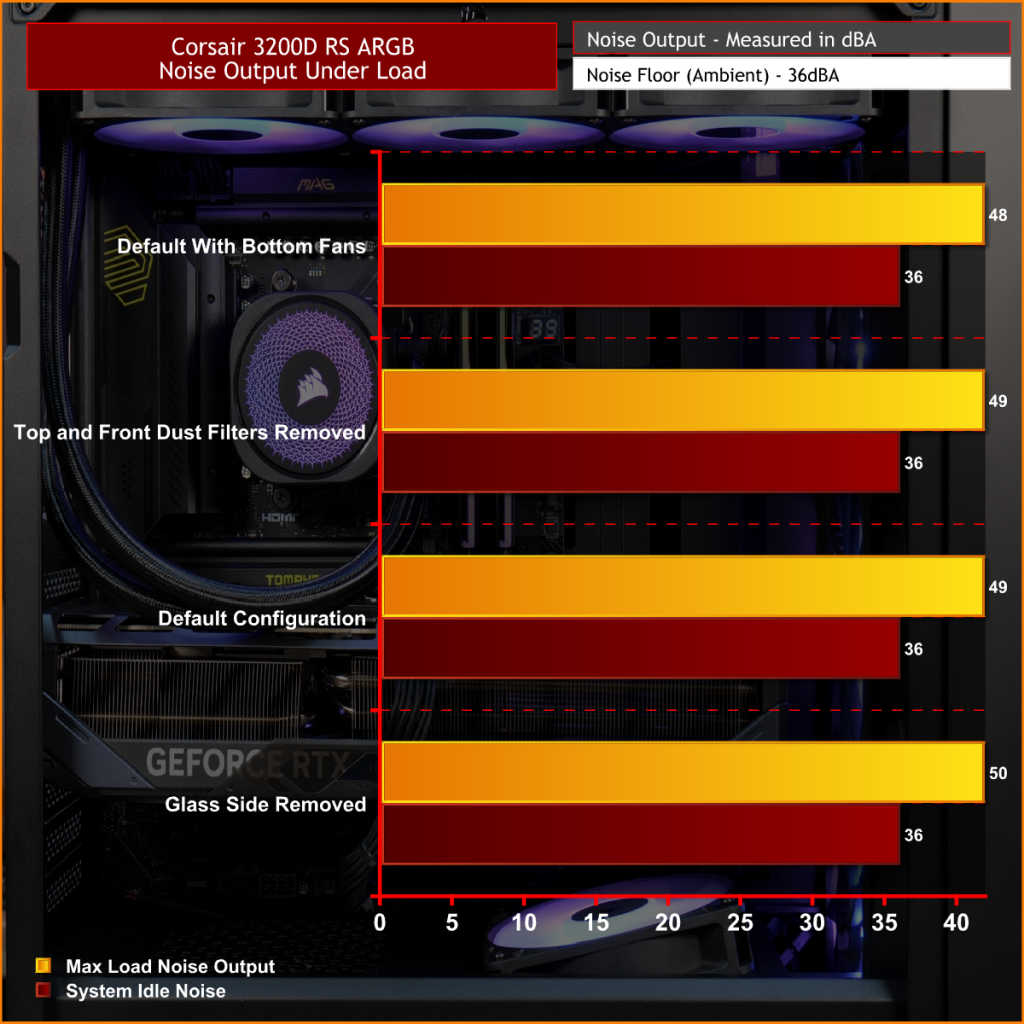
Moving on to noise output, results are again consistent across the different configurations. In the default setup the system measures 49 dBA under full load, while idle noise sits at a steady 36 dBA regardless of configuration.
Removing the dust filters or the glass side has little impact, with load noise varying only slightly from 49 to 50 dBA. The configuration with bottom fans installed produces the lowest load noise at 48 dBA, suggesting the additional airflow allows the GPU fans to work a little less aggressively under load, lowering overall system noise.
Closing Thoughts
Taken as a whole, the Corsair 3200D is a solid addition to the affordable airflow-focused case market. In our testing it delivers strong thermal performance with little variation in performance across configurations, so the case is well optimised for airflow and cooling straight out of the box. Build quality is also impressive for the price point, with a sturdy overall feel and a generally clean, understated design that should appeal to a wide range of consumers.
Hardware support is positive too, as the case manages to squeeze in high-end components despite its fairly compact mid-tower footprint. There’s room for large graphics cards, decent CPU cooler clearance, 360mm AIOs and support for several motherboard formats, which helps make the 3200D a flexible platform for mainstream gaming builds. While the interior layout does involve a few compromises due to the case dimensions, overall it still offers a fairly straightforward building experience.
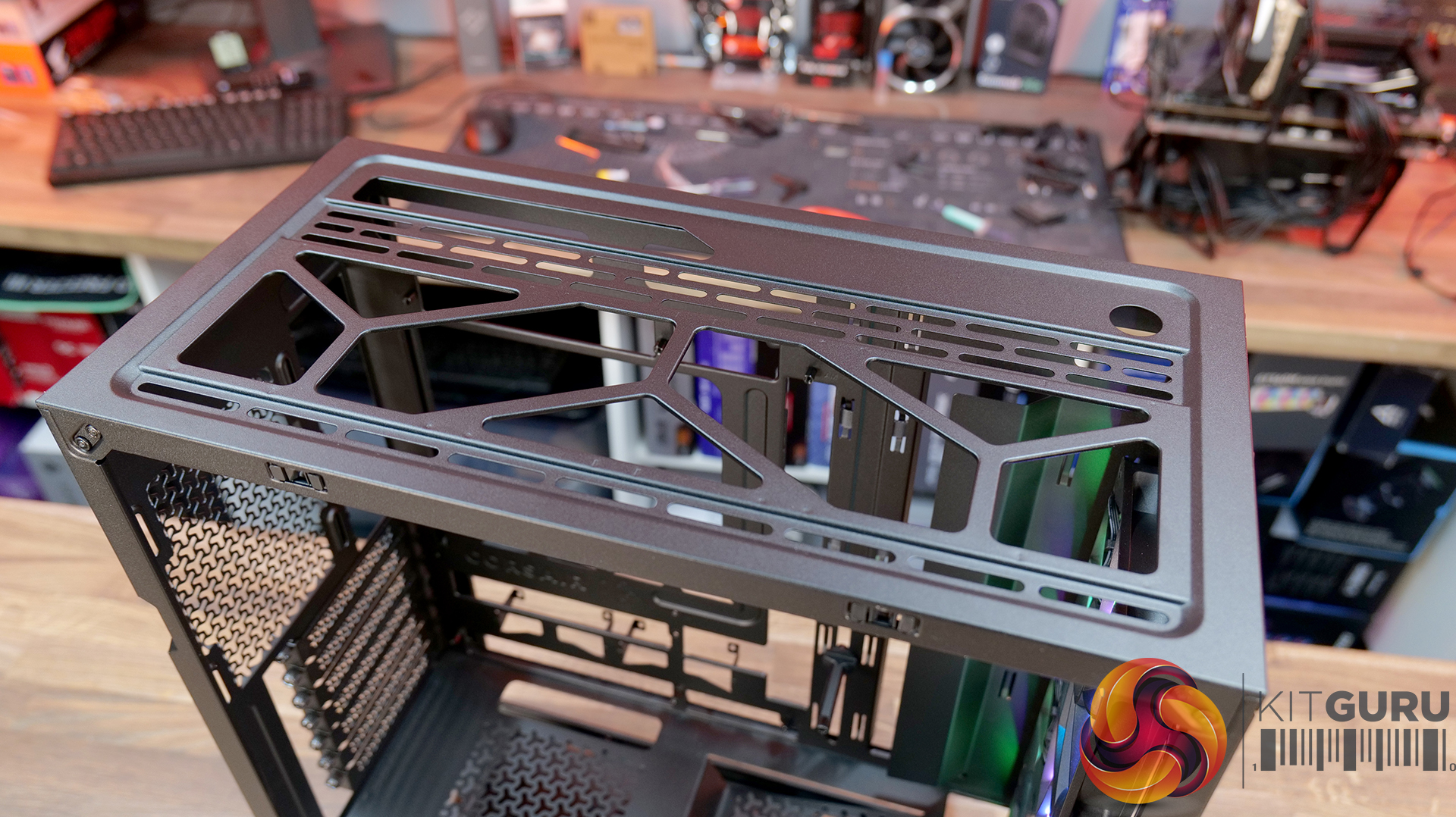
That said, there are a few areas where the design feels slightly underdeveloped. The 360mm top radiator support is there technically, but compatibility can be limited depending on radiators and fan size, plus installation itself is a little awkward without a detachable top panel or radiator/fan bracket. Similarly, the front I/O feels somewhat dated with the inclusion of a USB 2.0 Type-A port, where a USB 3.0 connection would make more sense for a modern chassis. This could come down to the choice of reverse connector motherboard support and tight right-hand side clearance for cable management, although Corsair suggests otherwise.
There are also some smaller usability quirks to be aware of. The included GPU support bracket may not work with some graphics cards, particularly those with fans that extend lower than the shroud, plus there's no fan/ARGB hub included. However, these drawbacks don’t completely undermine what the Corsair 3200D does well. With strong airflow performance, solid build quality and good overall hardware support, it remains a capable budget builder-friendly case – even if a few design tweaks could have made it a much stronger contender.
The Corsair 3200D RS ARGB is has an MSRP of £79.99 here in the UK.
Pros:
Strong airflow and cooling,
Solid build quality at this price point.
Good hardware support for its size, even with the compromises with a top 360 rad.
Cons:
Top 360 radiator compatibility is limited, and installation can be awkward.
USB 2.0 Type-A should be upgraded to USB 3.0.
No detachable top rad/fan mount.
GPU support bracket not compatible/interferes with fans on some graphics cards.
No fan/ARGB hub included.
KitGuru says: Corsair almost nailed it with the 3200D, it has great cooling potential and hardware support, but some extra attention to detail would have resulted in a more well-rounded case.

 Login
Login