Reading view

There are new articles available, click to refresh the page.

Samsung Eyes An Opening In China’s Dwindling Smartphone Market By Using CXMT Memory, But The Latest Report Has The Completely Wrong Idea About Pricing

Samsung reportedly wants to use CXMT DRAM chips to enter China

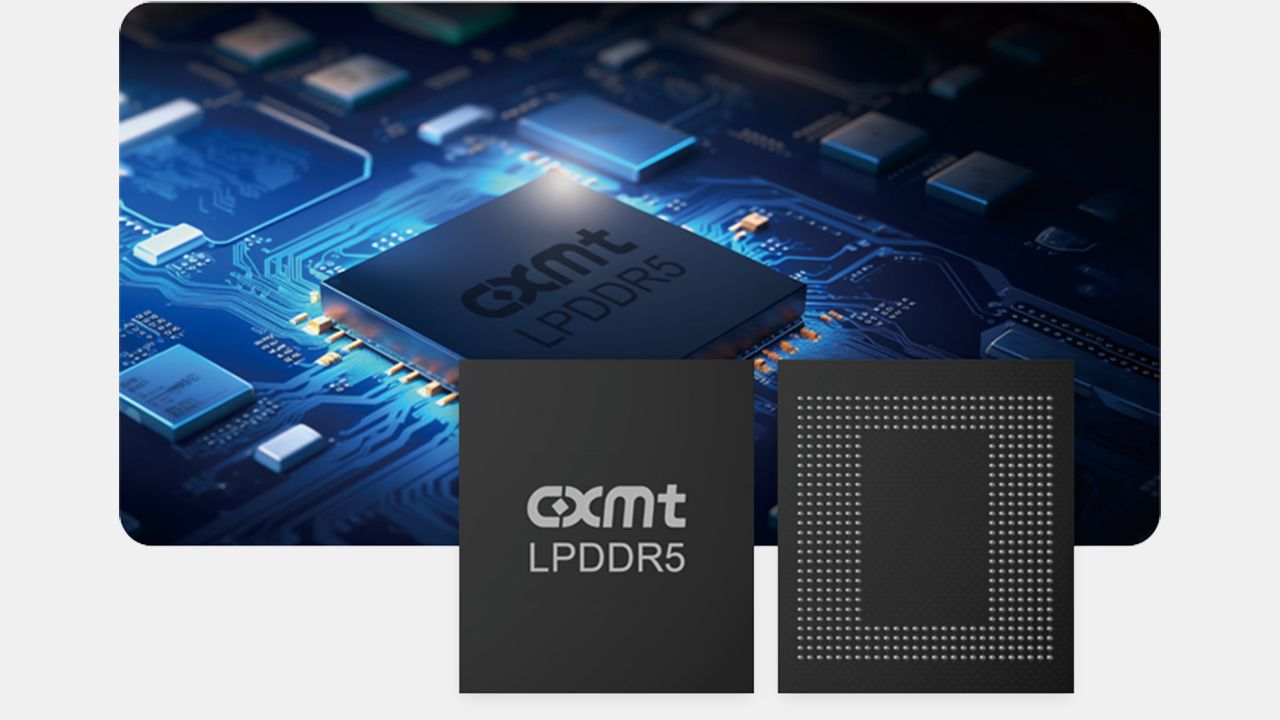
As Chinese smartphone brands cut smartphone shipments in the wake of the DRAM shortage, Samsung reportedly targets an opportunity to raise its tally in a market that it has struggled to penetrate for years. To achieve this, a new report states that the Korean giant will resort to using CXMT’s DRAM chips, which are said to be cheaper, but that’s where the misconception should end. CXMT’s DRAM chips are anything but cheap; Samsung still has a chance to enter China’s smartphone market A report from Asia Times claims that Samsung is considering the use of “low-cost” Chinese DRAM as the […]

Read full article at https://wccftech.com/samsung-china-smartphone-market-cxmt-memory-pricing/

Chinese CXMT DRAM doesn't look like the budget savior many were expecting — new modules enter the market, but prices still track the big three

One of the common misconceptions in today's memory market is that once memory modules based on chips from CXMT enter the consumer market, there will be cheaper alternatives to memory sticks running DRAM from the Big Three. While availability of CXMT-powered modules certainly impacts average selling prices, these products are not cheaper than those based on ICs from Micron, Samsung, and SK hynix even in China, as noticed by @harukaze5719.

A 64GB DDR5-5600 RDIMM based on memory from Samsung or SK hynix costs 18,595 CNY ($2,745) at JD.com, whereas a module featuring the same capacity and specification, but using DRAMs from CXMT is priced at 18,999 CNY ($2,805), according to observations by @harukaze5719. It is noteworthy that a Samsung 64GB DDR5-5600 RDIMM made by Samsung and sold by Samsung costs $2,425 at Amazon.com in the U.S.

While the $60 difference seems significant, it is really just 2.2%, which can be considered negligible at these sky-high prices. Nonetheless, many expect CXMT-based memory modules to be cheaper than those carrying chips from Micron, Samsung, or SK hynix, so observing that they are even a bit more expensive than offerings with ICs from renowned manufacturers may be a bit surprising.

Indeed, because CXMT produces memory chips using an outdated fabrication technology, its DRAM ICs consume more power than those made using the latest manufacturing processes, have lower performance potential, and mediocre overclockability. Furthermore, the Chinese government heavily subsidizes both ChangXin Memory Technologies and Yangtze Memory Technologies (YMTC), which enables both to sell their memory at lower prices although their actual costs may be higher compared to those of the Big Three.

As a result, it is reasonable to expect CXMT to charge less for its chips compared to chips from renowned producers. Truth to be told, we do not know CXMT's quotes, they may be as high as those from other manufacturers and the only reason why module producers buy them is that they are the only chips available. Furthermore, companies tend to price products based on what the market will bear, not strictly on production cost or their characteristics. In fact, as everyone is capacity constrained these days, there is little incentive for CXMT to price its DRAMs significantly below those from renowned makers. However, while CXMT may indeed charge less for chips (e.g., because the Chinese government issues an appropriate directive), this lowers costs for module makers, but has a limited effect on retail prices of actual DIMMs or RDIMMs.

Whether potential savings reach end customers depends on market competition, supply-demand conditions, and the pricing strategies of module makers, distributors, and retailers. Furthermore, when prominent companies like Apple, Dell, or Corsair use a memory chip SKU, this one must pass rigorous validation processes and is usually tested in-house, or by contract manufacturers, which adds to costs and somewhat erases the price difference between suppliers.

As a result, CXMT memory chips may make the lives of hardware makers easier, but are not expected to impact the retail prices you pay.

RAM thieves in China jailed after looting a string of eSport hotels — stole 16 sticks worth $2,000 in 'frenzied hotel room-dismantling'

A man by the name of Li and his partner by the name of Cheng have been arrested for a string of RAM stick thefts from various hotels in China where gaming PCs are standard room equipment. This was a pretty small-time operation, with a total of ~ 13,200 yuan (about $1,950) raised by selling 16 stolen RAM sticks on the second-hand goods market. However, the source describes the accused thieves as purveyors of "frenzied hotel room-dismantling" (machine translation).

According to the report, Li began his tech treasure crime spree in May, in Shihezi City, Northern Xinjiang. After checking into an eSports hotel, the light-fingered Li couldn’t resist plucking a pair of RAM sticks from the in-room computer. The solo RAM thief’s initial success spurred him to recruit a partner, and in the second two weeks of May, the dynamic RAM duo of Li and Cheng swept through multiple hotels in the aforementioned “frenzied” fashion.

The crime spree might be one of the first of its kind we’ve read about, but it wouldn’t make the thieves filthy rich. The source notes that 16 RAM sticks in total were taken from eSports hotels during the two-week criminal spree. They would sell the slyly stolen sticks of silicon for a total of ~ 13,200 yuan (about $1,950) in profit via a mix of online marketplaces and brick-and-mortar stores.

In the Chinese language report, it is noted that subsequent guests at the eSport hotels complained about systems with black screens, unable to boot. Customer complaints led to investigations by hotel staff, and the police were called out once the DRAM dirty deeds were definitive. Perhaps the duo would have been more successful if they had decided to just halve the RAM in the raided PCs. Guests who followed them would be less likely to loudly complain about RAM-deficient PCs than completely dead ones.

The Chinese media report ends by saying Li and Cheng are both in custody, with further investigations into the pair’s RAM piracy ongoing.

China’s CXMT Now Charges More Than Samsung For DRAM As Memory Demand Skyrockets, Even Denying Relief To Huawei

A CXMT DDR5 memory module is displayed against a blurred background.

CXMT is now charging more for memory than the big three DRAM makers as demand swells in China's domestic AI markets. CXMT Benefits Big Time From DRAM Crisis By Charging Hefty Premium For Its Memory Products Most global media outlets were under the impression that CXMT was going to be the "Cheaper Alternative" to Samsung, SK Hynix, and Micron, who are asking big sums of cash for their DRAM products, but that wasn't the case. In our exclusive, we reported that CXMT's advantage was not in its price, but in its supply, and that remained true; demand skyrocketed 10-fold, and […]

Read full article at https://wccftech.com/china-cxmt-charges-more-than-samsung-for-dram-as-memory-demand-skyrockets/

CXMT’s 64GB Server DDR5 Memory Chip Is Now Pricier Than Samsung’s, As It Races To Increase Capacity To 600,000 Wafers Per Month

Two RGB-lit KingBank RAM modules are displayed in front of a neon-lit background featuring the 'CXMT ChangXin Memory Technologies' logo.

CXMT's ideology is fast becoming wholly mercantile as it appears to have adopted the same price gouging tactics that are now the bread and butter of its 'Big Three' counterparts - Samsung, SK hynix, and Micron. CXMT's 64GB server DDR5 module now costs more than Samsung's $1,240 comparable offering According to Reuters, Chinese memory makers are now being picky about clients and dictating their own prices, which indicates their strengthened negotiation position. In what is a striking anecdote, CXMT abruptly evicted engineers affiliated with SiCarrier - a Huawei-linked equipment vendor - from its fabrication facility in Hefei. The engineers were […]

Read full article at https://wccftech.com/cxmts-64gb-server-ddr5-memory-chip-is-now-pricier-than-samsungs-as-it-races-to-increase-capacity-to-600000-wafers-per-month/

Gigabyte announces support for Chinese-made CXMT memory — pushes it to 8200 MT/s on Socket AM5

You're probably already well aware of the three largest memory vendors: South Korea's SK hynix and Samsung, and the United States' Micron. There's a fourth player up and coming in the market, though, and that's China's ChangXin Memory Technologies, more commonly known as CXMT. CXMT is pumping out RAM as fast as it can to soften the effects of the RAMpocalypse on domestic (to China) consumers, and it's also expanding capacity quickly. Given these factors and the size of the Chinese market, it should come as no surprise that motherboard vendors, including Gigabyte, are advertising fresh support for the chip.

MSI appears to have been the first major motherboard vendor to publicly promote BIOS optimizations specifically for CXMT DDR5 memory, initially through China-market BIOS releases and later with global announcements. What Gigabyte is saying is a little different: not only is CXMT RAM supported on Gigabyte motherboards for both AMD's Socket AM5 and Intel's LGA 1851, but it's supported at impressive speeds of up to 8200 MT/s on select boards.

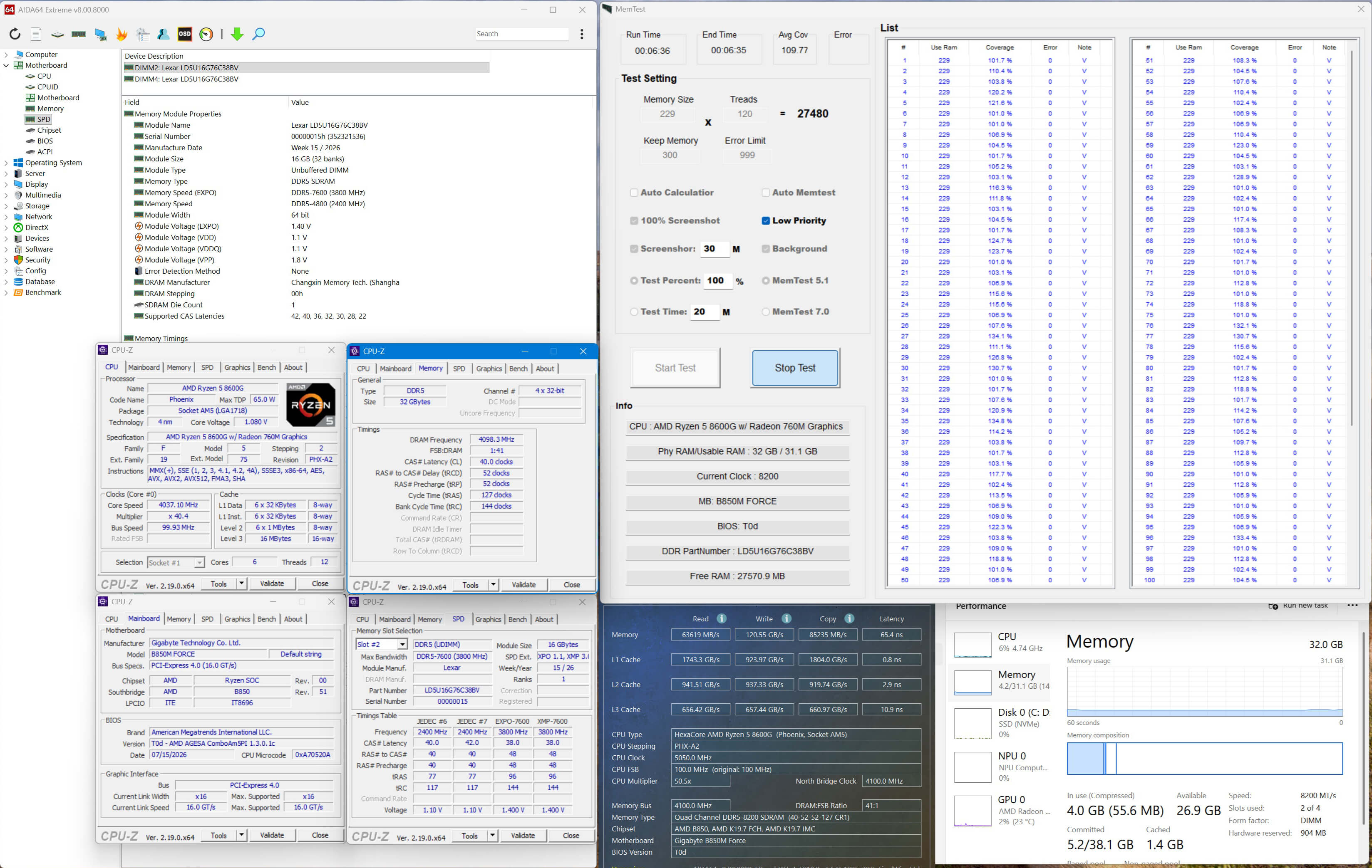
A composite screenshot showing many windows displaying memory overclocking success.

Click to zoom in if you want a hope of reading this screenshot. (Image credit: Gigabyte)

As proof, Gigabyte offers up a CPU-Z screenshot showing a pair of 16GB Lexar modules equipped with CXMT chips achieving a speed of 8200 MT/s with a CAS latency of just 40 cycles on one of its B850M FORCE motherboards. We have to remark that Gigabyte doesn't show the voltage required to hit these speeds, likely for good reason, but the firm did it without disabling the chip's integrated graphics. That doesn't prevent the chips from posting an excellent AIDA64 latency of just 65.4 nanoseconds on the monolithic Ryzen 5 8600G used for the test. For context, typical EXPO kits usually run around 80ns, JEDEC timings are more like 100ns, and LPDDR-based systems rarely come below 110-120ns.

As Gigabyte says, "CXSH (CXMT) chip-based memory offers a welcome additional source of supply for consumers." (CXSH is the JEDEC manufacturer ID code for CXMT) Gigabyte specifically notes that it is modules with 16-gigabit and 24-gigabit ICs that are supported; that means 16GB and 24GB single-rank modules, or 32GB and 48GB dual-rank modules.

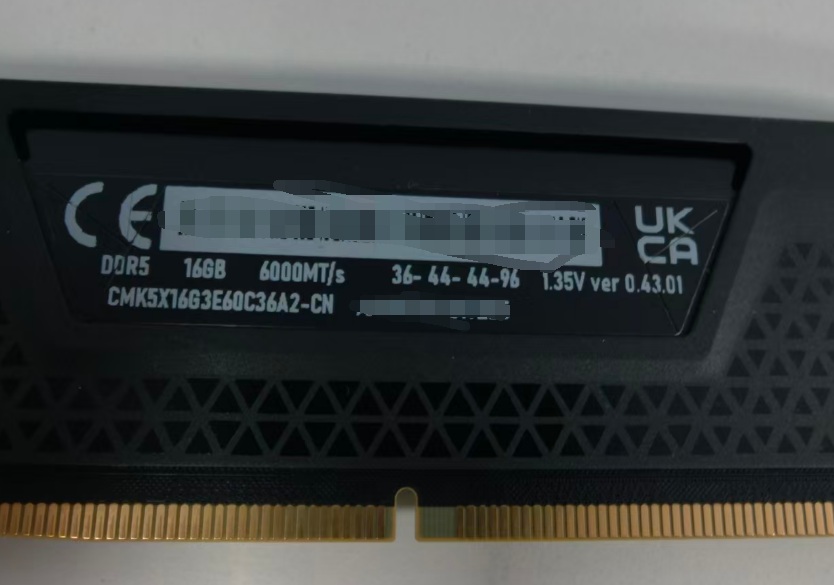
Corsair Vengeance DDR5-6000 memory module with CXMT chips inside

This Corsair module has CXMT chips inside, but it's also exclusive to China. (Image credit: @wxnod on X)

While CXMT memory is certainly a welcome additional source of supply, it's also not really clear how much of that memory is actually making its way outside of China, particularly to the US and Europe. CXMT isn't on the US Commerce Department's "Entity List" yet, so the firm's parts aren't actually banned, but the company is once again considered a Chinese military company by the Department of Defense after being briefly removed from the 1260H list in February. Lawmakers here in the states, likely laden with donations from the big three memory firms, want to see CXMT banned, while US tech companies like Corsair, HP, and Dell are already integrating ChangXin RAM into their products, and Apple wants in, too.

The reality is that, as a DIY builder, you are fairly unlikely to know or care if your memory is manufactured by CXMT. You don't usually buy RAM directly from SK hynix, Samsung, or Micron (certainly not since Micron unceremoniously executed Crucial); you buy your RAM from Silicon Power, G.SKILL, Patriot, Corsair, or one of the many other vendors who assemble DIMMs. If the RAM runs at its rated specifications, there's not a lot of reason for the individual consumer to care where it came from. It's nice to hear that the new chips are officially supported by familiar mainboards, though.

Memory Shortage Chokes The PC Market Into A 4% Q2 Decline, Leaving Only ASUS And Apple Growing

The PC market continues to struggle due to memory shortages, with the latest stats reporting a 4% decline in Q2 2026 as prices continued to climb. ASUS & Apple Were The Only PC Makers Who Saw Share Growth In Q2 2026 But Continue To Struggle Due To Memory Shortages The latest market statistics from Counterpoint Research for Q2 2026 are in, and show that the PC market declined 4% in Q2 2026 versus the prior year. PC shipments reached 65 million units, which broke the growth trend that started in Q1 2025, but have since been on a decline as […]

Read full article at https://wccftech.com/memory-shortage-chokes-pc-market-into-a-4-percent-q2-decline/

NVIDIA Reportedly Increased GDDR6 And GDDR7 Kit Prices For Its RTX GPUs

GPU Vendor Reveal The Reason For Higher NVIDIA RTX 50 Series Costs; Says GPU & VRAM Combo Makes Up To 80% Of Total Cost 1

Another substantial price hike is incoming as the green team has supposedly raised prices for its memory kits. NVIDIA RTX GPUs to See Another Price Hike as the Company Reportedly Passes Increased Memory Kit Costs to its Board Partners The GPUs continue to suffer from the instability caused by DRAM availability and pricing. NVIDIA and AMD have adjusted the prices of their current-gen GPUs multiple times already, and it looks like there is another price hike incoming in the coming days. Since both manufacturers source memory from major suppliers, they have no option but to pass the increased costs to […]

Read full article at https://wccftech.com/nvidia-reportedly-increased-gddr6-and-gddr7-kit-prices-for-its-rtx-gpus/

HBM’s & DRAM’s Importance Is Waning; Here’s The Silent Upgrade AI Giants Are Racing To Buy Before the Next Big Wave Hits

An AI upgrade that'll overshadow HBM and DRAM

As hyperscalers continue to increase their massive investments to boost capacity, there’s a growing realization that risks their lofty ambitions: power consumption, physical space constraints, and rising prices of HBM and DRAM memory that’ll only creep up due to stagnant capacity. Fortunately, a new report dives into a new component that’ll help accelerate hyperscalers’ goals, and with the ever-expanding capacity, this part will become a key player in this particular industry. Samsung & SK hynix are leading the high-capacity QLC eSSD market, helping to lift the burden from AI data centers as HBM and DRAM become the inference bottleneck We’ve […]

Read full article at https://wccftech.com/hbm-and-dram-important-waning-ai-giants-are-racing-towards-this-upgrade/

AI memory shortage is now increasing the price of cars — GM warns of vast cost increases, BYD hikes driver assistance prices 20%

While PC builders, enthusiasts, and gamers are some of the most heavily affected by the AI-driven memory chip shortage, experts have also been warning that this will eventually hit the automotive sector. It seems that their fears have come true, as Nikkei Asia reports that two major automakers are increasing their prices precisely for this reason. General Motors said that it expects new vehicle prices to increase by 0.3% this year, changing its previous projection of vehicle costs to remain the same or even slightly more affordable. On the other side of the world, Chinese automotive giant BYD has also raised the prices of the driver assistance features by 20%, which it sells separately from its models. South Korea’s Hyundai also called on domestic chip manufacturers to strengthen the local supply chain.

GM Chief Financial Officer Paul Jacobson said during the carmaker’s earnings call that GM expects its costs to increase by $1.5 to $2 billion, which is mostly driven by increasing prices of vehicle components, especially DRAM. While most people wouldn’t equate cars with memory chips, the increasing number of features and technologies that buyers expect from new models means that engineers and designers must add more memory compared to models from the past.

Micron said in 2023 that the average vehicle used 90GB of DRAM and NAND, and it’s expecting this combined requirement to jump to 278GB by 2026, with high-end models requiring up to 2TB. A British OEM broke down the memory requirements of vehicles released this year — infotainment systems require between 4GB and 16GB, ADAS and safety systems need 8GB to 32GB, while centralized systems often have a minimum requirement of 16GB and could go as high as 64GB or more. And as AI assistants start becoming available on cars, these systems will require at least 256GB of memory. In fact, Micron predicts that cars with level 4 autonomy will need at least 300GB of RAM, as they’re essentially supercomputers on wheels.

Note that automotive memory isn’t just any high-end chip that you can get from wafer production lines. Instead, these are specialized parts that take months or years to be validated for vehicle use. That’s because they must withstand various environmental factors that cars go through, from weather and constant road vibrations to extreme heat and cold.

All this means that the current memory chip shortage will have an outsize effect on the automotive industry and push prices even higher. This is bad news for the average car buyer, who is already facing record-high prices for new vehicles. And if the chip shortages continue, we might experience delays in vehicle deliveries and a lack of availability worse than what we experienced in 2021 during the height of port closures due to the pandemic.

Steam Deck sales see massive drop following price hikes

While Valve doesn't share specific sales numbers for any of its products, it would seem that the recent Steam Deck price hikes have had a meaningful impact on sales. According to a new report, sales may have dropped by as much as 80%. 

Valve raised the price for its Steam Deck OLED models a couple of months ago due to massively inflated costs for components like RAM and SSDs. As a result, the 512GB and 1TB models both rose in price by more than 40%, with a 1TB Steam Deck OLED now costing over $900.

As spotted by TechPowerUp, estimates from Boiling Steam show that the Steam Deck may have dropped from selling up to 18,000 units per week to up to 3000 units per week in July. Revenue generated by Steam Deck sales may have dropped by as much as 80%, as the system has continued to drop in the Steam Sale charts, after being a consistent top ten seller since launch.

Unfortunately, the likelihood of Steam Deck prices coming back down to normal levels is low. Valve has warned that memory prices are still getting worse and the prices consumers are seeing are lagging behind what OEMs like Valve are seeing by up to six months. If RAM and SSD prices continue to rise like Valve expects, then there is a chance that the Steam Deck and the Steam Machine end up becoming even more expensive over time rather than getting cheaper. This is something we have seen impacting the console market as well, with PS5 and Xbox Series X/S systems now costing hundreds of dollars more compared to their launch day prices six years ago.

KitGuru Says: The consumer tech market is in a very rough spot right now. Have your upgrade plans been put on hold due to current prices? 

The post Steam Deck sales see massive drop following price hikes first appeared on KitGuru.

SK hynix CEO Rings Alarm Bells: “Next Year Will Be The Worst Year In The Industry’s History From The Supply Perspective”

SK Hynix developing High Bandwidth Storage to boost AI performance in smartphones and tablets

If you think the ongoing memory chipflation-led mayhem in the consumer electronics sphere is the worst it gets, the CEO of SK hynix wants you to think again, especially amid consistent reports that the memory sphere will not enter into a supply-demand equilibrium for many years to come. The year 2027 will see wafer supply grow by 12%, but half of this growth will be consumed by HBM, limiting ex-HBM DRAM bit growth to 15% against a surge in demand of 22% To wit, SK hynix CEO, Kwak Noh-jung, has just projected that tougher times lie ahead even after the […]

Read full article at https://wccftech.com/sk-hynix-ceo-rings-alarm-bells-next-year-will-be-the-worst-year-in-the-industrys-history-from-the-supply-perspective/

Korean, US And Japanese Suppliers Race To Upgrade Fabs, Ending The NAND Flash Shortage In 2027

Finally, some good news after a long time. The ongoing NAND shortage is reportedly going to end next year. Noticeable Growth in NAND Supply to Put an End to Shortages by the End of 2027 as NAND Suppliers are Expected to Upgrade Production Lines While the DRAM market is expected to go through its worst-ever phase throughout the next two years, at the least the storage market is reportedly going to witness some relief. If you have been following the developments around the DRAM and NAND market, you might be aware that analysts predict instability for the next few years. […]

Read full article at https://wccftech.com/korean-us-and-japanese-suppliers-race-to-upgrade-fabs-ending-the-nand-flash-shortage-in-2027/

Samsung, Micron & SK hynix Are Treating Server Customers Like Royalty, Scrapping In-House DRAM Controllers For Standard Modules As Dread Sets In Over Billions Lost

Samsung, Micron and SK Hynix drop in-house DRAM controllers for server customers

As if the profits garnered from general-purpose DRAM weren’t enough for the three memory giants Samsung, Micron, and SK hynix, these companies also planned on deepening their pockets through the development of custom controllers for CXL (Compute Express Link), a next-generation technology designed to expand a server’s capacity. However, realizing that their lucrative customers won’t entertain spending a premium, the big three have reportedly abandoned development plans and are sticking with a universal input for standard DRAM. CXL controller design will now be handled by other companies, but Samsung, Micron, and SK hynix won’t pitch the idea if there’s zero […]

Read full article at https://wccftech.com/samsung-micron-sk-hynix-drop-in-house-dram-controllers-over-fear-of-losing-billions/

ADATA Chairman Warns DRAM Shortage Will Last Another 10 Years, Says AI Bubble Talk Can Wait Until 2040

Samsung's DRAM Division Finally Sees Profitiability After Years of Struggle 1

ADATA's chairman has said that there's no need to discuss the AI bubble yet since DRAM shortages will last another 10 years. Tech Markets Have Underestimated The Global Demand For DRAM and Memory Shortages Will Last At Least 10 Years, As Per ADATA's Chairman Following TSMC's recent stock decline after its earnings call, ADATA's chairman quickly responded to questions about whether this could be a signal of the AI bubble popping up. Chairman Chen Li-bai refuted this, and said that it's way too early to discuss anything related to an AI bubble, as that talk should only be discussed by […]

Read full article at https://wccftech.com/adata-chairman-warns-dram-shortage-will-last-another-10-years-ai-bubble-talk-can-wait-until-2040/

German DDR5 Memory Prices Explode To 448% Of July 2025 Levels As Every Kit Gets Swept Into RAMpocalypse

A set of GeIL DDR5 SPEAR V memory modules in black, gold, and silver with visible GeIL branding.

DDR5 RAM kits continue to see a noticeable rise in prices every month, and have now reached their highest levels ever. Germany Witnesses Nearly 7% Hike in DDR5 RAM Prices This Month, Higher Than Jan and Feb Levels DDR5 RAM prices are reaching ridiculously high levels this year. While January and February 2026 levels were already the worst in the memory market, July came with even worse prices ever recorded in history. This data might not represent the global pricing trend for DDR5 memory kits, but it's quite accurate when we compare the current DDR5 memory prices across various regions. […]

Read full article at https://wccftech.com/german-ddr5-memory-prices-explode-to-448-of-july-2025-levels/

Get This RTX 5070 For Just $579 At A Time When The GPU Sells For Over $650

A black graphics card with three fans is placed on a reflective surface with a colorful, gradient background.

The GPU has become quite expensive since RAMpocalypse started, but we have a rare deal that will let you grab the GPU close to its MSRP. PNY Lists GeForce RTX 5070 OC Triple Fan Card for Just $579, The Lowest it has Gone in the Last 90 Days It's incredibly difficult to find a GPU at MSRP due to the ongoing DRAM shortages, which have affected the PC hardware market significantly. Not just standalone RAM modules, but products that depend on the RAM chips are also selling for very high prices these days, including laptops, mini PCs, pre-built systems, and […]

Read full article at https://wccftech.com/get-this-rtx-5070-for-just-579-at-a-time-when-the-gpu-sells-for-over-650/

CXMT Debuts With $8.6 Billion IPO As Its DRAM Surge Chips Away At Samsung’s Market Dominance By 2028

A large, modern building with reflective glass and the 'GSMT' logo on the upper left corner.

CXMT is all set to tackle the "Big Three" in a significant way in the DRAM segment as it accelerates its memory product roadmap. DRAM Demand Turns CXMT Into A Major Memory Player, Gunning The Big Three With An Accelerated Roadmap Yesterday, CXMT made its stock market debut on the Shanghai STAR Board with an $8.6 billion IPO. While the company is valued at around $80-$85 billion, which puts it far below the $1.0 trillion that its competitors are valued at, the company is all set to tackle the "Big Three" big time with a roadmap that includes various products […]

Read full article at https://wccftech.com/cxmt-debuts-8-6-billion-ipo-as-dram-surge-chips-away-at-samsungs-dominance-by-2028/

❌