Reading view

There are new articles available, click to refresh the page.

TP-Link Fusion 2.5G Gateway Review (vs. Ubiquiti UCG-Max): A Valuable and Practical Omada-Enabled Multi-Gig Non-Wi-Fi Router

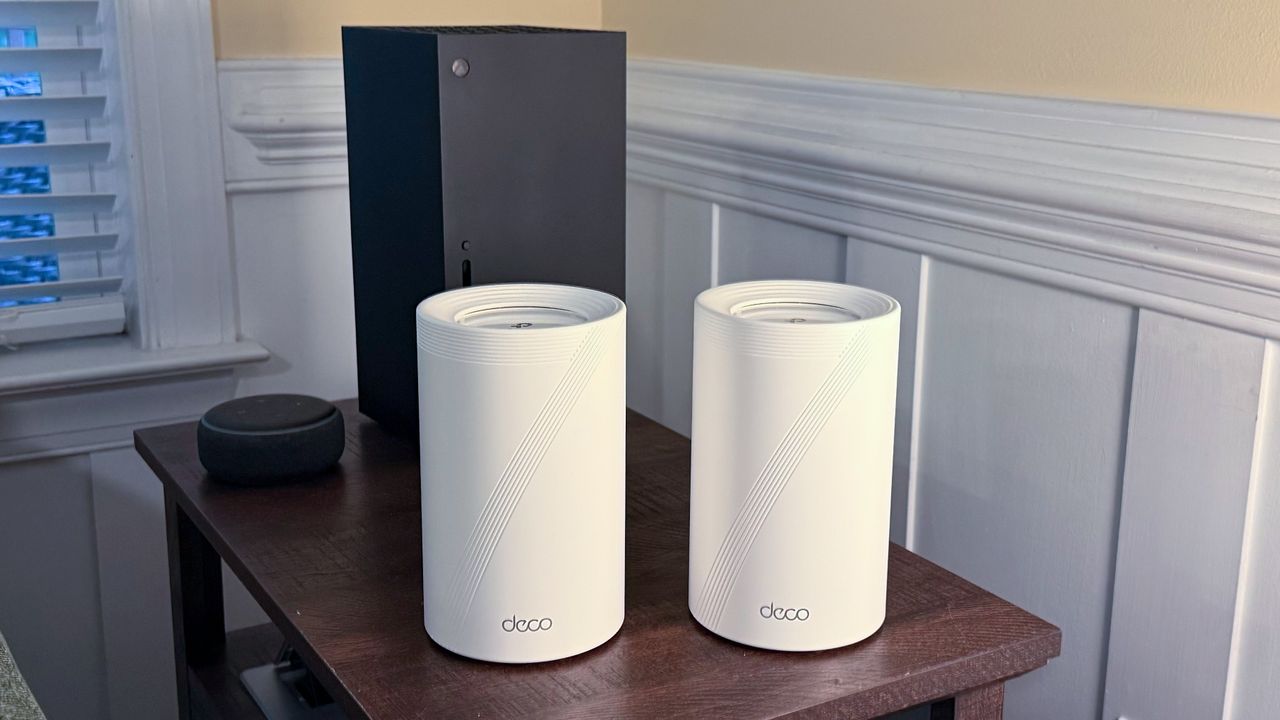
The Fusion 2.5G is an excellent addition to TP-Link’s Omada ecosystem. It represents TP-Link’s all-new Fusion Gateway lineup, officially launched on July 20, 2026, which simplifies hardware deployment by integrating an Omada hardware controller — similar to the OC300 — and a 2.5Gbps Multi-Gig router in a compact package. The ...

Continue Reading

Clever hacker fits 537,000 domains in a tiny $5 ESP32 ad-blocking dongle — firmware uses only around 50KB of RAM and can answer blocked lookups in 10 milliseconds

How cheap can you build a hardware-based ad-blocking DNS filter? "Free," if you're willing to salvage some used hardware that's being thrown away. What if you aren't so lucky? In the era of the RAMageddon, even a Raspberry Pi will cost you a couple hundred bucks. But you know, you don't even need something that powerful. In fact, you can use a $5 microcontroller to build a fully functional ad-blocking filter with over 500,000 domains blocked and around 10ms latency.

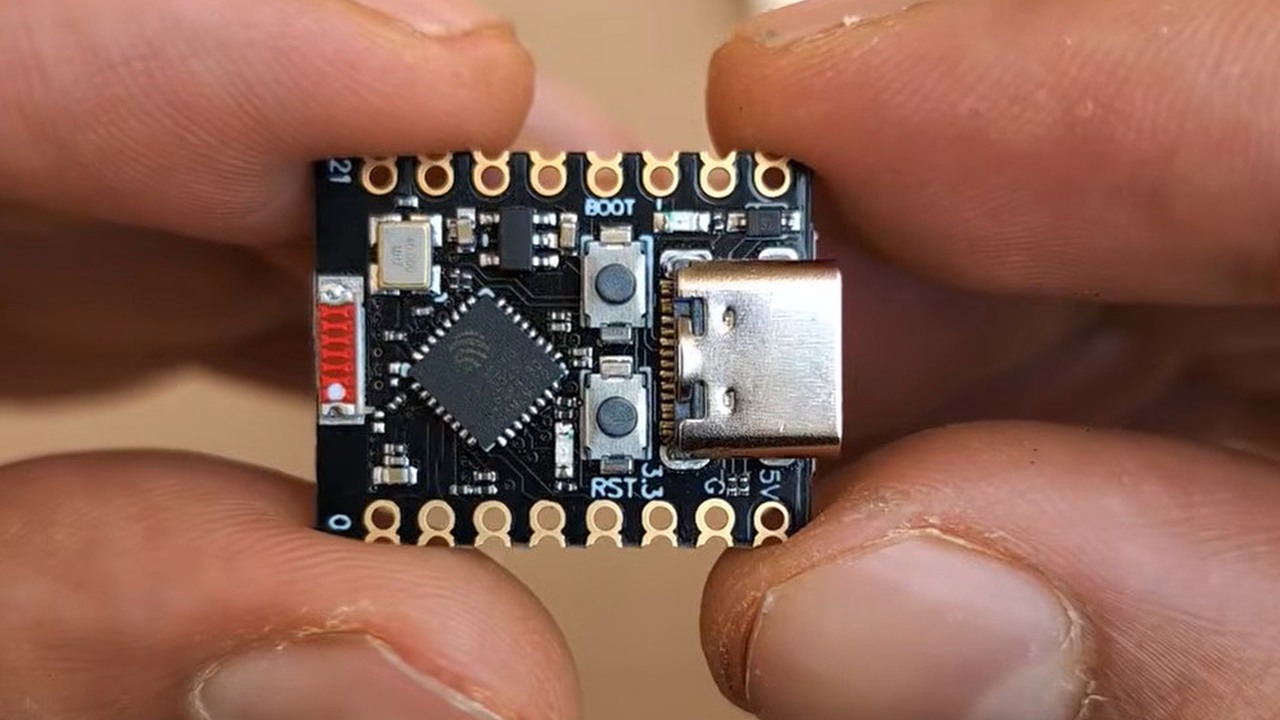
We know that's possible because Egyptian full-stack developer ZedAxis (@M-Abozaid on GitHub) has already built one. Using an ESP32-C3 "SuperMini" board, he's created a backup DNS for his home network that still provides ad blocking. His primary router is a Pi-hole, which is a Raspberry Pi running specialized software to manage DHCP addressing and DNS resolution with integrated ad-blocking. The SuperMini serves as a backup when the Pi-Hole is rebooting or otherwise unavailable.

A photo of the tiny ESP32 SuperMini board, bare of any casing.

The specific ESP32-C3 SuperMini board that ZedAxis used. (Image credit: ZedAxis/YouTube)

Strictly speaking, we haven't seen ZedAxis' creation in action, but there's no reason to believe it doesn't work. The ESP32 family of embedded Wi-Fi-enabled microcontrollers is a well-known quantity, and this functionality is by no means outside the realm of its capabilities. In fact, this specific trick allows the use of the ESP32-C3, which is a cost-reduced version of the chip that doesn't have the 8MB of PSRAM found on some higher-end models. (There are MANY variants of the ESP32.)

Instead, the ESP32-C3 used by ZedAxis has just 400KB of RAM, and 4MB of flash memory. With these limited specifications, he wasn't able to store a plaintext blocklist of any real size; it's simply too much data. So, he did what any enterprising hacker would do: he started hashing the data to reduce its size. Using 40-bit FNV-1a hashes, because 32-bit would give too many collisions and 64-bit wastes too much space, he can store some 537,000 domains in the flash memory of the device.

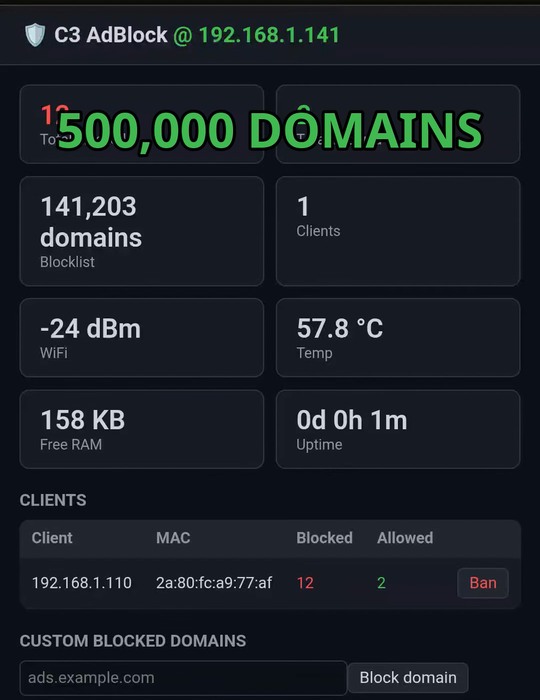
A screenshot of the rudimentary GUI for the C3 AdBlocker.

The project includes a rudimentary GUI where you can see some statistics and configure custom domains for blocking. (Image credit: ZedAxis/YouTube)

The clever part isn't really the hashing, though. Rather than storing the domains themselves, the build process downloads one or more public blocklists, strips out duplicate entries and comments, hashes each remaining domain into a 40-bit value, sorts the resulting list, and writes the finished database into the ESP32's flash memory. When a DNS query arrives, the device hashes the requested hostname the same way and performs a binary search against the sorted hash table. If it finds a match, the request is blocked. Otherwise, the query is forwarded to an upstream resolver. According to ZedAxis, the finished firmware uses only around 50KB of RAM while answering blocked lookups in roughly 10 milliseconds.

There's another neat compromise hiding in the design, too. The ESP32 normally reserves enough flash memory to hold two complete copies of its firmware, allowing over-the-air (OTA) updates without risking a failed flash leaving the device unbootable. If you don't care about wireless firmware updates, you can reclaim that second firmware partition for the blocklist database instead. With OTA support enabled, the project tops out at around 250,000 blocked domains. Give up OTA, and that jumps to roughly 537,000 domains on a microcontroller that you can usually buy for the price of a fast-food lunch. ZedAxis describes the price as $2; I wasn't able to find SuperMini boards any cheaper than about $5 US, but at that price there's not much need to quibble about the difference.

Of course, this isn't meant to replace a proper Pi-hole or AdGuard Home installation. The ESP32 project has a rudimentary dashboard, but it doesn't provide detailed per-client statistics, historical query logs, or all the knobs and dials that make those platforms attractive. Instead, it's designed as a tiny insurance policy. It sits quietly on the network, sips only a few dozen milliamps of power, and if the primary DNS server disappears for a reboot or a power outage, clients still get filtered DNS responses instead of falling back to whatever resolver the router happens to have configured.

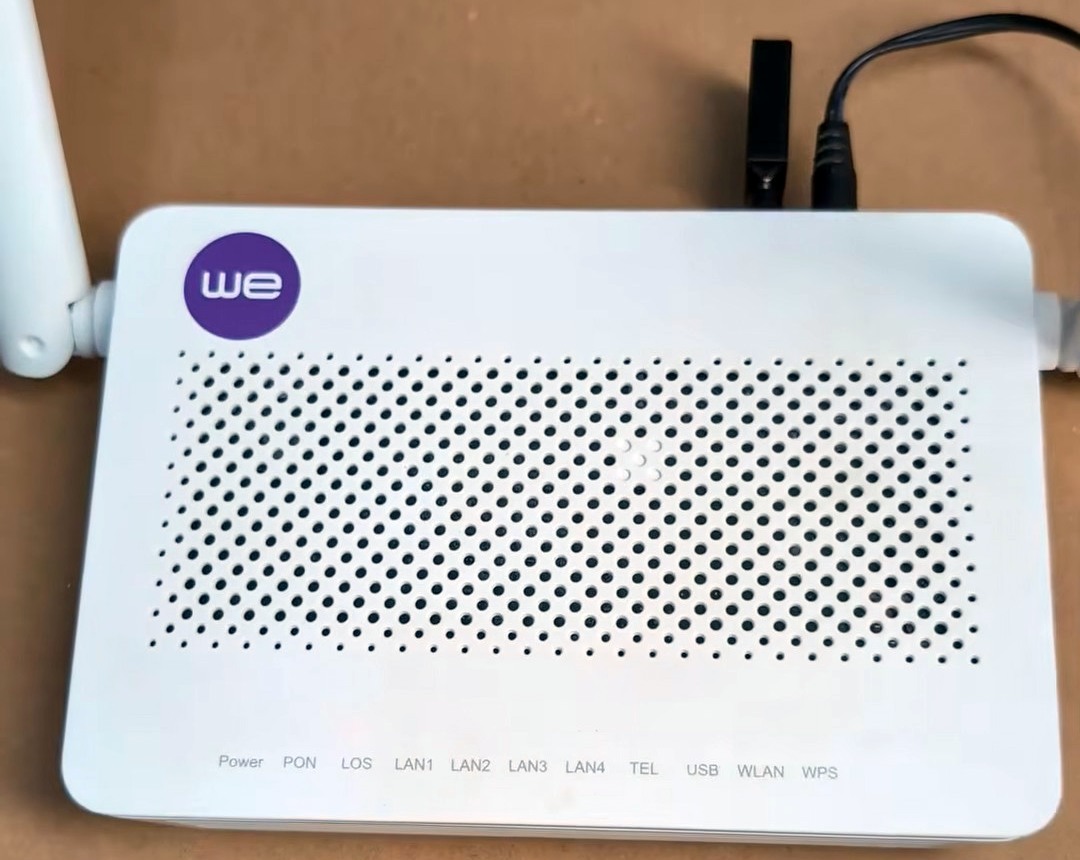
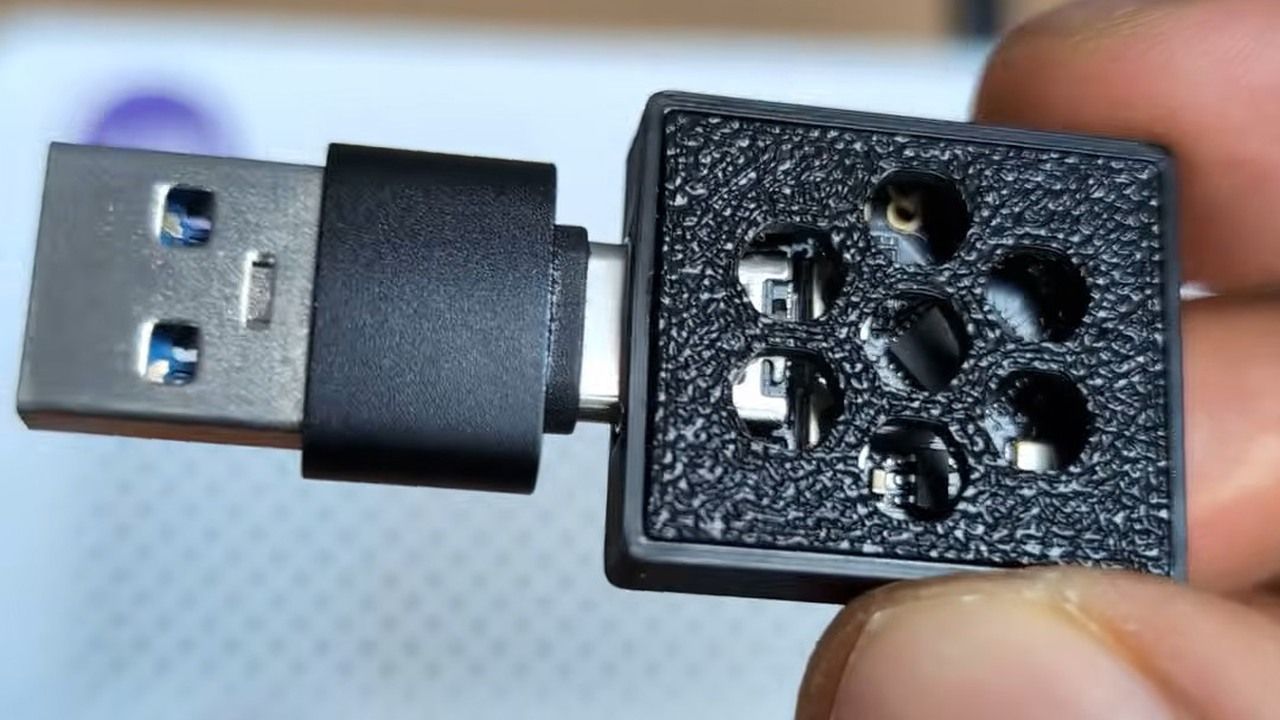
A photo of a tiny ad-blocking device plugged into a home fiber gateway device.

The backup ad-blocker is barely noticeable plugged into the creator's home gateway. (Image credit: ZedAxis/YouTube)

My favorite detail is that ZedAxis powers the whole thing from the USB port on the back of his ISP-provided fiber gateway, a Huawei OptiXstar home fiber gateway. The USB connection isn't carrying any data; the totality of the integration is the router saying "here's 5 volts" and the ESP32 replying "thanks." It's just that the port is a convenient power source for a device so small it practically disappears behind the router. All communications are carried out through the ESP32's integrated Wi-Fi adapter.

I have no idea whether projects like this will ever become common. Probably not, because most people who want network-wide ad blocking will still buy a Raspberry Pi, a used mini PC, or run AdGuard Home in a virtual machine. Still, it's refreshing to see somebody look at a $5 microcontroller with 400KB of RAM and decide, "Sure, that'll do."

Azure Becomes First Announced Hyperscaler to Deploy 3M’s Expanded Beam Optical Fiber

Microsoft and 3M have announced a strategic partnership covering both data center optical connectivity and enterprise AI adoption. Under the July 15 agreement, Azure becomes the first announced hyperscale cloud provider to deploy 3M’s Expanded Beam Optical (EBO) technology across its data centers, while 3M adopts Microsoft’s AI and digital platforms across several of its own business functions. The companies say the arrangement pairs Microsoft’s hyperscale infrastructure and digital tooling with 3M’s materials science and precision manufacturing background, aimed at speeding AI adoption and building out the physical network layer that cloud and AI workloads depend on.

EBO Technology Moves Into Azure Data Centers

The core of the infrastructure side of the deal is 3M’s EBO technology, which Microsoft will implement within Azure data centers as it scales capacity for generative AI and other high-performance workloads. Traditional fiber connectors rely on direct physical contact between polished ferrule end-faces. This design is sensitive to dust and debris and requires regular cleaning and inspection to maintain signal quality. EBO instead uses lenses to expand and collimate the light beam across an air gap between connectors, thereby reducing the connection’s sensitivity to contamination and physical wear. According to the companies, this makes EBO connections faster to install, more tolerant of dust and handling, and less demanding to maintain than direct-contact designs, which matters in dense, high-churn data center environments where cabling is installed and serviced constantly.

3M Expanded Beam Optical

Microsoft’s early use of the technology points to shorter deployment windows in specific data center scenarios, as well as stable optical performance in live environments where dust exposure and frequent handling during installation and maintenance are routine. For operators managing large fiber counts across AI clusters, that combination of faster installation and reduced maintenance overhead is the more practical selling point than the underlying optics itself.

3M is scaling production of EBO components to meet demand from hyperscalers and other data center operators building out AI infrastructure. The company has adapted its single-mode EBO design, developed over decades of work in materials science and precision manufacturing, for high-volume data center deployment. 3M was also involved in establishing the EBO Multi-Source Agreement (MSA), an industry effort to standardize the interface so that EBO components from different manufacturers can interoperate, which is typically a precondition for broader adoption across the supply chain rather than a single-vendor arrangement.

Cliff Henson, corporate vice president of Cloud Supply Chain at Microsoft, framed the EBO integration as part of a broader pattern of incorporating partner technology into Azure’s infrastructure to improve deployment speed, resilience, and scalability, providing customers with a more reliable environment for cloud and AI workloads.

3M Applies Microsoft’s AI Tools to Its Own Operations

On the enterprise side, 3M will roll out Microsoft’s AI and digital tools across parts of its transformation plan, including customer service, finance, sales, and marketing. The intent is to streamline internal processes, improve decision-making, and raise both customer satisfaction and employee productivity.

One concrete example already underway involves Microsoft Frontier Company engineers working alongside 3M’s Global Business Services group to automate customer order management. The two teams are building an AI-driven workflow that handles credit checks, delinquency assessments, and related system updates, with human-in-the-loop controls and a dashboard for real-time monitoring and approvals built into the process. The intent is to reduce manual processing, make the workflow more consistent, speed up cash flow, and free 3M staff to focus on higher-value work, while making the underlying process more scalable and auditable.

3M executive vice president and chief strategy officer Jon Van Wyck described AI as a lever for accelerating growth, improving customer experience, and increasing team effectiveness, and pointed to the Microsoft partnership as a way to optimize enterprise operations and build out AI infrastructure with an emphasis on practical, mutually beneficial outcomes rather than open-ended experimentation.

Next Up

Microsoft and 3M said they plan to continue the partnership through ongoing technical collaboration, direct engagement between engineering and commercial teams, and joint work across Microsoft’s data center and device ecosystem. The stated focus areas are reliability, faster deployment, higher interconnect density, and long-term scalability, drawing on 3M’s background in materials science, optical connectivity, and manufacturing.

Most notable is the EBO Multi-Source Agreement rather than the Azure deployment. A single hyperscaler adopting a new connector design is a data point; an MSA aimed at standardizing that design across vendors determines whether expanded-beam optics becomes a broader alternative to direct-contact fiber connectors industry-wide, rather than a one-off implementation limited to Microsoft’s own data centers.

The post Azure Becomes First Announced Hyperscaler to Deploy 3M’s Expanded Beam Optical Fiber appeared first on StorageReview.com.

Elon Musk's Starlink releases smaller and lighter V5 residential kit — offers speeds of up to 375 Mbps and almost half the power consumption of V4

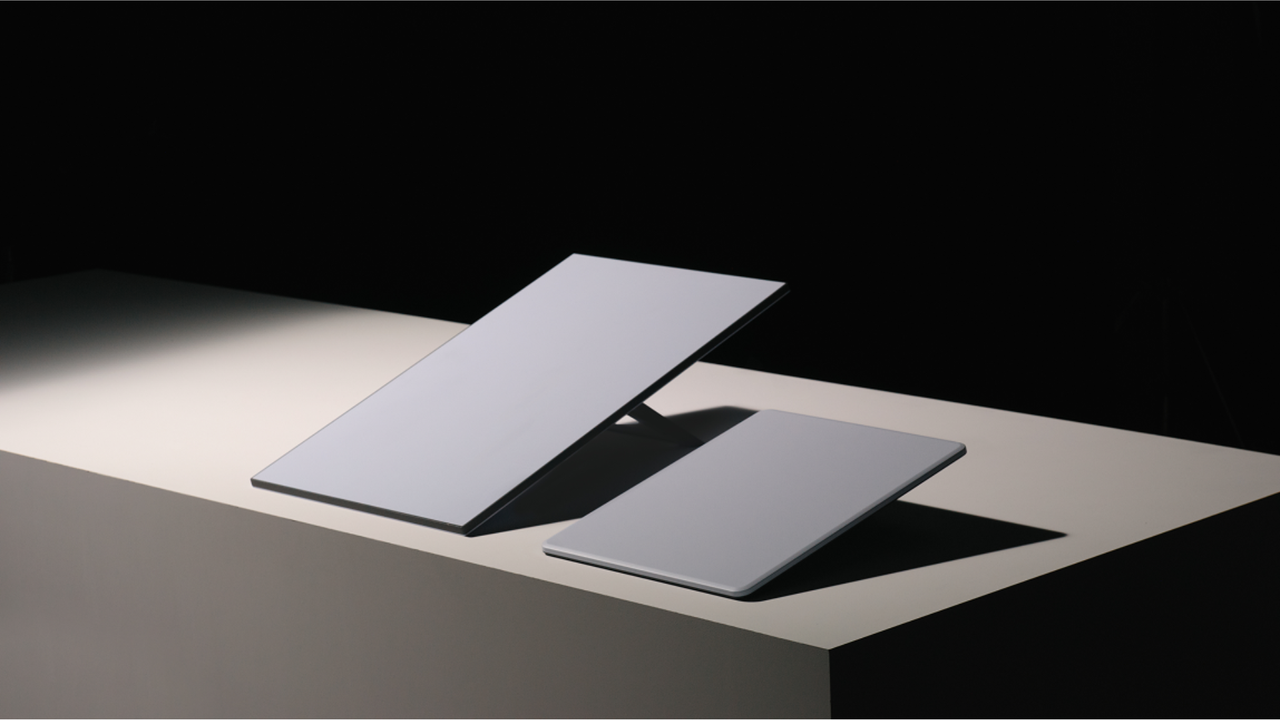
The SpaceX satellite internet service Starlink has just introduced its latest residential kit, letting users connect to the satellite network using a smaller and lighter terminal. The company announced the Starlink V5 on X, saying that it could hit up to 375+ Mbps for “streaming, video calling, gaming, and more.” It’s currently available in select areas only, though, with wider availability expected later as the company ramps up production.

Download speeds

Antenna

Field of View

Dish Weight

Environmental Rating

Operational Temperature

Mounted Wind Speed

Snow Melt Capability

Average Power Consumption

Power Indicator

Starlink V5

Up 375+ Mbps

Electronic Phased Array

110 degrees

2.4 lbs. (1.1kg)

IP67 Type 4

-22 deg F to 122 deg F (-30 deg C to 50 deg C)

165 mph (265 kph)

Up to 1.6 in. per hour (40mm per hour)

35 to 50 watts

LED / Starlink Top Face

Standard 4

Up to 400+ Mbps

Electronic Phased Array

110 degrees

6.4 lbs. (2.9kg)

IP67 Type 4

-22 deg F to 122 deg F (-30 deg C to 50 deg C)

60 mph (96 kph)

Up to 1.6 in. per hour (40mm per hour)

75 to 100 watts

LED / Router Face Plate

Mini

Up to 300+ Mbps

Electronic Phased Array

110 degrees

2.43 lbs. (1.1kg)

IP67 Type 4

-22 deg F to 122 deg F (-30 deg C to 50 deg C)

60 mph (96 kph)

Up to 1 in. per hour (25mm per hour)

25 to 40 watts

LED / Starlink Rear Face Plate

The new unit is significantly smaller and lighter than the Standard 4 used in most home deployments, and brings it close to the Starlink Mini, which is designed for both fixed and portable use. However, the Starlink V5 still requires a router (included), whereas the Mini can work without one, providing a wireless connection using its built-in Wi-Fi antenna. Still, the former is faster, offering speeds of up to 375+ Mbps. Although this is 25 Mbps slower than the 400+ Mbps that the Standard 4 is rated for, it’s still higher than the up to 300+ Mbps that SpaceX has set for the Mini.

The changes that SpaceX made to the Starlink V5 would make it much easier to set up, which is especially helpful for users who prefer to DIY their Starlink setup. Another interesting update to the new terminal is that it can handle faster wind speeds while mounted despite being lighter than the Standard 4. This should help it withstand tougher meteorological conditions, especially in areas frequently battered by storms and tornadoes.

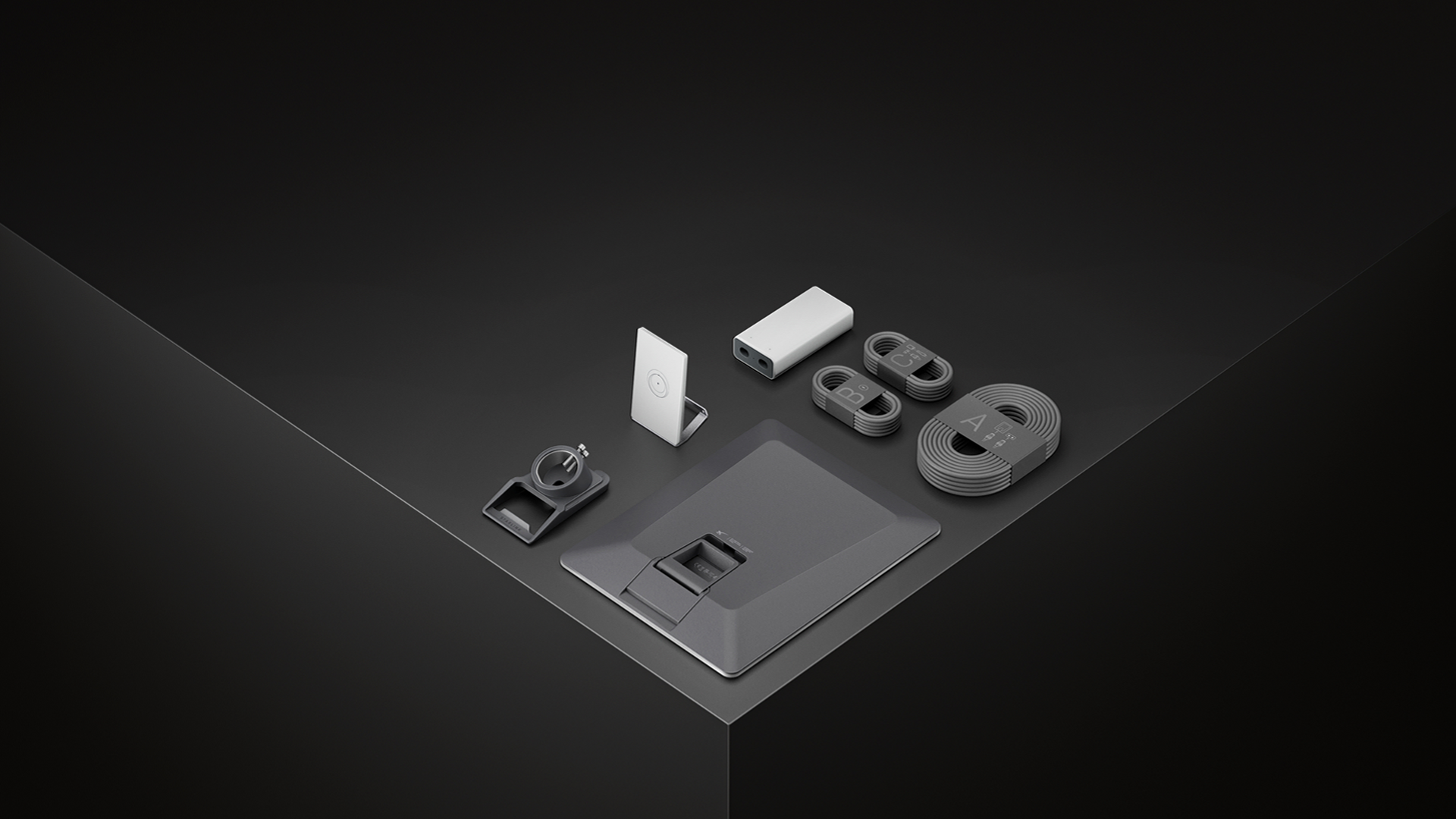
Starlink V5 contents

(Image credit: Starlink)

The much lower average power consumption, which is just about half of what the previous-generation Starlink terminals consumed, would also help power stations last longer, making it ideal for keeping communications alive, especially during emergencies. This is exactly what Japan is experimenting with, as Tokyo has started putting up Starlink antennas on fire hydrant signs to provide emergency Wi-Fi.

Although SpaceX and its owner, Elon Musk, are no strangers to controversy, Starlink has proven useful in various situations. Aside from being useful for first responders in disaster zones, it also helped Ukraine stay connected during the height of Russia’s invasion of the country in 2024. It has even gotten to the point that China simulated a Starlink blockade over Taiwan because of how useful the service is in keeping a government online and communicating with its allies during times of distress.

Global consumer Wi-Fi router shipments fell 6% in Q1 2026, down 34% from 2021 peak — mesh systems and gaming routers still prove popular

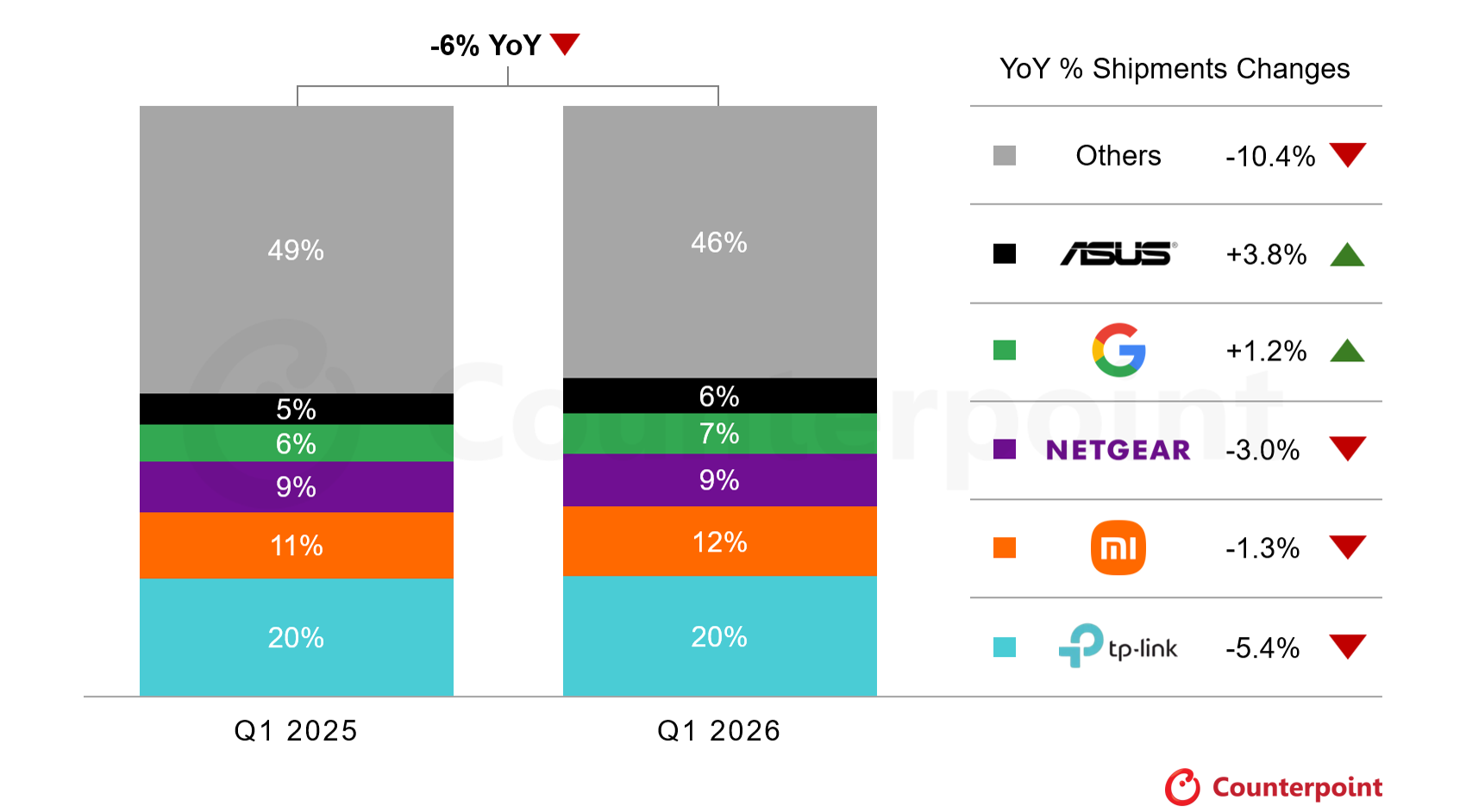
The Wi-Fi router market is facing headwinds as consumers pull back on spending. According to a new report from Counterpoint, we’re witnessing a softening in global consumer Wi-Fi router shipments, with a 6 percent YoY decline in Q1 2026. This decline follows an explosion of market growth during the COVID-19 pandemic, when consumers upgraded their Wi-Fi hardware to enhance their work-from-home capabilities.

Counterpoint notes that global Wi-Fi router shipments peaked in 2021, which was at the height of consumer hardware spending during the pandemic. There were some positive points in the report, with Asus and Google seeing global shipment increases of 3.8 percent and 1.2 percent, respectively, during Q1 2026. However, Xiaomi had a 1.3 percent shortfall, Netgear was down 3 percent, while TP-Link fell by 5.4 percent. Counterpoint also notes that “Others,” which includes dozens of other hardware vendors whose sales aren’t significant enough to be broken out individually, fell by 10.4 percent.

Since 2021, global shipments have declined by almost 34 percent, and a couple of factors explain this turn of events. For starters, many people who upgraded their Wi-Fi hardware in 2021 or 2022 simply see no reason to shift to newer technology. Even though the best Wi-Fi routers use the Wi-Fi 7 (802.11be) standard, offering multi-gig speeds across the 6 GHz and 5 GHz bands, those performance benefits are not enticing consumers on the sidelines because of rising costs for more essential goods.

Counterpoint Retail Wi-Fi CPE Tracker

(Image credit: Counterpoint)

Another reason global shipments of consumer routers have seen a steady decline is that ISPs have become more adept at bundling higher-end networking hardware with their services. Whether you’re signing up for new fiber, cable, or 5G home internet service, ISPs are including routers with integrated Wi-Fi 6, 6E, or 7 wireless connectivity. For customers with non-demanding network needs, this ISP-provided hardware is sufficient. For example, T-Mobile provides a Wi-Fi 7 gateway with its $60/month 5G home internet plan and a Wi-Fi 7 gateway plus a mesh extender with its $70/month plan.

Speaking of mesh systems, this is one of the few bright points for hardware vendors. Counterpoint notes that mesh Wi-Fi systems have seen significant growth as consumers seek to blanket every area of their homes with wireless coverage to support a substantial number of connected devices. Amazon’s Eero and Google’s Nest mesh Wi-Fi router systems were called out specifically for their strong performance (driven in part by high brand recognition and heavy sales promotions). The gaming router segment also bucked the decline in the broader Wi-Fi router market, as online gaming enthusiasts seek a competitive edge with lower latency and higher available network bandwidth.

There’s a possibility we could see a rebound in sales in the second half of 2026 and into early 2027 as the first Wi-Fi 8 hardware enters the market. However, Wi-Fi 8 is seen as more of a quality-of-life upgrade than another leap in performance over previous Wi-Fi generations.

Ubiquiti UniFi E7 and E7 Campus Review: 10-Stream WiFi 7 With 10GbE From $499

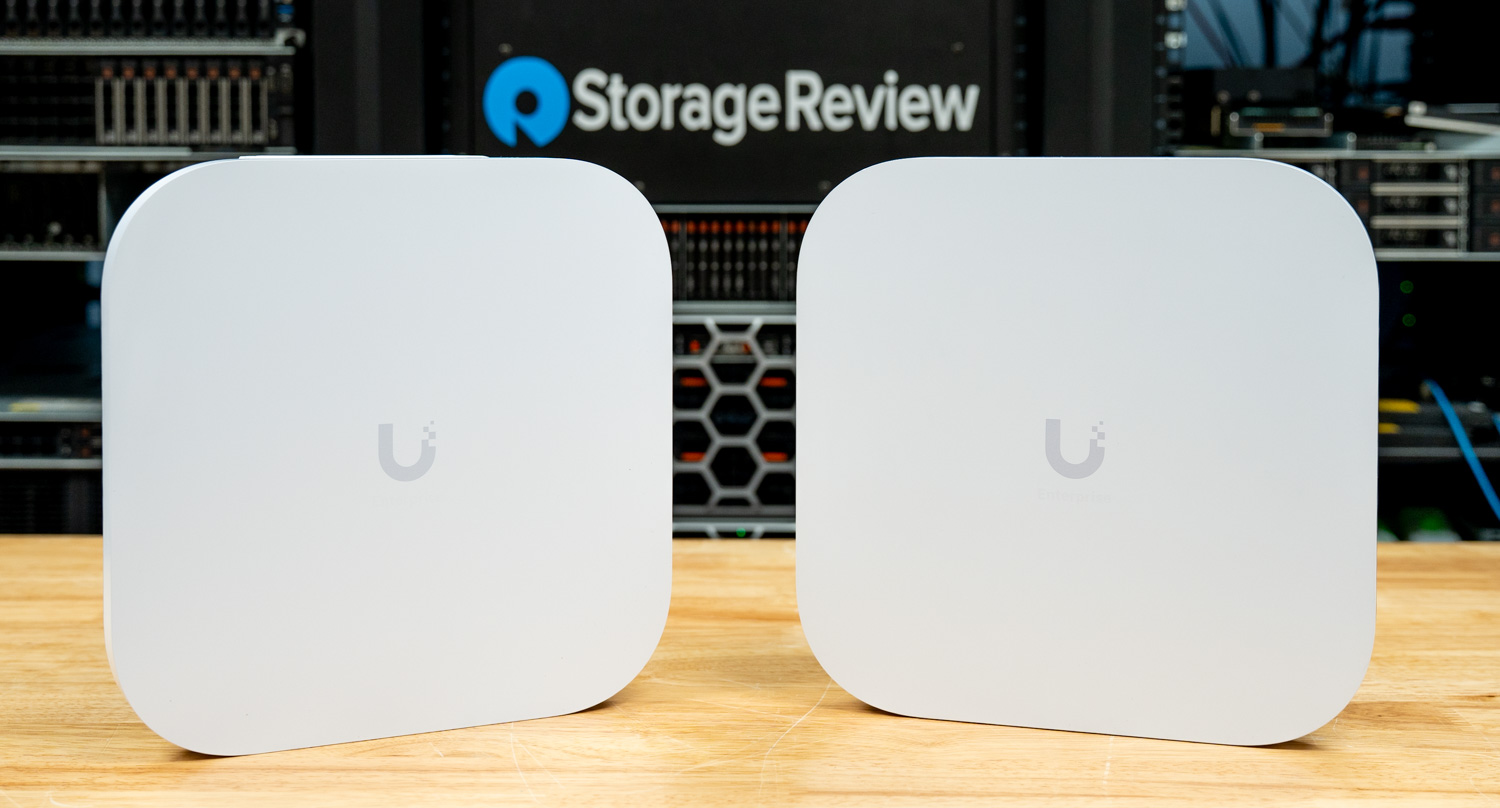
E7 and E7 Campus feature view image, both on their side so you can see the logo E7 and E7 Campus feature view image, both on their side so you can see the logo

Ubiquiti continues to expand into the enterprise wireless market with the introduction of the UniFi E7 and E7-Campus, two flagship WiFi 7 access points designed for high-density, high-performance deployments. Built around a 10-stream tri-band radio architecture, 10GbE connectivity, and the latest 802.11be standard, the E7 family marks a significant step forward from previous UniFi generations, bringing features traditionally reserved for premium enterprise vendors into the UniFi ecosystem.

While both access points share the same core hardware platform and WiFi 7 feature set, they target very different deployment scenarios. The standard UniFi E7 is optimized for demanding indoor environments, such as offices, schools, convention spaces, and other areas where large numbers of clients compete for airtime. The UniFi E7-Campus builds on that foundation with a redesigned directional antenna system and RF characteristics tailored for large indoor venues, courtyards, stadiums, outdoor gathering spaces, and campus-wide deployments where extended coverage and client density are equally important.

E7 and E7 Campus feature view image, both on their side so you can see the logo
The E7 lineup also signals UniFi’s continued expansion beyond the SMB market into larger enterprise deployments. As organizations adopt multi-gig switching, faster internet connections, and bandwidth-intensive applications, wireless infrastructure is increasingly the limiting factor. By pairing WiFi 7 radios with 10GbE uplinks and enterprise-class management via UniFi Network, the E7 family provides the headroom needed for modern campus networks while maintaining the simplified deployment and centralized management that have become hallmarks of the UniFi platform.

With pricing starting at $499 for the UniFi E7 and $799 for the UniFi E7-Campus (affiliate links), these access points sit at the premium end of Ubiquiti’s portfolio. Rather than simply chasing higher headline speeds, they are designed to deliver the capacity, coverage, and scalability organizations need for their next-generation wireless infrastructure. In this review, we’ll examine where each model fits, explore the hardware differences between the two, and dive into key features.

Specifications

Specifications E7 E7-Campus
Overview
Price $499.00 $799.00
WiFi Standard WiFi 7 WiFi 7
Spatial Streams 10 10
Coverage Area 185 m² (2,000 ft²) 465 m² (5,000 ft²)
Max. Client Count 1000+ 1000+
Uplink 10 GbE
1 GbE
10 GbE
1 GbE
Power Method PoE++ PoE++
Physical
Dimensions 250 x 250 x 43.5 mm
(9.8 x 9.8 x 1.7″)
Device: 250 x 250 x 45.5 mm
(9.8 x 9.8 x 1.8″)
Articulating mount: ⌀104 x 149.4
(⌀4.1 x 5.9″)
Weight 1.8 kg (4 lb) Device: 2.2 kg (4.9 lb)
With articulating mount: 3.1 kg (6.8 lb)
Mounting Ceiling, Wall, VESA
(Pro Mount Included)
Wall, Pole (Mounts Included)
VESA (Optional)
Weatherproofing IPX6
IP67 with Waterproof Door Kit (Included)
Performance
MIMO 6 GHz: 4 x 4
5 GHz: 4 x 4
2.4 GHz: 2 x 2
6 GHz: 4 x 4
5 GHz: 4 x 4
2.4 GHz: 2 x 2
Max. Data Rate 6 GHz: 11.5 Gbps
5 GHz: 8.6 Gbps
2.4 GHz: 688 Mbps
6 GHz: 11.5 Gbps
5 GHz: 8.6 Gbps
2.4 GHz: 688 Mbps
Antenna Gain 6 GHz: 6 dBi
5 GHz: 6 dBi
2.4 GHz: 5 dBi
6 GHz: 12 dBi
5 GHz: 12 dBi
2.4 GHz: 9 dBi
Max. TX Power 6 GHz: 24 dBm / 30 dBm
5 GHz: 30 dBm
2.4 GHz: 23 dBm
6 GHz: 30 dBm (36 dBm EIRP)
5 GHz: 30 dBm
2.4 GHz: 23 dBm
Features
Wireless Meshing / Roaming / RRM
Zero-Wait DFS
PRISM™ RF Filtering
Hardware
Max. Power Consumption 43W 44W
Supported Voltage Range 42.5–57V DC 42.5–57V DC
Networking Interface (1) 10 GbE RJ45 port
(1) 1 GbE RJ45 port
(1) 10 GbE RJ45 port
(1) GbE RJ45 port
Environmental
Operating Temperature -30 to 50° C (-22 to 122° F) -30 to 60° C (-22 to 140° F)
Operating Humidity 5 to 95% noncondensing 5 to 95% noncondensing
Software
UniFi Network Version Version 9.2.87 and later Version 9.0.114 and later

Performance Positioning: WiFi 7 at Scale

From a throughput perspective, both the E7 and E7-Campus fully leverage the expanded bandwidth of WiFi 7. With up to 11.5 Gbps on 6 GHz using 320 MHz channels, these APs target environments with dozens or hundreds of clients active simultaneously, rather than chasing single-client peak speeds.

The key differentiator, however, is RF design. The standard E7 uses omnidirectional antennas with moderate gain, making it ideal for traditional indoor deployments such as offices, classrooms, or dense residential settings. In contrast, the E7-Campus uses high-gain directional antennas, delivering significantly higher dBi values and focused coverage patterns. As a result, it performs far more effectively in large open areas, outdoor campuses, or long-range indoor corridors.

Additionally, the E7 Campus includes PRISM RF filtering and active hardware filtering, which give it an advantage in congested RF environments. Both models support Zero-Wait DFS, which maintains channel availability when a radar event forces a channel switch, but the Campus pairs that capability with filtering hardware tailored to the interference profiles of dense outdoor and mixed-use deployments.

Build and Design

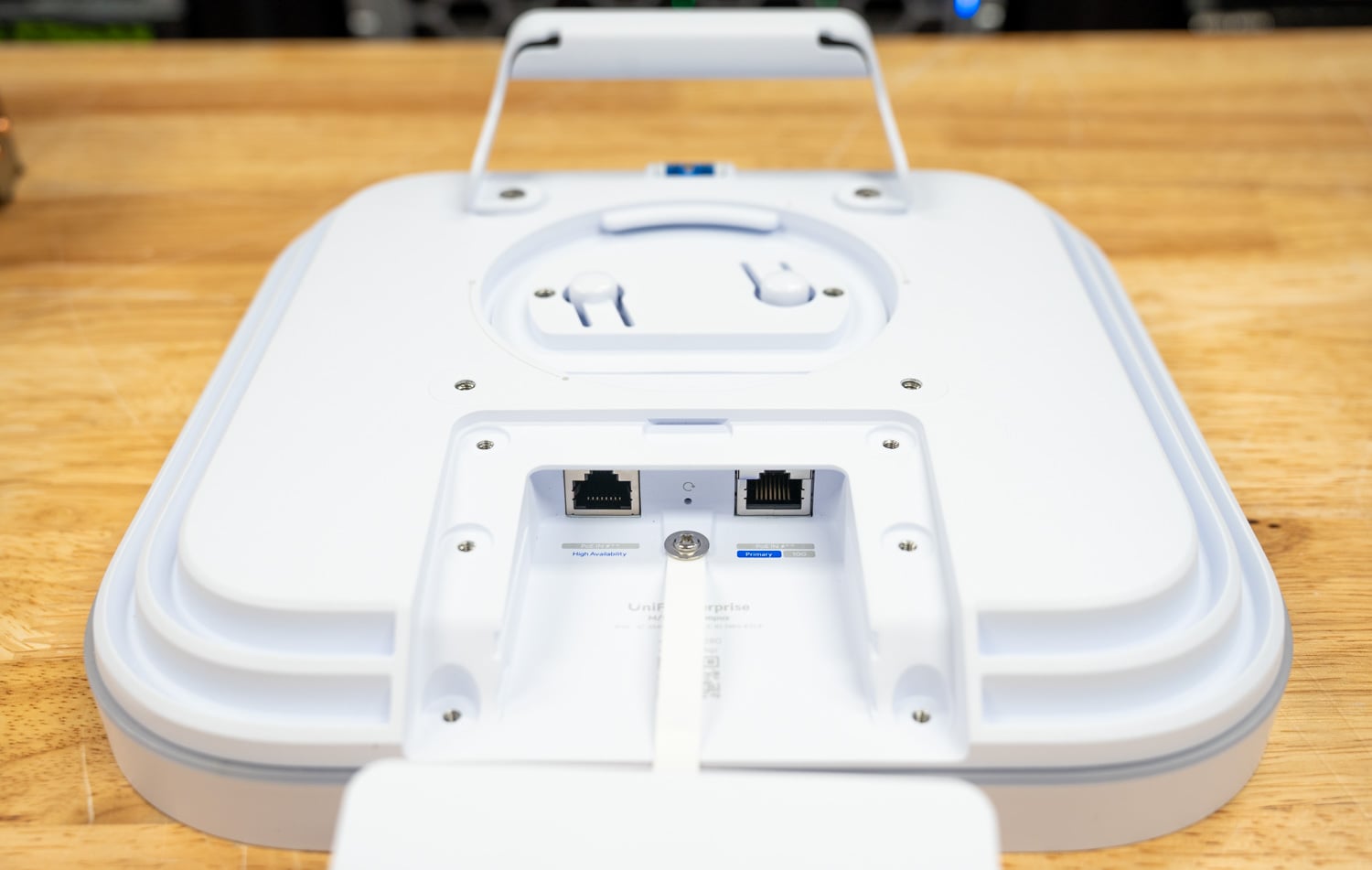
The E7 follows the familiar UniFi ceiling-mount design language, with a low-profile squircle enclosure measuring 250 x 250 x 43.5 mm. Ubiquiti clearly intended it for clean indoor installations, blending into office ceilings or wall mounts without drawing attention. Build quality is consistent with UniFi’s higher-end gear, using a mix of UV-stabilized polycarbonate and aluminum.
e7 rear io

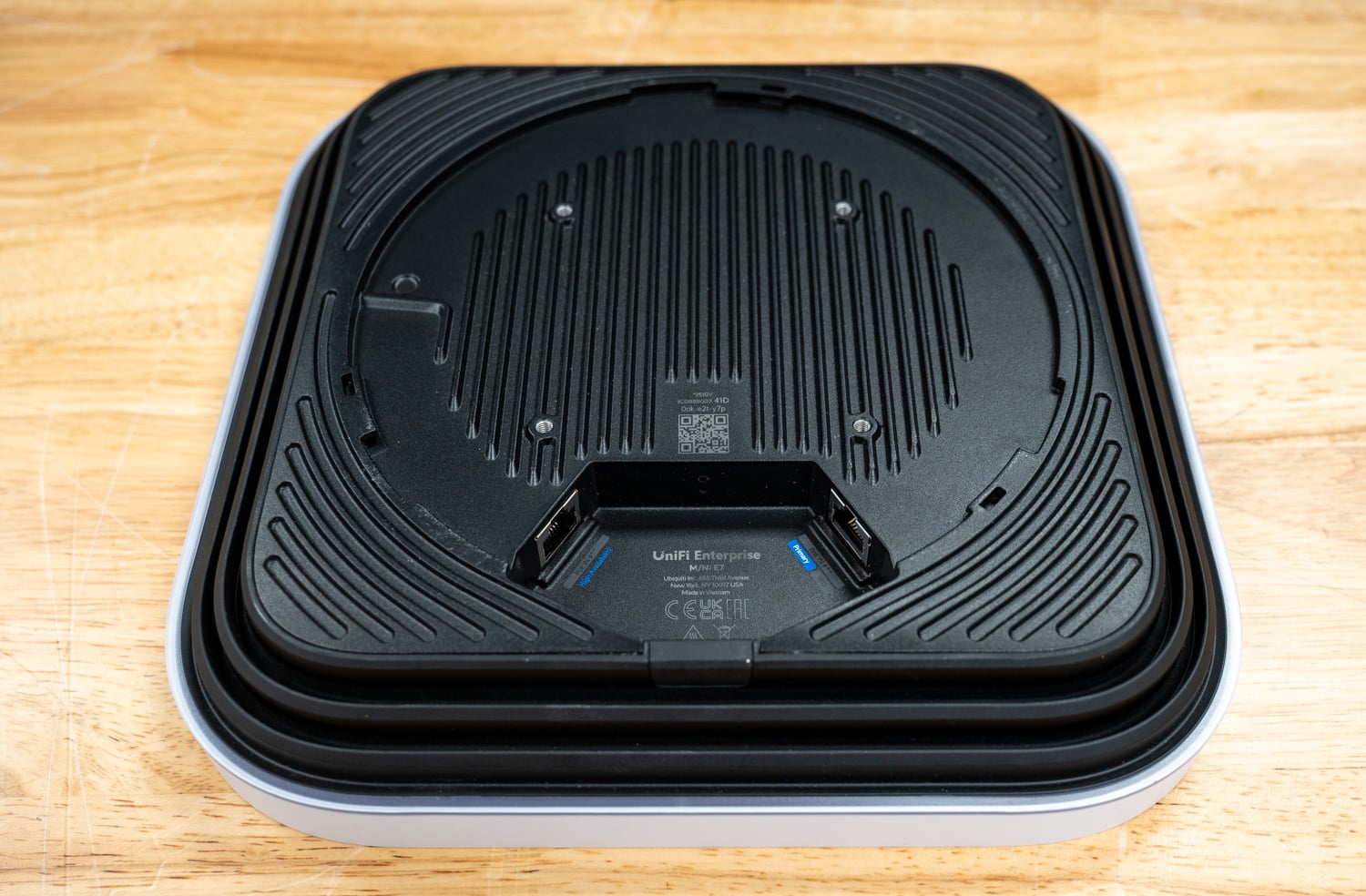
The E7-Campus, on the other hand, takes a more purpose-built approach. While similar in footprint, it adds thickness and more rugged construction, along with an articulating mount for precise directional alignment. Furthermore, with IPX6 weather resistance and IP67 support via the included waterproof door kit, it handles harsh outdoor conditions without compromise.
e7 campus rear io

Weight also reflects the difference in intent. The E7 remains relatively lightweight at 1.8 kg, while the E7-Campus weighs 2.2 kg (3.1 kg with the mount), reinforcing its focus on industrial deployment.

Deployment Flexibility

The E7 and E7-Campus target distinct deployment scenarios yet share enough DNA to coexist naturally within a unified UniFi infrastructure. The standard E7 supports ceiling, wall, and VESA mounting, with a pro mount included out of the box, making it straightforward to deploy in standard commercial interiors. Moreover, its omnidirectional radiation pattern suits symmetric coverage zones where clients approach from all directions.
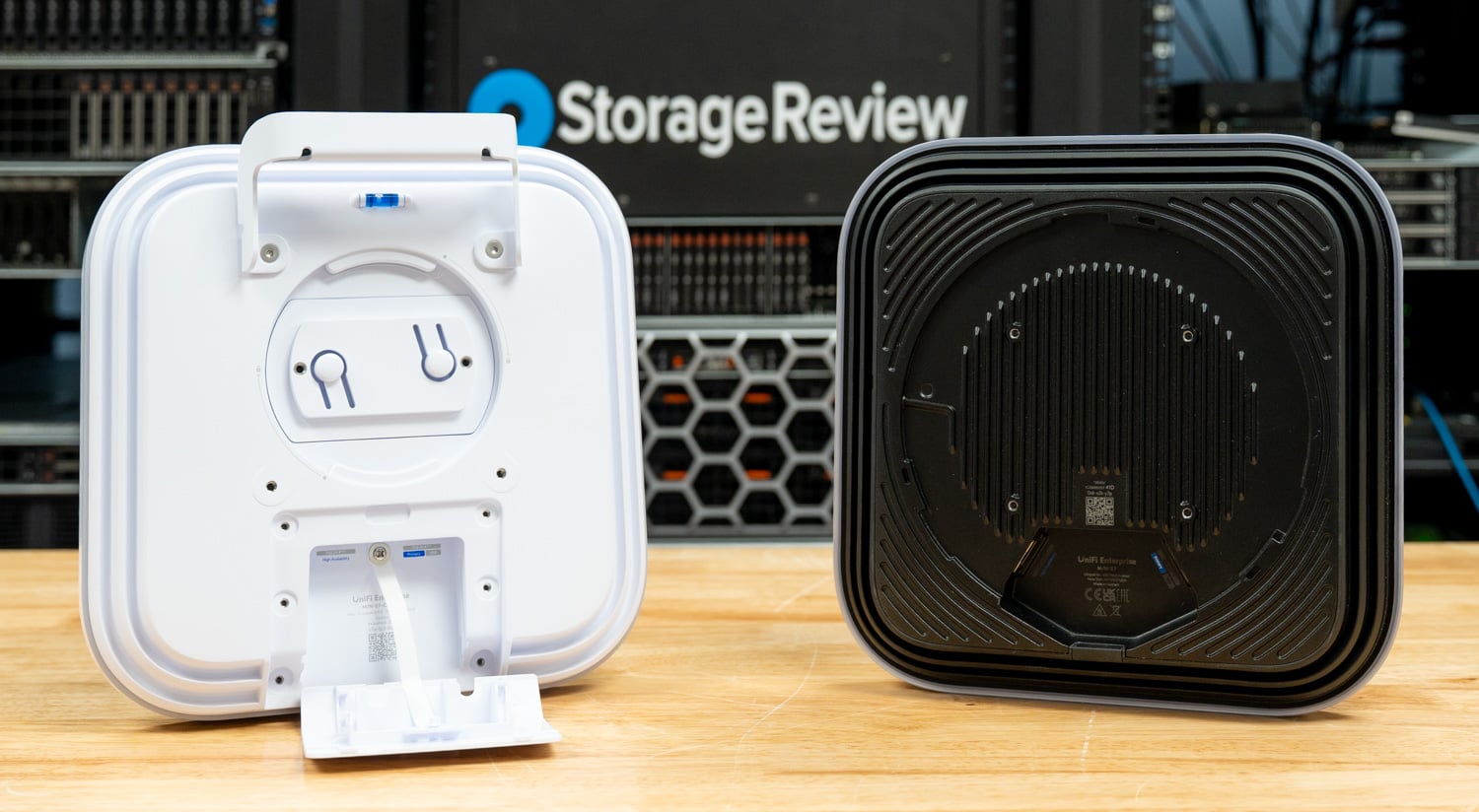
e7 and e7 campus showing mounting , rear

The E7-Campus flips that logic entirely. Wall and pole mounting are the primary options, with VESA available as an option, and the included articulating mount enables precise beam aiming. This directional approach is critical for deployments across large outdoor quads, parking structures, stadiums, or long indoor corridors. The pole mount accommodates pole diameters from 1 to 2.5 inches, covering most standard street and facility poles without additional hardware.

Both models require PoE++ power delivery, so infrastructure planning must account for 802.3bt-capable switches or injectors. Ubiquiti offers a 10G PoE++ Adapter (60W) as an accessory for the E7. Power draw is nearly identical between the two units at 43W and 44W, respectively, meaning existing PoE++ budgets translate cleanly when mixing models across a deployment.

From a high-availability standpoint, both APs include a redundant 1 GbE port alongside the primary 10 GbE uplink, a welcome addition at this tier that provides network architects with a failover path without additional hardware.

Software and Management

Both access points are managed through the UniFi Network application, which provides centralized wireless management across the entire deployment. Administrators can configure SSIDs, VLANs, security policies, radio settings, guest access, roaming behavior, and RF optimization from a single interface, while monitoring client health, coverage, airtime utilization, and overall network performance. Whether managing a handful of access points or a campus-wide deployment, UniFi Network offers a unified platform for deployment, monitoring, firmware updates, and ongoing wireless optimization.
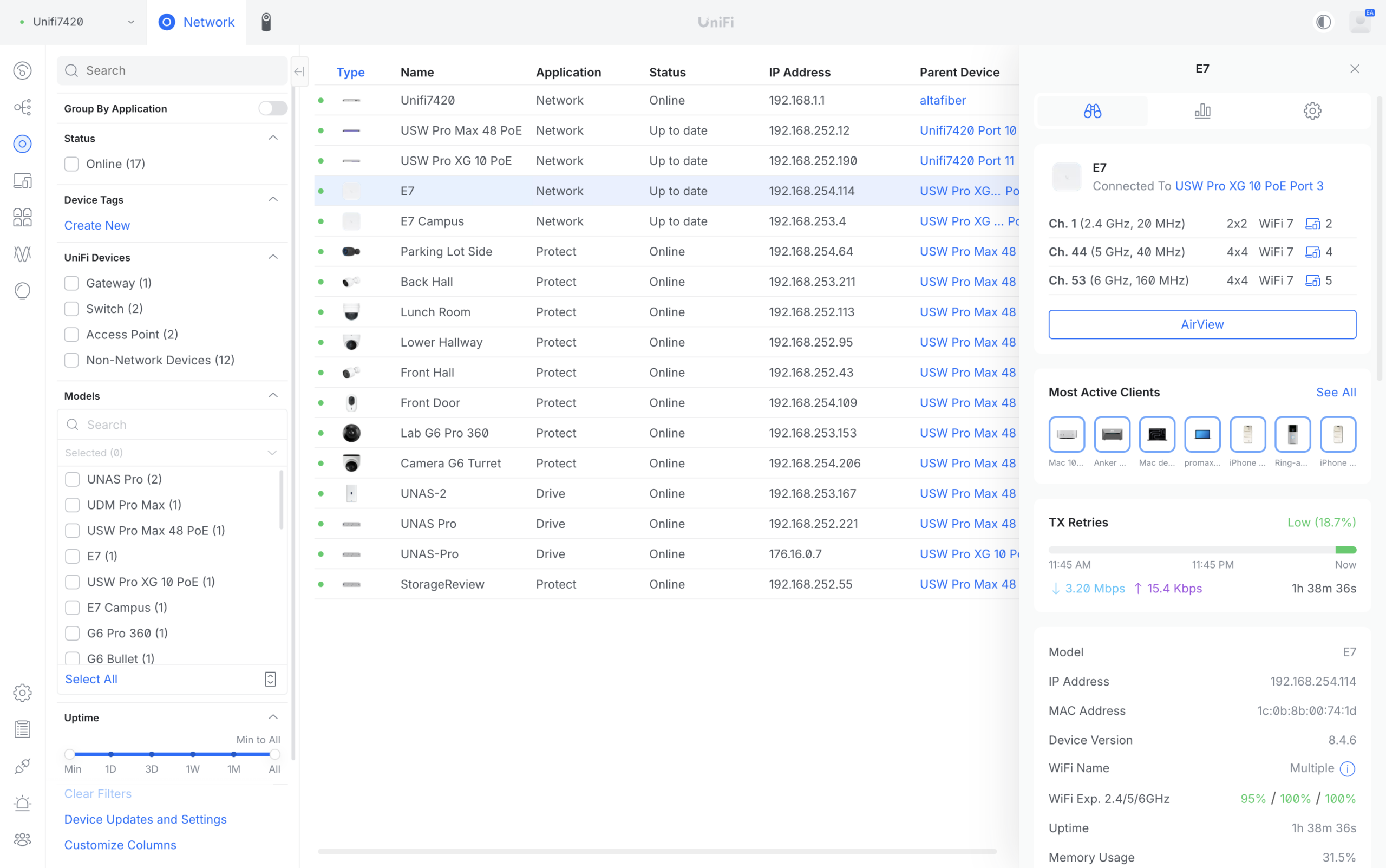
Feature parity across the software stack is strong. Both APs support wireless meshing, band steering, 802.11r fast roaming, 802.11k RRM, and real-time spectral analysis. The full captive portal suite is available on both, including voucher-based, payment-based, and external portal authentication, making either unit viable for hospitality or public-access deployments. RADIUS over TLS (RadSec) and dynamic VLAN assignment round out the enterprise authentication story.
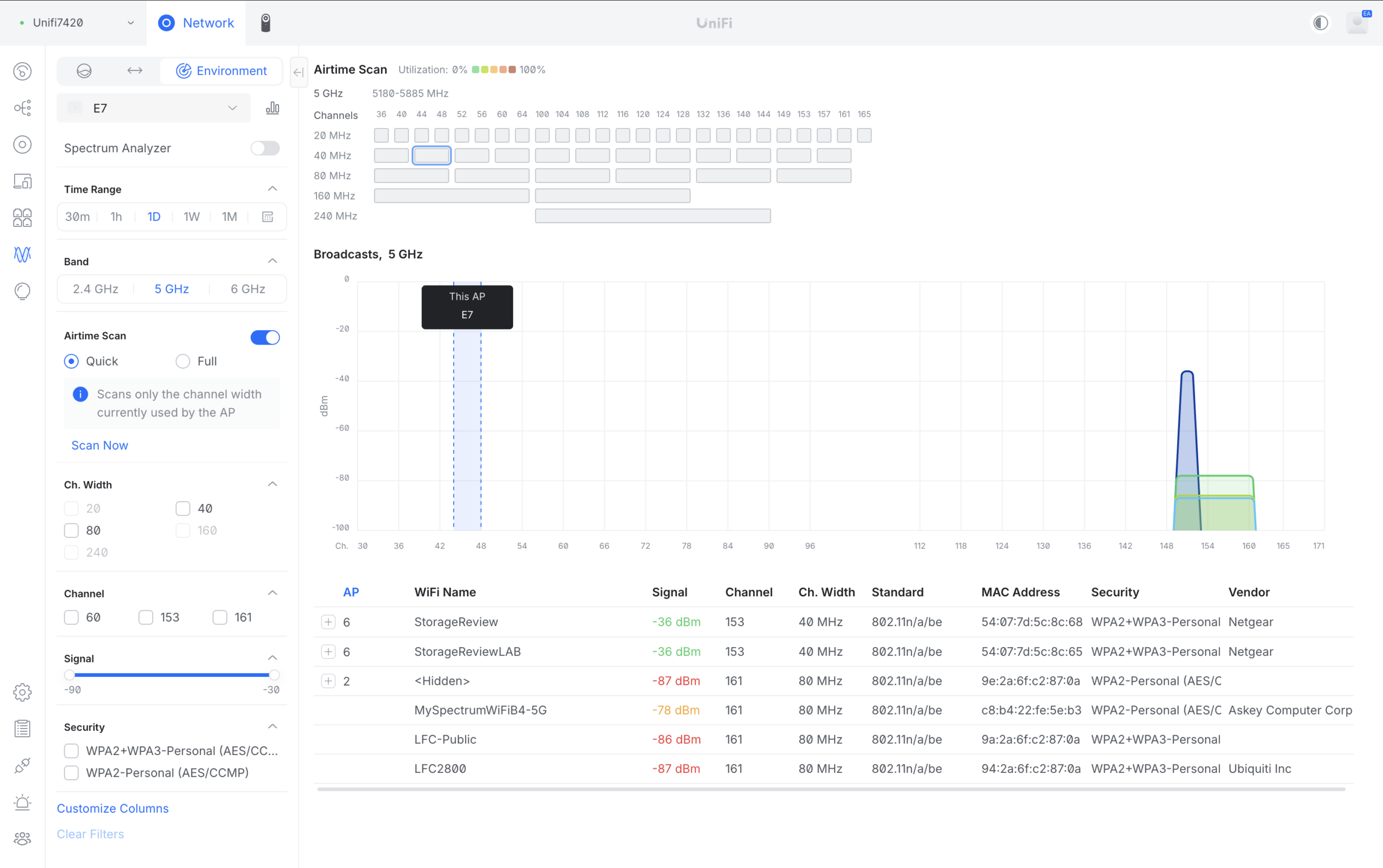
That shared foundation includes Zero-Wait DFS on both models, eliminating the channel-switching delays standard DFS introduces when radar is detected. Beyond it, the E7 Campus adds PRISM RF filtering, and in outdoor or mixed-use environments where 5 GHz DFS channels and adjacent-band interference are common, the combination translates directly into a more consistent client experience.
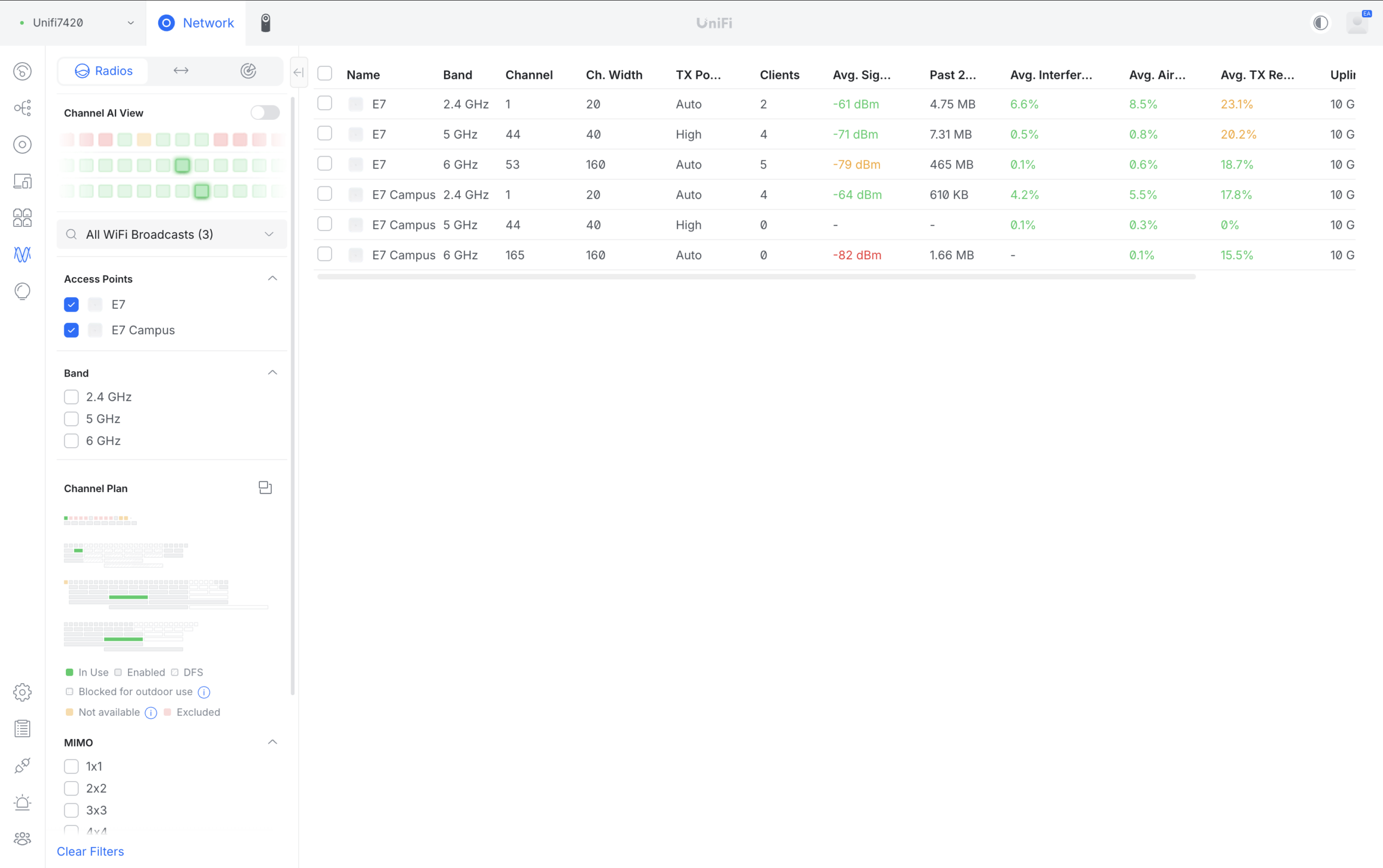
6 GHz and AFC Considerations

Both models support operation in the 6 GHz band, though available channels and transmit power are governed by regional regulations. In the FCC/IC regulatory domain (United States and Canada), UniFi supports Automated Frequency Coordination (AFC), allowing eligible deployments to operate in Standard Power mode where permitted. AFC dynamically coordinates channel usage with incumbent licensed services, enabling higher transmit power than Low Power Indoor operation while protecting existing spectrum users. Outside FCC/IC regions, 6 GHz availability and power limits vary by local regulations.

Hardware design further separates the two access points. The UniFi E7 uses omnidirectional 6 dBi antennas and operates at up to 24 dBm on 6 GHz, increasing to 30 dBm (36 dBm EIRP) when AFC-enabled Standard Power operation is available. The E7-Campus pairs a 30 dBm (36 dBm EIRP) 6 GHz radio with high-gain 12 dBi directional antennas, concentrating RF energy into a focused coverage pattern rather than broadcasting uniformly in all directions. This directional design delivers significantly greater effective coverage and signal strength across its intended service area, making it well suited for large indoor venues, courtyards, stadiums, and outdoor campus deployments.

Conclusion

The UniFi E7 and E7-Campus represent a mature, well-differentiated approach to enterprise WiFi 7. Rather than offering two versions of the same product with minor spec bumps, Ubiquiti draws a clear architectural line between them. The E7 is a high-density indoor workhorse built for environments that require high client capacity under controlled RF conditions. The E7-Campus, by contrast, is a purpose-engineered outdoor, long-range platform that adds directional RF, active filtering, and environmental hardening to tackle the more demanding deployments for which the standard E7 was never designed.
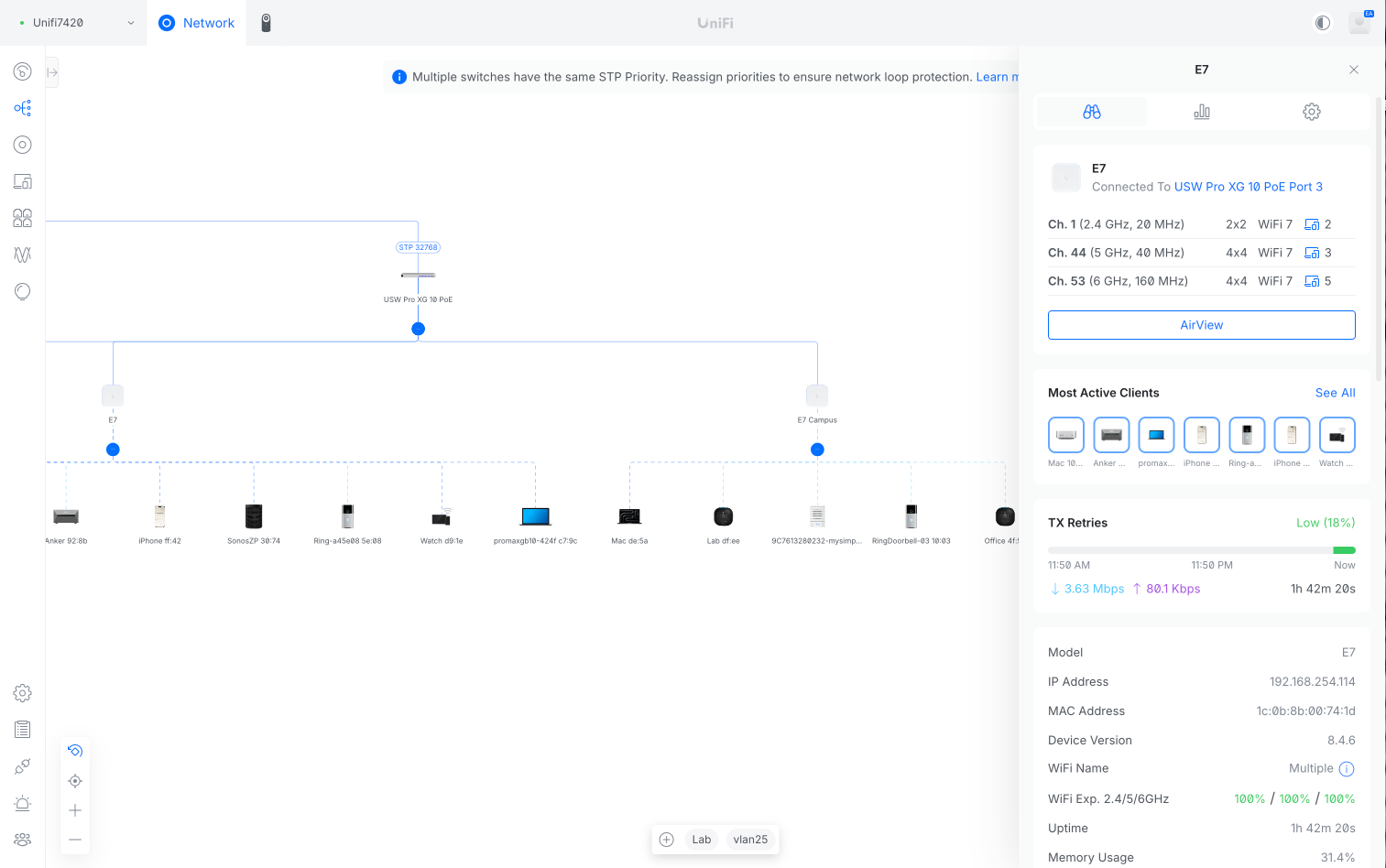
At $499, the E7 competes strongly in its price range, particularly given its 10 GbE uplink and 1000+ client capacity. The E7 Campus at $799 carries a meaningful price premium, but the inclusion of PRISM RF filtering, IP67-capable weatherproofing, and high-gain 12 dBi directional antennas makes the case clear. For organizations already invested in the UniFi ecosystem, both units slot in naturally and extend existing infrastructure without compromise. For those evaluating enterprise WiFi 7 platforms from scratch, the E7 family sets a high bar for both capability and manageability.

Product Pages:

Ubiquiti E7
Ubiquiti E7-Campus

The post Ubiquiti UniFi E7 and E7 Campus Review: 10-Stream WiFi 7 With 10GbE From $499 appeared first on StorageReview.com.

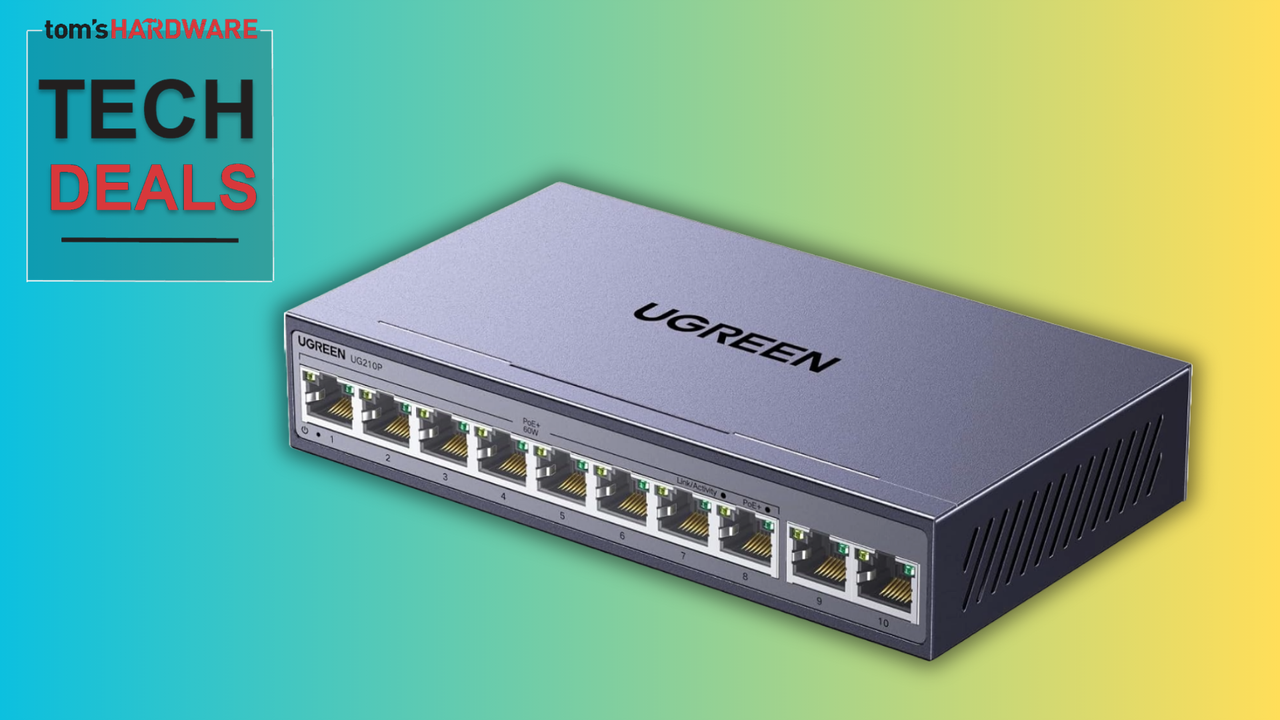
Record-low price on this 10-port PoE+ switch with gigabit speeds and up to 60W of power, save 24% — $38 for Ugreen switch that unlocks an extra eight power-delivery ports for cameras and Wi-Fi extenders

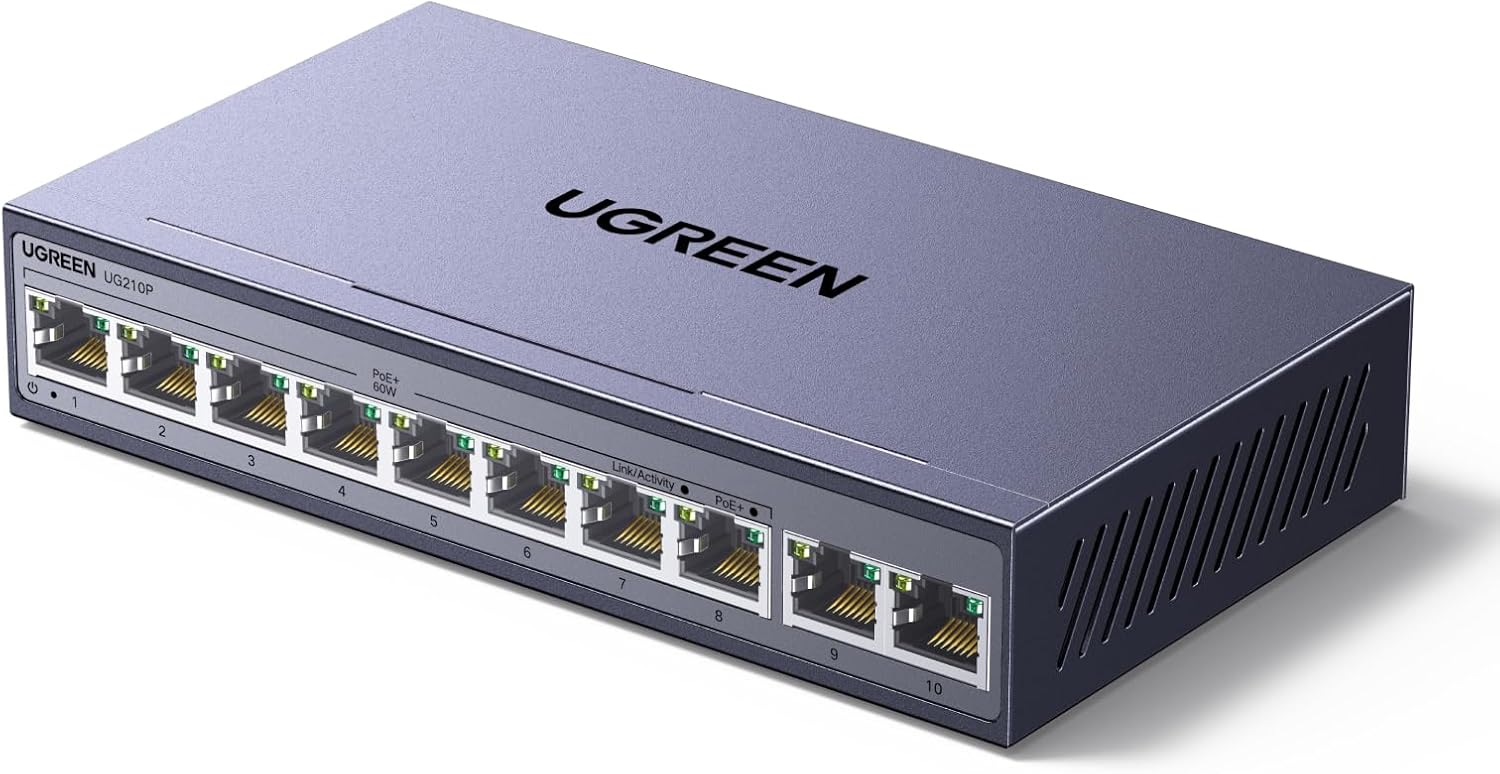
A Power-over-Ethernet switch is a must-have addition for a home network if you're thinking about seriously kitting it out with cameras, WiFi extenders, and other smart home tech. Luckily, a budget-friendly Ugreen 10-port PoE+ switch is on sale for just $37.97 on Amazon right now. That's a new record low for this model, giving you eight extra PoE+ ports (and 10 total) for your network at a lower cost than many of its rivals.

Check out this deal on Amazon

Ugreen is a brand that feels ubiquitous on Amazon these days, with decently priced and well-designed hardware on sale, from wall chargers to peripherals, including network switches like this one. This 10-port switch offers the PoE+ standard (IEEE 802.3at) that offers up to 30W of power per port.

That means faster, newer devices can connect to this switch, delivering both power and data over a single Ethernet cable. The switch supports 60W in total, but it works in a cascade system. If power draw exceeds 60W, it'll shut down ports to prevent overload, from port 8 down to port 1. It auto-detects PoE devices, too, so it won't inadvertently short out a normal network device like your PC or laptop. It also supports an extended power delivery mode that lets you connect devices up to 820 feet away.

The Ugreen 10-port PoE+ network switch offers Gigabit speeds and 30W per-port of power over each Ethernet cable across eight different ports, with two ports used as uplink ports for data connection to your main network.View Deal

This is the ultimate device for supporting a smart home network. PoE switches are useful for network-attached cameras, additional WiFi extenders, and smart home hubs and sensors. This Ugreen switch is unmanaged, so a huge setup process isn't required here, and it should work immediately with your existing kit. That means it lacks the extra customization that a more expensive managed switch can offer, but for most users, that won't be a problem.

It'll work with almost any Ethernet-ready device you own, too, even those that don't take advantage of the power delivery provided by this switch. That includes laptops and PCs, NAS drives, game consoles, printers, and TVs.

Another important feature here, too, is speed. This switch offers gigabit speeds across your network, meaning you can banish lag and WiFi latency issues while you're gaming and streaming. An Ethernet connection using this switch will help you to max out the bandwidth provided by your internet provider, with the switch offering two uplink ports that you can use to connect to your existing network.

Fanless, with built-in lightning protection, and compressed into a compact chassis just 6.6 x 3.7 x 1.3 inches in size, this Ugreen PoE+ switch is the ultimate home network upgrade. The $37.97 sale price for this 10-port Ugreen switch is available for a limited time only, however, so if you're interested, you'll need to order it soon.

If you're looking for more savings, check out our Best PC Hardware deals for a range of products, or dive deeper into our specialized SSD and Storage Deals, Hard Drive Deals, Gaming Monitor Deals, Graphics Card Deals, Gaming Chair, Best Wi-Fi Routers, Best Motherboard, or CPU Deals pages.

You can also join the Tom's Hardware deals Discord for up-to-the-minute hardware deals.

Fire hydrant signs with Starlink antennas tested for emergency Wi-Fi in disaster-prone Japan— existing widespread grid of street-level furniture can be used for communications network fallback

Japan’s Fire Hydrant Sign Co., Ltd. has demonstrated an expansive Wi-Fi network that melds its established infrastructure of street signs with Starlink satellite broadband antennas. The big idea is that this network could provide important, if not essential, fallback connectivity in the event of a natural disaster knocking out fiber, mobile masts, and so on. Japan sits on the intersection of multiple tectonic plates and is prone to earthquakes, tsunamis, and volcanic eruptions – as well as some extreme weather.

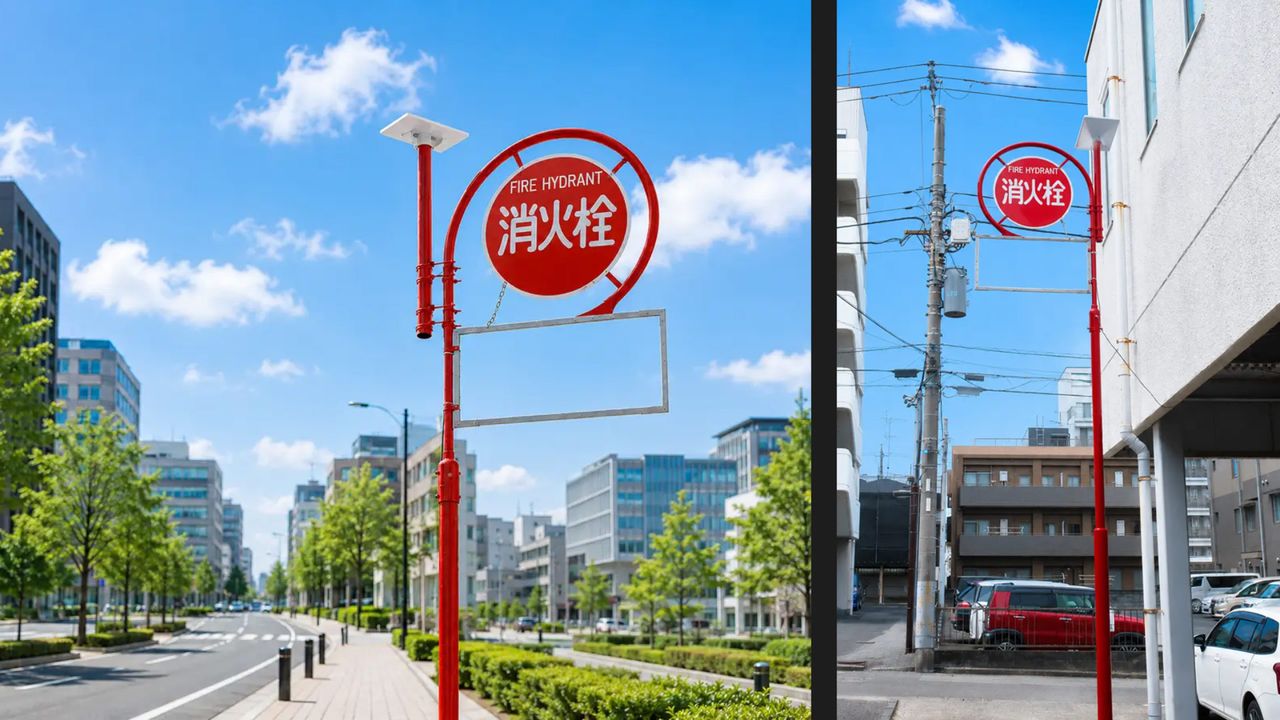
On Thursday, the Fire Hydrant Sign Co. completed a technical demonstration of a Starlink-supported Wi-Fi network in the vicinity of its Kanagawa Branch. Each sign, a common item of street furniture in residential neighborhoods, can become a dual-purpose emergency water supply sign and ‘communication hub.’ In the top image, you can see two example installations with the Starlink antenna atop a pole beside the traditional circular fire hydrant signage.

One of the key strengths of this initiative is that where the Fire Hydrant Sign Co. has a sign, no extra land or structures are required to set up the pole to host a Starlink antenna. Japan has 120,000 fire hydrant signs nationwide, with the trial taking place near Kanagawa province, near Tokyo.

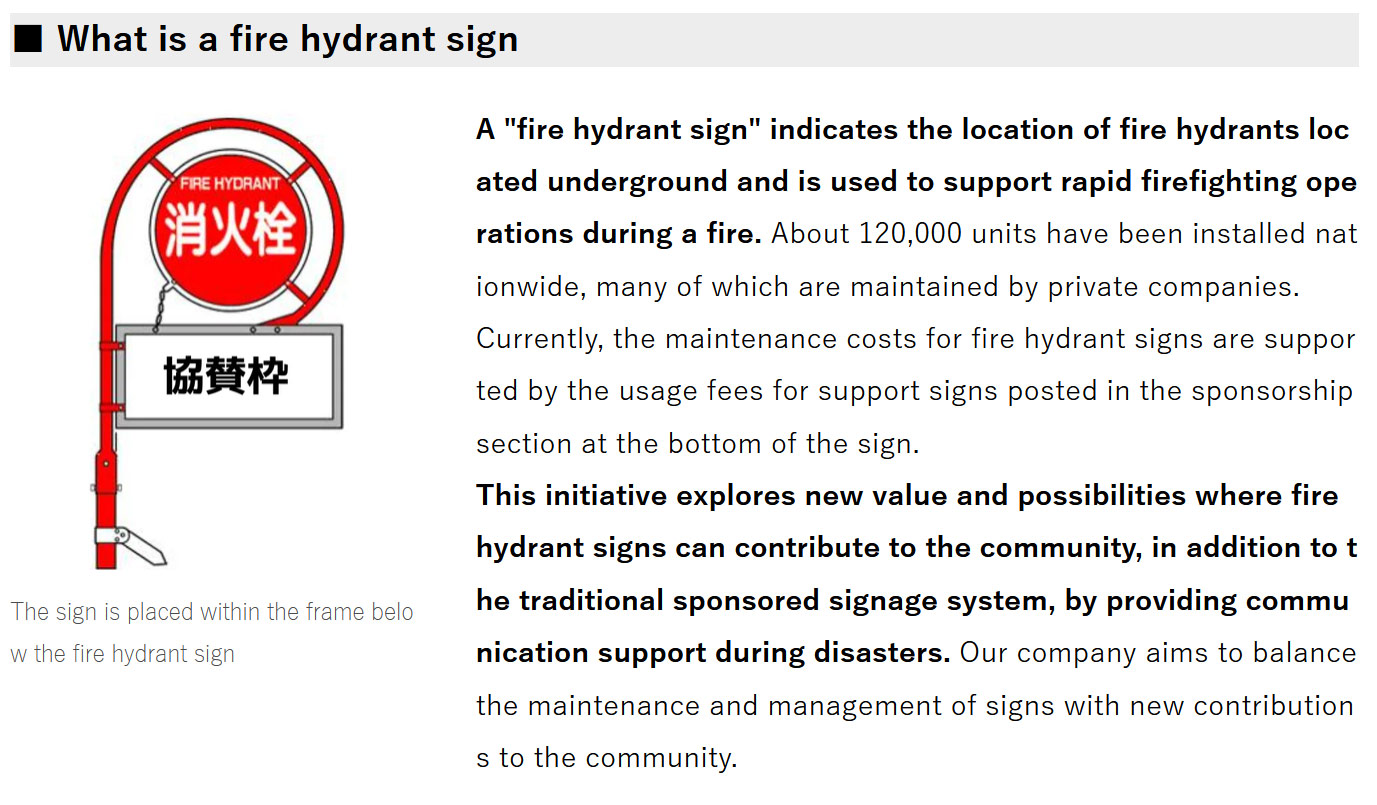
Fire hydrant sign + Starlink

Fire hydrant sign explainer (Image credit: Japan’s Fire Hydrant Sign Co., Ltd. PRTimes)

Somewhat surprisingly, fire hydrant signs are largely maintained by private companies in Japan. They make some money via the advertising space on a sign directly below the one indicating the emergency water source location. Adding Starlink to them could provide the aforementioned disaster relief, as well as other monetization opportunities.

The Fire Hydrant Sign Co. behind this trial says that it will consider collaboration with local governments, regional companies, and related organizations to roll out this initiative, now proven to be useful. It isn’t only going to be useful in the event of a disaster; the company foresees demand during power cuts, local large-scale events, and other opportunities where more Wi-Fi connectivity options are desirable.

In some press release ‘small print,’ the firm says that its successful trial doesn’t mean that a Wi-Fi service will eventually be launched. It was a technical demo, and it also states that Starlink wasn’t a partner or collaborator in any official capacity.

China’s hollow-core fiber trial pushes 51.3 Tb/s over 128 miles without signal regeneration — milestone targets AI-era networking bottlenecks

Chinese firm Yangtze Optical Fiber and Cable Joint Stock Limited Company (YOFC) announced on June 16 that it had successfully completed the world’s first field trial of hollow-core fiber (HCF) wavelength-division multiplexing (WDM) capable of 1.2 Tb/s per wavelength over an ultra-long unrepeatered span. The trial — conducted in collaboration with state-owned China Telecom and optical equipment maker Dekoli — achieved an unprecedented aggregate transmission capacity of 51.3 Tb/s over roughly 128 miles (206.5 km) without signal regeneration.

These figures, which the collaborators describe as a new world record for unrepeatered WDM capacity-distance performance without remote-pumped amplifiers, were achieved using only erbium-doped fiber amplifier amplification. The demonstration was carried out under the framework of the National Key Laboratory for Advanced Manufacturing and Application Technologies of Optical Fibers and Cables.

The success of this trial marks a major leap forward in optical communications. What separates it from earlier HCF results is the combination of capacity, distance, and amplification approach in a live network rather than a lab. China Telecom had previously demonstrated 1.2 Tb/s over a single wavelength, back in July 2024, but only over a 20-kilometer span.

Elsewhere, researchers have pushed unrepeatered HCF spans past 300 kilometers, but at far lower capacities. Pulling 1.2 Tb/s per channel over more than 200 kilometers on a commercial cable, using only conventional erbium-doped fiber amplifiers (EDFAs) rather than the remote-pumped boosters typically needed to extend unrepeatered reach, is the remarkable new achievement YOFC claims.

Hollow-core fiber is a next-generation optical data transmission medium that is rapidly emerging as a leading candidate for high-capacity, low-latency networking. Unlike conventional optical fiber, which guides light through a solid glass (silica) core, HCF guides light through an air-filled channel. This structural difference offers several advantages. Light travels roughly 1.5 times faster through air than through glass, cutting latency. Furthermore, the air core sidesteps some of the nonlinear distortion and dispersion baked into silica. YOFC has previously claimed that its hollow-core fiber technology can deliver 31% lower latency, 47% faster transmission speeds, and near-zero optical nonlinearity compared with conventional solid-core fiber.

In theory, HCF's air core would enable it to carry far more data over far greater distances with fewer amplification points. The trade-off has always been loss. Commercial hollow-core fiber has historically run at higher attenuation than mature silica fiber, limiting how far a signal can travel before it needs a boost. This limitation has been narrowing, with the trial's 200 km-plus unrepeatered span being the latest milestone.

The collaborators achieved this through two main innovations: one at the system level and the other in the amplifier hardware. At the system level, they used a self-developed optimization scheme for per-wavelength rate and channel power allocation. Rather than pushing every wavelength at the same data rate and power, the system adapted each channel to the link conditions, enabling hybrid transmission across multiple data rates, channel spacings, and power levels. The companies say this helped reduce capacity losses caused by gas-absorption peaks inside the hollow core, a quirk specific to guiding light through air rather than glass.

On the hardware side, the researchers built a high-power amplifier using a cascaded dual-gain-unit architecture and a multi-element doping design, achieving a maximum output of 33.5 dBm (roughly 2.24 W) while maintaining flat gain across the operating band. That higher-power, flatter amplification helped stretch an unrepeatered span without resorting to the remote-pumped amplifiers the team was trying to avoid. Because pushing that much power over a live optical link carries a real risk of failure, the system was wrapped in safeguards, including optical-path power anomaly detection, automatic interlock shutdown, and alarm-linked response mechanisms to catch faults before they damage equipment.

The stakes in this trial, and in HCF more broadly, tie directly to the AI buildout. As hyperscalers race to stand up ever-larger GPU clusters, the network linking those clusters, inside data centers and across the long-haul links between facilities, is fast becoming the bottleneck. HCF's lower latency lets operators site facilities farther from expensive, power-constrained hubs without a speed penalty, while its capacity headroom helps move the enormous traffic AI training and inference generate. The same properties make it attractive for latency-sensitive workloads like financial trading.

That promise is already pulling in serious money, mostly from the West. Microsoft, which moved early via its 2022 Lumenisity acquisition, struck manufacturing deals with Corning and Heraeus in September 2025 to scale production across Azure. AWS has developed its own HCF, claiming a 30% latency improvement over standard fiber, and says it wants more than it can currently get. Corning also has fiber deals with Microsoft, Meta, and Lumen, and is expanding in North Carolina with Nvidia's backing. Trials like YOFC’s are closing existing gaps toward full, widespread HCF deployment, though China's progress largely sits outside the Western supply chain now forming.

❌