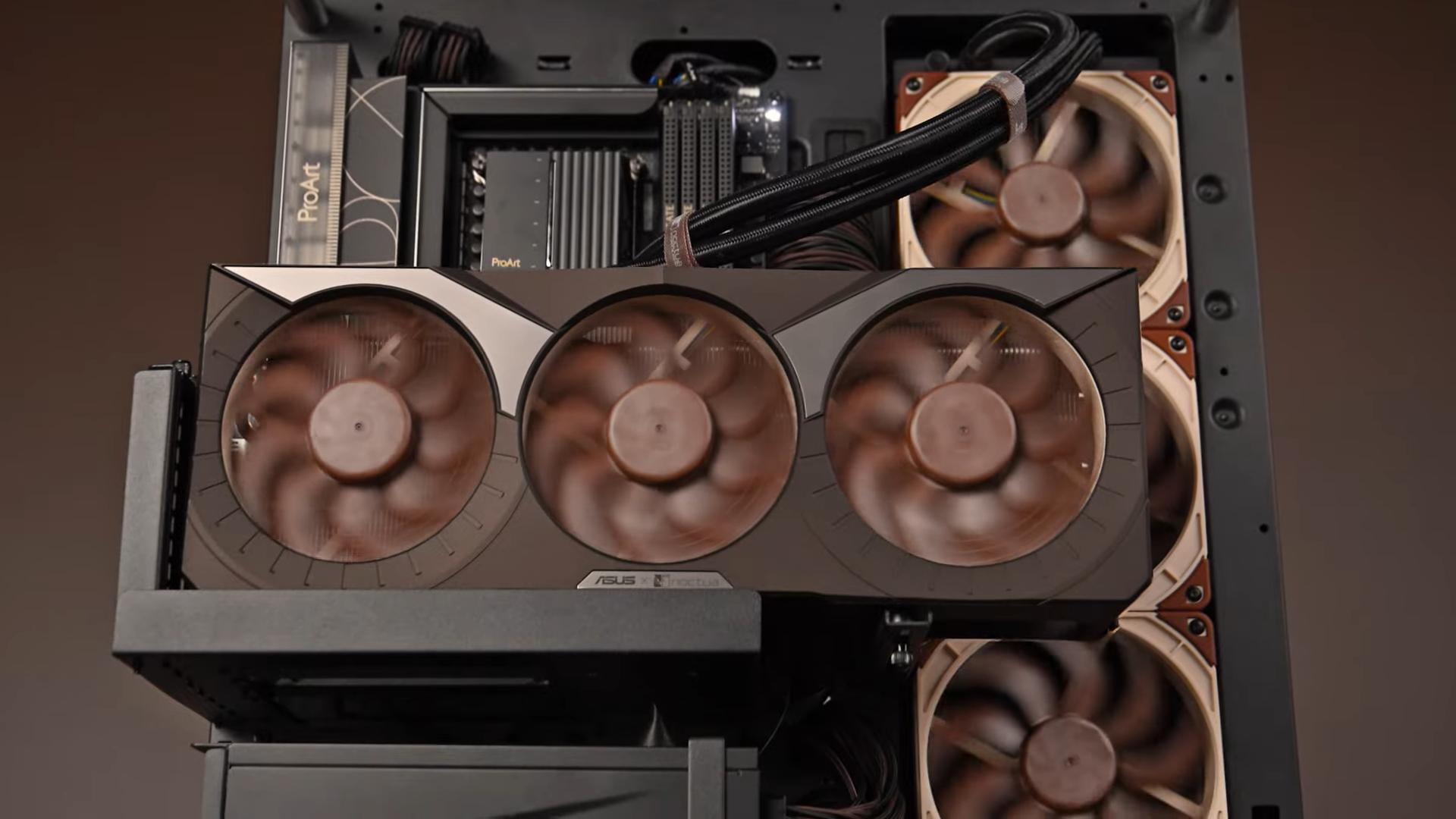
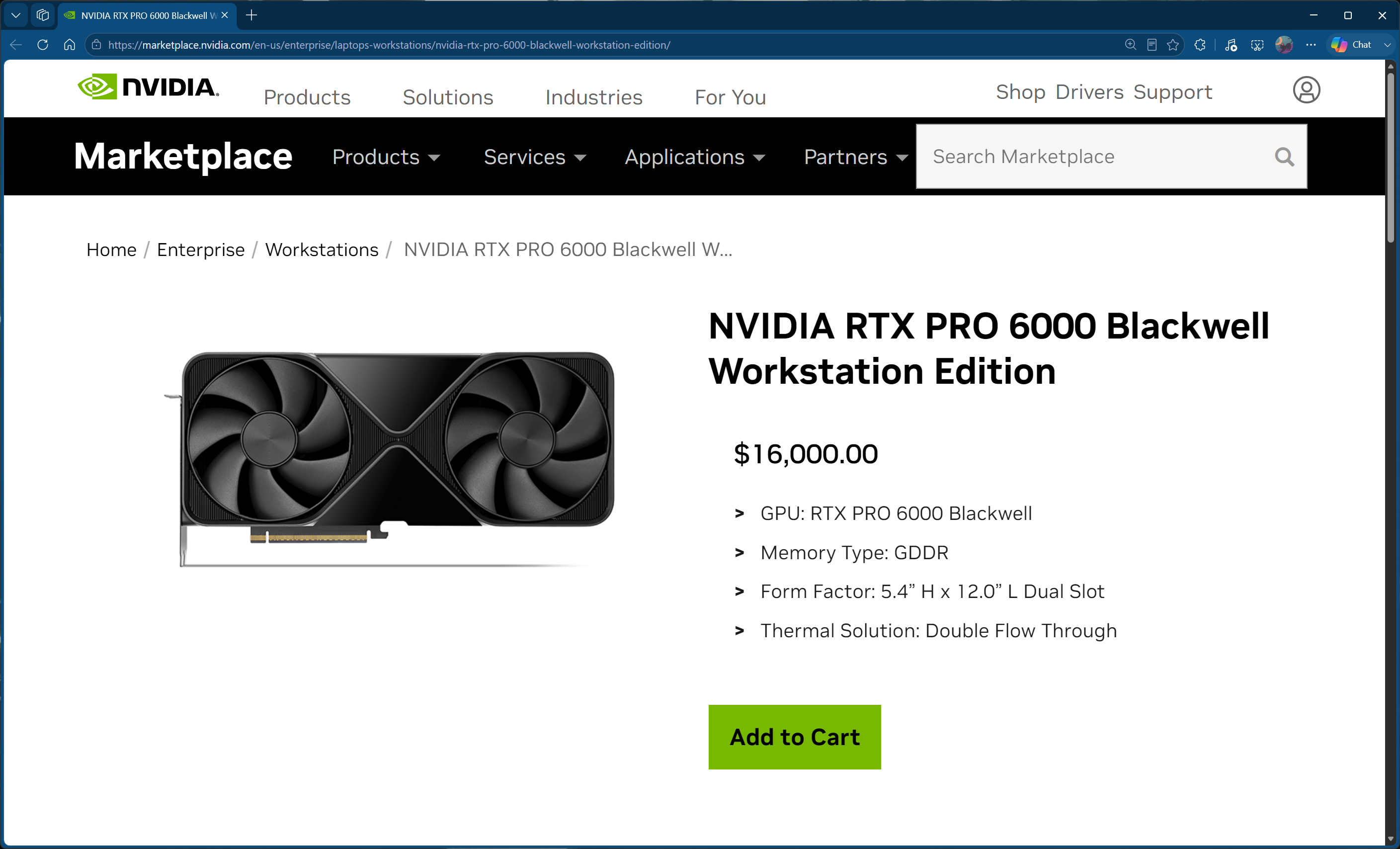
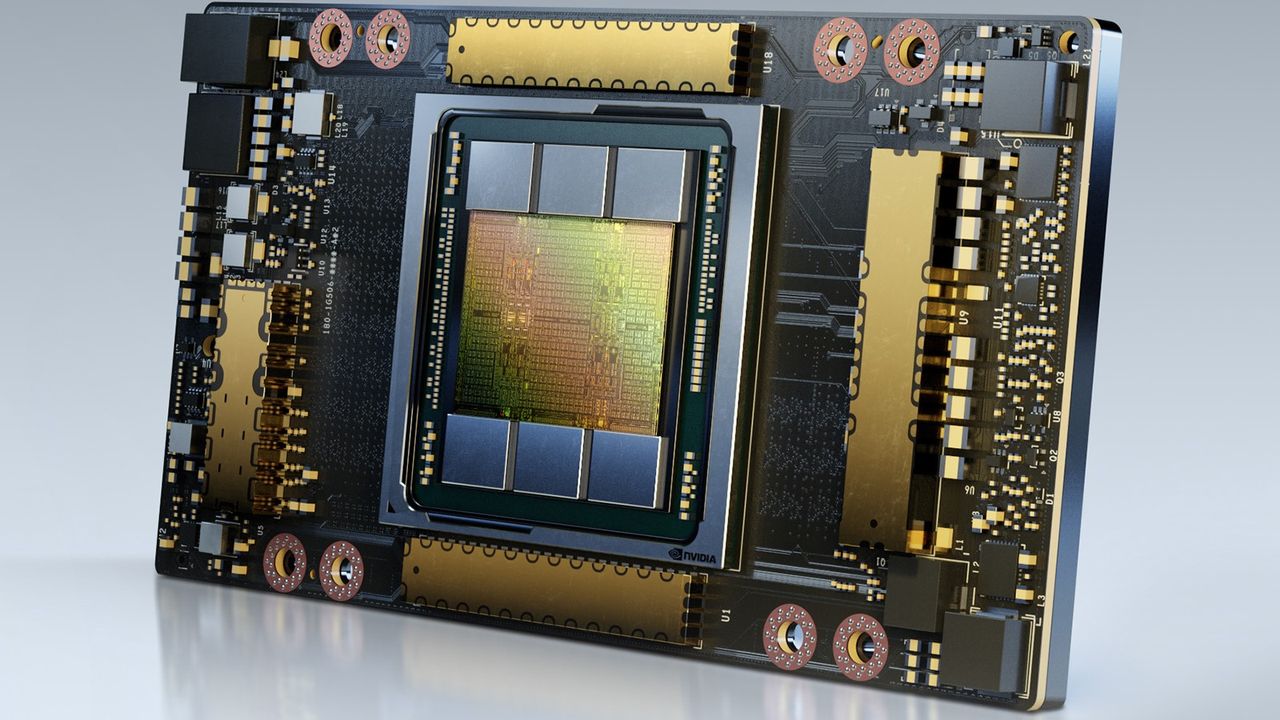
NVIDIA's flagship Blackwell GPU, the RTX PRO 6000, is now listed at $16,000 US, the highest price since its launch. Continued Memory Shortages Lead To Doubling In Price of NVIDIA's 96 GB RTX PRO 6000 Blackwell GPU Memory shortages and the resultant price increases are giving no relief to PC segments, whether on the gaming or professional side of the spectrum. Just two months ago, the RTX PRO 6000 was selling for over $13,000 US, and now, it has reached a new high of $16,000. The NVIDIA RTX PRO 6000 Blackwell is a specialized variant, designed for prosumers, and has […]
AMD has officially raised the MSRP/SEP prices of its Radeon RX 9000 GPUs in Q3 2026, with the RX 9070 XT now costing more than $1000 on average. AMD Couldn't Escape the Memory Shortages-Related Prices Bump, Raises Radeon RX 9000 GPUs By Up To 20% With All Models Affected Retailers and Distributors in China had warned us of an imminent price hike, & when we initially reported the increases, the harshest price increases were seen for NVIDIA GPUs. AMD Radeon graphics cards also saw a price bump, but it wasn't as significant as their competitor. Now, a few weeks later, […]
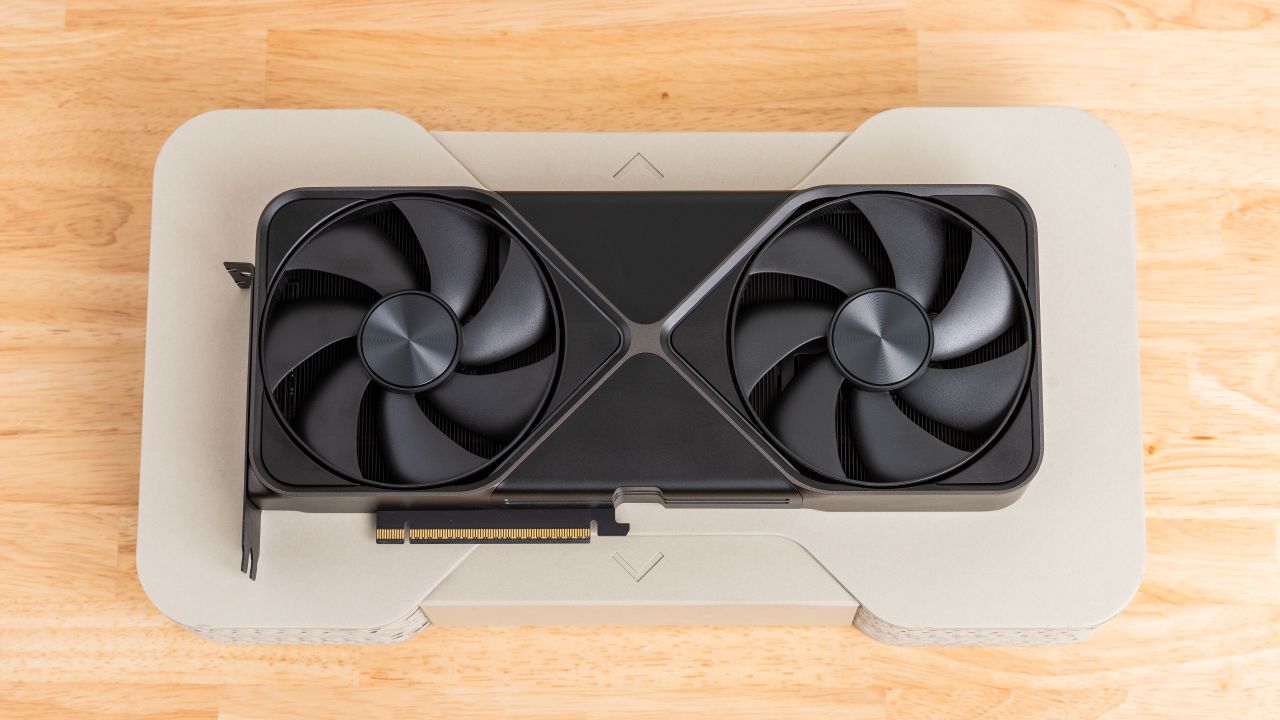
Nvidia has once again silently raised the price of its RTX PRO 6000 Blackwell on its US Marketplace website to $16,000. The card was previously listed for $13,250, which itself was a price hike earlier this year since it actually launched at $8,565. Workstation GPUs of this caliber don't really have an MSRP since no one's buying them at retail, but we saw pre-orders for this GPU as low as $7,673 back in March 2025.
That's when the card was first announced, and it went on sale a month later, in April 2025, where initial listings had it up for $8,435 for bulk orders and $8,565 for single-unit purchases. This means the June 2026 change from $8,435 to $13,250 was already a 57% price increase, and now, from $13,250 to $16,000, we're seeing a roughly 20% hike. In total, from March 2025 to August 2026, the RTX Pro 6000 became almost 90% more expensive.
(Image credit: Future)
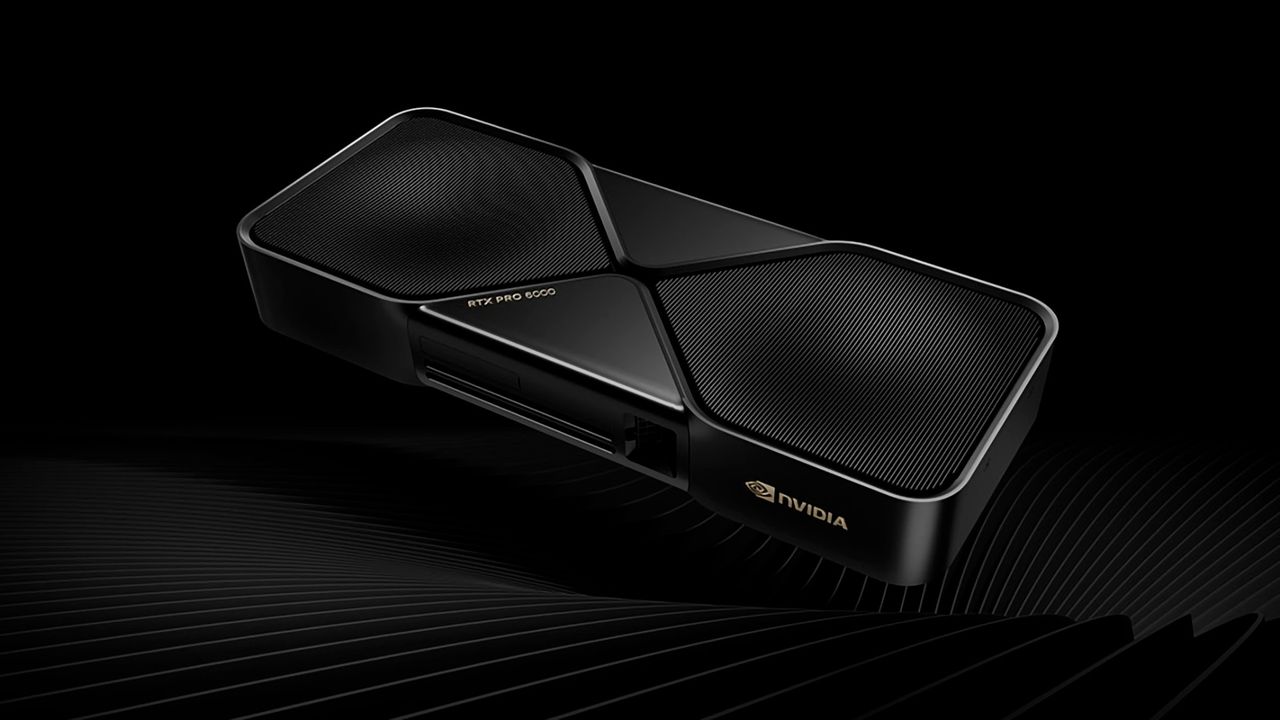
If you count the pre-order prices that were momentarily below $8,000 — we're seeing this card sell for more than twice what it debuted at. Keep in mind that we're talking about the boxed Workstation Edition, which is basically like the Founder's Edition for these professional cards, because otherwise it's also available in a 300W Max-Q variant with a blower-style cooler, and a server edition with passive cooling for rack mounts.
These price hikes were not officially confirmed by Nvidia at any point during 2025 and 2026. With the ongoing component crisis continuing to worsen memory prices, these changes are not a surprise, especially when you consider the RTX Pro 6000 Blackwell has 96GB of GDDR7 VRAM.
Still, a nearly $7,500 increase from March 2025 listings to now is a sizeable jump. For what it's worth, we found the same SKU listed on Newegg for $13,998, so $2,000 less than Nvidia's official store and basically the same price as before. Perhaps this listing will rise to $16,000 the moment current inventory runs out, and prices always vary between retailers. Case in point, B&H has the RTX Pro 6000 Blackwell up for $15,499 right now.
CoreWeave signed a contract for Nvidia A100 GPUs that runs into 2029, nine years after the Ampere-based SKU debuted, CEO Mike Intrator disclosed on the company's second-quarter earnings call on Monday. The company reported $2.58 billion in quarterly revenue, up 112% year over year, and a $104 billion revenue backlog that excludes more than $25 billion in new commitments booked since July. In remarks made during the earnings call, Intrator said, “pricing for prior generation SKUs is at or above where it was years ago.”
Michael Burry accused hyperscalers in November of understating depreciation by $176 billion between 2026 and 2028 by stretching GPU useful-life assumptions to five or six years against a chip cadence that now delivers a new Nvidia architecture roughly every year. Concerns that accelerating GPU obsolescence could unravel AI financing predate his estimate, and an unnamed Google architect put datacenter GPU service life at one to three years back in 2024.
Intrator told CNBC at the time that a batch of H100s coming off an expired contract was immediately rebooked at 95% of the original price, and Nvidia CFO Colette Kress countered Burry directly, saying A100s sold six years ago still run at full utilization. The 2029 deal stretches that record further, putting contracted revenue on 2020 silicon beyond even the six-year depreciation schedules defended by hyperscalers.
An air-cooled Nvidia DGX A100 system draws 6.5kW at maximum load and fits comfortably in legacy data center halls designed for roughly 20kW per rack. Nvidia's current GB200 and GB300 NVL72 racks draw 120kW to 140kW and require direct-to-chip liquid cooling, roughly six times what those older facilities can feed and cool. Blackwell therefore can't move into the halls where Ampere is currently deployed without a rebuild of power delivery and cooling infrastructure.
That mismatch is helping to keep A100 fleets in service regardless of how gracefully or not silicon itself ages. The energized, air-cooled capacity holding them has no higher-value use, and renting nine-year-old GPUs is a better alternative to leaving it in the dark.
CoreWeave's contracted power grew to 3.7 GW in Q2 and stood at 4.2 GW as of Monday, against just 1.5 GW online, so customer commitments already cover nearly triple the capacity the company can deliver. CFO Nitin Agrawal added on the call that capacity coming up for renewal represents a very limited share of CoreWeave's fleet, with older-generation ASPs at or above levels from a year ago.
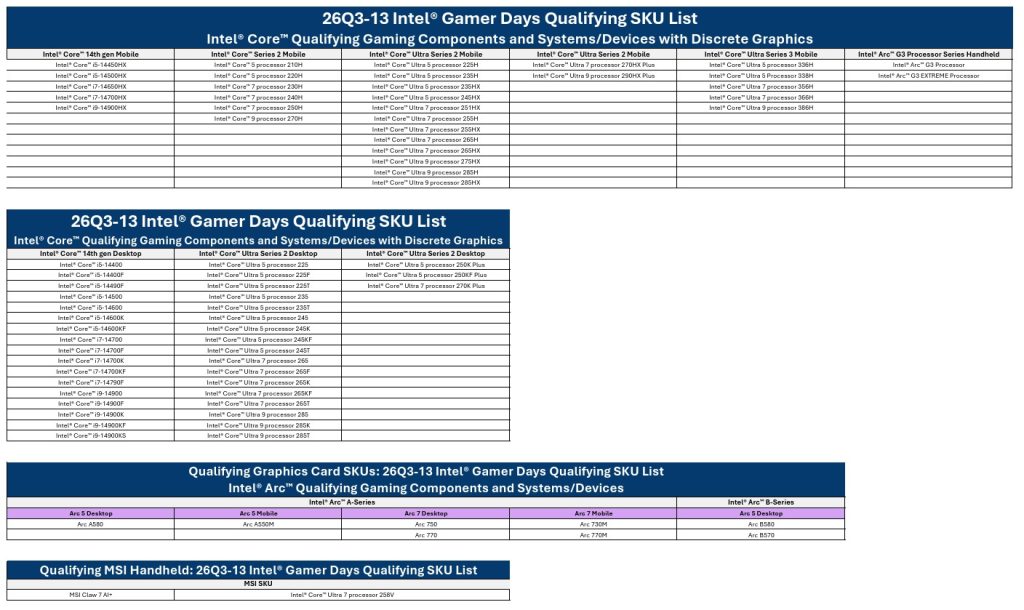
Intel has relaunched its Gamer Days Bundle promotion. This time, Intel is offering buyers two free games with qualifying processors, graphics products, and prebuilt systems.
Running from August 10th through September 13th, the bundle includes full game downloads for STAR WARS: Galactic Racer and Tomb Raider: Legacy of Atlantis. Customers have until October 31st to redeem their game codes after making a purchase. Depending on where you buy, redemption requires a Master Key, a system hardware scan, or basic purchase verification with proof of purchase. Only one offer is available per qualifying product and returned or cancelled orders will lose eligibility.
The offer covers a wide range of hardware, including Arc G3 graphics, Core 200H laptop processors, 13th and 14th Gen Core chips, and Core Ultra 100, 200, and 300 H-series processors. Newer Core Ultra Plus models and MSI handhelds featuring Lunar Lake SOCs are also on the eligible list alongside various suffix variants like K, KF, H, and so on. A more detailed list of the qualifying processor families can be found below:
Note that participating retailers may vary on which specific products qualify at their stores.
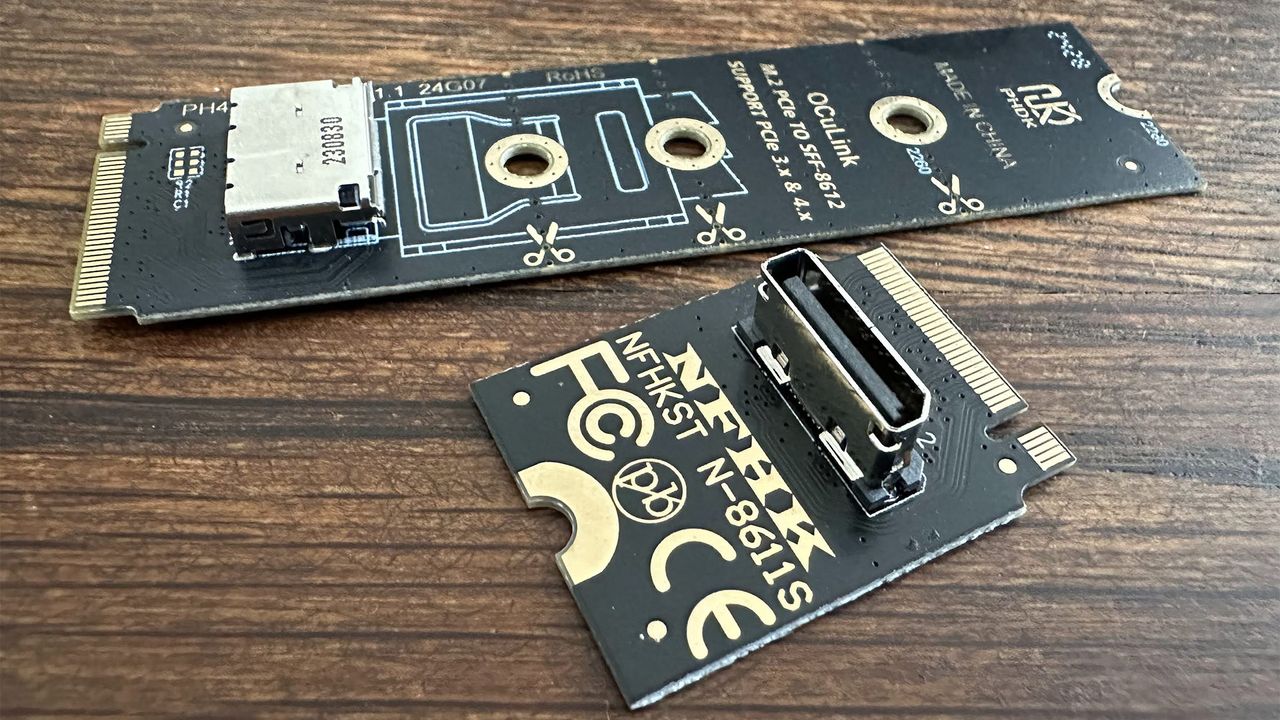
A Redditor has successfully connected a very powerful eGPU to the Steam Machine. Large_Customer_3840 briefly explains how they managed to add a potent AMD Radeon RX 9070 XT to Valve’s compact modern gaming desktop by fitting an M.2 to OCuLink adapter in the machine. That was cable-connected to an Aoostar EG01, which hosted the hulking triple-fan desktop graphics card. However, there remained some wrangling to do due to Steam Machine hardware limitations.
The idea outlined above sounds like a quick and simple hack to add a more powerful GPU to the Steam Machine, but there are a few limitations of the Valve hardware that need addressing. Firstly, this compact computer has just one M.2 PCIe 4.0 NVMe slot, which is used by the SSD that Valve supplies with the machine. Valve reckons folks can augment this storage using the microSD slot, just like Steam Deck gamers are accustomed to doing.
So, after fitting an OCuLink to M.2 adapter, Large_Customer_3840 had to find somewhere for the boot drive to live. The answer was simply to shove the boot drive into a USB-C to NVMe caddy and boot from that. Valve’s Steam Machine has a USB 3.2 Gen 2 (10 Gbps) port on the back which supports DP-Alt and Power Delivery. This is the fastest USB port it has, so it was used for the operating system.
A second snag with the M.2 to OCuLink adapter setup here is that there will need to be a case mod done so the cable can be threaded through the rear of the chassis. Large_Customer_3840 hasn’t made such a mod yet, and they are happy to have the system running open for now.
But many eGPU solutions like this, using the Aoostar EG01 in this instance, are inherently messy anyway. This older Aoostar eGPU dock has no enclosure, making it little more than a platform with a PCIe slot and supporting circuitry to host a desktop GPU, exposed, on your desk. Moreover, the EG01 doesn’t have a built-in PSU, unlike some models, so you also have a typically ugly PC power supply in view, too.
Looking beyond the aesthetic mess, the Redditor was pleased that “When I turned it on the 9070xt became the primary monitor and worked straight away. There was no hassle no selecting of graphic adapters.” The extra shot of performance delivered by one of the best graphics cards for PCs in 2026 was also welcomed. Apparently the OCuLink-connected Radeon RX 9070 XT eGPU ran Crimson Desert at over 100 frames per second using the High preset. It would have been interesting to know how the Steam Machine’s built-in discrete GPU handled the game at the same settings… As the Steam Machine basically runs a GPU similar to the Radeon RX 7600 – you can see our extensive Graphics Card Hierarchy data to see the expected difference between the RX 7600 and RX 9070 XT in various gaming scenarios. Online testing for Crimson Desert at the High preset yields frame rates of around 50 FPS, making the eGPU addition a sizeable performance buff.
Many AMD mini PCs come with USB4 ports nowadays, so it is a shame that the Steam Machine’s USB connectivity plateaus at USB 3.2 Gen 2 (10 Gbps) via a single USB-C on the rear. USB4, or better, is a more convenient hot-pluggable eGPU port opening up lots of other docking options for compact system users. It may offer worse bandwidth than OCuLink, but most folks find it an acceptable compromise. I’ve used both and was slightly annoyed by both, vowing not to be tempted into the eGPU world again until mainstream USB4 v2/Thunderbolt 5 solutions have arrived at affordable levels.
News of regional price increases for Nvidia graphics cards has been rolling in over the past little while, and those hikes have now arrived in the United States. We nearly spit out our coffee this morning while checking Newegg prices for Blackwell products. After months of painful but still relatively reasonable e-tail prices versus skyrocketing RAM and SSD costs, popular Blackwell GPUs are now eye-wateringly expensive. And those increases appear to be rolling out across other e-tailers, too.
Newegg RTX 50-series median graphics card pricing, August 2026
Median price, June 2026
Median price, August 2026
Percentage change
RTX 5050
$299.99
$314.99
5%
RTX 5060
$369.99
$469.99
27%
RTX 5060 Ti 8GB
$469.99
$529.99
13%
RTX 5060 Ti 16GB
$569.99
$804.99
39%
RTX 5070
$659.99
$899.99
36%
RTX 5070 Ti
$1099.99
$1099.99
flat
RTX 5080
$1461.99
$1499.99
3%
RTX 5090
$4299.99
$4699.99
9%
As part of our ongoing research for the best graphics cards, we track the prices of every e-tail listing we can find for consumer graphics cards and calculate the median price of those products. We specifically track this figure as we feel it represents the price of a given graphics card model that you're most likely to find in stock, not stripped-down models that might be produced in limited volume to hit an artificially low MSRP.
With that, the theoretically entry-level RTX 5060 is now $469.99 at the midpoint of current prices, which is now two rungs up the MSRP ladder compared to its $299.99 launch MSRP. Just a couple of months ago, 5060s were selling for a median $369.99, or just below the RTX 5060 Ti 8GB’s $379.99 launch MSRP. Now, the cheapest GDDR7 Blackwell card costs more than the RTX 5060 Ti 16GB’s $429.99 launch price.
RTX 5060 Ti 8GB cards used to be among the least marked-up Blackwell parts thanks to the fact that their performance and VRAM capacity was out of line with their high $379.99 launch MSRP, but they’re now headed up the escalator like their stablemates. The median 5060 Ti 8GB now costs $529.99, which is about 13-15% more expensive than a couple of months ago.
The RTX 5060 Ti 16GB now commands an astounding $799.99 median price, a jaw-dropping 38% more expensive than the $579.99 midpoint we last calculated. The 5060 Ti 16GB was already far too expensive to recommend for gaming at that price, and the new markup suggests that it’ll only be of interest to local AI explorers trying to get the most VRAM they can on a Blackwell card for under $1000. Pour one out for what used to be the best entry-level enthusiast GPU we recommended.
The RTX 5070 was another one of the last gaming holdouts near its MSRP thanks to strong competition from the RX 9070 16GB, but the midpoint of prices for 5070s has now leaped an incredible 29% over our last survey, to about $850-$900. Even comparing lows to lows, prices for the cheapest 5070s have jumped about 20%. That takes this card entirely out of the midrange running and positions it closer to the much faster RTX 5070 Ti, which also has 16GB of VRAM to play with.
The hikes appear to have hit the middle of the Blackwell lineup the hardest, as the midpoint of RTX 5070 Ti prices is the same as it was during our last check-in. RTX 5080s haven’t gotten substantially more expensive than they have been, either, as prices for those cards have always been highly elevated compared to their $999 MSRP. And the RTX 5050’s price has barely moved today, either, hovering near the $300 it’s maintained since around the beginning of the year.
These increases haven’t been matched by hikes on the AMD side—yet. Heavy emphasis on yet. We’re only seeing single-digit percentage increases in RDNA 4 card prices compared to our last survey, although Radeon RX 9000-series cards appear to be affected by the silicon supply crunch in other ways.
The assortment of available RX 9070 16GB cards is perhaps a bit smaller than it’s been in the past, while the cut-down RX 9070 GRE is available in abundance around its $549 MSRP, suggesting that card has taken over the true midrange role the plain 9070 could never quite manage at the same MSRP.
We felt that the GRE’s price was high at launch, but AMD likely has a better crystal ball for silicon supply chain trends than we do, as the GRE now offers incredible bang for the buck compared to the RTX 5070’s new sticker.
The RX 9060 XT 8GB isn’t completely dead yet, but only one XFX 8GB model remains readily available at e-tail for $399. The RX 9060 XT 16GB’s median price has slightly risen to $474.99, and the RX 9070 XT now sits 5% higher than our last check-in at a median of $799.99.
All told, these Blackwell price hikes are another body blow for a DIY PC component market that’s already reeling from sky-high RAM and NAND prices. Graphics cards had until recently been one of the less hiked-up component categories in a DIY PC’s bill of materials compared to the pre-AI times, but that period of relative solace is well and truly over if you want access to Nvidia’s hardware and software stack.
If you’re a PC gamer, there’s no good news here. We’ll have to see whether there’s a similar price spike waiting in the wings for Radeon cards in the coming days, or whether this is the sad, sorry new normal.
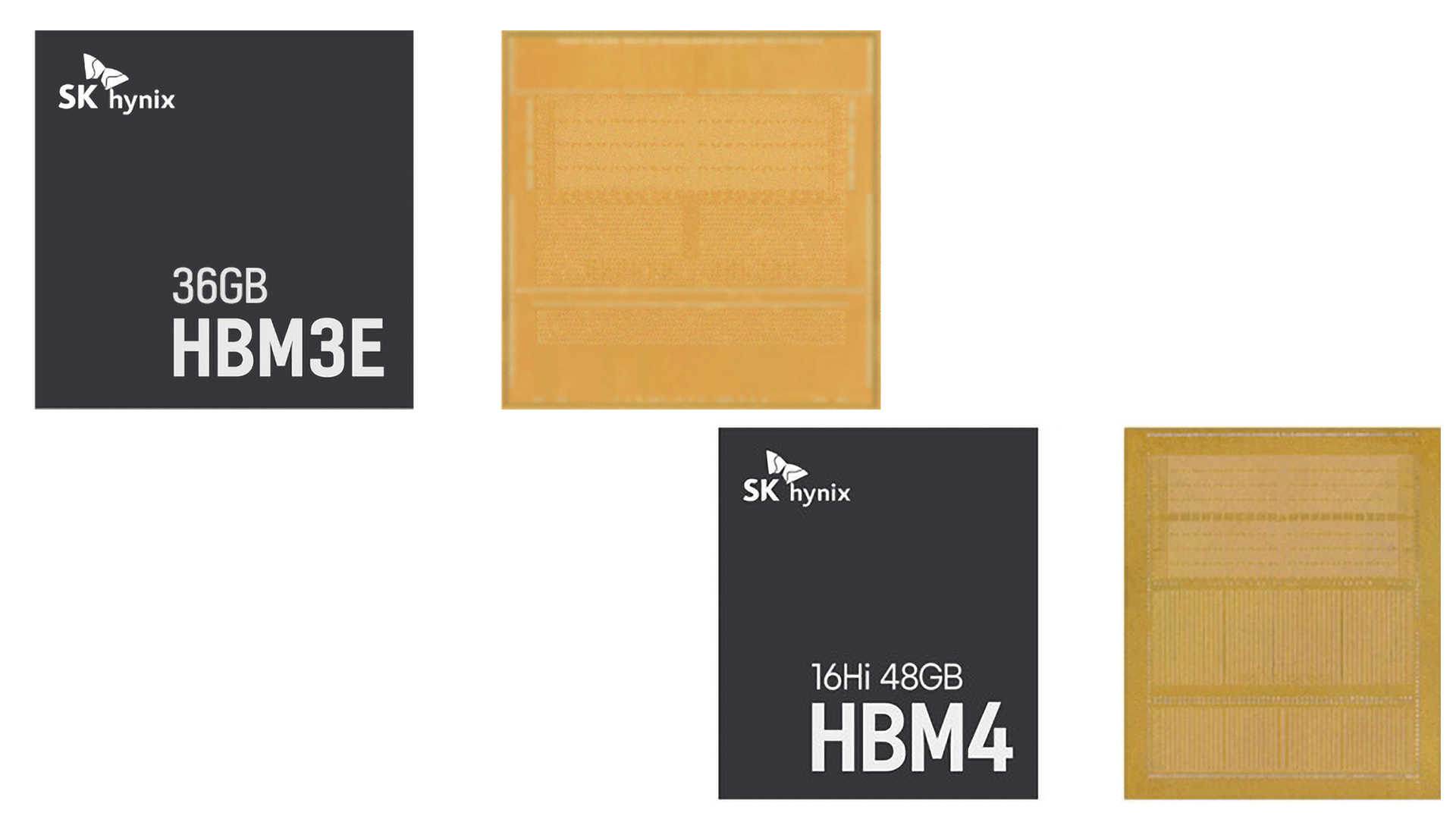
Nvidia is reportedly testing variations of its upcoming Rubin Ultra accelerator with less memory due to concerns it won't be able to source enough HBM. Some versions include just 192 GB of memory and use HBM4 instead of HBM4E, as originally announced, according to The Information. The report confirms an earlier comment from firm SemiAnalysis about a potential Rubin Ultra memory downgrade.
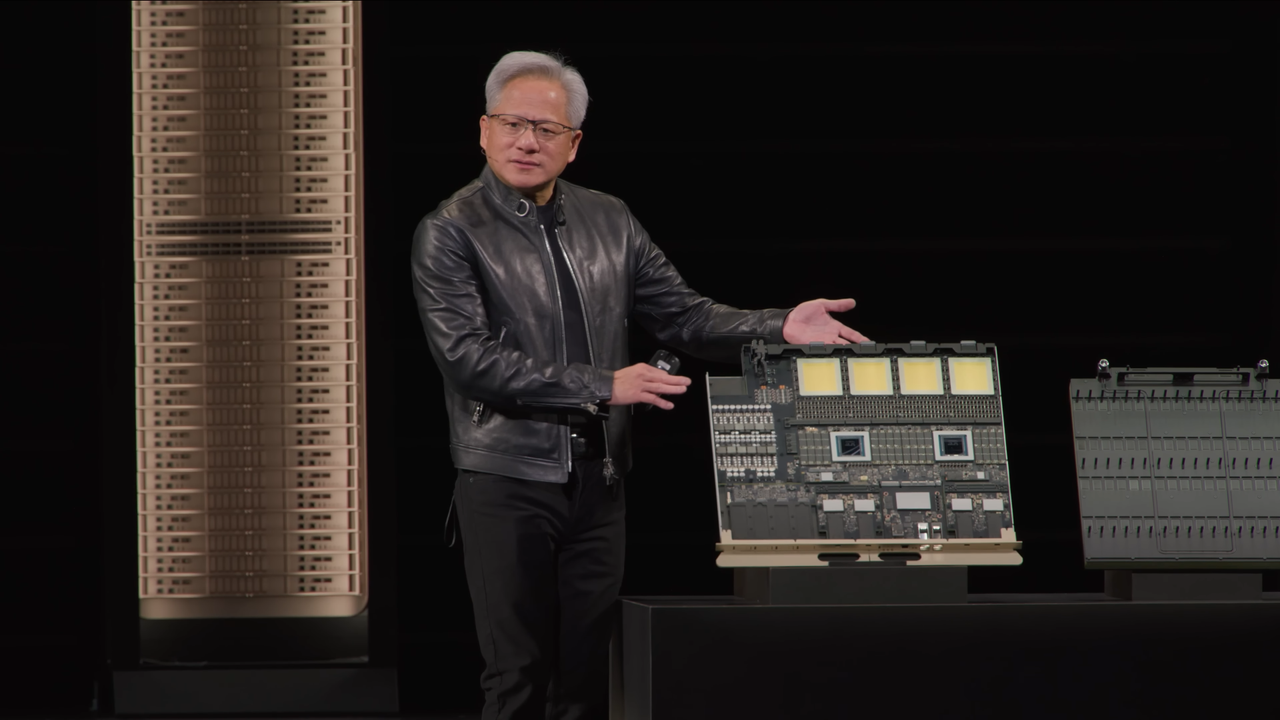
We first saw Rubin Ultra in the flesh earlier this year at GTC, where Nvidia showed off a compute tray housing four compute chiplets alongside 1 TB of HBM4E memory. The accelerator is part of Nvidia's Kyber NVL144 design, which is set to roll out in 2027. SemiAnaylsis reported that the rack was delayed to 2028. "Our roadmap is intact," said Nvidia to Tom's Hardware in response, though the company made no clarification on if the delay was real or not. We've reached out to Nvidia regarding this latest report.
According to The Information, Nvidia is testing versions of Rubin Ultra with 192 GB or 256 GB of memory, as well as versions that use fewer than the 16 announced memory stacks. Perhaps most importantly, Nvidia is reportedly testing with HBM4, not HBM4E as originally announced. Along with the traditional improvements we see in each new HBM generation, HBM4E is unique in that it offers a customizable base logic die. Last year, Micron announced a partnership with TSMC to manufacture the base die and allow customers to tweak the logic die based on their needs.
The complexity of HBM4E has reportedly caused a strain on supply, with memory manufacturers unable to keep pace with Rubin Ultra's rollout. At least three lower-memory designs have been tested by Nvidia, according to the report, though we don't have a full picture of details on those prototypes. The report claims testing with HBM4, as well as 192 GB and 256 GB configurations, though it makes no mention of the number of compute dies, nor the memory type for each tested capacity.
The number of dies is important. In June, reports circulated that Nvidia cancelled its quad-die Rubin Ultra design due to manufacturing complexities. Although Nvidia has yet to comment, reports at the time suggested Nvidia would move ahead with a dual-GPU Rubin Ultra. In such a case, less memory would make more sense. Even with a dual-die Rubin Ultra, the quoted capacities are lower than expected. Each base Rubin GPU currently ships with 288 GB of HBM4.
It's clear Nvidia is trying to get ahead with memory in a world where agreements have been signed multiple years into the future. Nvidia has several of its own agreements. In June, the company announced a partnership with SK hynix to develop next-generation memory technology, which includes HBM, but also LPDDR5X and DDR5. In July, Nvidia expanded that partnership with a $500 billion strategic relationship that includes a long-term memory supply agreement with SK.
Although Nvidia is considering lower-memory configurations, one Nvidia customer told The Information that per-GPU memory isn't a top concern, valuing the relationship with Nvidia over the long term.
Memory shortages are touching nearly every design currently on the market, though enterprise systems packing HBM are particularly vulnerable. Last week, Digitimes reported that Samsung, SK hynix, and Micron have sold through their HBM capacity through 2027. Last month, SK Hynix CEO Kwak Noh-jung said 2027 will be the "worst year" for the memory shortage, with supply constraints lasting through 2030.
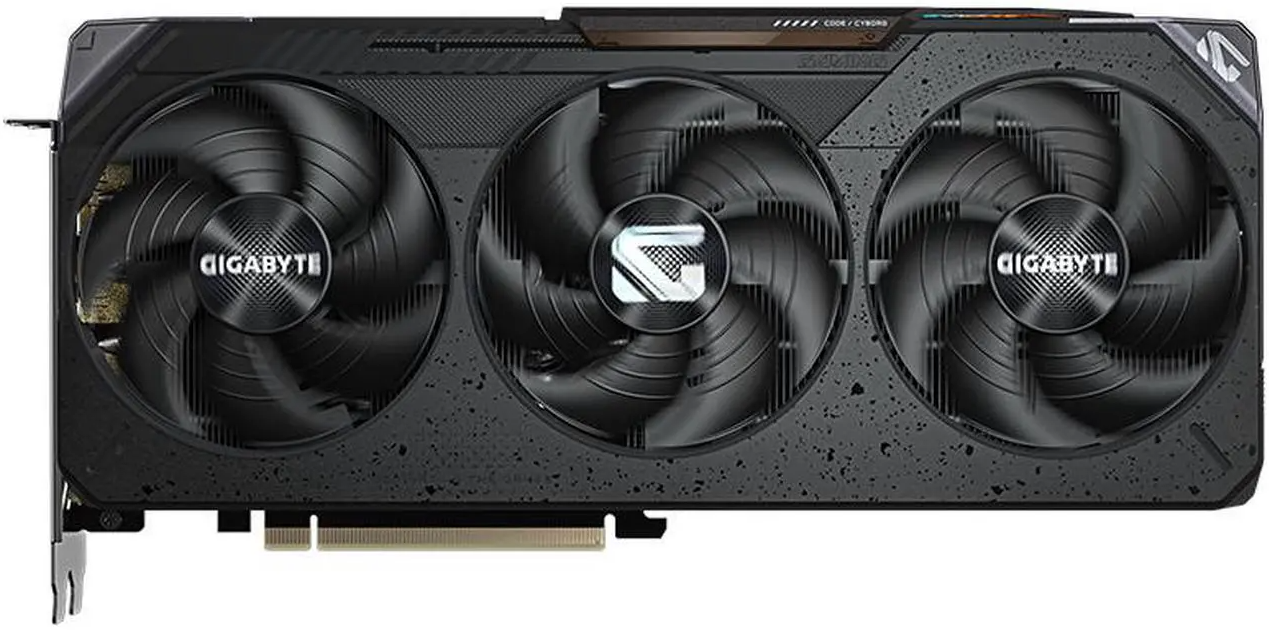
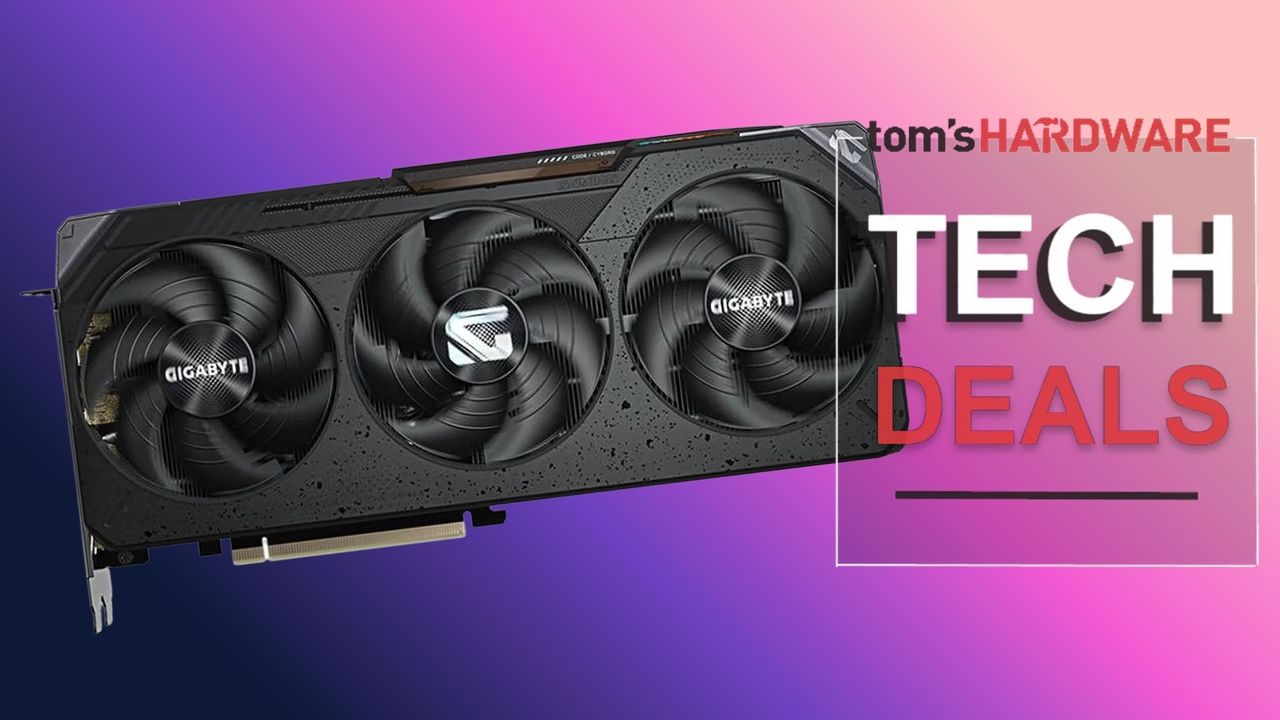
A very rare sight indeed; that's how I'd describe the price of the deal on AMD's Gigabyte Gaming Radeon RX 9070 GRE graphics card, on sale at Newegg for $499, a return to its lowest-ever price. It's a very grim time for hunting down PC component upgrades, so to see an actual deal on a GPU that takes it below its MSRP in today's climate is a bit of a shock. The MSRP on the RX 9070 GRE is $549, having only recently extended its availability outside of the Chinese market. To grab the $35 discount and hit the $499 deal price, you must provide your email address to Newegg by clicking the "Extra Discount Available" link.
The Radeon RX 9070 GRE is built on AMD’s RDNA 4 graphics architecture and uses the same Navi 48 GPU as the Radeon RX 9070 and RX 9070 XT. Initially released for the Chinese market, the RX 9070 GRE features a cut-down version of the Navi 48 chip with 48 compute units compared to the RX 9070's 56.
The RX 9070 GRE also cuts the available VRAM to just 12GB of GDDR6, but still sports bandwidth speeds of 18 Gbps on a 192-bit bus, producing 432 GB/s of memory bandwidth in gaming and applications.
It's also reasonably power efficient, using just 220W total power draw. Identical to the standard Radeon RX 9070 GPU.
A great graphics card for 1080p and 1440p gaming, the RX 9070 GRE sports 12GB of VRAM and boost clock speeds of 2920 MHz. View Deal
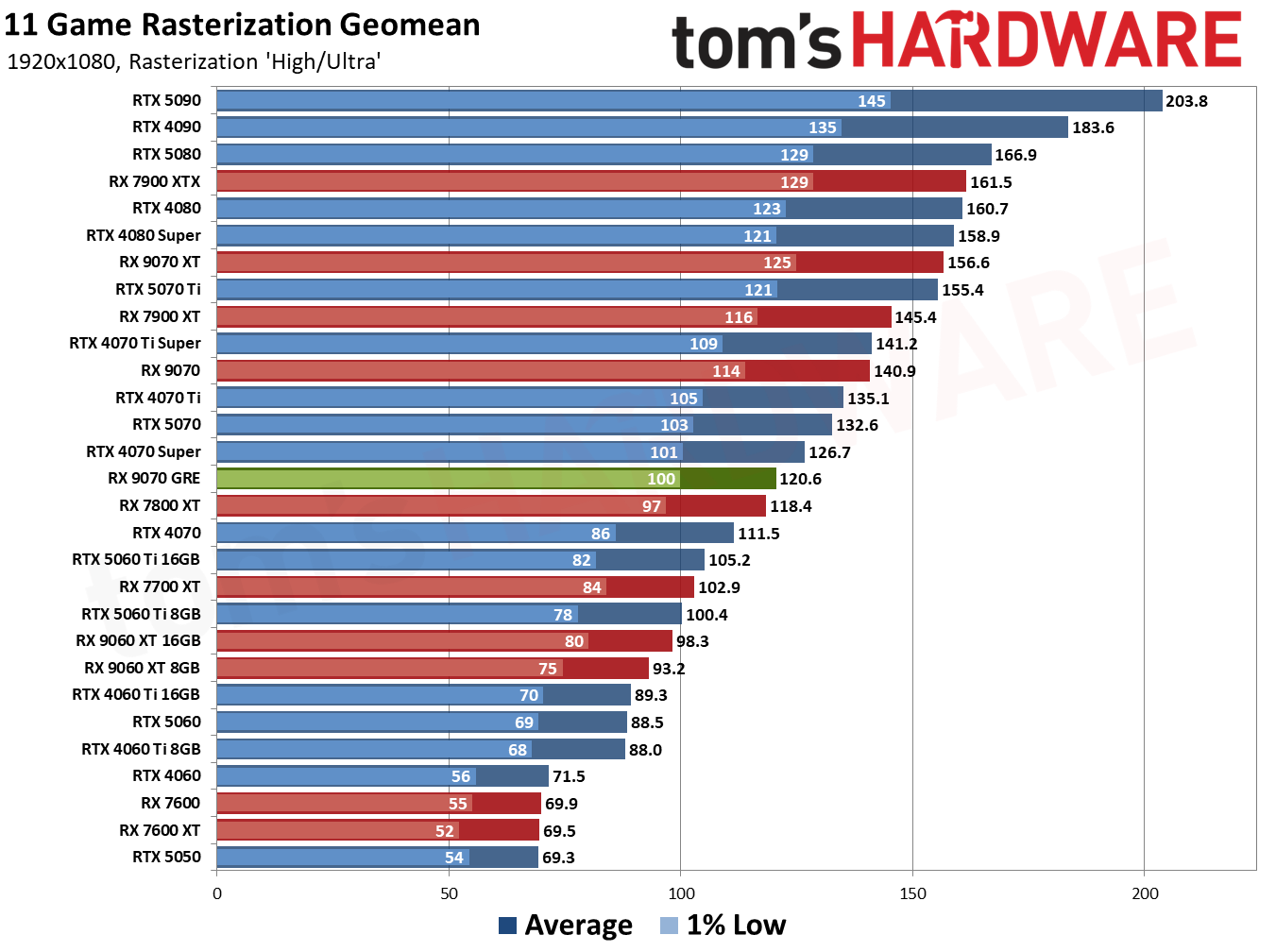
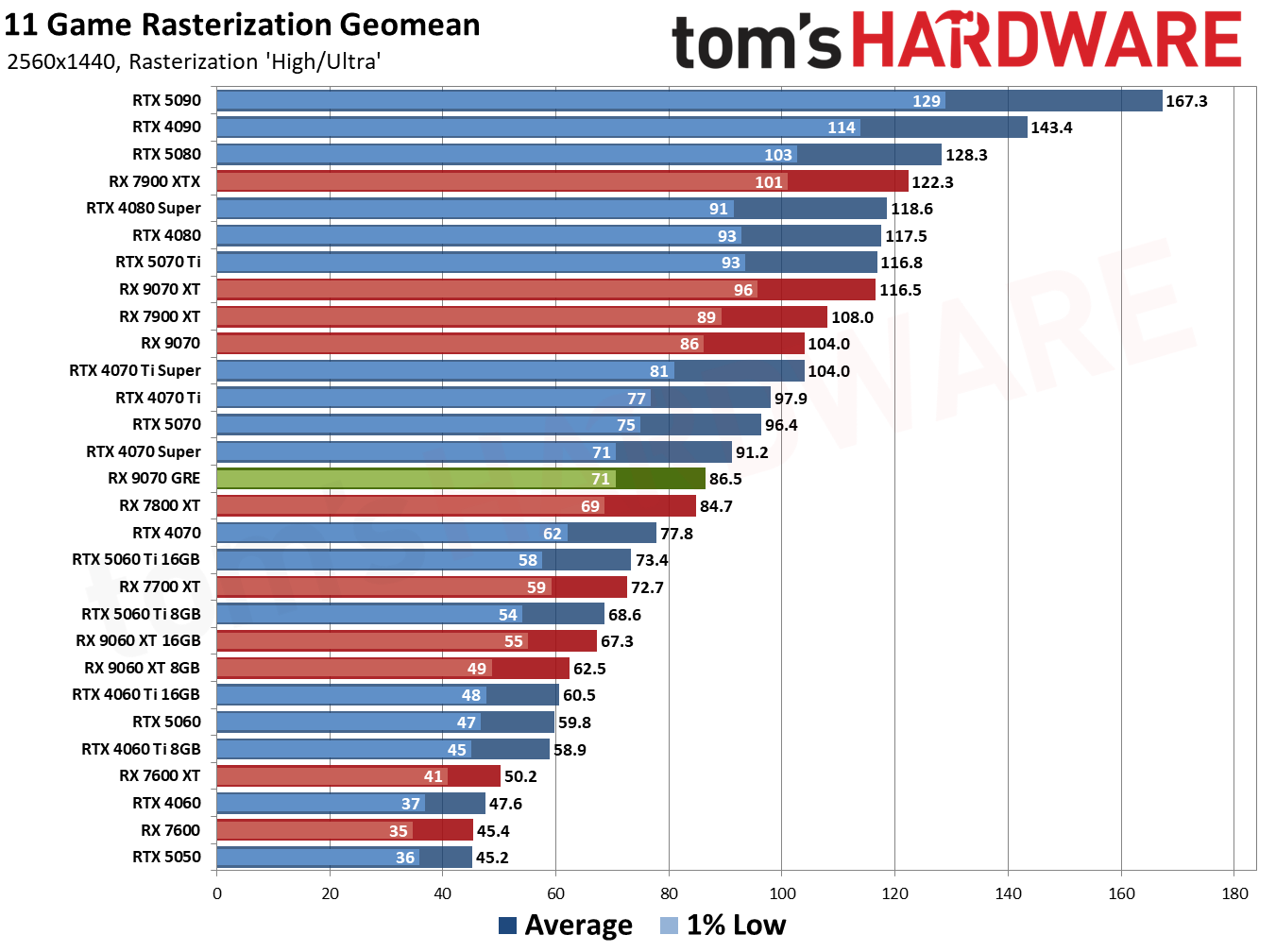
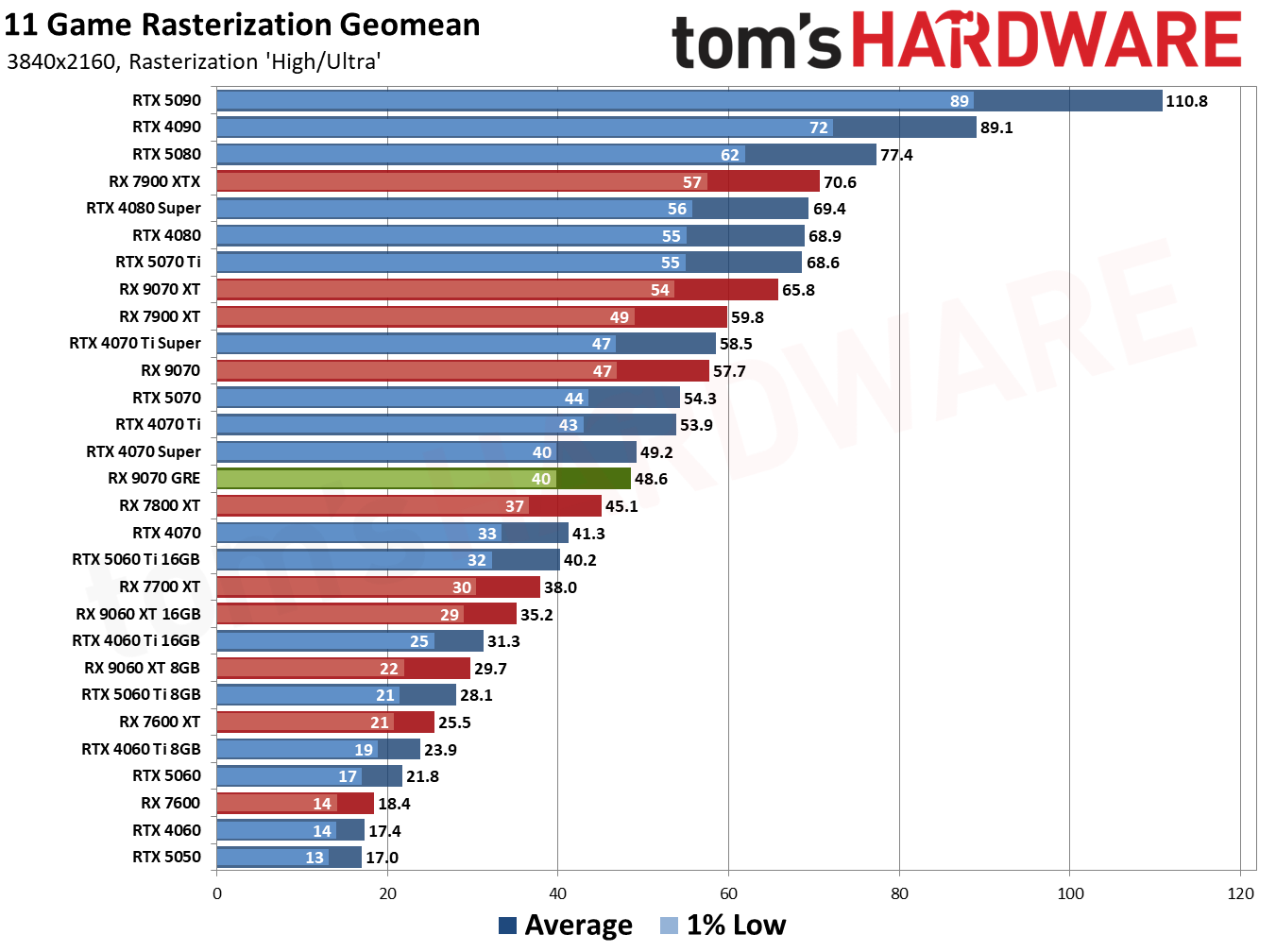
In our benchmark testing, from our review of the Radeon RX 9070 GRE, we found that the card averages 120 FPS at 1080p and 86.6 FPS at 1440p across our 11-game raster-only test suite. Perfect for 1080p and 1440p gaming, the RX 9070 GRE has ample VRAM, but pushing ultra settings on 1440p may tax the 12GB quite quickly.
Taking a quick peek at our performance charts, you can see the GPU outperform the RX 9060 XT 16GB and RTX 5060 Ti 16GB, and slip in closely behind Nvidia's RTX 5070.
FutureFutureFuture
In the current PC component market, this is a very rare opportunity to pick up a graphics card for well below its MSRP launch price. So if you're looking for a competent card for 1080p and 1440p gaming, then consider the Gigabyte Gaming RX 9070 GRE for $499.99.
The AI-driven memory apocalypse has made computer parts so expensive that the average buyer has stopped building PCs. Multiple research firms have already said that, but we’re now seeing it in action in the market. Uniko’s Hardware shared on X four crazy combos of RTX 5090 GPUs being sold on the Taiwanese e-commerce platform PChome24h.
Some of the GPUs that come with a lot of "freebies" include the Asus ROG Astral GeForce RTX 5090, Gigabyte Aorus RTX 5090 Master, MSI GeForce RTX 5090 Gaming Trio OC, and a Gigabyte Aorus RTX 5090 AI Box external graphics card. These items are priced in NTD, but we’ll list them below, including their retail prices in dollars (NTD 32.25 = USD $1 exchange rate) and the included items.
As we can see, even though GPU prices are quite inflated, many of them come with enough freebies that you can start building one high-end system and three to five entry-level gaming rigs. They’re still priced relatively high compared to Amazon or Newegg in the U.S., though, but we have to keep in mind that Taiwan is a different market, so there will likely be variations in prices plus VAT.
buy one 5090, get seven free mobos?lets take a look at the msi 5090 gaming trio bundle priced at 274090ntd (~8500usd).it contains:- the 5090- three msi x870e carbon (42606ntd)- two msi b650m gaming plus wifi (8580ntd)- one amd 9950x3d (24150ntd)so the mobos + the cpu =… https://t.co/zTZupvfh2S pic.twitter.com/WeNuiGhYE5August 7, 2026
That’s because sellers often put slow-moving products in a combo to help get their inventory moving. Given the number of motherboards, entry-to-mid-range GPUs, and other components included in these combos, it’s safe to say that these items aren’t selling and retailers are doing all these crazy deals just to free up capital.
As the AI-driven memory crisis has pushed up the prices of memory and graphics cards, many have already paused or delayed their purchases and upgrades. Only those with deep pockets who can afford to spend thousands of dollars on parts and combos like these are still buying PC parts.
We tested gaming performance with both NVMe and SATA SSDs across 11 games to determine if upgrading to a faster drive is worth it. Solid-state drives (SSDs) have been a staple of PC gaming for years, but their importance grew significantly with the launch of the PlayStation 5 and Xbox Series X|S in 2020. Both consoles feature high-speed NVMe SSDs and storage architectures designed to fully leverage their capabilities, enabling faster asset streaming and reducing traditional storage bottlenecks.
As a result, game developers have increasingly developed their titles for SSDs, with many modern games now listing them as a minimum system requirement. But how exactly do games use SSDs during gameplay, and does upgrading to a faster SSD actually improve gaming performance? In this article, we'll examine SSD activity in modern games and determine whether higher storage speeds translate into a better gaming experience. Given the surge in SSD prices, will a slower drive deliver comparable gaming performance to high-end alternatives?
Load Times
Load Times
While this article focuses primarily on SSD activity and performance during gameplay, loading times remain one of the most significant advantages of solid-state storage. It's well known that games can take several minutes to load from an HDD, whereas modern SSDs typically reduce load times to just a few seconds.
The gap between SSDs is much smaller. In some titles, PCIe NVMe drives can load games several times faster than SATA SSDs, but in many cases, the difference is relatively small. Naturally, different generations of PCIe SSDs have even smaller differences, with flagship drives often delivering only marginal improvements to loading times despite their substantially higher sequential throughput.
Disk I/O Operations in Games
Disk I/O Operations in Games
Before examining the performance results, it's important to understand the types of disk I/O operations that games typically generate. Two key metrics are block size and queue depth. The block size of an I/O operation defines the size of the chunk of data a game will read at one time, while queue depth is the number of pending I/O requests that a storage device has queued at any one time.
During gameplay, the vast majority of storage activity consists of random read operations as game assets are streamed from storage into memory. Sequential reads are less common, and write activity is generally minimal.
Microsoft provides several storage optimization recommendations for developers in its DirectStorage documentation. Although these guidelines are intended for DirectStorage-enabled titles, many of the underlying principles apply to games in general, even if they do not use DirectStorage. Among Microsoft's recommendations are the use of block sizes of at least 32k and sufficiently high queue depths to maximize storage throughput.
Modern games typically employ 32k or 64k random I/O requests. However, despite Microsoft's recommendations, most games continue to operate at relatively low queue depths.
Performance Comparison
Performance Comparison
Now we will examine SSD activity and compare performance across different SSD generations. The games included in our testing were selected because they either exhibited higher storage bandwidth than usual, had greater peak or average SSD utilization, had support for DirectStorage, or because they are popular titles that many gamers would be interested in seeing analyzed from a storage-performance perspective.
To place as much stress as possible on each SSD, all testing was conducted with 16GB of system memory. Using a smaller memory capacity reduces the amount of game data that can be held in RAM, forcing games to rely more heavily on the SSD than they would in a 64GB configuration. It also better reflects the configurations found in many mainstream gaming PCs. That said, we observed little difference in SSD activity when comparing 16GB and 64GB memory configurations.
When interpreting the SSD activity data below, it is important to understand that 100% utilization does not necessarily mean an SSD is reaching its maximum rated bandwidth. For example, a PCIe 4.0 SSD reporting 100% utilization is unlikely to be delivering its full 7.5 GB/s of sequential read throughput. In gaming workloads, SSDs can become fully utilized while transferring data at significantly lower bandwidths.
This is because the speeds advertised by SSD manufacturers are based on sequential read performance, whereas games primarily rely on random reads. While random-read throughput can approach sequential-read speeds under certain conditions, doing so requires sufficiently large block sizes and high queue depths. Although modern games often use relatively large block sizes, they typically do not use the high queue depths needed to fully saturate an SSD's theoretical bandwidth.
We have also chosen not to test any traditional hard drive disks. There are many documented examples of modern games performing poorly, taking an unbearably long time to load, or having visual issues when installing the game on an HDD. There are some games where this may not be an issue, but we still do not recommend playing modern games on an HDD.
The testing was conducted in gameplay. No built-in benchmarks were used. We found that SSD activity increases with higher settings, so that is where we focused our testing. We set each game to its absolute maximum settings.
We used HWiNFO to measure SSD activity and set it to the lowest polling rate possible to capture activity accurately without incurring overhead.
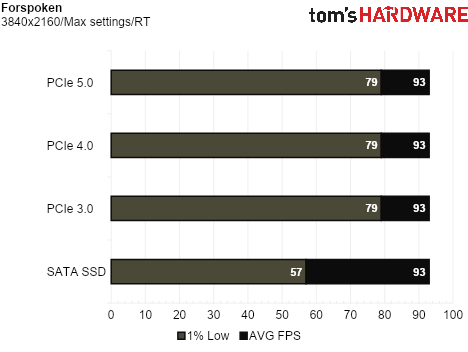
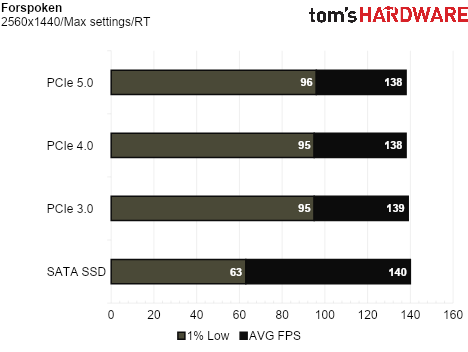
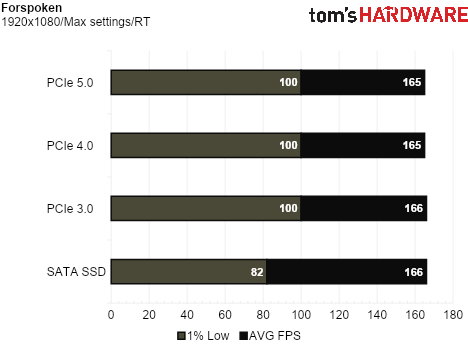
Forspoken was the first game to support DirectStorage on PC. DirectStorage is a feature that aims to allow games to make full use of high-speed storage devices while reducing the CPU overhead associated with making reads from disk.
Looking at the table below, you can see that it does exhibit a fairly high peak and average bandwidth. In fact, it’s the highest average bandwidth we have seen in any game we have tested. Average utilization is also quite high, and the game hits 100% SSD utilization frequently.
SSD Activity at 1080p
Peak Bandwidth
Average Bandwidth
Peak Utilization
Average Utilization
SATA SSD
485 MB/s
240 MB/s
100%
52%
PCIe 3.0
1324 MB/s
301 MB/s
100%
50%
PCIe 4.0
2956 MB/s
374 MB/s
100%
30%
PCIe 5.0
2761 MB/s
307 MB/s
100%
19%
SSD Activity at 1440p
Peak Bandwidth
Average Bandwidth
Peak Utilization
Average Utilization
SATA SSD
486 MB/s
271 MB/s
100%
59%
PCIe 3.0
1645 MB/s
318 MB/s
100%
56%
PCIe 4.0
2931 MB/s
382 MB/s
100%
28%
PCIe 5.0
2890 MB/s
352 MB/s
100%
17%
SSD Activity at 2160p
Peak Bandwidth
Average Bandwidth
Peak Utilization
Average Utilization
SATA SSD
565 MB/s
264 MB/s
100%
56%
PCIe 3.0
1656 MB/s
317 MB/s
100%
54%
PCIe 4.0
2886 MB/s
379 MB/s
100%
26%
PCIe 5.0
2901 MB/s
366 MB/s
100%
19%
How does this translate to performance?
Tom's HardwareTom's HardwareTom's Hardware
While there is no difference in performance between the PCIe NVMe SSDs, you can see that having a PCIe SSD can give you a large boost in the 1% lows compared to a SATA SSD. We see a 39% increase in 1% lows at 4K, a 51% increase at 1440p, and a 22% increase at 1080p.
The higher peak and average bandwidth used by the PCIe drives resulted in higher 1% lows in this game, which makes for a smoother gameplay experience.
Alan Wake 2
Alan Wake 2
Alan Wake 2 makes extensive use of modern rendering technologies, including path tracing, mesh shaders, and RTX Mega Geometry. In a recent interview, Remedy explained that the game operates with a fixed memory budget, continuously streaming the assets required for the current scene from the SSD while evicting assets that are no longer needed. This approach keeps memory usage under control despite the game's highly detailed textures and geometry, making Alan Wake 2 one of the most storage-intensive titles available today.
SSD Activity at 1080p
Peak Bandwidth
Average Bandwidth
Peak Utilization
Average Utilization
SATA SSD
562 MB/s
80 MB/s
100%
63%
PCIe 3.0
582 MB/s
83 MB/s
100%
62%
PCIe 4.0
572 MB/s
82 MB/s
91%
14%
PCIe 5.0
1047 MB/s
83 MB/s
100%
13%
SSD Activity at 1440p
Peak Bandwidth
Average Bandwidth
Peak Utilization
Average Utilization
SATA SSD
570 MB/s
100 MB/s
100%
72%
PCIe 3.0
938 MB/s
113 MB/s
100%
62%
PCIe 4.0
887 MB/s
111 MB/s
100%
19%
PCIe 5.0
1673 MB/s
116 MB/s
100%
17%
SSD Activity at 2160p
Peak Bandwidth
Average Bandwidth
Peak Utilization
Average Utilization
SATA SSD
572 MB/s
212 MB/s
100%
85%
PCIe 3.0
1435 MB/s
214 MB/s
100%
76%
PCIe 4.0
3045 MB/s
225 MB/s
100%
38%
PCIe 5.0
5128 MB/s
223 MB/s
100%
32%
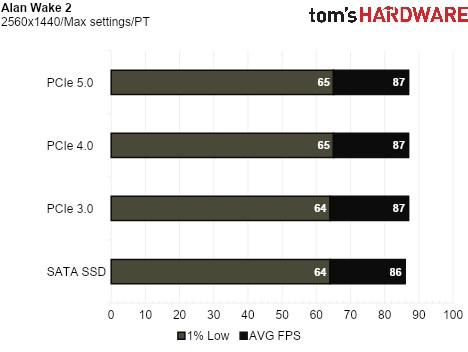
The SSD activity increases with resolution in this game. We see an average of over 200 MB/s on each drive at 4K, which is rare for a game. We also see a whopping 5.1 GB/s of peak bandwidth on a PCIe 5.0 SSD at 4K.
How does this impact performance?
Tom's HardwareTom's HardwareTom's Hardware
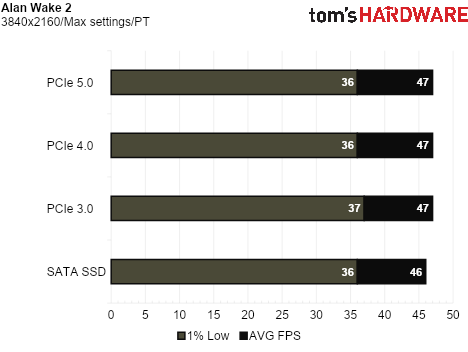
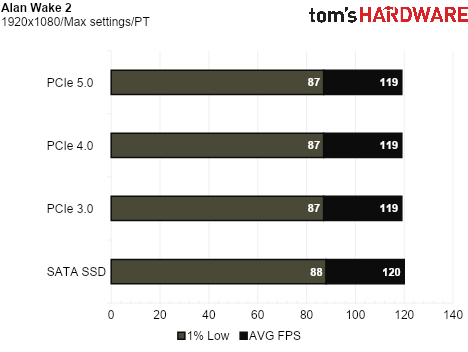
Unlike Forspoken, we do not see any difference in performance here for any of the drives tested.
Although the faster SSDs reach higher peak bandwidth, these peaks are only brief bursts rather than sustained transfers. In other words, the game is not continuously streaming multiple gigabytes of data every second. Instead, it transfers smaller amounts of data over very short intervals, resulting in high instantaneous bandwidth readings. As a result, the average bandwidth is the more meaningful metric, and it remains relatively similar across all of the SSDs we tested.
The average utilization on the SATA SSD can reach over 80% at 4K, but it is not enough to degrade its performance in comparison to the PCIe drives.
Ratchet and Clank: Rift Apart
Ratchet and Clank: Rift Apart
SSD Activity at 1080p
Peak Bandwidth
Average Bandwidth
Peak Utilization
Average Utilization
SATA SSD
505 MB/s
61 MB/s
100%
16%
PCIe 3.0
1045 MB/s
60 MB/s
100%
13%
PCIe 4.0
1039 MB/s
58 MB/s
51%
2%
PCIe 5.0
987 MB/s
66 MB/s
33%
2%
SSD Activity at 1440p
Peak Bandwidth
Average Bandwidth
Peak Utilization
Average Utilization
SATA SSD
512 MB/s
62 MB/s
100%
15%
PCIe 3.0
1039 MB/s
62 MB/s
100%
14%
PCIe 4.0
1208 MB/s
61 MB/s
71%
3%
PCIe 5.0
1798 MB/s
61 MB/s
52%
2%
SSD Activity at 2160p
Peak Bandwidth
Average Bandwidth
Peak Utilization
Average Utilization
SATA SSD
532 MB/s
62 MB/s
100%
16%
PCIe 3.0
1462 MB/s
61 MB/s
100%
17%
PCIe 4.0
1899 MB/s
60 MB/s
64%
3%
PCIe 5.0
2234 MB/s
64 MB/s
57%
2%
The disk bandwidth through this sequence is actually lower than the previous two games. This makes sense, as the game uses GPU decompression, which increases the effective bandwidth flowing through the PCIe bus beyond what CPU decompression would. However, this increase in effective bandwidth is not reflected in the data that is being read from disk.
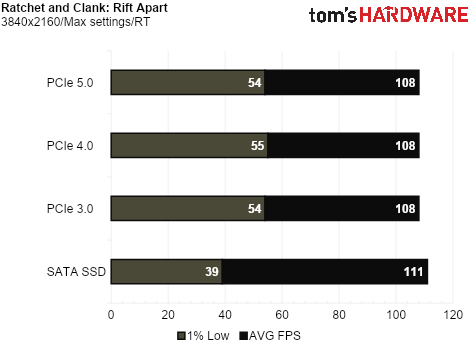
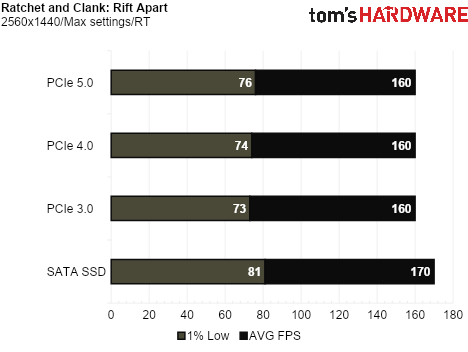
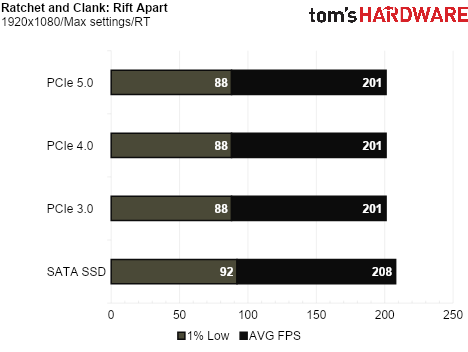
When reading the performance charts below, it is important to note that PCIe SSDs reduce portal transition times by roughly 2-3 seconds compared to SATA SSDs. On SATA drives, Ratchet therefore spends more time within each portal sequence. As a result, average performance and 1% lows can generally be slightly higher on SATA SSDs, since there is less active rendering during these extended transition periods. However, there is one exception.
Tom's HardwareTom's HardwareTom's Hardware
While the SATA SSD has an advantage at 1440p and 1080p due to the extended time spent inside of each portal, the 1% lows take a hit at 4K. The SATA drive does not handle the first portal transition in the sequence particularly well at 4K, and so the PCIe drives have about a 38% advantage in 1% lows.
This portal sequence is the most storage-intensive part of the game. In normal gameplay, the game uses significantly less bandwidth, and so there is no difference in performance at all between the SATA SSD and the PCIe SSDs.
Spider-Man 2
Spider-Man 2
Spider-Man 2 was the second game to use GPU decompression of assets on PC. This is the third DirectStorage title we have tested so far.
SSD Activity at 1080p
Peak Bandwidth
Average Bandwidth
Peak Utilization
Average Utilization
SATA SSD
149 MB/s
42 MB/s
54%
15%
PCIe 3.0
139 MB/s
39 MB/s
84%
16%
PCIe 4.0
144 MB/s
43 MB/s
43%
9%
PCIe 5.0
133 MB/s
45 MB/s
32%
6%
SSD Activity at 1440p
Peak Bandwidth
Average Bandwidth
Peak Utilization
Average Utilization
SATA SSD
150 MB/s
40 MB/s
45%
12%
PCIe 3.0
177 MB/s
43 MB/s
85%
13%
PCIe 4.0
168 MB/s
35 MB/s
40%
10%
PCIe 5.0
208 MB/s
41 MB/s
33%
7%
SSD Activity at 2160p
Peak Bandwidth
Average Bandwidth
Peak Utilization
Average Utilization
SATA SSD
161 MB/s
44 MB/s
34%
10%
PCIe 3.0
194 MB/s
49 MB/s
100%
22%
PCIe 4.0
187 MB/s
46 MB/s
44%
12%
PCIe 5.0
198 MB/s
48 MB/s
36%
10%
Since the game uses GPU decompression, the effective bandwidth after decompression will be considerably higher than what we see here, but none of the SSDs we tested are being stressed in this game.
Tom's HardwareTom's HardwareTom's Hardware
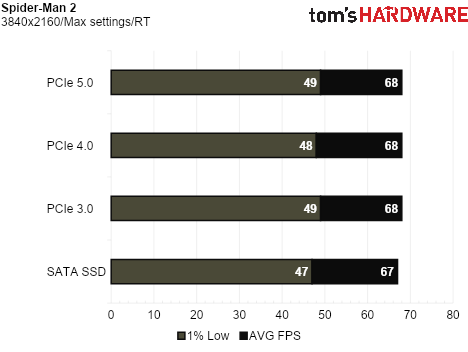
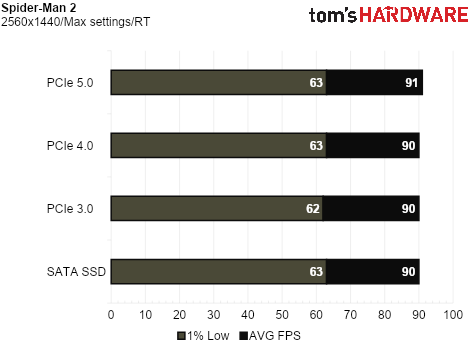
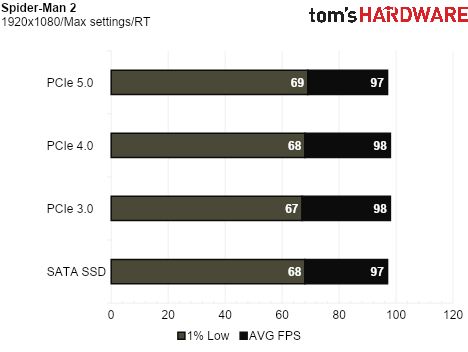
Performance is virtually identical on all drives in this game.
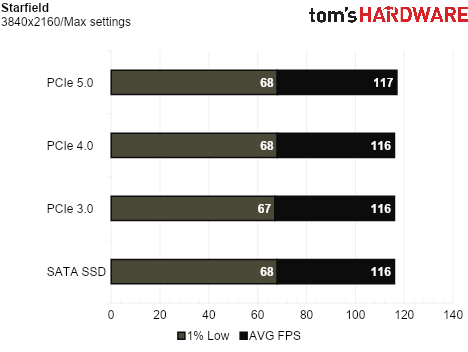
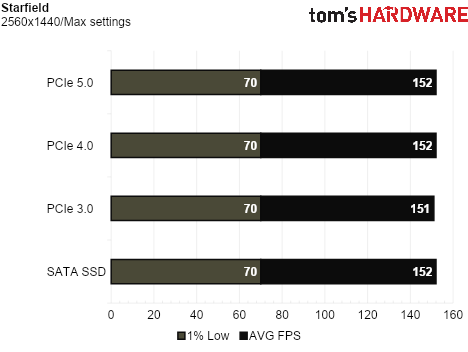
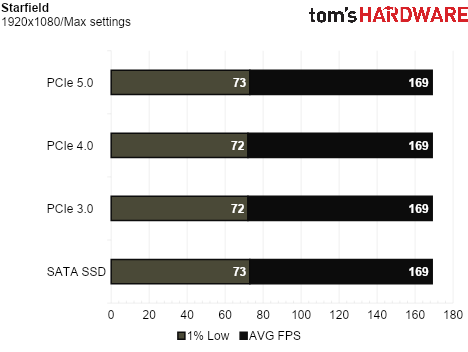
Starfield
Starfield
Starfield is an open world game that constantly reads data from disk. It also frequently hits 100% disk utilization as you traverse the world.
SSD Activity at 1080p
Peak Bandwidth
Average Bandwidth
Peak Utilization
Average Utilization
SATA SSD
339 MB/s
15 MB/s
100%
29%
PCIe 3.0
397 MB/s
17 MB/s
100%
16%
PCIe 4.0
434 MB/s
17 MB/s
100%
7%
PCIe 5.0
404 MB/s
18 MB/s
100%
4%
SSD Activity at 1440p
Peak Bandwidth
Average Bandwidth
Peak Utilization
Average Utilization
SATA SSD
395 MB/s
19 MB/s
100%
28%
PCIe 3.0
501 MB/s
19 MB/s
100%
15%
PCIe 4.0
528 MB/s
18 MB/s
100%
7%
PCIe 5.0
599 MB/s
19 MB/s
100%
3%
SSD Activity at 2160p
Peak Bandwidth
Average Bandwidth
Peak Utilization
Average Utilization
SATA SSD
455 MB/s
18 MB/s
100%
24%
PCIe 3.0
704 MB/s
19 MB/s
100%
15%
PCIe 4.0
813 MB/s
20 MB/s
100%
6%
PCIe 5.0
934 MB/s
19 MB/s
100%
3%
In previous games, 100% SSD utilization was accompanied by much higher peak bandwidth. Here, the lower peak bandwidth suggests the game uses a very low queue depth for its read operations. As you move through the open world, it continuously streams data from the SSD in frequent, small transfers, keeping average bandwidth very low.
Tom's HardwareTom's HardwareTom's Hardware
Once again, we see no improvement in performance going from the SATA SSD to any of the faster PCIe NVME SSDs.
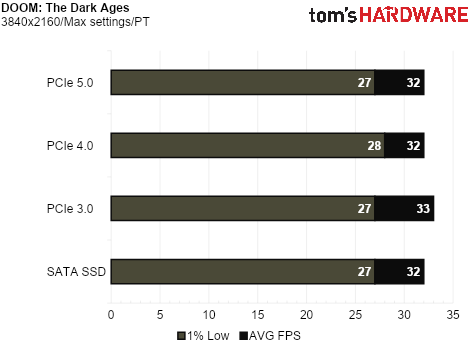
DOOM: The Dark Ages
DOOM: The Dark Ages
DOOM: The Dark Ages was the first game to list an NVMe SSD as a requirement. Not only is it listed as such on the PC system requirements, but Bethesda has a support page that reiterates that installing the game on an NVMe SSD is required.
The developers at idSoftware mentioned that the game uses a proprietary ultra-fast continuous sector streaming tech that virtually eliminates load times between levels.
SSD Activity at 1080p
Peak Bandwidth
Average Bandwidth
Peak Utilization
Average Utilization
SATA SSD
189 MB/s
40 MB/s
55%
23%
PCIe 3.0
199 MB/s
62 MB/s
50%
16%
PCIe 4.0
212 MB/s
61 MB/s
43%
12%
PCIe 5.0
208 MB/s
63 MB/s
34%
10%
SSD Activity at 1440p
Peak Bandwidth
Average Bandwidth
Peak Utilization
Average Utilization
SATA SSD
178 MB/s
62 MB/s
53%
25%
PCIe 3.0
248 MB/s
69 MB/s
53%
17%
PCIe 4.0
247 MB/s
70 MB/s
44%
13%
PCIe 5.0
229 MB/s
68 MB/s
35%
11%
SSD Activity at 2160p
Peak Bandwidth
Average Bandwidth
Peak Utilization
Average Utilization
SATA SSD
192 MB/s
73 MB/s
58%
25%
PCIe 3.0
245 MB/s
73 MB/s
53%
18%
PCIe 4.0
238 MB/s
74 MB/s
43%
14%
PCIe 5.0
287 MB/s
73 MB/s
38%
11%
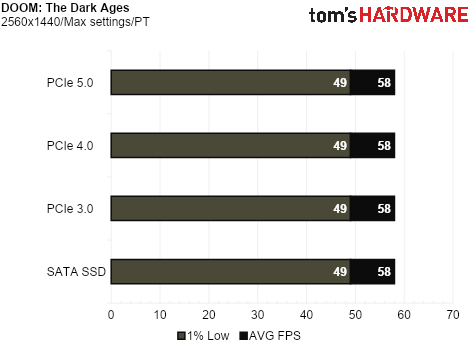
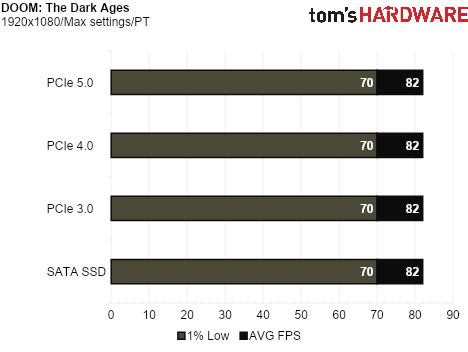
The drives we tested are hardly being stressed in DOOM: The Dark Ages.
Tom's HardwareTom's HardwareTom's Hardware
Given the disk utilization figures, it comes as no surprise that all of the tested drives deliver identical gameplay performance.
Although this article focuses on in-game performance rather than loading times, we also found little difference in load times when using a SATA SSD. Loading screens were not noticeably longer, and we observed no visual artifacts or streaming issues while playing on the slower drive.
Based on our testing, it is unclear why Bethesda lists an NVMe SSD as a requirement. A SATA SSD provided an indistinguishable gameplay experience, with no measurable performance drawbacks or observable streaming issues.
Dead Space Remake
Dead Space Remake
Dead Space Remake made headlines when it launched with abhorrent performance and stuttering issues. But how much of that was due to streaming from slower storage? Does a faster SSD help performance?
SSD Activity at 1080p
Peak Bandwidth
Average Bandwidth
Peak Utilization
Average Utilization
SATA SSD
511 MB/s
33 MB/s
100%
23%
PCIe 3.0
809 MB/s
38 MB/s
100%
12%
PCIe 4.0
788 MB/s
39 MB/s
100%
7%
PCIe 5.0
902 MB/s
52 MB/s
100%
5%
SSD Activity at 1440p
Peak Bandwidth
Average Bandwidth
Peak Utilization
Average Utilization
SATA SSD
562 MB/s
38 MB/s
100%
26%
PCIe 3.0
1003 MB/s
34 MB/s
100%
14%
PCIe 4.0
967 MB/s
38 MB/s
100%
8%
PCIe 5.0
833 MB/s
42 MB/s
100%
7%
SSD Activity at 2160p
Peak Bandwidth
Average Bandwidth
Peak Utilization
Average Utilization
SATA SSD
560 MB/s
37 MB/s
100%
25%
PCIe 3.0
1192 MB/s
51 MB/s
100%
15%
PCIe 4.0
998 MB/s
48 MB/s
100%
8%
PCIe 5.0
1299 MB/s
50 MB/s
100%
6%
Although average disk utilization and bandwidth are relatively low, the game frequently reaches 100% utilization. Yet even during these periods, peak bandwidth remains well below what PCIe SSDs can achieve under high-queue-depth random workloads. This indicates the game is issuing read requests at a very low queue depth, leaving much of the SSD's available performance untapped. Additionally, the difference in average bandwidth between the SSDs is minimal.
Tom's HardwareTom's HardwareTom's Hardware
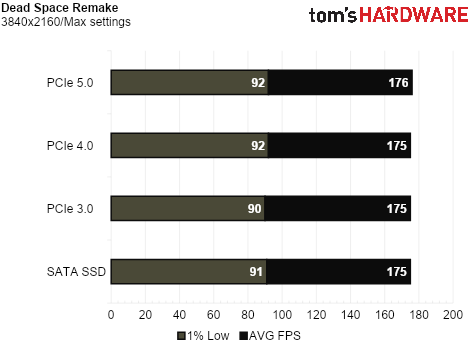
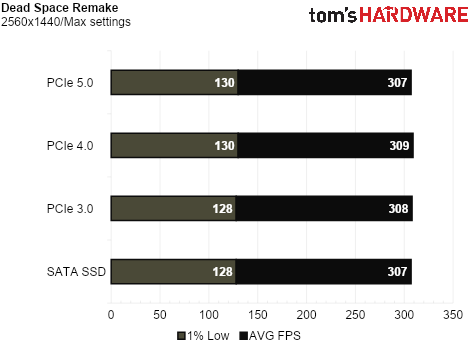
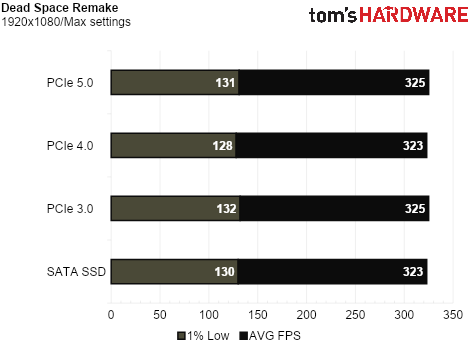
All drives provide the same performance. There is nothing to be gained from a faster SSD in this title.
Cyberpunk 2077
Cyberpunk 2077
We included Cyberpunk 2077 in our testing because the game features a large and seamless open world, and it is one of the most popular games ever released.
SSD Activity at 1080p
Peak Bandwidth
Average Bandwidth
Peak Utilization
Average Utilization
SATA SSD
40 MB/s
7 MB/s
11%
2%
PCIe 3.0
55 MB/s
8 MB/s
20%
2%
PCIe 4.0
53 MB/s
9 MB/s
17%
1%
PCIe 5.0
44 MB/s
8 MB/s
11%
1%
SSD Activity at 1440p
Peak Bandwidth
Average Bandwidth
Peak Utilization
Average Utilization
SATA SSD
99 MB/s
8 MB/s
25%
3%
PCIe 3.0
73 MB/s
8 MB/s
23%
3%
PCIe 4.0
63 MB/s
8 MB/s
18%
1%
PCIe 5.0
78 MB/s
9 MB/s
10%
1%
SSD Activity at 2160p
Peak Bandwidth
Average Bandwidth
Peak Utilization
Average Utilization
SATA SSD
121 MB/s
12 MB/s
29%
4%
PCIe 3.0
126 MB/s
11 MB/s
40%
3%
PCIe 4.0
134 MB/s
13 MB/s
22%
1%
PCIe 5.0
111 MB/s
9 MB/s
10%
1%
The average bandwidth is by far the lowest we have seen in the games tested so far. This is not entirely surprising. Although the game was released in the same year as the PlayStation 5 and Xbox Series X|S, development began well before those consoles were released. As a cross-generation title, it also needed to run on the previous generation of consoles, which relied on mechanical hard drives. As a result, the game's streaming system was designed to perform well on significantly slower storage devices.
Tom's HardwareTom's HardwareTom's Hardware
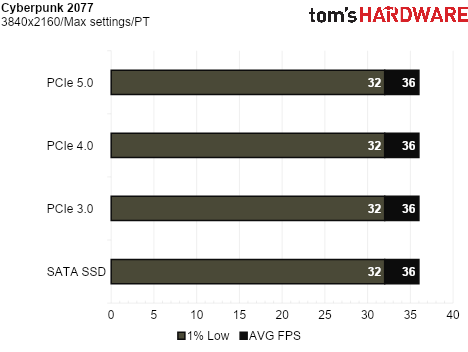
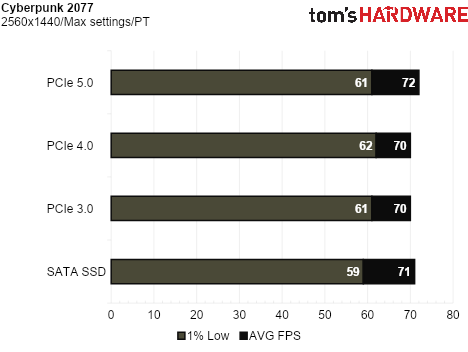
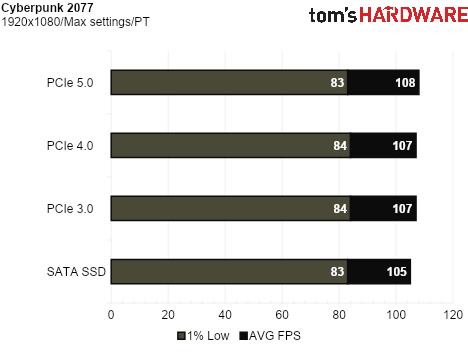
There is no noticeable difference in performance across the drives tested.
The Elder Scrolls IV: Oblivion Remastered
The Elder Scrolls IV: Oblivion Remastered
The Elder Scrolls IV: Oblivion Remastered modernizes the look of the original game with improved visuals. Built on Unreal Engine 5, it utilizes Nanite virtualized geometry, Lumen global illumination, and virtual shadow maps. This is an open-world game, and our first UE5 title is tested in this article.
SSD Activity at 1080p
Peak Bandwidth
Average Bandwidth
Peak Utilization
Average Utilization
SATA SSD
214 MB/s
21 MB/s
70%
5%
PCIe 3.0
165 MB/s
24 MB/s
68%
7%
PCIe 4.0
287 MB/s
22 MB/s
49%
4%
PCIe 5.0
267 MB/s
26 MB/s
28%
3%
SSD Activity at 1440p
Peak Bandwidth
Average Bandwidth
Peak Utilization
Average Utilization
SATA SSD
326 MB/s
20 MB/s
68%
5%
PCIe 3.0
266 MB/s
31 MB/s
66%
7%
PCIe 4.0
252 MB/s
29 MB/s
42%
5%
PCIe 5.0
299 MB/s
33 MB/s
22%
3%
SSD Activity at 2160p
Peak Bandwidth
Average Bandwidth
Peak Utilization
Average Utilization
SATA SSD
312 MB/s
21 MB/s
55%
5%
PCIe 3.0
379 MB/s
33 MB/s
57%
7%
PCIe 4.0
344 MB/s
32 MB/s
38%
5%
PCIe 5.0
433 MB/s
42 MB/s
27%
3%
None of the SSDs we tested reached 100% peak utilization and average utilization is extremely low, too.
Tom's HardwareTom's HardwareTom's Hardware
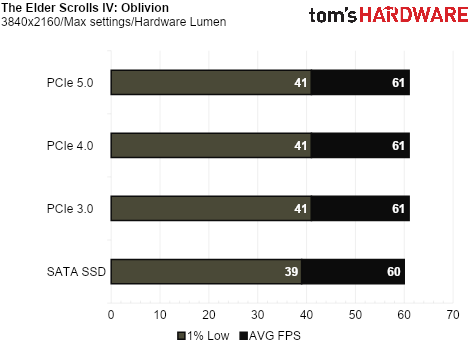
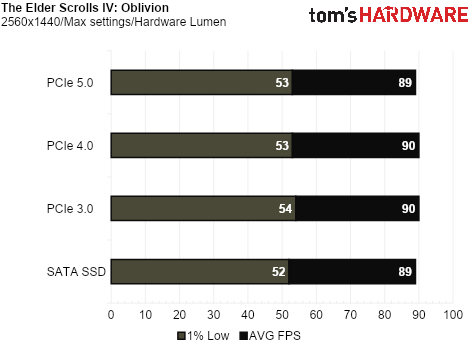
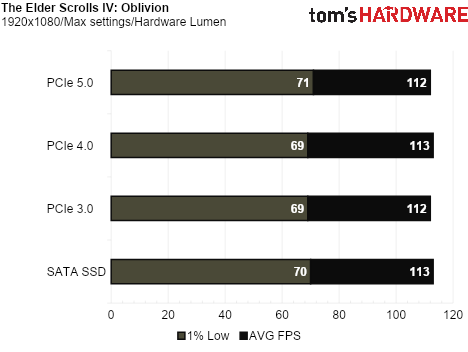
As is the case with most of the games we have tested, the SATA SSD holds its own and there is no difference in performance across all of the drives.
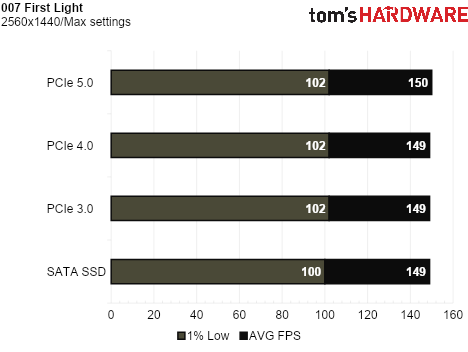
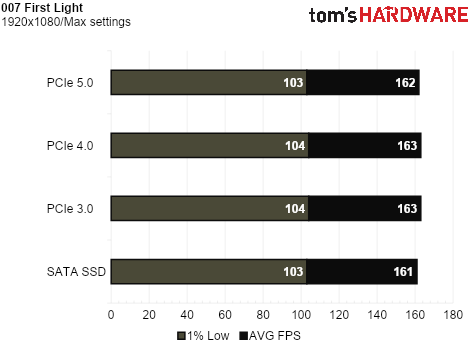
007 First Light
007 First Light
007 First Light is a recently released game that uses DirectStorage. In a recent interview, the developers at IO Interactive revealed that the real-time level streaming system in the Glacier engine was redesigned for 007 First Light. The new system uses dynamic loading and unloading to allow for seamless transitions between sequences.
SSD Activity at 1080p
Peak Bandwidth
Average Bandwidth
Peak Utilization
Average Utilization
SATA SSD
164 MB/s
11 MB/s
39%
3%
PCIe 3.0
178 MB/s
12 MB/s
57%
4%
PCIe 4.0
166 MB/s
12 MB/s
29%
3%
PCIe 5.0
171 MB/s
11 MB/s
19%
3%
SSD Activity at 1440p
Peak Bandwidth
Average Bandwidth
Peak Utilization
Average Utilization
SATA SSD
160 MB/s
15 MB/s
39%
5%
PCIe 3.0
181 MB/s
16 MB/s
52%
6%
PCIe 4.0
172 MB/s
14 MB/s
32%
4%
PCIe 5.0
168 MB/s
15 MB/s
21%
3%
SSD Activity at 2160p
Peak Bandwidth
Average Bandwidth
Peak Utilization
Average Utilization
SATA SSD
169 MB/s
15 MB/s
56%
5%
PCIe 3.0
193 MB/s
15 MB/s
68%
7%
PCIe 4.0
170 MB/s
15 MB/s
43%
4%
PCIe 5.0
202 MB/s
16 MB/s
24%
3%
It’s clear that this new streaming system does not place a heavy burden on storage devices.
Tom's HardwareTom's HardwareTom's Hardware
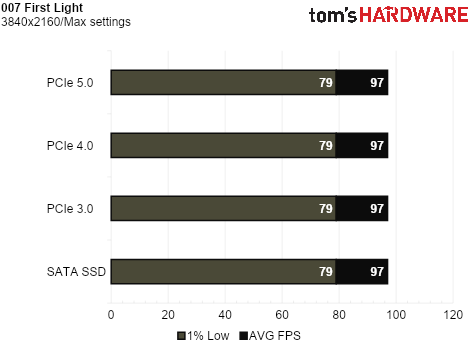
Given the I/O activity in this game, it is not surprising to see that all SSDs we tested perform the same.
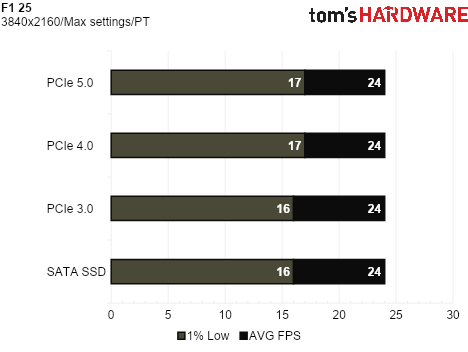
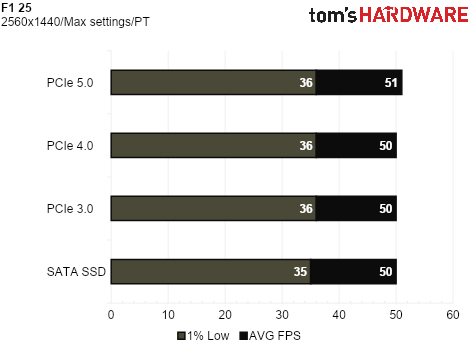
F1 25
F1 25
We included F1 25 because it exhibits higher peak bandwidth and utilization than most games. The game’s high-speed driving requires rapid streaming of trackside assets, as the environment changes quickly and the player covers large distances in very short periods of time.
SSD Activity at 1080p
Peak Bandwidth
Average Bandwidth
Peak Utilization
Average Utilization
SATA SSD
523 MB/s
47 MB/s
94%
9%
PCIe 3.0
498 MB/s
60 MB/s
89%
6%
PCIe 4.0
473 MB/s
62 MB/s
78%
5%
PCIe 5.0
515 MB/s
59 MB/s
71%
4%
SSD Activity at 1440p
Peak Bandwidth
Average Bandwidth
Peak Utilization
Average Utilization
SATA SSD
515 MB/s
70 MB/s
75%
14%
PCIe 3.0
499 MB/s
70 MB/s
72%
8%
PCIe 4.0
474 MB/s
75 MB/s
66%
6%
PCIe 5.0
587 MB/s
79 MB/s
62%
5%
SSD Activity at 2160p
Peak Bandwidth
Average Bandwidth
Peak Utilization
Average Utilization
SATA SSD
554 MB/s
79 MB/s
71%
15%
PCIe 3.0
541 MB/s
83 MB/s
68%
9%
PCIe 4.0
523 MB/s
88 MB/s
54%
6%
PCIe 5.0
602 MB/s
89 MB/s
51%
5%
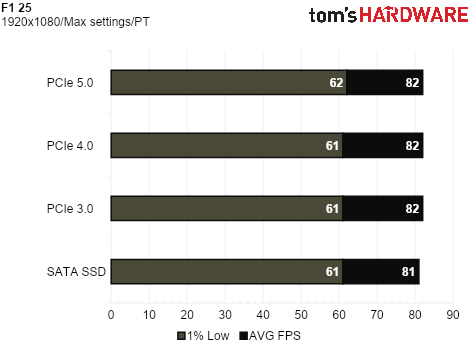
The game exhibits higher peak and average bandwidth than many of the games we have tested, but it is still not enough to truly stress a SATA SSD.
Tom's HardwareTom's HardwareTom's Hardware
Once more, all of the drives show identical performance.
What About the Visuals?
What About the Visuals?
Many readers may be wondering if playing on a SATA drive resulted in any visual anomalies, such as slower loading textures, additional pop-in, or other visual artifacts. We did not notice any such issues in the 11 games we tested. There are some games that exhibit pop-in, but that is consistent across all storage devices. All of the drives we used in our testing provided an identical visual experience.
The Verdict
The Verdict
Out of all the games tested, only two showed measurable performance differences between SATA and PCIe SSDs: Forspoken and Ratchet & Clank: Rift Apart.
In Forspoken, moving from a SATA SSD to any PCIe SSD – regardless of generation – resulted in a significant improvement in 1% lows.
Ratchet & Clank: Rift Apart showed more nuanced results. During the portal sequences at 1440p and 1080p, average framerate and 1% lows were slightly higher on the SATA SSD, as slower loading increased the time spent inside the portals. Since the portals contain less on-screen complexity, framerates are naturally higher within them. However, at 4K resolution, PCIe SSDs delivered better 1% lows. Outside of the portal sequence in normal gameplay, there was no measurable performance difference between any of the drives.
Across all other titles, PCIe SSDs provided no meaningful performance advantage, and there were no observable differences between PCIe generations. In the vast majority of games tested, a SATA SSD delivers comparable performance.
Nvidia has a booth at the annual QuakeCon, which is happening from August 6 to 9 at the Gaylord Texan Resort & Convention Center in Grapevine, Texas, where the company is selling RTX 50-series GPUs at their original launch price. The company said in its blog post that several Founders Edition graphics cards are available at MSRP while supplies last, and that there will also be several prizes and freebies, including the GeForce Trading Cards Series 1.
“If you’re attending this year’s event between August 6th and 9th, head to the GeForce booth ASAP to get in on the action,” Nvidia said in its blog update. “And if you want a GPU upgrade, our team is bringing Verified Priority Access IRL to QuakeCon, enabling you to purchase Founders Edition GeForce RTX 5090, 5080, and 5070s at MSRP while supplies last.”
The firm officially announced the RTX 50-series in Las Vegas at CES 2025, with the RTX 5090 priced at $1,999, the RTX 5080 at $999, the RTX 5070 Ti at $749, and the RTX 5070 at $549. However, the supplies of these GPUs were limited — the 5090s and 5080s went out of stock on the same day that they arrived on store shelves. It took several months for the RTX 50-series to finally dip below MSRP, but this only lasted a few months as the memory shortage took hold and caused VRAM prices to skyrocket.
This means that the best graphics cards for gaming are quite expensive at the moment, with Tom’s Hardware’sGPU price tracker showing the best price for the RTX 5090 sitting at $4,381 — more than double the $1,999 MSRP that Nvidia set for the GPU. Even the RTX 5080, 5070 Ti, and 5070 aren’t immune to these price increases, with the most affordable options for the graphics cards sitting at $1,289 (29% over MSRP), $989 (32% over MSRP), and $629 (more than 14% over MSRP), respectively.
Unfortunately, this isn’t likely the worst that we will see when it comes to GPU pricing. There has been some disturbing news that prices for RTX 50-series GPUs jumped by 30% in South Korea as wafer costs from TSMC have increased, and GDDR7 modules push past $20. While this hasn’t reached the U.S. at the moment, there is fear that retailers in the country will follow suit soon.
Such is the state of the PC building industry that RTX 50-series GPUs at MSRP have now become a come-on to desperate gamers who just want to upgrade their gaming PCs for a reasonable price. Unfortunately, “Verified Priority Access IRL” is only available during the convention and only until supplies last — once there’s no more stock on site, you’d have no choice but to troll the interwebs for a deal or a secondhand unit if you refuse to pay for more than the MSRP. Alternatively, if you believe that you’ve got the skills, Nvidia is also hosting Quake III Arena RTX Remix and DOOM: The Dark Ages | Revelations challenges, where the best players will each receive an RTX 5070 Founders Edition GPU.
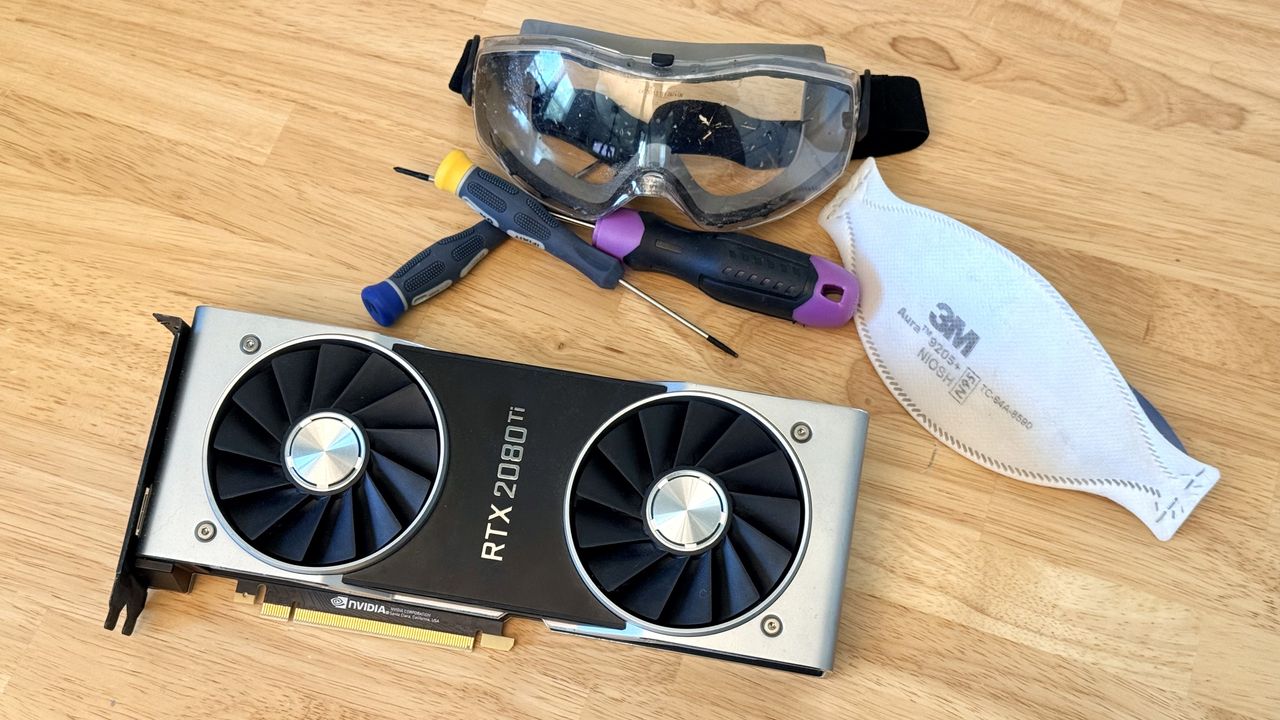
The AI boom means that no matrix math FLOPS are disposable, and that means older Nvidia GPUs with Tensor Cores are getting a new lease on life. Services are popping up that will outfit your RTX 2080 Ti with 22GB of VRAM, doubling its original memory pool and making it more useful for modern LLM and diffusion workloads. If you’re hard up for compute and you don't have an RTX 2080 Ti to modify, however, eBay has just the thing. A Hong Kong-based seller will send you a pre-modded 22GB 2080 Ti in exchange for $499.
The listing only promises that you'll receive a "Turbo," i.e., blower-style, RTX 2080 Ti with the 22GB mod. Don't get too picky about the particular brand of card you might receive, as the seller says: "The GPU brand could be Gigabyte, MSI, ASUS, Leadtek or others. It depends on what we have in hand."
The eBay listing photos show a Gigabyte blower-style card along with a large box of presumably modified cards ready to ship and a GPU-Z screenshot confirming the availability of 22528 MB of memory from a running card.
The seller only has 99.6% lifetime feedback on eBay, which is relatively low, but feedback for this specific listing shows that at least 38 happy buyers have received these cards and that they’re working as described.
Assuming you can count yourself as one of those happy buyers, a $500 22GB RTX 2080 Ti might be the best VRAM bang for your buck that you can find these days. That relatively large memory pool, combined with the RTX 2080 Ti's 616 GB/s of memory bandwidth and Tensor Cores, means that it's still useful for local LLM tasks, although its raw compute capacity and limited reduced-precision data type support compared to more modern products might make demanding diffusion workloads leisurely.
Among Turing cards, the 24GB Titan RTX still commands about $800 on eBay at today's prices, and a Quadro RTX 6000 with the same amount of VRAM is about $900. The local AI enthusiast's favorite RTX 3090, which has 24GB of faster GDDR6X offering 936 GB/s of memory bandwidth, looks to be selling for about $1200. Ampere RTX Pro cards with even more VRAM rapidly get more expensive from there.
The fact that all of these GPUs are still commanding such high prices many years after their introduction is a testament to the continuing utility and universal availability of Nvidia’s Tensor Core architecture across both consumer and data center products since 2018.
AMD has had matrix math accelerators in its IP arsenal since CDNA 1 in 2020, but their availability has been limited to Instinct data center products until RDNA 4 arrived early last year. Intel included XMX matrix engines in the Alchemist architecture from the start in late 2022, but Arc graphics products have faced considerable challenges beyond the presence or absence of that capability. And Apple only just introduced Neural Accelerators to its GPUs with the M5 family.
All that means that if you’re hard up for VRAM capacity and still need a decent amount of compute to go with it, a 22GB RTX 2080 Ti could be a compelling and relatively budget-friendly way to get there, and you get access to the entirety of the CUDA software ecosystem in the bargain. Not bad for an eight-year-old GPU that might have previously ended up in the e-waste bin by now.
Many owners of high-end NVIDIA graphics cards live in fear of the high-density 12+4-pin connector that supplies power to their video hardware, as the connector has been shown to have dubious reliability versus the previous-generation PCI Express peripheral power connectors, largely due to an extremely minimal safety margin. A user on Reddit has decided that existing measures to protect his card weren't sufficient, and has now vibe-coded himself up a free tool that shuts the whole PC down if per-pin power draw is too high for too long.
The tool is ironically called "12VHPWR Guard" despite the fact that none of the graphics cards it supports actually have a 12VHPWR connector. The two cards primarily supported are the ASUS ROG Astral GeForce RTX 5080 and GeForce RTX 5090, both of which come with the updated 12V-2x6 connector. The modified plug is an attempt to mitigate the melting issue by slightly adjusting the dimensions, forcing users to make sure it is fully inserted into the card. However, the main power delivery wires and their contact points remain the same, and so the burning issue continues.
The reason the developer says that the tool only supports these two cards is that the ROG Astral GPUs have dedicated per-pin current sensors, although, despite what the author says on Reddit, ASUS' ROG Matrix RTX 4090 and RTX 5090 also have these sensors, and the author lists at least the Matrix RTX 5090 as supported on GitHub. The author also notes that ASUS' GPU Tweak III software can throw a warning when power draw goes too high, but that the warning "does nothing" if he's in-game or AFK, despite the fact that the app does support an audible warning.
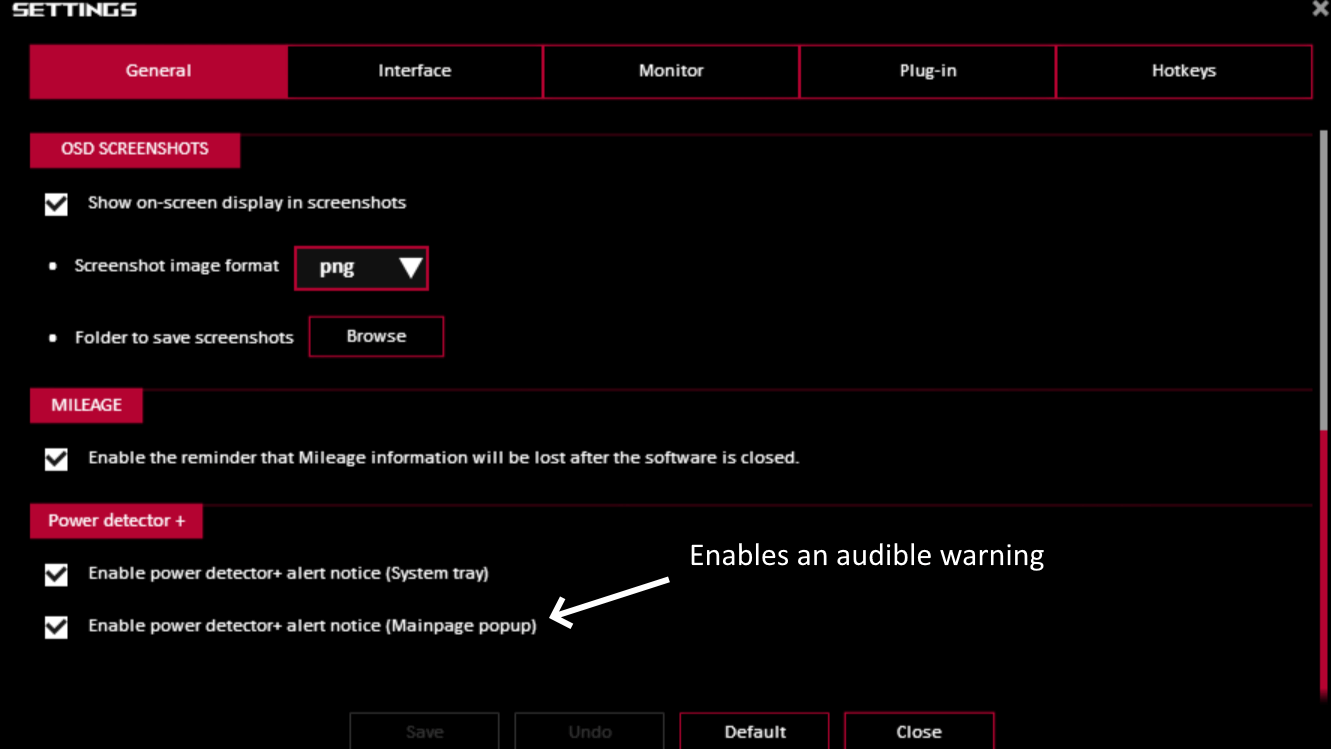
ASUS' GPU Tweak III software can sound an audible warning if the card's current draw goes over the pre-set limit of 9.2A on any single pin. (Image credit: ASUS)
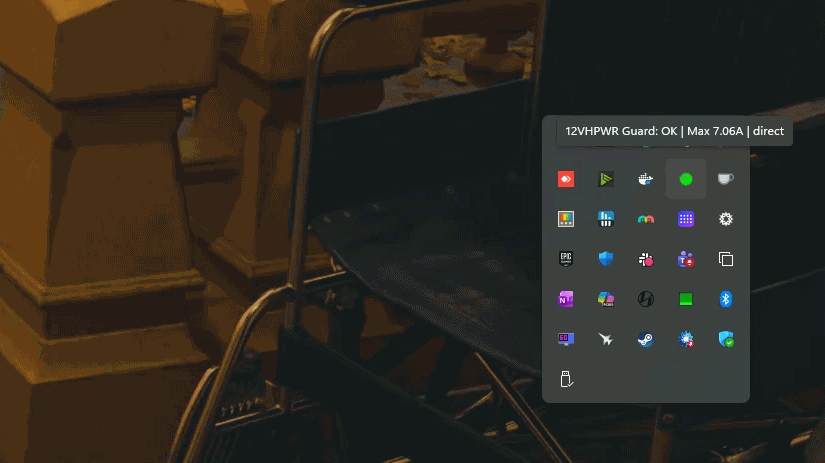
In any case, the app by Humza Khalid and Claude AI is a very simple and fully free app that requires 35MB of RAM and a minuscule amount of CPU time to poll the I2C bus on the card for the current values twice per second. You can mouse over the system tray icon to see the current maximum power draw for any of the six +12V pins on the power connector. The pins are rated for about 9 amperes of current, and ASUS' own warning threshold is 9.2A, but Khalid has configured his tool such that it looks for current draw over 9.5A over a period of 15 seconds. If that period is exceeded, the tool abruptly shuts the system down, force-closing blocking apps.
The current threshold and the required duration are both configurable, so if you want more lenient or more vigilant settings, you can set them that way. It's surprisingly full-featured; it supports HWiNFO-based shared memory monitoring if the app is unable to access I2C for whatever reason, and it also supports both toast notifications and Windows Event Viewer logging. It's also apparently smart enough to detect sensor loss and avoid reporting all is well when it doesn't actually know, which is reassuring.
The 12VHPWR Guard application running alongside Khalid's many, many other system tray applications, showing stable current draw in Alan Wake 2. (Image credit: Humza Khalid/GitHub)
Given the extreme cost of these GPUs (which are among the best graphics cards, to be fair), it's easy to see why owners would resort to these measures. The cheapest of them, the ROG Astral OC GeForce RTX 5080, is currently starting at about $1810 USD. While there have been attempts to blame user error (and indeed some cases certainly were user error with the 12VHPWR connector), it has been thoroughly proven that this connector can fail through no fault of the user. While these failures aren't really commonplace, the fact that they happen does speak to the razor-thin safety margin built into the connector.
If you have one of the supported graphics cards, you can head over to Khalid's GitHub page to grab the tiny application. Only Windows 10 and 11 are supported for now, and you'll also need Python 3.10 or higher, which is why such a simple application requires 35MB of RAM. Just remember that the app isn't a replacement for making sure your graphics card, including its 12V-2x6 connector, is installed correctly.
One more lucky user got his hands on a budget GPU for the price of a cup of coffee,, allowing him to upgrade his second system. Redditor Grabs MSI RTX 3050 GPU from Local Thrift Store for CAD$4.99, While the GPU Sells for Over $200 I know it can be hard to digest it, but such deals do exist. These are rare, but if you are willing to check your local Thrift store, you might be able to snag a piece of hardware for super cheap. We have seen how some users have managed to get hardware for way cheaper […]
More evidence that almost every vendor is now increasing the GPU prices for both AMD and NVIDIA SKUs. NVIDIA and AMD Graphics Cards are About to Get Expensive As Their Board Partners Implement a New 20% Price Hike for RTX 50 and Radeon RX 9000 Series The latest generation of NVIDIA and AMD graphics cards is witnessing another significant price hike. There have been multiple reports of the same, and we have seen how some retailers have already started to increase GPU prices on their stores. Starting in August, some vendors have even begun cancelling GPU orders. Recently, ASUS cancelled […]
Nvidia has reportedly begun to cancel orders for RTX 5090 graphics cards that were placed prior to raising their price, according to a Redditor’s own report. The claim, made in the Asus ROG subreddit, suggests that an order for an Asus ROG Astral RTX 5090 BTF graphics card was cancelled and a refund issued.
The purchaser, who made their order through Nvidia’s marketplace, was reportedly given the choice to pay the “new price” for the GPU or to lose out. Meanwhile, contact with Nvidia’s customer support team, shared in a later post, placed the blame at Asus’ door instead, suggesting that it’s actually Asus’ fault for failing to notify them of the GPU’s new pricing.
IndependentOk1031 shared their story on Reddit over the last two days. In their original post, the Redditor explains that the order was for Asus to fulfil, even at the “stupid high” price of $4,429 (or $4,607 after taxes), but it was later cancelled. An updated post shared since then goes on to explain that, after reaching out to customer support, an Nvidia customer care agent suggested that Asus wasn’t happy to fulfil the order at the price that it was listed for at the point of order, which the Redditor suggests was Friday, July 31.
According to Nvidia, that’s because the “price change update” was provided a “little late,” resulting in the cancellation. Nvidia suggests that it did try to get Asus to honor the order but, according to its agent, Asus was “unable to fulfil it at the previous price rate.” As a result, Nvidia wasn’t able to make any further steps forward. The same GPU is now listed on Nvidia’s website for $4,929.99 before tax, an increase of $500 (or 11.28%). The Redditor is still waiting on contact from an Asus supervisor to discuss the situation but notes that “the odds of anything happening are slim.”
This follows reports last week of Nvidia price rises at major tech retailers in the United States, including at Best Buy and Amazon. While the RTX 5090 Founders Edition continues to hold an MSRP of $1,999, a price still listed prominently on Nvidia’s website, pricing for this top-spec GPU means consumers have to pay thousands of dollars more. Third-party pricing data from CamelCamelCamel shows that the lowest ever pricing for this high-end Asus ROG card on Amazon to date has been $3,289.09, with current pricing set at $4,849.99 from a seller.
As our GPU price index shows, this phenomenon isn’t restricted to the RTX 5090. Current and last-gen Nvidia and AMD graphics cards across the board have all seen significant price rises in a market being badly affected by the AI boom. The cost of memory has pushed the manufacturing costs up, while the demand for the cards themselves caused by AI has caused the retail price to soar further.
With no location mentioned, it’s unclear if the Redditor has any other remedies to pursue his case further. Either way, a near-$600 price hike for a GPU already costing over two times its MSRP demonstrates the significant strain facing buyers globally in the current PC hardware market. With no sign that the market is likely to cool any time soon, buyers looking for the best GPU on sale right now could see further price hikes in the months ahead.
The vendor not only increased the GPU prices significantly, but it also resulted in the cancellation of several existing orders. Retailer Says GIGABYTE Increased GPU Prices by 20-40%, Leading to Cancellation of Several Orders The notice by CFD-BIZ confirms the report of NVIDIA raising the GPU prices. We have seen how drastic the price increase was for the GeForce RTX 50 series in China. We also heard reports that AMD raised the GPU prices for its RX 9000 series, which it delayed due to fear of losing GPU share to NVIDIA. However, reports confirm that both manufacturers have already implemented […]
Graphics cards with 16 GB VRAM have gained more popularity in the last month as gamers transition to 16 GB GPUs. Latest Steam Hardware Survey Reveals 8 Core CPUs and 16 GB GPUs are the Most Popular Configurations for Gamers This was inevitable since 8 GB graphics cards have started to bottleneck performance in intensive titles where 8 GB VRAM doesn't supply enough juice to run games smoothly. For the last few years, we have seen how modern titles have started to gobble up a lot of VRAM, and even GPU manufacturers like AMD appear to be advertising their high-VRAM […]

 Login
Login