Reading view

There are new articles available, click to refresh the page.

Re-examining the DDR4 gaming gap with Intel’s LGA 1700 CPUs in mid-2026 — performance drops of 14% on average, and up to 25% in some games

Unless you already have a kit of DDR5, or deep pockets for PC hardware, you’re stuck right now. Despite seeing some of the best CPUs for gaming released just in the past year, the DDR5 tax represents a major hurdle to building or upgrading your PC. Intel’s LGA 1700 CPUs hold an unintended solution, offering support for both DDR4 and DDR5. We wanted to see if this on-ramp to a next-gen platform was really as smooth as it looks at first glance.

The idea is simple. If you already have a DDR4 kit, you can upgrade to a relatively new CPU while keeping the door open for a transition to DDR5 without buying a new chip. It’s inexpensive, and a bit more of a practical solution than upgrading to DDR5 with a single DIMM and worrying about pairing it with another later.

Our testing shows how much of a performance difference there is with DDR4 in games. We’re focused on games here for a few reasons. First, in non-gaming applications, memory speed is highly dependent on the specific workload you’re running. Games, despite using different engines, are largely similar workloads that stress the hardware in similar ways. Further, those workloads are continually evolving as new games, new technologies, and new hardware targets are released.

We kept our testing focused on Intel’s LGA 1700 CPUs because they’re the only options that give us a true apples-to-apples comparison between DDR4 and DDR5. We don’t have any AMD CPUs in our test pool because there aren’t any chips that support both DDR4 and DDR5. This isn’t intended to be a competitive analysis between AMD and Intel. That conversation opens up a much broader conversation about total platform cost.

Testing DDR4 vs. DDR5 on Intel’s LGA 1700 CPUs

To test DDR4 and DDR5’s gaming performance, we ran Intel’s main LGA 1700 stack through a 15-game gauntlet of benchmarks. Notably, we don’t have results for the Core i9-12900K, as our sample has a janky memory controller that won’t boot on DDR5 systems. You can read a full breakdown of how (and why) we tested in the way we did in the section below.

We ran all of the games through our 16-game benchmark suite, though we cut Doom: The Dark Ages from the results here. An update for the game rolled out mid-way through testing and skewed our results, so we’re omitting it. The 15 remaining games still paint a clear picture of the performance difference between DDR4 and DDR5.

As usual, we tested with the RTX 5090 Founder’s Edition at 1080p with a mixture of High and Ultra settings. We test at 1080p to maximize the differences between CPUs, and it remains the most widely-used resolution for gaming. Deltas between CPUs will decrease as the resolution climbs and the GPU becomes a larger influence in performance.

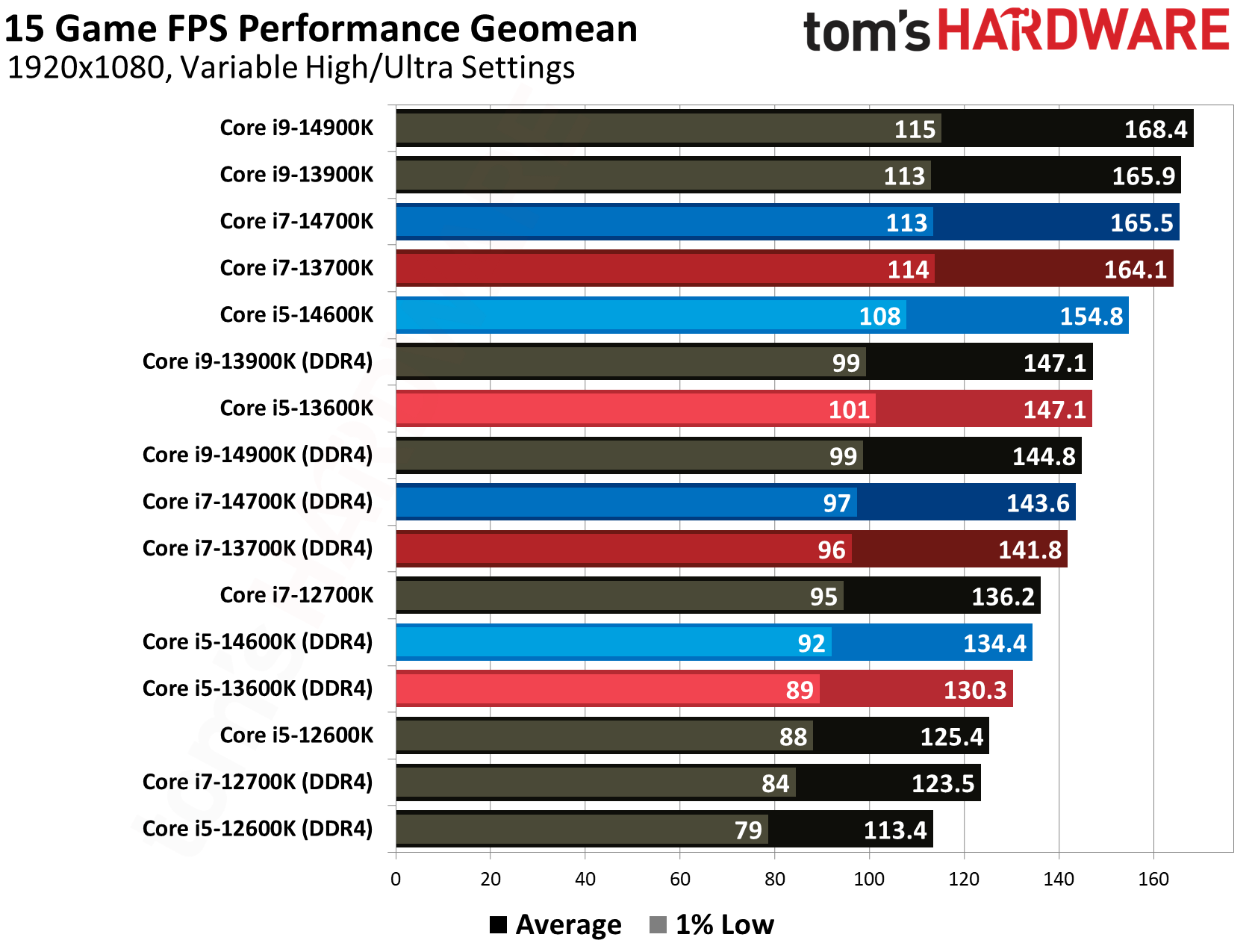
Below is our geomean from testing across the suite. Given that we’re looking to compare a single CPU’s performance with DDR4 and DDR5, we’ve highlighted some CPUs with the same color (13700K is always dark red, for instance, while 14700K is always dark blue).
DDR4 vs DDR5

(Image credit: Tom's Hardware)

The chart above is a bit difficult to parse, mainly because we’re often jumping several entries to get to a comparison point. For the stack of chips we tested, here’s a clearer overview of the performance difference with DDR4:

CPU

DDR4 % Difference

Core i9-14900K

-14%

Core i7-14700K

-13.2%

Core i5-14600K

-13.1%

Core i9-13900K

-11.3%

Core i7-13700K

-13.5%

Core i5-13600K

-11.4%

Core i7-12700K

-9.3%

Core i5-12600K

-9.5%

As we’ll get into with the individual game tests below, the drop in performance between DDR4 and DDR5 can be much larger than the comparison in our geomean (and, in turn, smaller in other games). What’s important for the overall performance drop is the trend as we move to newer chips. You can see a 9% drop grow to 14%, as DDR4 becomes a more significant bottleneck when the processor it’s feeding becomes more powerful.

That trend is one of the main driving forces behind our look at DDR4 and DDR5 gaming performance today. We looked at DDR4 and DDR5 performance extensively near the Alder Lake launch, and even more recently last year, evaluating performance across a wide range of applications. The testing here is focused solely on gaming to answer a critical question of building a PC today: Are you really giving up that much gaming performance with DDR4?

The answer is, yes, you’re giving up around 11% to 14% of your gaming performance overall when the memory is the only variable that changes. That’s a consistent drop, as well. Older titles care see less of a benefit from DDR5 generally, but we saw a steady decrease of around 11-14% across the games we tested, with some titles pushing above a 20% drop.
DDR4 vs DDR5

(Image credit: Tom's Hardware)

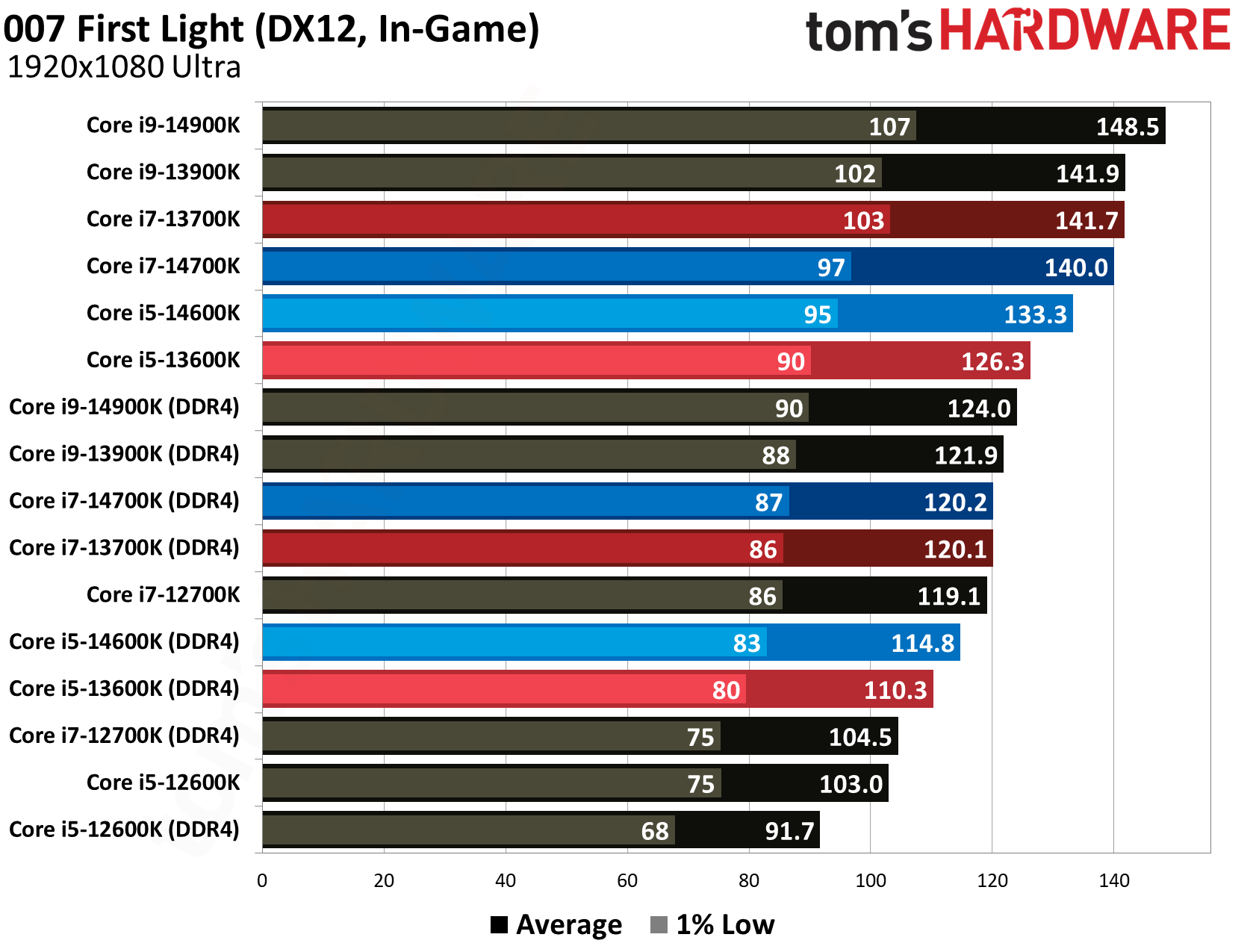
007 First Light is the newest game we tested, and it outpaces our averages. The 14900K sees a 16.5% drop with DDR4, while the 13600K drops 12.7% of its performance. Especially among the most powerful CPUs here, you can see DDR4 level off performance in a way that’s undesirable. The 14900K, for instance, is just 1.7% faster than the 13900K with DDR4, but it’s 4.6% faster with DDR5.
DDR4 vs DDR5

(Image credit: Tom's Hardware)

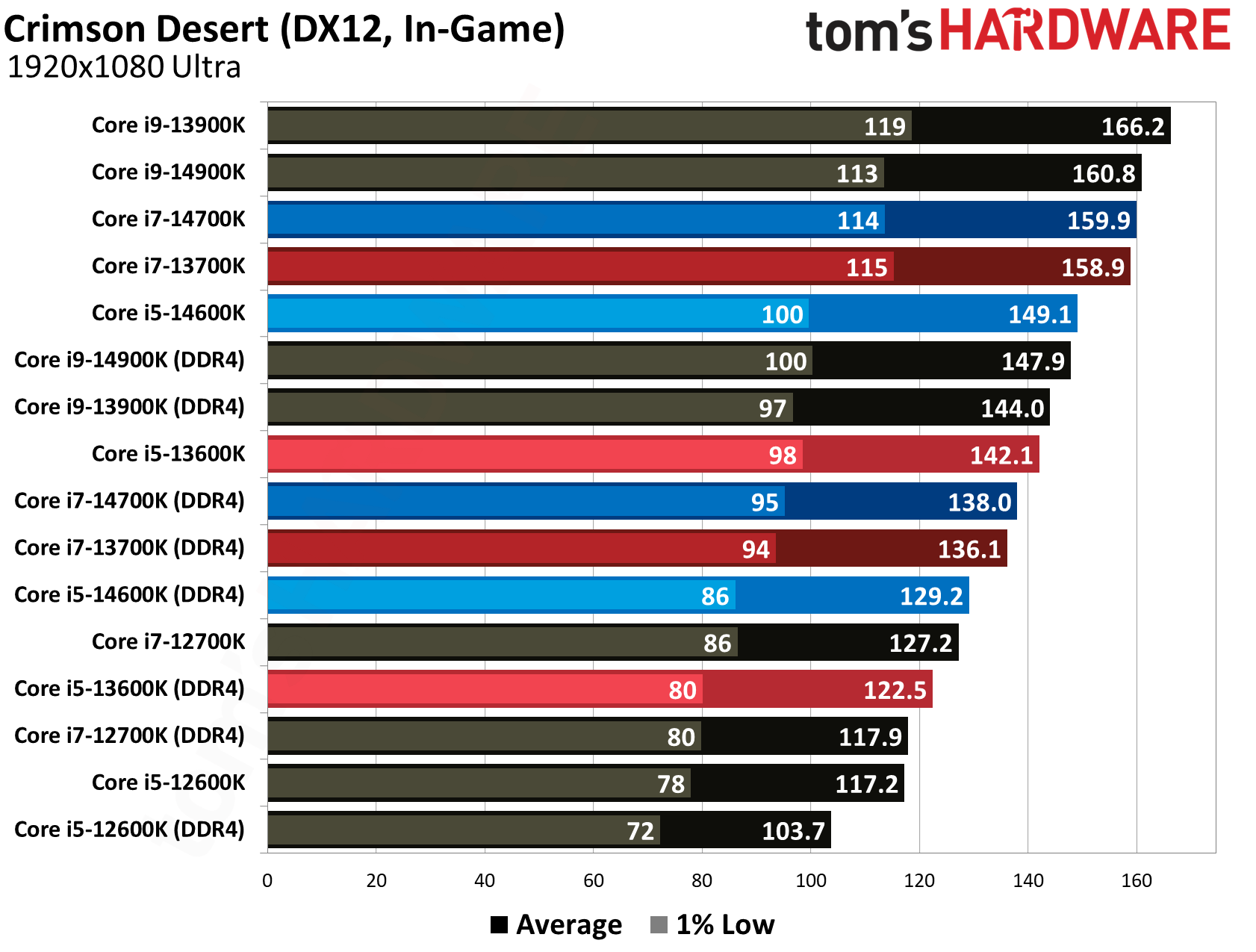
Similarly, in Crimson Desert, you can see the 13700K lose 13.7% of its performance with DDR4, and the 14600K drop 13.2% of its performance. It’s worth noting that neither of these games are particularly sensitive to memory speed. You can see in our recent Ryzen 7 5800X3D re-review that even a boost from 3D V-Cache doesn’t give CPUs with a robust memory chain an automatic advantage.
DDR4 vs DDR5

(Image credit: Tom's Hardware)

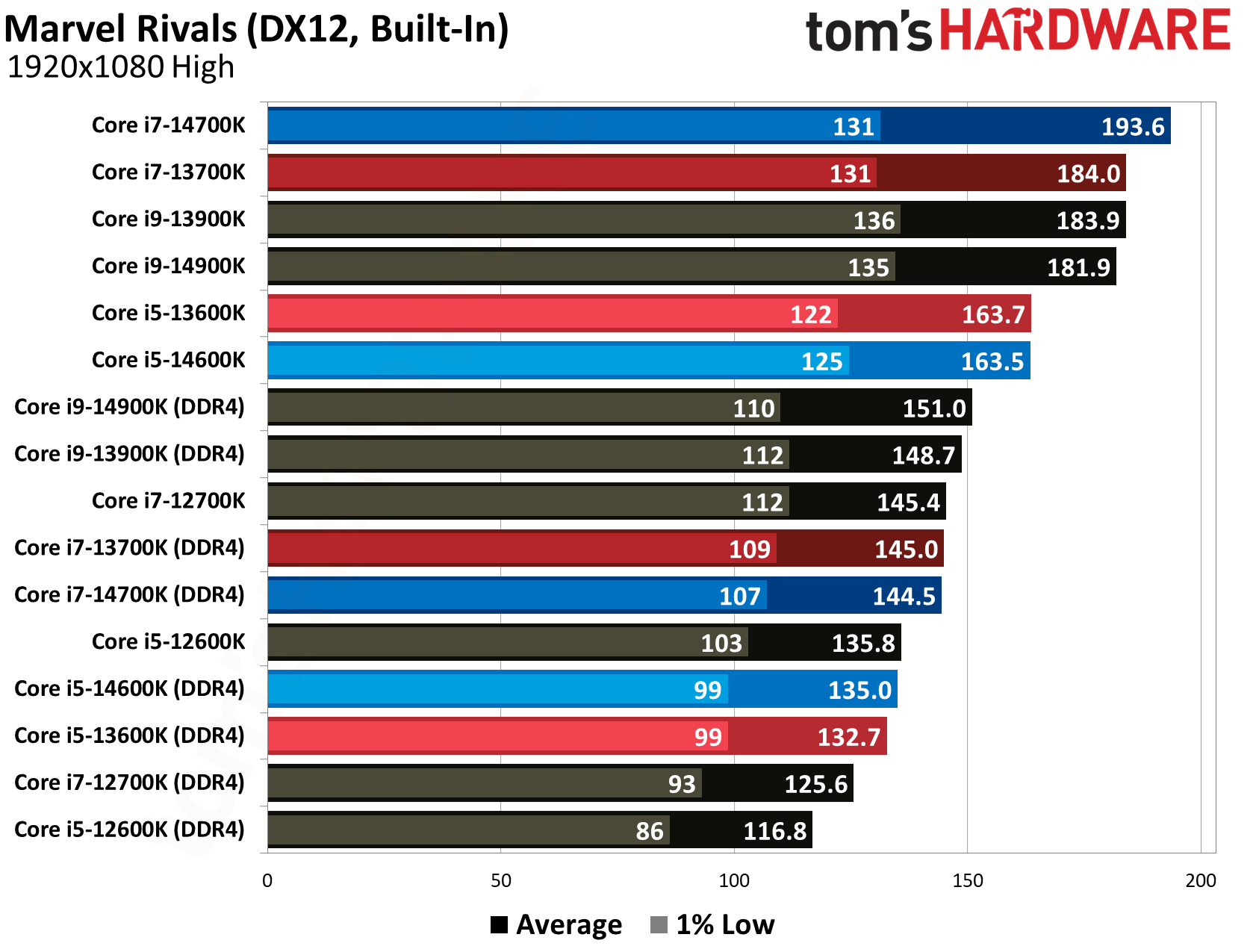
Perhaps the most consequential of the newer games we tested is Marvel Rivals, not only because it shows a much larger gap between DDR4 and DDR5, but also because it’s the most-played game in our test suite by a long shot (short of Counter-Strike 2). For weaker chips like the 12600K, the gap is 13.9%, just slightly above our geomean. For the more powerful 14700K, however, it shows a gap of 25.3%. Even the 14600K drops 17.4% of its performance with DDR4.
DDR4 vs DDR5

(Image credit: Tom's Hardware)

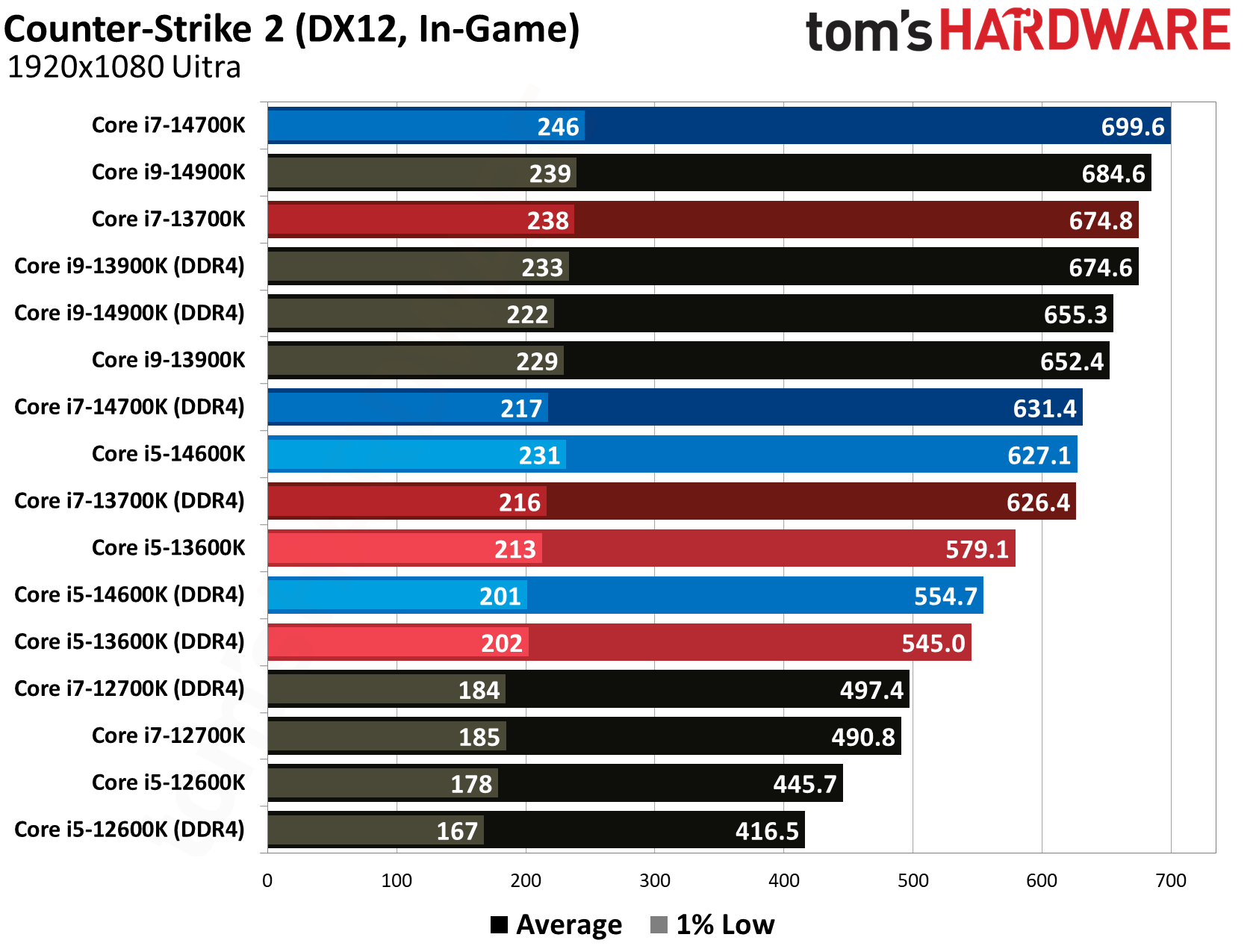
Counter-Strike 2 is less extreme, perhaps as a consequence of having such a high floor for average frame rates. You can see that the Alder Lake chips don’t care much about DDR4, with the Core i7-12700K performing identically across both memory standards. That gap grows with more powerful CPUs, however, with the 14700K creeping up toward a 10% delta.
DDR4 vs DDR5

(Image credit: Tom's Hardware)

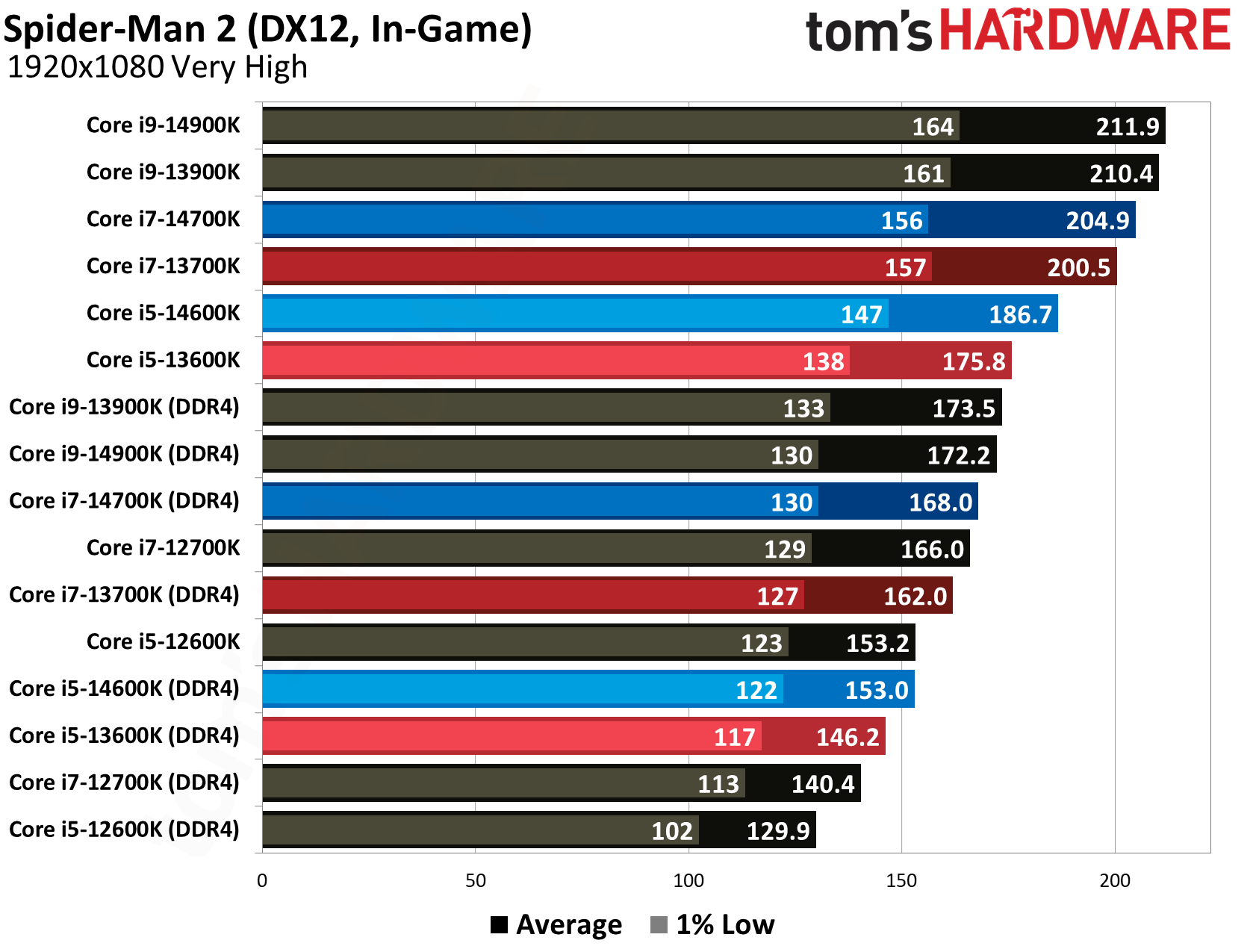
In Spider-Man 2, we can see more consistent drops across the stack of chips we tested, with most CPUs dropping around 18% of their average performance with DDR4. That’s true even on the weaker 12700K, which lost 15% of its performance. The 14900K, meanwhile, was 18.7% slower with DDR4.
DDR4 vs DDR5

(Image credit: Tom's Hardware)

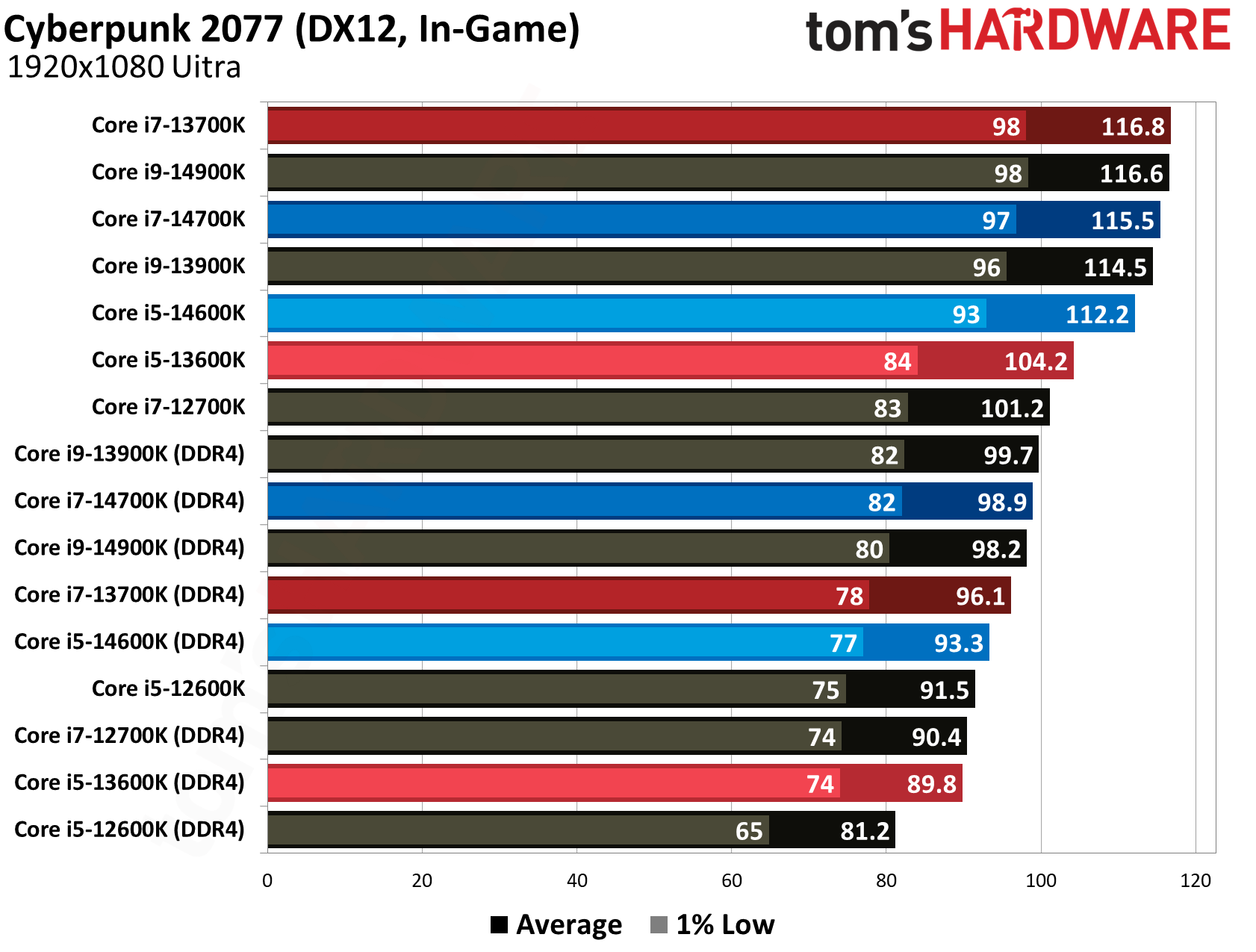
Even in an older, GPU-heavy title like Cyberpunk 2077, we can see a consistent drop. You can see in this game that we become completely bound by the GPU at the top of the rankings, but that’s a level these chips can’t hit when paired with DDR4. The 14700K drops about 14% of its performance, and the 13600K, about 13% of its performance.
DDR4 vs. DDR5
Tom's Hardware
DDR4 vs. DDR5
Tom's Hardware
DDR4 vs. DDR5
Tom's Hardware
DDR4 vs. DDR5
Tom's Hardware
DDR4 vs. DDR5
Tom's Hardware
DDR4 vs. DDR5
Tom's Hardware
DDR4 vs. DDR5
Tom's Hardware
DDR4 vs. DDR5
Tom's Hardware
DDR4 vs. DDR5
Tom's Hardware

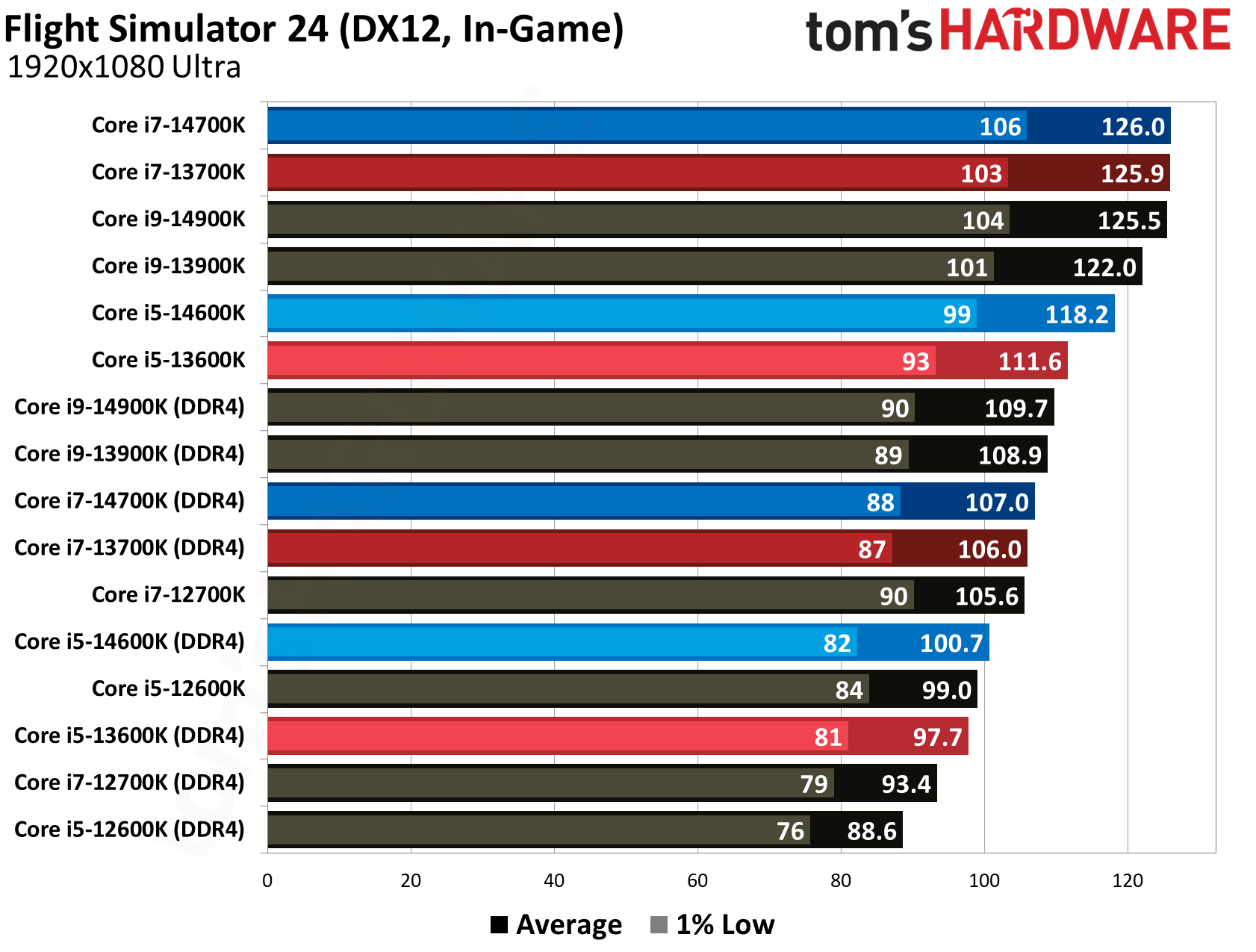
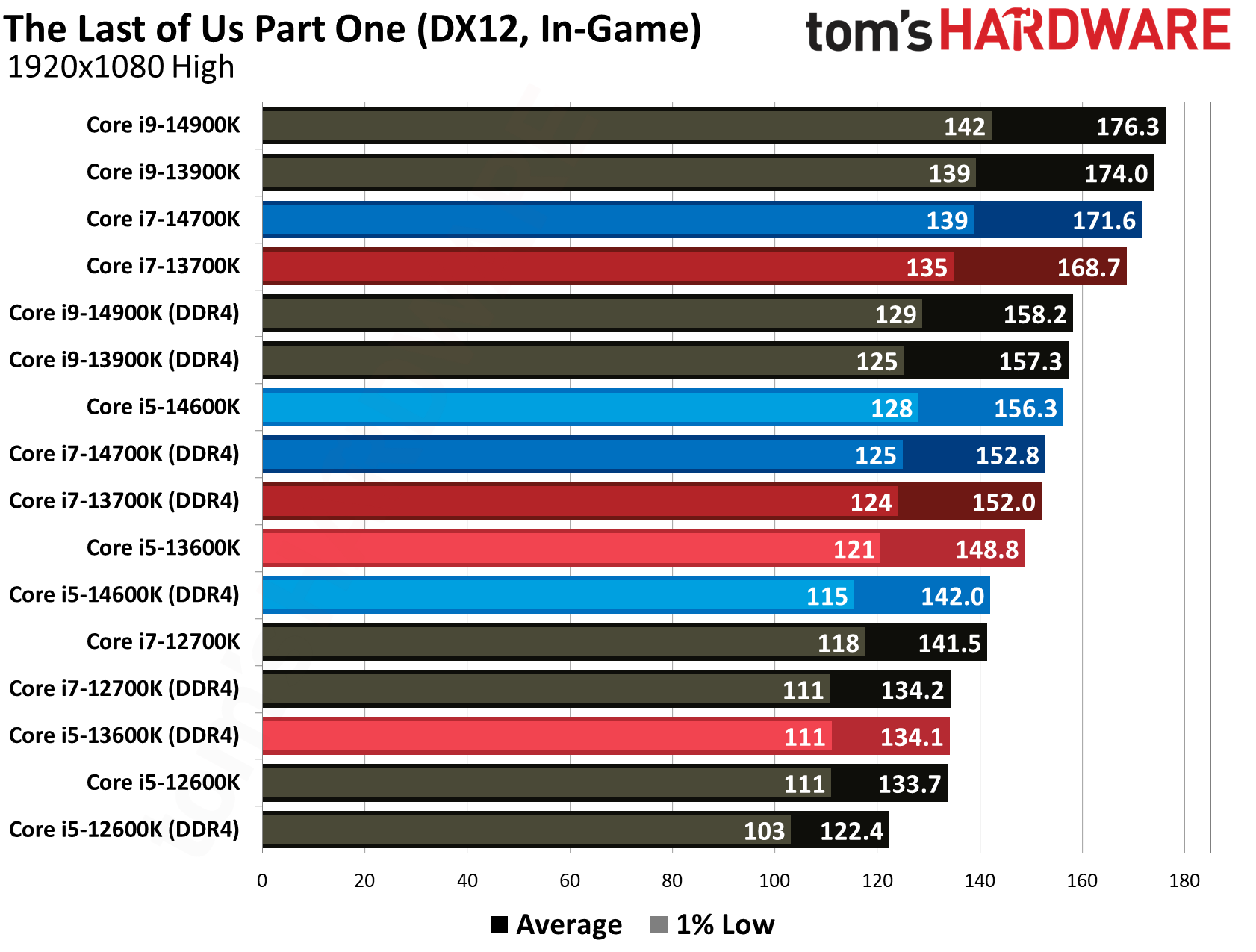
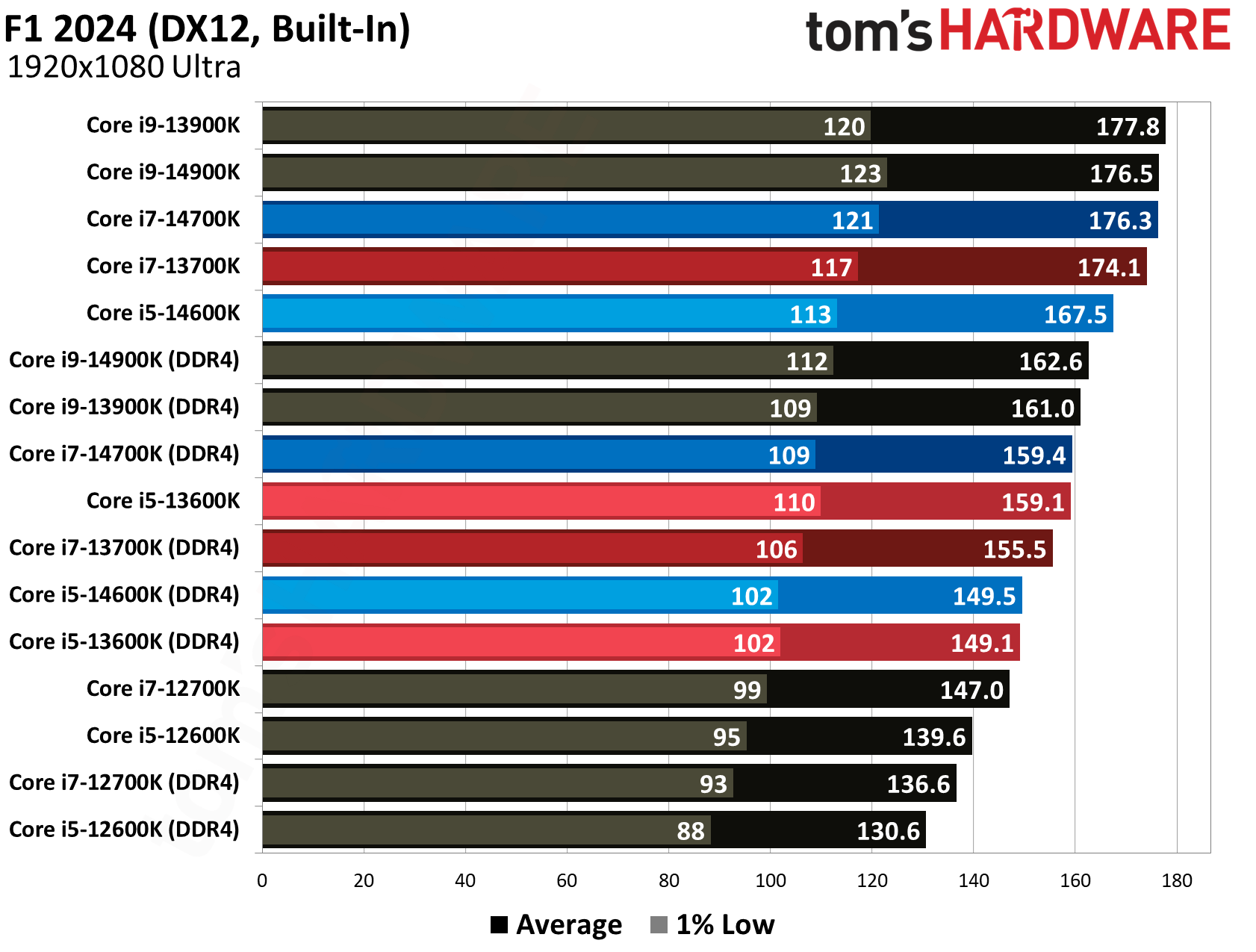
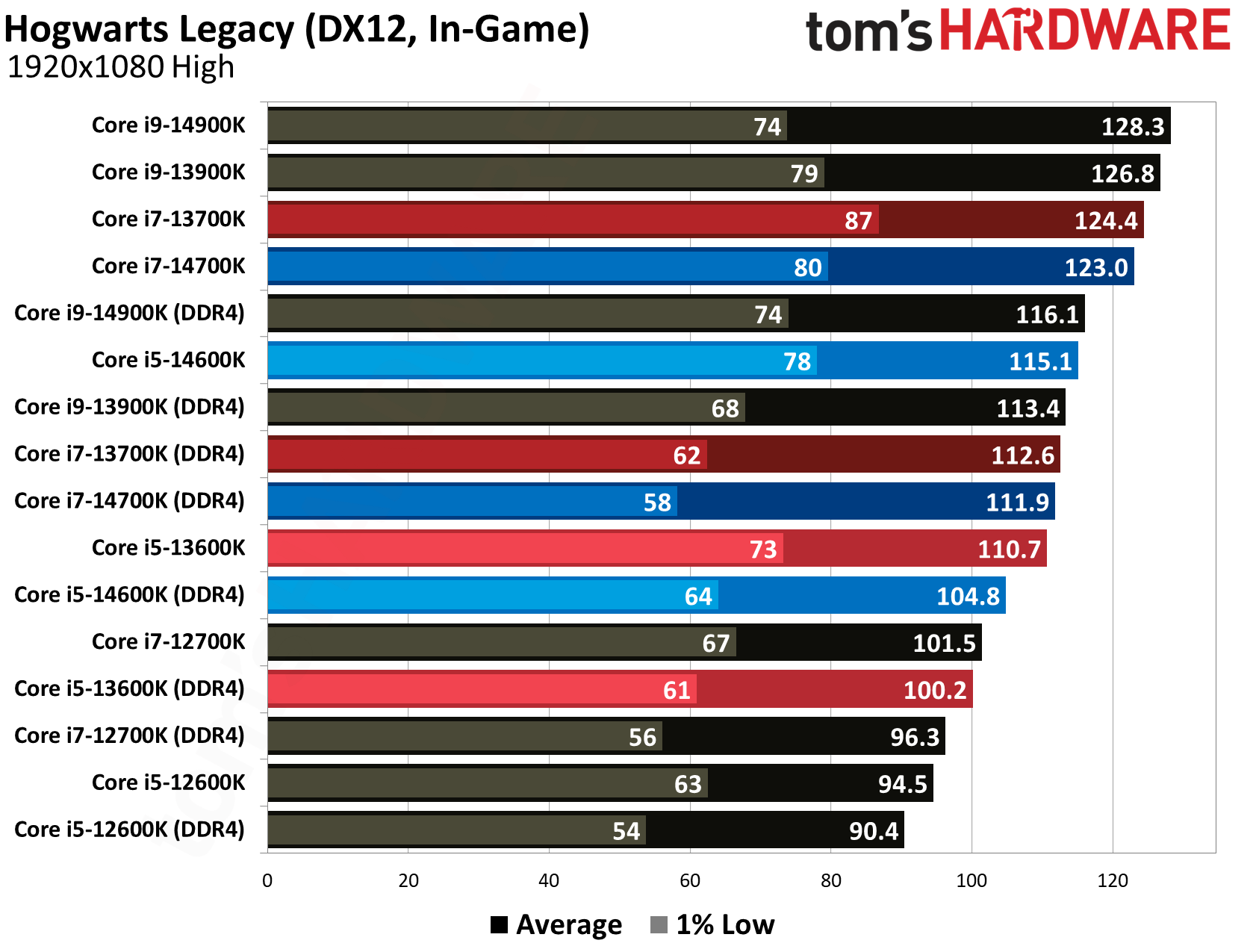
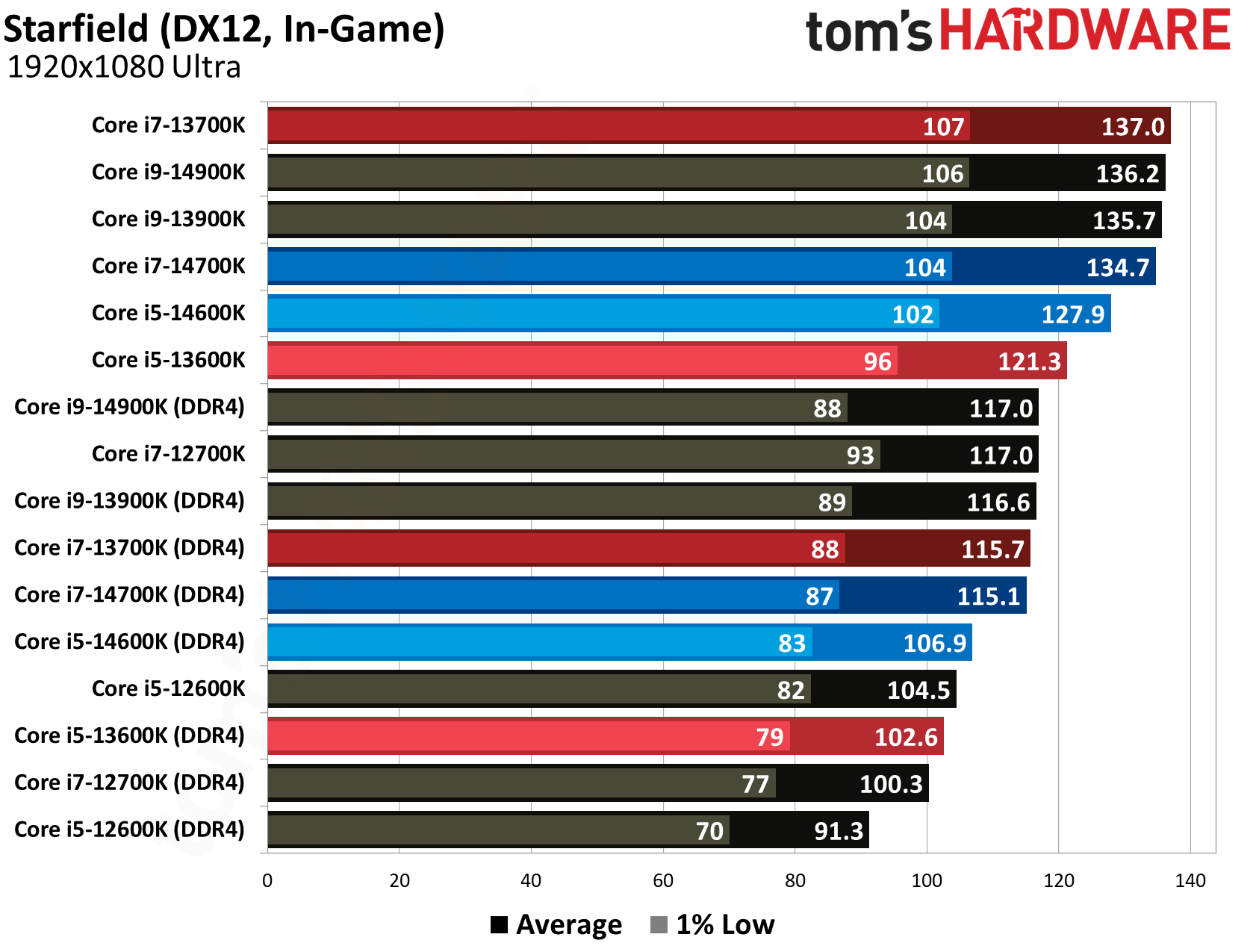
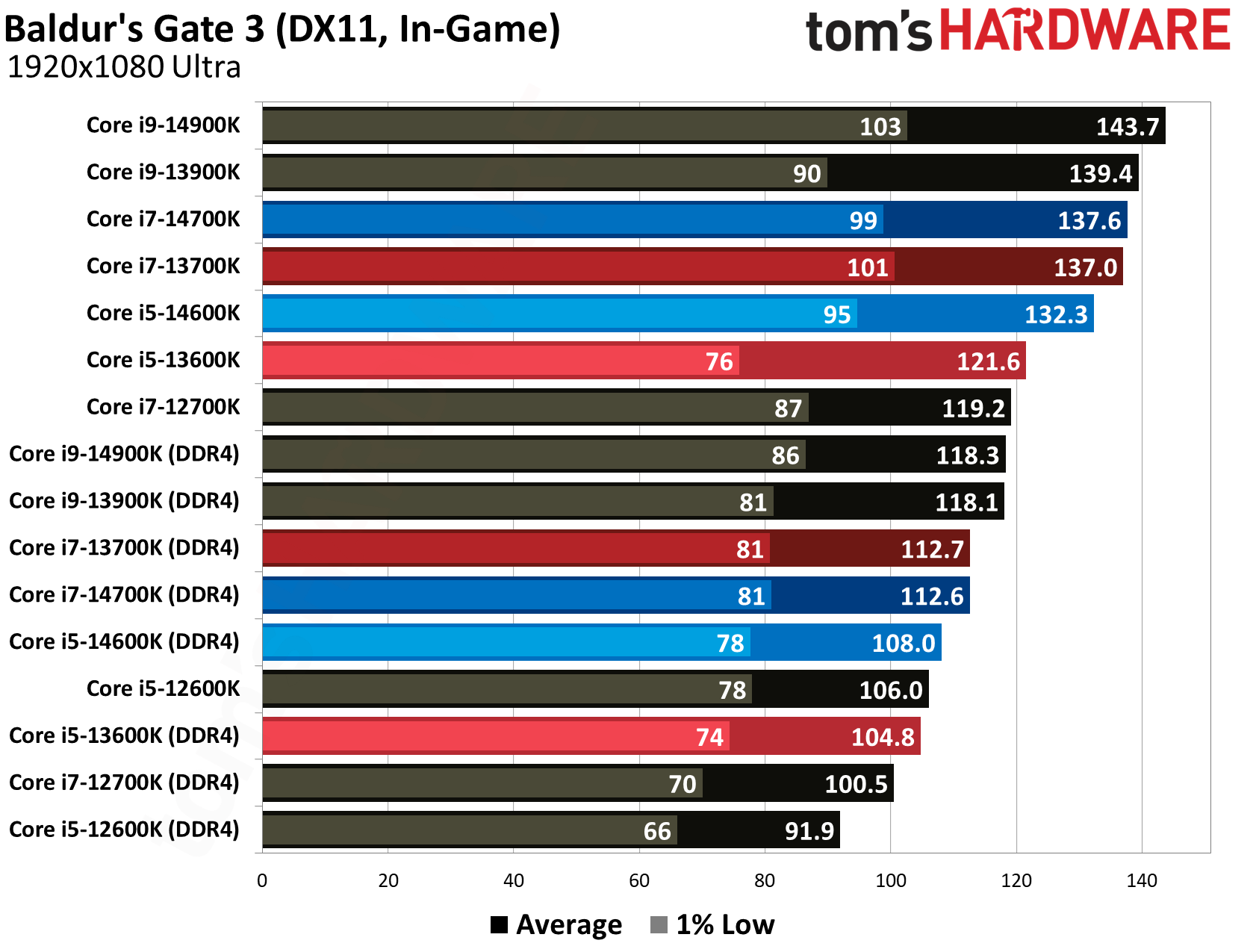
You can browse through our remaining benchmarks using the gallery above, but most games tell a similar story. The gap between DDR4 and DDR5 persists, of course, but there’s another angle to look at the data. DDR4 flattens off performance, creating a bottleneck with faster CPUs. That could be justification for buying a weaker chip if you can only afford DDR4 memory right now.
DDR4 vs DDR5

(Image credit: Tom's Hardware)

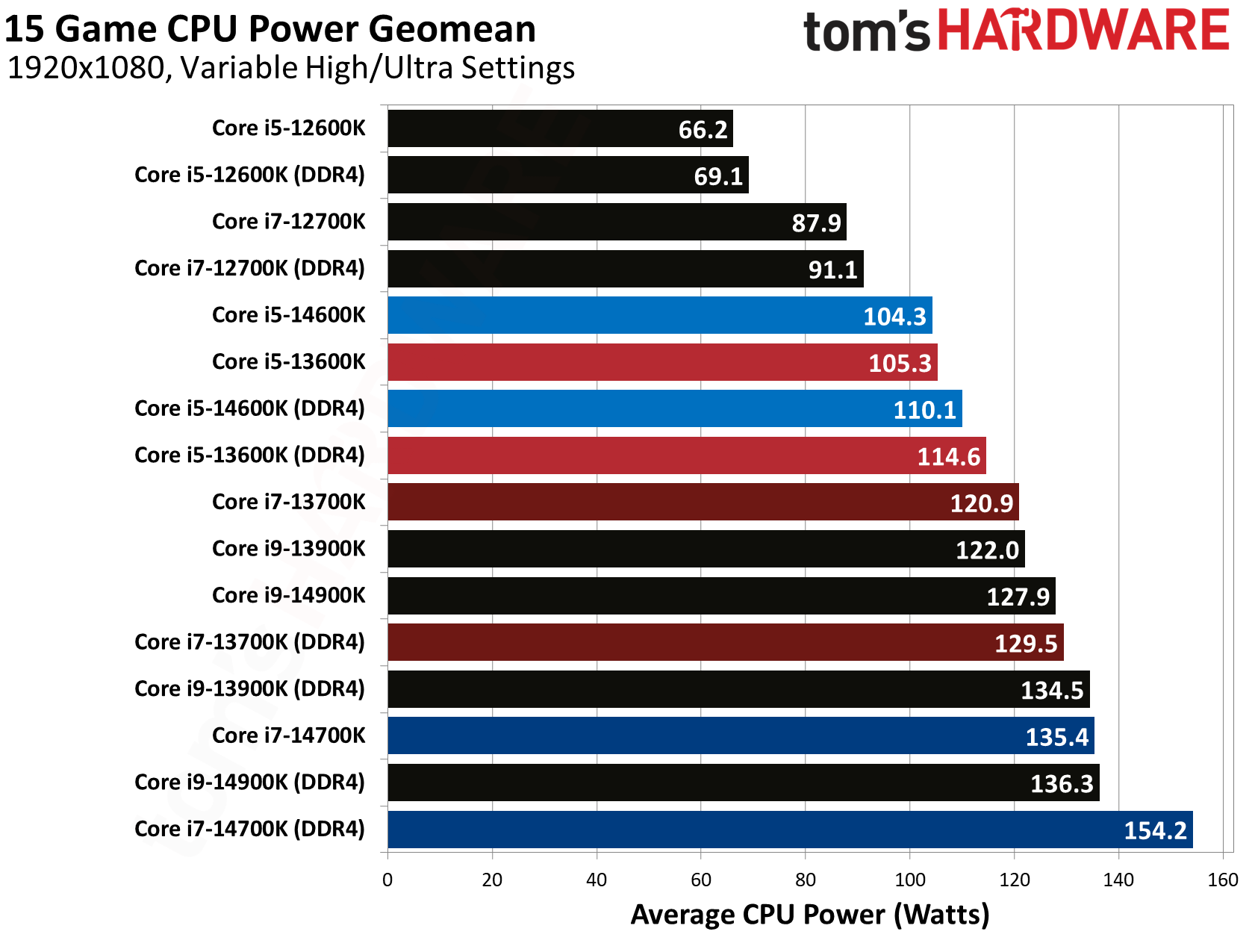
Outside of performance, one important aspect of using a DDR4 system compared to DDR5 is power consumption. With DDR4, power consumption of the CPU increases, as you can see in the chart above. The jump is generally only a few watts, but it’s worth noting nonetheless. In games, we’re well below the operating temperature of all the chips in our test pool, but when pushing toward maximum power draw, DDR4 will post yet another limitation.

How (and why) we tested DDR4 vs. DDR5 now

DDR5 is way too expensive, and Intel’s LGA 1700 CPUs represent a unique value proposition given the unprecedented increases in memory prices over the past several months. The idea is that you can upgrade to a newer platform while sticking with DDR4, giving you a stopgap for an eventual DDR5 upgrade. It seems Intel recognizes this value proposition, as well, as it’s reportedly slated to launch Raptor Lake Next CPUs on the LGA 1700 socket.

We tested the main stack of chips, short of the Core i9-12900K, as described above. We didn’t test variants like KS releases to keep our testing focused, as well as lower-end SKUs like the 12100F or 14400. The memory controllers in these lower-end chips are weaker, sustaining lower DDR5 speeds, so expect less of a difference in performance with them.

Below, you can see the test benches we used. In addition to keeping hardware consistent, we use a frozen OS image with an identical software stack. We’re running the same version of the same apps on the same OS update, with identical drivers.

In the BIOS, we enabled XMP for both kits of memory. We also tested with Resizeable BAR turned on, and Virtualization-Based Security (VBS) turned off. Most motherboard vendors off a profile with the power limits removed on Intel CPUs, which can push the processor outside of warrantied specifications. We stuck with the default “Performance” profile for our testing here.

Intel LGA 1700 (Raptor Lake, Alder Lake)

Motherboard

MSI MPG Z790 Carbon Wi-Fi

RAM

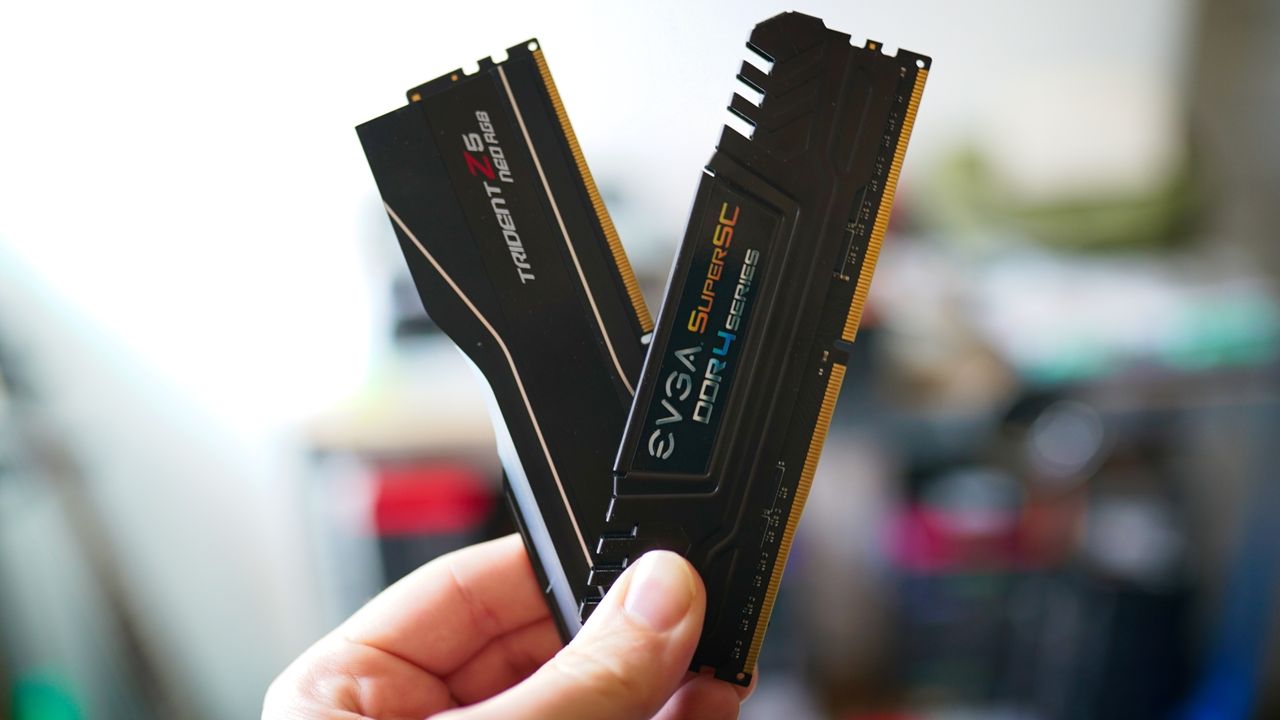
2x16GB G.Skill Trident Z Neo RGB DDR5-7200

Intel LGA 1700 DDR4 (Raptor Lake, Alder Lake)

Motherboard

MSI MPG Z690 Edge Wi-Fi DDR4

RAM

4x8GB G.Skill Trident Z RGB DDR4-3200

All Systems

Gaming CPU

Nvidia GeForce RTX 5090 Founder’s Edition

Cooler

Corsair iCue Link H150i RGB

Storage

2TB Sabrent Rocket 4 Plus

PSU

MSI MPG A1000GS, Gigabyte UD1000GM PG5 V2

Other

Arctic MX-4 TIM, Windows 11 Pro, Alamengda open test bench

Is DDR4 still worth it?

It makes sense that we’ve seen a shift back toward DDR4. Although DDR4 prices have risen in lockstep with DDR5 prices, they started from a much lower base. A kit of DDR4 today is not much more expensive than a DDR5 kit of similar capacity a year ago. And, with estimates that the memory shortage could persist through 2030, there’s a strong argument for going with a DDR4 system if you’re in need of an upgrade.

The performance trade-off alone isn’t as big of a problem as it appears at first glance. You’re going to lose about 15% of your average gaming performance with Intel’s LGA 1700 CPUs (particularly Raptor Lake chips). You’ll spend more than twice as much on a 32GB kit of DDR5-6000 as you will on a 32GB kit of DDR4-3200, as you can see in our RAM price tracker. And, you might already have a DDR4 kit, cutting that cost completely out of an upgrade. Dollars spent for performance gained, DDR4 makes complete sense.

However, performance isn’t the only factor at play, and that’s the unfortunate reality of using a DDR4 platform right now. It’s a dead end, both for performance and upgrade potential. As we saw in our recent testing of the Ryzen 7 5800X3D, there’s a performance wall in games with DDR4, one which the 5800X3D often runs up against. The memory is a bottleneck, and it doesn’t seem like there’s a way around that problem without upgrading to DDR5.

We also aren’t seeing any new DDR4 CPUs, at least right now. AMD re-released the Ryzen 7 5800X3D, and there are murmurs of Raptor Lake Next. But given the current landscape, we don’t expect a CPU that will radically change the performance you can get out of a DDR4 platform.

Instead of sticking with DDR4 for a better CPU, the best course of action right now is to bite the bullet on DDR5 and buy a weaker CPU, particularly if gaming performance is your main concern. Given that memory prices are out of control, there are excellent deals on DDR5 CPUs right now, allowing you to offset the cost of an upgrade and giving you a kit of DDR5 to carry forward in future builds.

As an example, AMD’s recently-released Ryzen 7 7700X3D is $80 cheaper than the re-released Ryzen 7 5800X3D, despite coming in nearly 20% faster in average gaming performance. The $230 Ryzen 5 7600X3D shows similar gains, and it’s even more affordable.

In Intel’s camp, the Core Ultra 7 270K Plus and Core Ultra 5 250K Plus represent some of the best all-around value in the CPU world right now, with compelling gaming performance and chart-topping application performance, all for around $300.

You will spend more on a cheaper CPU and a kit of DDR5. There’s no indication that the memory shortage is ending soon, however. We’ve actually seen prices continue to increase despite the surge leveling off. Opting for DDR5 today buys you better gaming performance, but more importantly, it gives you a kit of memory that you can continue to use as new CPUs and platforms are released.
Samsung Eyes An Opening In China’s Dwindling Smartphone Market By Using CXMT Memory, But The Latest Report Has The Completely Wrong Idea About Pricing

Samsung reportedly wants to use CXMT DRAM chips to enter China

As Chinese smartphone brands cut smartphone shipments in the wake of the DRAM shortage, Samsung reportedly targets an opportunity to raise its tally in a market that it has struggled to penetrate for years. To achieve this, a new report states that the Korean giant will resort to using CXMT’s DRAM chips, which are said to be cheaper, but that’s where the misconception should end. CXMT’s DRAM chips are anything but cheap; Samsung still has a chance to enter China’s smartphone market A report from Asia Times claims that Samsung is considering the use of “low-cost” Chinese DRAM as the […]

Read full article at https://wccftech.com/samsung-china-smartphone-market-cxmt-memory-pricing/

Chinese CXMT DRAM doesn't look like the budget savior many were expecting — new modules enter the market, but prices still track the big three

One of the common misconceptions in today's memory market is that once memory modules based on chips from CXMT enter the consumer market, there will be cheaper alternatives to memory sticks running DRAM from the Big Three. While availability of CXMT-powered modules certainly impacts average selling prices, these products are not cheaper than those based on ICs from Micron, Samsung, and SK hynix even in China, as noticed by @harukaze5719.

A 64GB DDR5-5600 RDIMM based on memory from Samsung or SK hynix costs 18,595 CNY ($2,745) at JD.com, whereas a module featuring the same capacity and specification, but using DRAMs from CXMT is priced at 18,999 CNY ($2,805), according to observations by @harukaze5719. It is noteworthy that a Samsung 64GB DDR5-5600 RDIMM made by Samsung and sold by Samsung costs $2,425 at Amazon.com in the U.S.

While the $60 difference seems significant, it is really just 2.2%, which can be considered negligible at these sky-high prices. Nonetheless, many expect CXMT-based memory modules to be cheaper than those carrying chips from Micron, Samsung, or SK hynix, so observing that they are even a bit more expensive than offerings with ICs from renowned manufacturers may be a bit surprising.

Indeed, because CXMT produces memory chips using an outdated fabrication technology, its DRAM ICs consume more power than those made using the latest manufacturing processes, have lower performance potential, and mediocre overclockability. Furthermore, the Chinese government heavily subsidizes both ChangXin Memory Technologies and Yangtze Memory Technologies (YMTC), which enables both to sell their memory at lower prices although their actual costs may be higher compared to those of the Big Three.

As a result, it is reasonable to expect CXMT to charge less for its chips compared to chips from renowned producers. Truth to be told, we do not know CXMT's quotes, they may be as high as those from other manufacturers and the only reason why module producers buy them is that they are the only chips available. Furthermore, companies tend to price products based on what the market will bear, not strictly on production cost or their characteristics. In fact, as everyone is capacity constrained these days, there is little incentive for CXMT to price its DRAMs significantly below those from renowned makers. However, while CXMT may indeed charge less for chips (e.g., because the Chinese government issues an appropriate directive), this lowers costs for module makers, but has a limited effect on retail prices of actual DIMMs or RDIMMs.

Whether potential savings reach end customers depends on market competition, supply-demand conditions, and the pricing strategies of module makers, distributors, and retailers. Furthermore, when prominent companies like Apple, Dell, or Corsair use a memory chip SKU, this one must pass rigorous validation processes and is usually tested in-house, or by contract manufacturers, which adds to costs and somewhat erases the price difference between suppliers.

As a result, CXMT memory chips may make the lives of hardware makers easier, but are not expected to impact the retail prices you pay.

China’s CXMT Now Charges More Than Samsung For DRAM As Memory Demand Skyrockets, Even Denying Relief To Huawei

A CXMT DDR5 memory module is displayed against a blurred background.

CXMT is now charging more for memory than the big three DRAM makers as demand swells in China's domestic AI markets. CXMT Benefits Big Time From DRAM Crisis By Charging Hefty Premium For Its Memory Products Most global media outlets were under the impression that CXMT was going to be the "Cheaper Alternative" to Samsung, SK Hynix, and Micron, who are asking big sums of cash for their DRAM products, but that wasn't the case. In our exclusive, we reported that CXMT's advantage was not in its price, but in its supply, and that remained true; demand skyrocketed 10-fold, and […]

Read full article at https://wccftech.com/china-cxmt-charges-more-than-samsung-for-dram-as-memory-demand-skyrockets/

CXMT’s 64GB Server DDR5 Memory Chip Is Now Pricier Than Samsung’s, As It Races To Increase Capacity To 600,000 Wafers Per Month

Two RGB-lit KingBank RAM modules are displayed in front of a neon-lit background featuring the 'CXMT ChangXin Memory Technologies' logo.

CXMT's ideology is fast becoming wholly mercantile as it appears to have adopted the same price gouging tactics that are now the bread and butter of its 'Big Three' counterparts - Samsung, SK hynix, and Micron. CXMT's 64GB server DDR5 module now costs more than Samsung's $1,240 comparable offering According to Reuters, Chinese memory makers are now being picky about clients and dictating their own prices, which indicates their strengthened negotiation position. In what is a striking anecdote, CXMT abruptly evicted engineers affiliated with SiCarrier - a Huawei-linked equipment vendor - from its fabrication facility in Hefei. The engineers were […]

Read full article at https://wccftech.com/cxmts-64gb-server-ddr5-memory-chip-is-now-pricier-than-samsungs-as-it-races-to-increase-capacity-to-600000-wafers-per-month/

Gigabyte announces support for Chinese-made CXMT memory — pushes it to 8200 MT/s on Socket AM5

You're probably already well aware of the three largest memory vendors: South Korea's SK hynix and Samsung, and the United States' Micron. There's a fourth player up and coming in the market, though, and that's China's ChangXin Memory Technologies, more commonly known as CXMT. CXMT is pumping out RAM as fast as it can to soften the effects of the RAMpocalypse on domestic (to China) consumers, and it's also expanding capacity quickly. Given these factors and the size of the Chinese market, it should come as no surprise that motherboard vendors, including Gigabyte, are advertising fresh support for the chip.

MSI appears to have been the first major motherboard vendor to publicly promote BIOS optimizations specifically for CXMT DDR5 memory, initially through China-market BIOS releases and later with global announcements. What Gigabyte is saying is a little different: not only is CXMT RAM supported on Gigabyte motherboards for both AMD's Socket AM5 and Intel's LGA 1851, but it's supported at impressive speeds of up to 8200 MT/s on select boards.

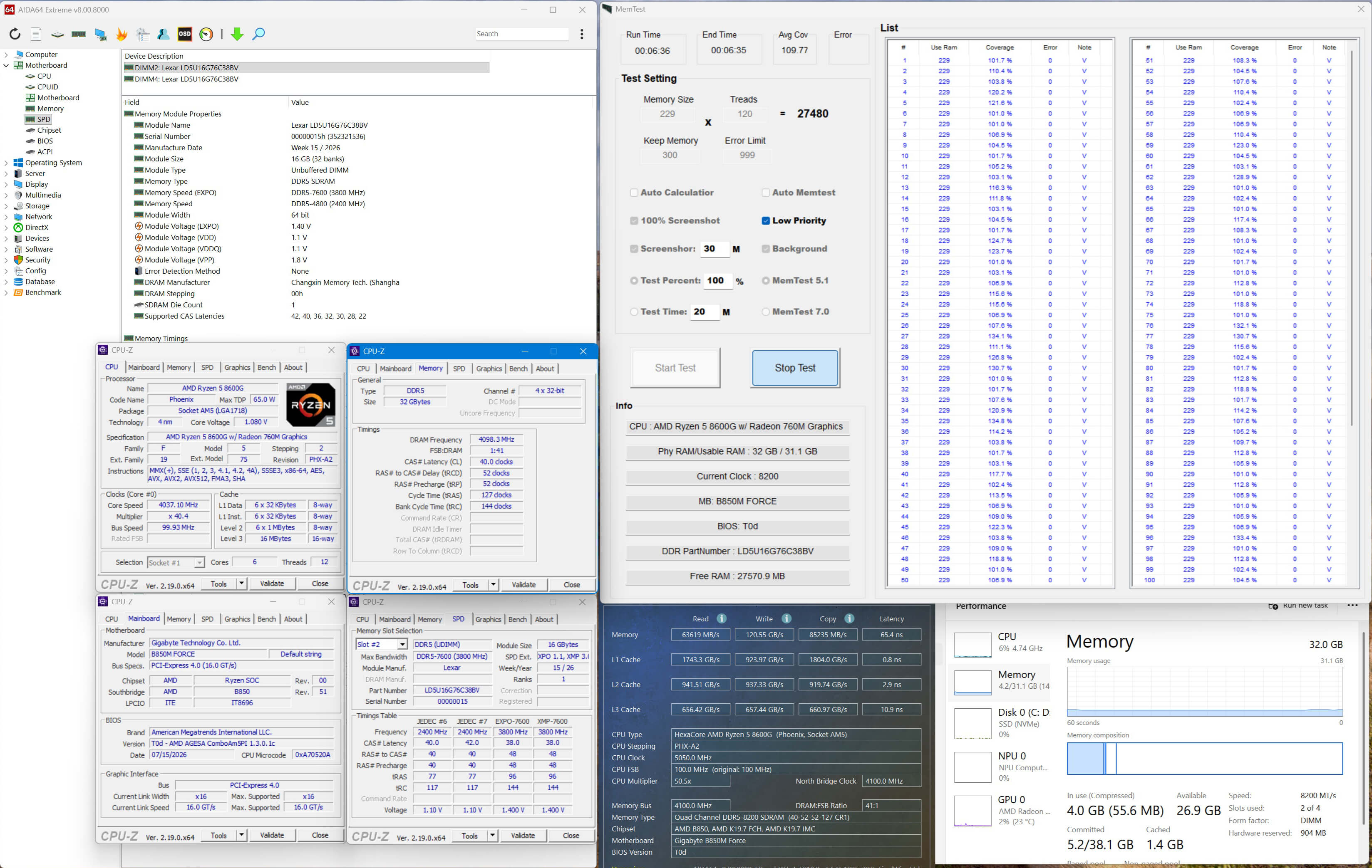
A composite screenshot showing many windows displaying memory overclocking success.

Click to zoom in if you want a hope of reading this screenshot. (Image credit: Gigabyte)

As proof, Gigabyte offers up a CPU-Z screenshot showing a pair of 16GB Lexar modules equipped with CXMT chips achieving a speed of 8200 MT/s with a CAS latency of just 40 cycles on one of its B850M FORCE motherboards. We have to remark that Gigabyte doesn't show the voltage required to hit these speeds, likely for good reason, but the firm did it without disabling the chip's integrated graphics. That doesn't prevent the chips from posting an excellent AIDA64 latency of just 65.4 nanoseconds on the monolithic Ryzen 5 8600G used for the test. For context, typical EXPO kits usually run around 80ns, JEDEC timings are more like 100ns, and LPDDR-based systems rarely come below 110-120ns.

As Gigabyte says, "CXSH (CXMT) chip-based memory offers a welcome additional source of supply for consumers." (CXSH is the JEDEC manufacturer ID code for CXMT) Gigabyte specifically notes that it is modules with 16-gigabit and 24-gigabit ICs that are supported; that means 16GB and 24GB single-rank modules, or 32GB and 48GB dual-rank modules.

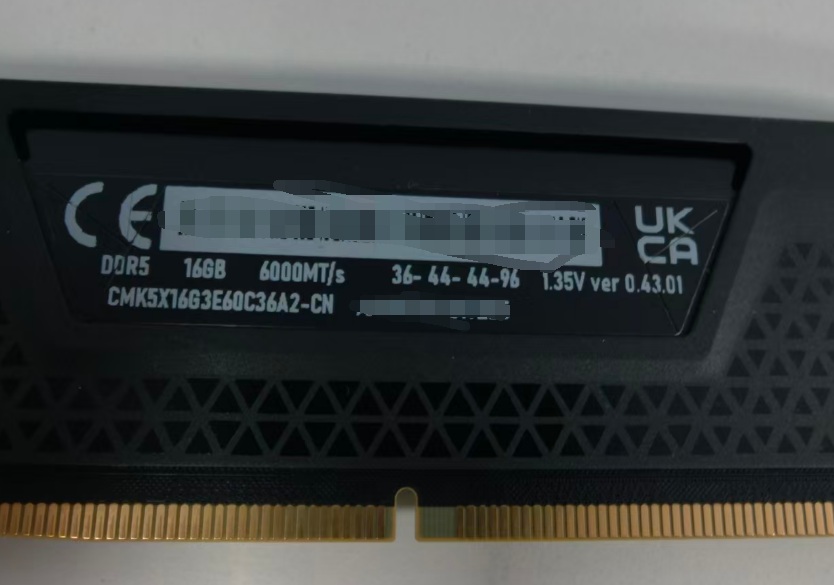
Corsair Vengeance DDR5-6000 memory module with CXMT chips inside

This Corsair module has CXMT chips inside, but it's also exclusive to China. (Image credit: @wxnod on X)

While CXMT memory is certainly a welcome additional source of supply, it's also not really clear how much of that memory is actually making its way outside of China, particularly to the US and Europe. CXMT isn't on the US Commerce Department's "Entity List" yet, so the firm's parts aren't actually banned, but the company is once again considered a Chinese military company by the Department of Defense after being briefly removed from the 1260H list in February. Lawmakers here in the states, likely laden with donations from the big three memory firms, want to see CXMT banned, while US tech companies like Corsair, HP, and Dell are already integrating ChangXin RAM into their products, and Apple wants in, too.

The reality is that, as a DIY builder, you are fairly unlikely to know or care if your memory is manufactured by CXMT. You don't usually buy RAM directly from SK hynix, Samsung, or Micron (certainly not since Micron unceremoniously executed Crucial); you buy your RAM from Silicon Power, G.SKILL, Patriot, Corsair, or one of the many other vendors who assemble DIMMs. If the RAM runs at its rated specifications, there's not a lot of reason for the individual consumer to care where it came from. It's nice to hear that the new chips are officially supported by familiar mainboards, though.

Memory Shortage Chokes The PC Market Into A 4% Q2 Decline, Leaving Only ASUS And Apple Growing

The PC market continues to struggle due to memory shortages, with the latest stats reporting a 4% decline in Q2 2026 as prices continued to climb. ASUS & Apple Were The Only PC Makers Who Saw Share Growth In Q2 2026 But Continue To Struggle Due To Memory Shortages The latest market statistics from Counterpoint Research for Q2 2026 are in, and show that the PC market declined 4% in Q2 2026 versus the prior year. PC shipments reached 65 million units, which broke the growth trend that started in Q1 2025, but have since been on a decline as […]

Read full article at https://wccftech.com/memory-shortage-chokes-pc-market-into-a-4-percent-q2-decline/

NVIDIA Reportedly Increased GDDR6 And GDDR7 Kit Prices For Its RTX GPUs

GPU Vendor Reveal The Reason For Higher NVIDIA RTX 50 Series Costs; Says GPU & VRAM Combo Makes Up To 80% Of Total Cost 1

Another substantial price hike is incoming as the green team has supposedly raised prices for its memory kits. NVIDIA RTX GPUs to See Another Price Hike as the Company Reportedly Passes Increased Memory Kit Costs to its Board Partners The GPUs continue to suffer from the instability caused by DRAM availability and pricing. NVIDIA and AMD have adjusted the prices of their current-gen GPUs multiple times already, and it looks like there is another price hike incoming in the coming days. Since both manufacturers source memory from major suppliers, they have no option but to pass the increased costs to […]

Read full article at https://wccftech.com/nvidia-reportedly-increased-gddr6-and-gddr7-kit-prices-for-its-rtx-gpus/

HBM’s & DRAM’s Importance Is Waning; Here’s The Silent Upgrade AI Giants Are Racing To Buy Before the Next Big Wave Hits

An AI upgrade that'll overshadow HBM and DRAM

As hyperscalers continue to increase their massive investments to boost capacity, there’s a growing realization that risks their lofty ambitions: power consumption, physical space constraints, and rising prices of HBM and DRAM memory that’ll only creep up due to stagnant capacity. Fortunately, a new report dives into a new component that’ll help accelerate hyperscalers’ goals, and with the ever-expanding capacity, this part will become a key player in this particular industry. Samsung & SK hynix are leading the high-capacity QLC eSSD market, helping to lift the burden from AI data centers as HBM and DRAM become the inference bottleneck We’ve […]

Read full article at https://wccftech.com/hbm-and-dram-important-waning-ai-giants-are-racing-towards-this-upgrade/

SK hynix CEO Rings Alarm Bells: “Next Year Will Be The Worst Year In The Industry’s History From The Supply Perspective”

SK Hynix developing High Bandwidth Storage to boost AI performance in smartphones and tablets

If you think the ongoing memory chipflation-led mayhem in the consumer electronics sphere is the worst it gets, the CEO of SK hynix wants you to think again, especially amid consistent reports that the memory sphere will not enter into a supply-demand equilibrium for many years to come. The year 2027 will see wafer supply grow by 12%, but half of this growth will be consumed by HBM, limiting ex-HBM DRAM bit growth to 15% against a surge in demand of 22% To wit, SK hynix CEO, Kwak Noh-jung, has just projected that tougher times lie ahead even after the […]

Read full article at https://wccftech.com/sk-hynix-ceo-rings-alarm-bells-next-year-will-be-the-worst-year-in-the-industrys-history-from-the-supply-perspective/

Korean, US And Japanese Suppliers Race To Upgrade Fabs, Ending The NAND Flash Shortage In 2027

Finally, some good news after a long time. The ongoing NAND shortage is reportedly going to end next year. Noticeable Growth in NAND Supply to Put an End to Shortages by the End of 2027 as NAND Suppliers are Expected to Upgrade Production Lines While the DRAM market is expected to go through its worst-ever phase throughout the next two years, at the least the storage market is reportedly going to witness some relief. If you have been following the developments around the DRAM and NAND market, you might be aware that analysts predict instability for the next few years. […]

Read full article at https://wccftech.com/korean-us-and-japanese-suppliers-race-to-upgrade-fabs-ending-the-nand-flash-shortage-in-2027/

Samsung, Micron & SK hynix Are Treating Server Customers Like Royalty, Scrapping In-House DRAM Controllers For Standard Modules As Dread Sets In Over Billions Lost

Samsung, Micron and SK Hynix drop in-house DRAM controllers for server customers

As if the profits garnered from general-purpose DRAM weren’t enough for the three memory giants Samsung, Micron, and SK hynix, these companies also planned on deepening their pockets through the development of custom controllers for CXL (Compute Express Link), a next-generation technology designed to expand a server’s capacity. However, realizing that their lucrative customers won’t entertain spending a premium, the big three have reportedly abandoned development plans and are sticking with a universal input for standard DRAM. CXL controller design will now be handled by other companies, but Samsung, Micron, and SK hynix won’t pitch the idea if there’s zero […]

Read full article at https://wccftech.com/samsung-micron-sk-hynix-drop-in-house-dram-controllers-over-fear-of-losing-billions/

ADATA Chairman Warns DRAM Shortage Will Last Another 10 Years, Says AI Bubble Talk Can Wait Until 2040

Samsung's DRAM Division Finally Sees Profitiability After Years of Struggle 1

ADATA's chairman has said that there's no need to discuss the AI bubble yet since DRAM shortages will last another 10 years. Tech Markets Have Underestimated The Global Demand For DRAM and Memory Shortages Will Last At Least 10 Years, As Per ADATA's Chairman Following TSMC's recent stock decline after its earnings call, ADATA's chairman quickly responded to questions about whether this could be a signal of the AI bubble popping up. Chairman Chen Li-bai refuted this, and said that it's way too early to discuss anything related to an AI bubble, as that talk should only be discussed by […]

Read full article at https://wccftech.com/adata-chairman-warns-dram-shortage-will-last-another-10-years-ai-bubble-talk-can-wait-until-2040/

Get This RTX 5070 For Just $579 At A Time When The GPU Sells For Over $650

A black graphics card with three fans is placed on a reflective surface with a colorful, gradient background.

The GPU has become quite expensive since RAMpocalypse started, but we have a rare deal that will let you grab the GPU close to its MSRP. PNY Lists GeForce RTX 5070 OC Triple Fan Card for Just $579, The Lowest it has Gone in the Last 90 Days It's incredibly difficult to find a GPU at MSRP due to the ongoing DRAM shortages, which have affected the PC hardware market significantly. Not just standalone RAM modules, but products that depend on the RAM chips are also selling for very high prices these days, including laptops, mini PCs, pre-built systems, and […]

Read full article at https://wccftech.com/get-this-rtx-5070-for-just-579-at-a-time-when-the-gpu-sells-for-over-650/

CXMT Debuts With $8.6 Billion IPO As Its DRAM Surge Chips Away At Samsung’s Market Dominance By 2028

A large, modern building with reflective glass and the 'GSMT' logo on the upper left corner.

CXMT is all set to tackle the "Big Three" in a significant way in the DRAM segment as it accelerates its memory product roadmap. DRAM Demand Turns CXMT Into A Major Memory Player, Gunning The Big Three With An Accelerated Roadmap Yesterday, CXMT made its stock market debut on the Shanghai STAR Board with an $8.6 billion IPO. While the company is valued at around $80-$85 billion, which puts it far below the $1.0 trillion that its competitors are valued at, the company is all set to tackle the "Big Three" big time with a roadmap that includes various products […]

Read full article at https://wccftech.com/cxmt-debuts-8-6-billion-ipo-as-dram-surge-chips-away-at-samsungs-dominance-by-2028/

Lawmakers want US government to ban memory chips from China, even in allied supply chains — citing 'unacceptable risk' to national, economic, and supply chain security

As Apple and other American companies seek to use memory chips from China-based CXMT and YMTC amid massive supply constraints, U.S. lawmakers want to ban exports of Chinese memory chips to the U.S., citing concerns of weakening domestic and allied suppliers and indirectly supporting the development of 3D NAND and DRAM by Chinese companies, reports the Financial Times.

John Moolenaar, Republican chair of the U.S. House China Committee, and Democratic Congressman George Whitesides asked Commerce Secretary Howard Lutnick to prevent U.S. companies from purchasing semiconductors from businesses included either on the Pentagon's Chinese Military Companies blacklist or the Commerce Department's Entity List. They also called on the administration to add CXMT to the Entity List and impose additional restrictions on YMTC.

"Dependence on Chinese memory manufacturers creates an unacceptable risk for U.S. national security, economic security, and supply chain security," the letter by Moolenaar and Whitesides reads.

Apple has been seeking approval from the Trump administration to source memory from CXMT amid a severe global DRAM supply crisis caused by the rapid expansion of AI infrastructure. Corsair, Patriot Memory, and some other suppliers of branded memory modules and SSDs have been using DRAM from CXMT and 3D NAND from Yangtze Memory for some time now.

"We are alarmed that Apple and other U.S. tech companies seek to purchase memory from Chinese semiconductor manufacturers, including those with ties to the Chinese military," the U.S. lawmakers wrote.

DRAM maker CXMT is already on the Pentagon's Chinese Military Companies list, whereas 3D NAND producer YMTC is already in the DoC's Entity List. Their presence in the lists does not outright prevent American companies like Apple from buying their products, but at a significant political risk.

Technically, American companies could buy chips from CXMT and YMTC to use inside products bound for China or other countries and continue to use memory from traditional suppliers in products aimed at the U.S. market. To prevent this, Moolenaar and Whitesides also urge the American government to coordinate with Japan, South Korea, and the EU to prevent CXMT and YMTC from taking advantage of the current supply shortage to establish themselves in allied supply chains, which they believe could ultimately leave the West strategically dependent on Chinese memory.

Moolenaar and Whitesides argue that purchases from Chinese memory manufacturers could indirectly support technologies applicable to China's military.

"Leading Chinese memory manufacturers are all closely intertwined with the Chinese military; thus, every memory purchase by a U.S. company will directly subsidize the People’s Liberation Army's development of this critical dual-use technology," the letter stresses.

The lawmakers argue that CXMT and YMTC could repeat China’s playbook in solar, steel, telecom, and EV markets: use state subsidies to undercut foreign rivals, weaken their investments, and ultimately exploit the resulting dependence for strategic leverage. That said, using Chinese memory now could permanently weaken Western production capacity and leave the West strategically dependent on China for a critical component of AI infrastructure, Moolenaar and Whitesides believe.

China Develops Its First 3.5D “Infinity Chiplet” & 3D DRAM Tech As It Tackles External HBM Constraints Through Domestic AI Supply Chain

China Develops Its First 3.5D "Infinity Chiplet" & 3D DRAM Tech As It Tackles External HBM Constraints Through Domestic AI Supply Chain

China's DFSX is working on fueling its domestic AI supply chain with next-gen 3.5D "Infinity Chiplet" architectures & 3D DRAM technologies. DFSX Is Working on China's First DF1000 AI Accelerator With 3D DRAM Technology, Also Unveils 3.5D+ Packaging DFSX recently hosted a presentation where they announced China's first 3D AI chip that is built entirely using China's domestic supply chain. There is a lot to unpack here, but the key product is the DF1000, which is a software-defined near-in-memory computing AI accelerator that will be used by domestic AI and tech firms. DF1000 - China's First 3D DRAM-Powered AI Accelerator […]

Read full article at https://wccftech.com/china-develops-first-3-5d-infinity-chiplet-3d-dram-tech-as-it-tackles-external-constraints/

CXMT's DDR5 RAM isn't as performant or as consistent as SK hynix dies, early testing shows — reveals resistance to voltage scaling and inferior manual overclocking capabilities

Homegrown DDR5 memory from China, manufactured by ChangXing Memory Technologies, has been making the rounds lately as more and more vendors start legitimizing it. However, new testing from overclocker Safedisk, shared by Uniko's Hardware, purportedly shows that it actually carries inferior performance compared to similar options from SK Hynix, alongside significant variance in the silicon between different batches.

kingbank 2x24 6000c36 1.25 kit (cxmt 3gb dies) on asus c10amanual oc to 8600c44 mt 100%key characteristics of cxmt dies- dont scale with voltage- cant tighten timings- silicon variance appears to be massive between batches- not as strong as hynix when it comes to manual… pic.twitter.com/WNPRiHj233July 15, 2026

CXMT began producing DDR5 in late 2025 despite lacking any cutting-edge EUV lithography tools. Fast forward to today, and reports of the company matching Micron's memory capacity by this year are now floating around. If true, China would become the second-largest memory maker in the world. At such scale, it's no wonder that many companies in China have already started sourcing CXMT-made RAM to fill the gap in the consumer market.

Throughout 2026, we've seen motherboard manufacturers verify CXMT's DDR5 with official BIOS optimizations that allow it to run beyond 8,000 MT/s at this point. OEMs such as Dell and HP are using CXMT RAM in their region-bound systems, and even proper PC hardware companies like Corsair are using CXMT modules. Lexar, Kingbank, Netac, Asgard, Gloaway and more are also producing retail DDR5 kits with CXMT chips.

As such, the testing features a Kingbank 48GB (2x24) DDR5-6000 kit running at CL36 and found several weaknesses despite successfully achieving an 8,600 MT/s overclock at CL44. The first revelation is that CXMT modules don't scale with voltage, meaning you can't just increase voltage in hopes of achieving higher clocks. CXMT's DDR5 apparently doesn't respond well to tuning sub-timings either, forcing you to remain stuck with baseline CAS latency (or higher, like in this case).

Different batches of CXMT-equipped memory perform differently, too, so silicon lottery plays a much bigger role than it would with other vendors. Speaking of which, SK Hynix-made DDR5 modules allegedly performed better at identical clock speeds, while CXMT's modules were less susceptible to overclocking in general. We didn't get any comparative benchmarks for any metric, so take these claims with a grain of salt.

Overall, if the testing is to be believed, it serves as counterprogramming against the popular narrative forming around China as the savior of consumer interests. CXMT's strength lies in the fact that it doesn't have to cater to opulent AI clients as much as the Big Three, which reduces opportunity cost, allowing CXMT to produce more DDR5 memory. That doesn't mean it would be cheaper, though, or at least no evidence has suggested that so far.

CXMT has remained limited to the Chinese region for now, and breaking through to the Western market would mean impressing a lot of skeptics. Not only would pricing play a big factor, but the reliability of a new DRAM manufacturer would raise serious concerns. Stories like these certainly don't help, but with CXMT's IPO on the way, it's only a matter of time before it becomes a serious mainstream contender.

CXMT close to matching Micron's memory capacity in 2026, research claims — would put China on track to become world's second-largest DRAM producer

ChangXin Memory Technologies (CXMT), China's largest DRAM maker, is on track to match Micron's production capacity in 2026, if Citrini Research's forecasting models are correct. If this happens, China will become the world's second-largest DRAM production base in the coming years.

The bottom-up model estimates that CXMT will finish 2026 with approximately 350,000 wafer starts per month (WSPM) of DRAM capacity, which is just 25,000 WPM less than Micron. According to the analysis, the federal government is pushing CXMT to share its DRAM technology with JHICC, Swaysure, and YMTC's subsidiary XMC to ease domestic shortages. All three companies have either built DRAM capacity already, or will do so in the short-term future, the report claims.

Swaysure has completed construction of a 140,000-WSPM fab in Shenzhen, while JHICC's Jinjiang complex contains enough cleanroom space for 120,000 WSPM, and the initial 60,000-WSPM phase is expected to receive equipment by the end of 2026. YMTC is also projected to operate about 50,000 WSPM of DRAM production at Wuhan Fab 3. If all these facilities initiate operations in the coming years, then China will have a total DRAM capacity of 600,000 WSPM (not counting Samsung's and SK hynix's fabs in China), which is dramatically lower compared to South Korea, but ahead of Japan, Taiwan, and the U.S. combined.

But China is not going to stop developing its DRAM industry, and by 2030, its total capacity will increase to around 1.41 million WSPM, according to Citrini. CXMT alone is projected to build new production capacities in Beijing, Hefei, and Shanghai, to expand its production capability to 950,000 WSPM in 2030, assuming everything goes as planned.

The supply model assumes that about 400,000 WSPM of CXMT output will remain on D1a, another 400,000 WSPM will migrate to D1b, and roughly 150,000 WPM will produce D1c devices.

Forecasted DRAM manufacturing capacities (in thousands WSPM)

2026E

2027E - 2029E

2030E

CXMT

350

?

950

JHICC

-

60

120

Micron

375

?

?

Samsung

720

?

1,140 - 1,450

SK hynix

590

?

1,180

Swaysure

-

?

140

YMTC/XMC

50

50

200

Enough fab tools?

Citrini admits that producing China's outlook is considerably more difficult than predicting the development of established DRAM makers. On the one hand, there is rapidly expanding fabrication infrastructure in China, abundant state-backed financing, and government-directed technology transfers. On the other hand, among the key near-term limitations remains lithography equipment availability, particularly if the proposed MATCH Act restricts sales of advanced immersion DUV tools to select Chinese companies.

However, the author expects SMEE's domestic immersion DUV scanners to enter volume production around late 2026 or early 2027 following beta testing, as well as SiCarrier/Yuliangsheng introduce its own production-ready DUV platform in 2028. Perhaps a bit optimistically, the analysts predict that availability of lithography tools is not expected to constrain Chinese production beyond 2028, at least for mature logic and DRAM nodes. Yet, for obvious reasons, if the MATCH Act works as planned and disrupts supply of advanced immersion DUV tools to DRAM makers, production capacity expansions will not occur in the next couple of years, the report suggests.

Still, both SMEE and SiCarrier will need time to ramp up production of their lithography systems, whereas DRAM makers must learn how to use them efficiently, so we would not be as optimistic as the authors and would not expect Chinese tools to produce meaningful DRAM volumes before the early 2030s. Still, the key takeaway here is that China is on track to become a major DRAM maker rather sooner than later.

Unprecedented demand

Citrini Research projects total DRAM demand to reach 157.5 exabytes (EB) per year by 2030, including 75 EB of commodity DRAM for agentic AI CPUs, 25 EB of commodity DRAM for conventional cloud servers, 20 EB of commodity DRAM for client devices, and 37.5 EB of HBM4E as well as HBM5 for AI accelerators (15 EB and 22.5 EB, respectively).

Meanwhile, Citrini expects the whole industry to only produce around 37.5 EB of HBM4E/HBM4 memory (mostly by Micron, Samsung, and SK hynix) as well as 91.3 EB of commodity DRAM (including output in China) in 2030, leaving a deficit of 28.7 EB, or roughly 25%.

That said, the rapid expansion of DRAM production in China could be the industry's best hope to maintain relatively low prices of memory, something that will be particularly beneficial for the market of consumer devices that are sensitive to memory prices, analysts from Citrini believe. Yet, the author argues that most of this new capacity would satisfy China's own demand rather than eliminate the global shortage. Furthermore, even if companies like CXMT can expand their fabs faster, that additional capacity will mostly be consumed by domestic needs, according to Citrini.

It should be noted that to make more memory, DRAM makers need more fab tools, primarily 193nm immersion scanners. Yet, companies like ASML, Canon, and Nikon cannot increase output of immersion DUV systems quickly as these are extremely complex machines containing tens of thousands of parts. While Chinese memory companies certainly pin their hopes on local producers like SMEE and SiCarrier, neither has delivered a single commercial immersion system, and after they do, it will take them years to ramp up production of such tools.

❌