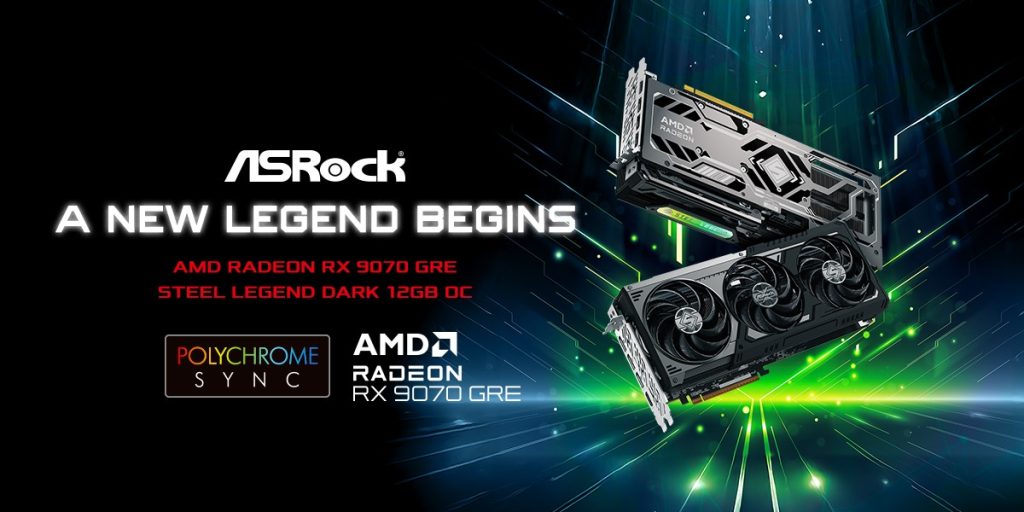
ASRock has launched the AMD Radeon RX 9070 GRE Steel Legend Dark 12GB OC graphics card, using the newly launched AMD Radeon RX 9070 GRE GPU. Designed with a black-and-grey colour scheme, the new model features factory pre-overclocking and a triple-fan cooling system.
The underlying AMD Radeon RX 9070 GRE GPU is built on the AMD RDNA 4 architecture. It features 3rd Gen Raytracing and 2nd Gen AI accelerators, delivering up to 48 AMD RDNA 4 CUs. It also supports technologies such as AMD FSR Redstone and AMD Fluid Motion Frames (AFMF).
ASRock has configured the Radeon RX 9070 GRE Steel Legend Dark 12GB OC with a boost clock of up to 2920MHz. To manage thermal performance, the card employs a triple-fan cooling design using the company's proprietary Striped Ring Fans, Air Deflecting Fin, and Ultra-fit Heatpipe technologies. Structural rigidity is handled by a reinforced metal frame and a metal backplate designed to prevent VGA sag.
For aesthetics, an ARGB LED panel is integrated into the side of the shroud, supporting Polychrome Sync lighting technology for user-customisable lighting effects.
KitGuru says: Are you interested in getting a Radeon RX 9070 GRE?
Today, as part of its Computex 2026 programme, AMD has announced worldwide availability for the RX 9070 GRE. Technically, this GPU launched over a year ago as a Chinese exclusive, but it is now rolling out globally. Offering what is essentially a cut-down RX 9070 die, the 9070 GRE features fewer cores, 4GB less memory and a narrower memory interface. But what does that mean for performance, and is it still worth buying? We find out today.
Timestamps
00:00 Intro
00:50 Key info, pricing
01:21 Core specs
02:15 Test setup
03:02 Game benchmarks
03:57 Performance summary, comparison vs RTX 5070
05:01 Cost per frame analysis
05:39 Ray tracing performance
07:07 FSR 4 upscaling
07:51 The Sapphire Pulse card
08:32 Thermals and noise
09:23 Power + efficiency
10:12 Closing thoughts
The RX 9070 GRE launched to little fanfare back in April 2025, given it was only on sale in China, but today AMD has announced global availability, with a $549 price tag. In the UK we're told to expect pricing in the £469-479 region, so it's a similar ballpark to the RTX 5070 that can be regularly found at £500.
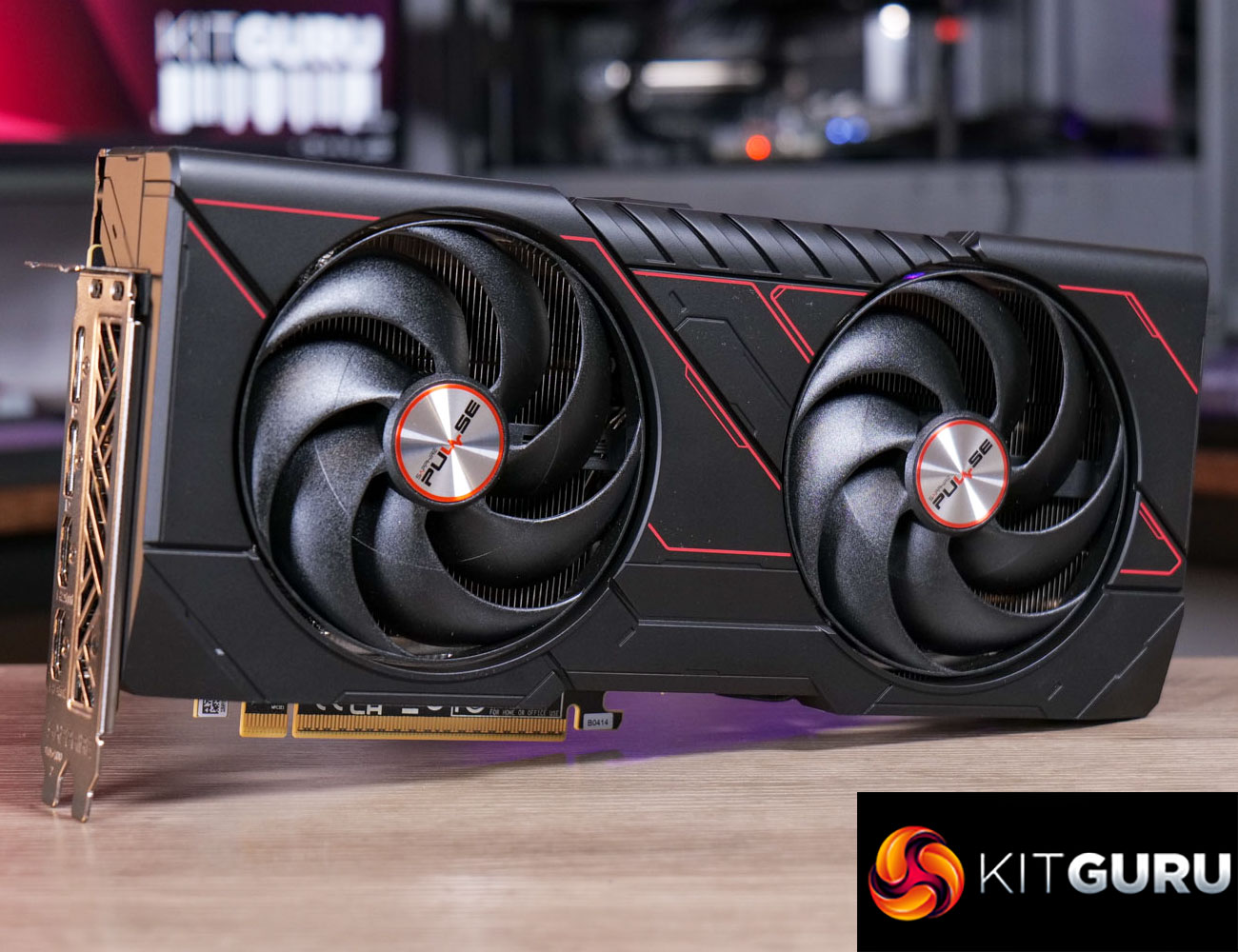
Like the rest of the RDNA 4 family, there's no reference model, and instead we have tested the Sapphire Pulse edition. This card does come factory overclocked, but as regular readers will know, we manually test all GPUs at reference specifications for these day one reviews, so we can ensure that all testing is ‘apples to apples.'
RX 9070 XT
RX 9070
RX 9070 GRE
RX 9060 XT
Architecture
RDNA 4
RDNA 4
RDNA 4
RDNA 4
Manufacturing Process
TSMC N4
TSMC N4
TSMC N4
TSMC N4
Transistor Count
53.9 billion
53.9 billion
53.9 billion
29.7 billion
Die Size
357 mm²
357 mm²
357 mm²
199 mm²
Compute Units
64
56
48
32
Ray Accelerators
64
56
48
32
Stream Processors
4096
3584
3072
2048
Game GPU Clock
2400 MHz
2070 MHz
2220 MHz
2530 MHz
Boost GPU Clock
Up to 2970 MHz
Up to 2520 MHz
Up to 2790 MHz
Up to 3130 MHz
ROPs
128
128
96
64
AMD Infinity Cache
64MB
64MB
48MB
32MB
Memory
16GB GDDR6
16GB GDDR6
12GB GDDR6
8/16GB GDDR6
Memory Data Rate
20 Gbps
20 Gbps
18 Gbps
20 Gbps
Memory Bandwidth
645 GB/s
645 GB/s
432 GB/s
322 GB/s
Memory Interface
256-bit
256-bit
192-bit
128-bit
Board Power
304W
220W
220W
160W
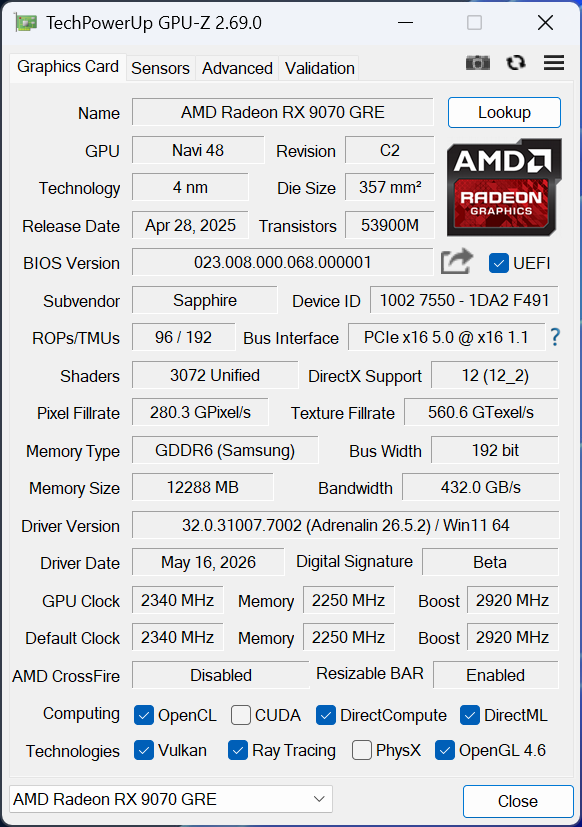
First, let's take a quick look at the specs. The RX 9070 GRE is built on the same Navi 48 die as the RX 9070 and 9070 XT. It measures 357mm², and it's worth pointing out this is a monolithic chip, so AMD is not using a chiplet-based design as per RDNA 3. In total, Navi 48 silicon packs in 53.9 billion transistors.
While a full Navi 48 GPU packs in 64 Compute Units, the 9070 GRE is cut down to 48 CUs, and each CU houses 64 Stream Processors, for a total of 3072 shaders. There's also 48 Ray Accelerators – one per CU – and 96 ROPs.
As for clock speed, the RX 9070 GRE runs faster than the regular 9070, sporting a rated game clock of 2220MHz and a boost clock of up to 2790MHz.
The memory configuration is cut down however, with 12GB of GDDR6 memory clocked at 18Gbps, operating over a 192-bit memory interface, for total memory bandwidth of 432 GB/s. 48MB of Infinity Cache is also present.
Power draw for the RX 9070 GRE is rated at 220W Total Board Power (TBP), but we are using our updated GPU power testing methodology in this review, so read on for our most detailed power and efficiency testing yet.
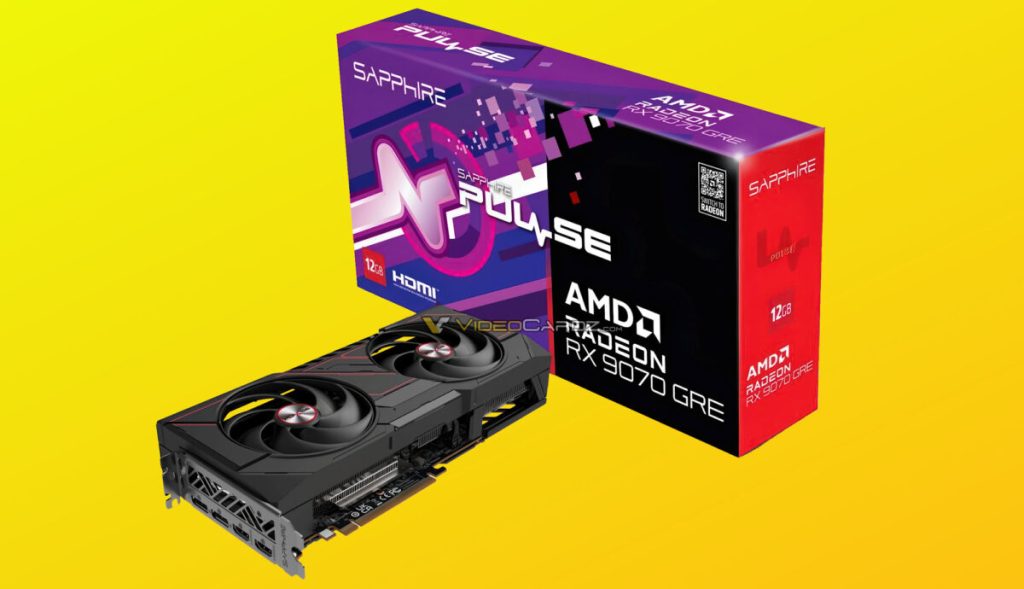
AMD appears to be preparing a global launch for its previously China-exclusive Radeon RX 9070 GRE graphics card. A leaked image of an upcoming Sapphire Radeon RX 9070 GRE Pulse reveals retail packaging with English branding.
The image of the packaging shared by VideoCardz shows it's quite similar to the Chinese packaging, with some changes to the lettering in the top-left corner. The Radeon RX 9070 GRE originally debuted as a regional product built around the Navi 48 XL GPU. The silicon features 3,072 stream processors across 48 CUs, paired with 12GB of GDDR6 video memory running on a 192-bit bus, delivering 432GB/s of memory bandwidth.
Further indications of an expanded rollout include retail listings on Newegg for prebuilt gaming desktops configured with Radeon RX 9070 GRE graphics cards, alongside early standalone product listings.
AMD has yet to confirm new regional availability for the RX 9070 GRE, but as retailers are starting to list them in the US, we expect that to change soon.
KitGuru says: Would you consider getting a Radeon RX 9070 GRE graphics card if it were available in your region?

 Login
Login