Login
LoginNerdioCon 2026: Manager 8.0 Brings AVD Hybrid to Nutanix, Adds Global Pools
Last week, we had the opportunity to attend NerdioCon, held May 4–6, 2026, at the La Quinta Resort & Club in Palm Springs. The conference focused on Nerdio’s products and other cloud technologies, specifically Microsoft Azure, Azure Virtual Desktop (AVD), and Intune. It had keynotes, technical labs, and networking for IT leaders and MSPs. The opening day focused on Managed Service Providers (MSPs), so we attended the conference on days two and three.
General Conference Morning Session
The general conference kicked off on Tuesday, May 5th, with keynote speeches. Joseph Land, Nerdio president and co-founder, welcomed participants to the fifth annual conference. Following the opening remarks, Land introduced Rachel Bondi, Corporate Vice President, Small and Medium Enterprises and Channel at Microsoft Asia.
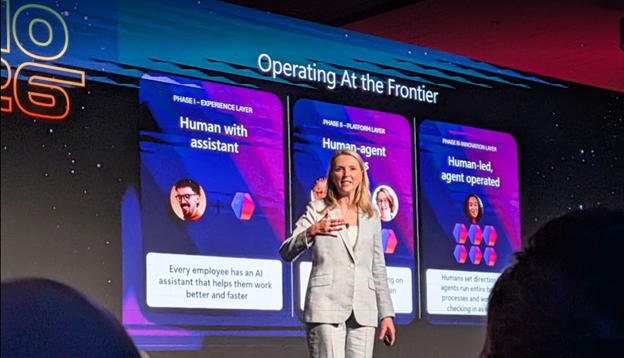
Bondi began by describing a “Frontier Firm” as a cutting-edge organization that redesigns its operating model to be “human-led and agent-operated,” by putting AI at the core of its strategy to boost productivity, innovation, and agility.
She said these companies go beyond simple AI adoption by deploying AI agents to handle, automate, and optimize business processes across various functions. She then outlined the path to becoming a frontier firm by integrating artificial intelligence. Bondi detailed a strategic framework for success built on enriching employee experiences, automating business processes, and leveraging a unified data strategy to drive innovation with AI.
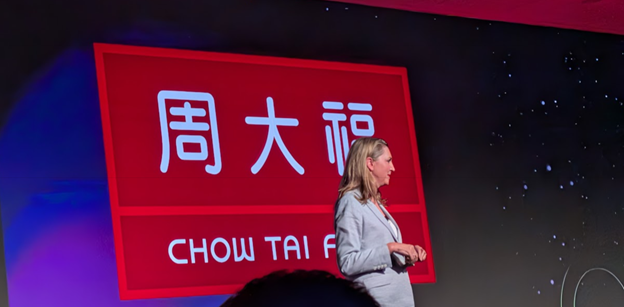
She delivered real-world examples, which were appreciated, that included SoftBank and Chow Tai Fook. She underscored that true transformation requires leadership-led change management and a commitment to responsible AI governance. She concluded her presentation by celebrating the synergy between Microsoft and Nerdio and positioning their partnership as a vital catalyst for helping businesses navigate the emerging AI landscape securely and efficiently.
Tami Pesic, Head of Strategic Partnerships at Huntress, and Rob Rae, Corporate Vice President of Community for PAX8, joined Bondi on stage for a roundtable discussion.
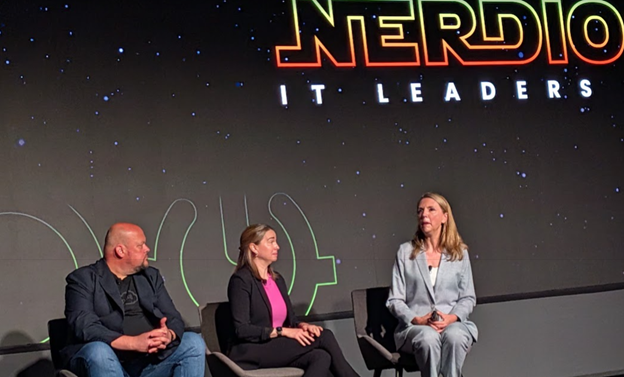
The ensuing discussion centered on the inevitable shift toward artificial intelligence and its impact on managed service providers. They highlighted the current gap between rapid AI adoption and lagging data governance, and urged businesses to prioritize security as they explore new AI technologies. The speakers emphasized that success requires a cultural mindset shift, encouraging leaders to empower corporate “tinkerers” within their teams and move past historical resistance to change. Ultimately, their dialogue served as a call to action for companies to become “customer zero” by using and testing AI internally so they can guide their clients through the significant economic and operational transition that the AI era will require.
Vadim Vladimirskiy, CEO and co-founder of Nerdio, joined Joseph Lands, Scott Manchester, Chief Product & Technology Officer at Nerdio, and Christiaan Brinkhoff, Senior Director, Product Management at Nerdio, on stage to discuss The Great Cloud Migration.
It was interesting to see these Nerdio leaders on stage addressing the IT audience and discussing the “great migration” from legacy virtual desktop infrastructure to modern Windows cloud solutions. They framed the current landscape as a “generational disruption” where organizations must navigate rising costs and complexity by adopting more flexible, cloud-native tools.
Key technical announcements during the keynotes included the launch of Nerdio Manager for Enterprise 8.0, featuring Intune Policy Studio for streamlined endpoint management and Global Pools to overcome Azure regional capacity limits.
Nerdio Manager for Enterprise 8.0 represents a significant shift toward hybrid cloud management and DevOps integration. The feature we found most interesting was the public preview of Azure Virtual Desktop (AVD) Hybrid on Nutanix Cloud Platform (NCP). This feature extends the control plane to manage on-premises hyperconverged infrastructure. Organizations can orchestrate desktop delivery across local Nutanix AHV and Azure cloud environments from a single interface, enabling a more flexible, “at your own pace” migration strategy. Additionally, the introduction of Global Pools enables admins to deliver desktops across multiple Azure regions and subscriptions from a single, unified pool, effectively addressing capacity constraints and high-availability challenges for global deployments.
The update emphasizes modern automation and AI-driven operations. It has an advanced Terraform-based installer, allowing IT teams to treat their EUC environment as code and align deployment with existing infrastructure-as-code (IaC) workflows. For endpoint management, the Intune Policy Studio provides a centralized hub for creating, versioning, and rolling back Intune policies, with full change-history auditing. Finally, the reintroduction of Nerdio Copilot brings AI-powered assistance directly into the console to help with troubleshooting and should simplify administrative tasks.
The group also introduced Nerdio Compass as a strategic management and optimization platform for Managed Service Providers, designed to streamline the delivery and profitability of Microsoft Cloud services, particularly Azure and Windows 365. It is an extension of the Nerdio Manager that focuses on “the business of the cloud,” providing visibility into margins and automated cost-modeling tools. By simplifying the complexities of Azure pricing and configuration, Compass enables MSPs to move away from manual tracking costs toward a scalable, data-driven approach to managing client environments.
After the keynotes, we attended some sessions and spoke with vendors on the showroom floor, including 10ZiG, Numecent, Recast, and Omnissa.
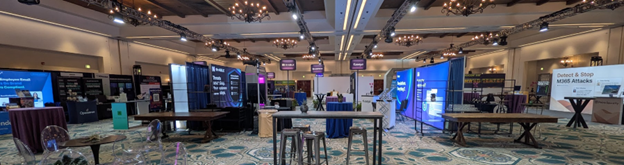
The sessions we attended were well done, and we especially enjoyed our chats with vendors. We hope to follow up with them for future articles.
First Day, Afternoon Session
The afternoon keynote session featured talks by Tristan Scott, Microsoft’s Partner Group Product Manager for Windows Cloud, Tarkan Maner, President and Chief Commercial Officer at Nutanix, and Scott Manchester.
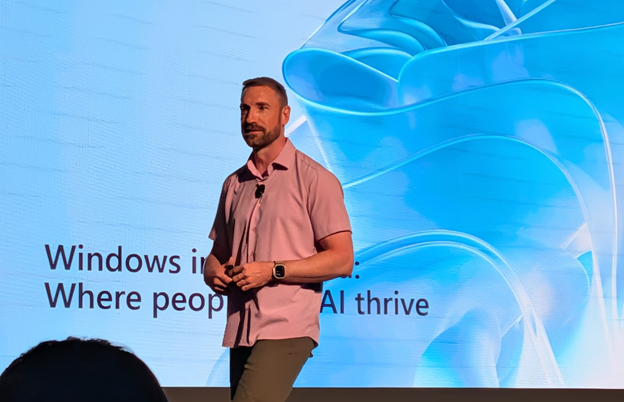
Tristan took the stage and focused on the evolution of the EUC world and how Windows has transitioned from a physical tether to a persistent, cloud-delivered service. He stated that, with over 1 billion Windows 11 users, the operating system is no longer where we work; it is also where AI works. Based on the latest strategic shifts from Microsoft, Nutanix, and Nerdio, the “beige box” is officially dead. In its place is an agentic, elastic, and cloud-smart future.
He went on to state that the most critical hurdle for IT leaders is understanding that Windows 365 isn’t just another line item in a software subscription. It isn’t an app like Word or Teams; it’s a fundamental re-architecture of the personal computer. By hosting a full, persistent Windows PC in Azure and streaming it to any device, from an iPad to the newly announced Windows 365 Link (a purpose-built, secure thin client), Microsoft is effectively moving the “unit of work” to the cloud.
Tristan Scott drove this home by stating, “Windows 365 is not an app… It is a full Windows PC. All of your apps, files, and settings hosted in Azure are streamed down to your device.”
For the strategist, this move from “managing infrastructure” to “managing endpoints” is underpinned by three pillars:
- Security: With no local data, there is zero local risk. Even if the hardware is lost, the data remains protected by a cloud firewall.
- Elasticity: Organizations are no longer locked into hardware specs for three-year cycles. vCPUs, RAM, and GPU power can be scaled instantly as needs change.
- Simplicity: With Intune integration, Cloud PCs are managed just like physical laptops, eliminating the legacy complexity of traditional VDI.
Of course, AI is changing everything, and we are entering the age of “Windows 365 for Agents.” He feels that the Cloud PC provides the ultimate “UI Bridge.” As Microsoft is now deploying autonomous agents that don’t just process data, they can “read” the screen, click buttons, and type just like a human.
Next on stage was Tarkan Maner, President and CCO of Nutanix.
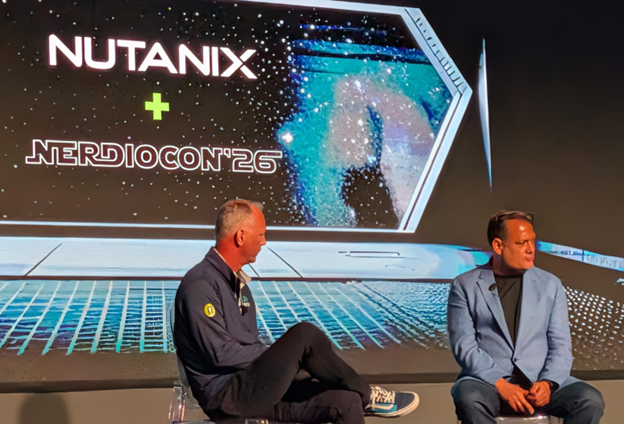
We hadn’t heard Tarkan speak before and found him to be a forceful and engaging speaker. He discussed the “Great Migration”, a period of unprecedented volatility in the hypervisor market, sparked largely by the Broadcom acquisition of VMware. Tarkan estimated that approximately 200 million vCPUs (or cores) are currently “up for grabs” as enterprises reassess their vendor loyalties.
A broken supply chain exacerbates this, he said, noting that lead times for physical servers are now stretching to 360 days or more. The old “Cloud First” mantra has matured into “Cloud Smart.”
Enterprises are now demanding hybrid flexibility. Solutions like Azure Virtual Desktop (AVD) Hybrid via Azure Arc are said to serve as the essential “stepping stone” for regulated industries. This architecture allows companies to keep session hosts on-premises, behind a firewall, for data gravity reasons, while still leveraging the Azure management plane. It provides the cloud’s elasticity without forcing an overnight total migration.
Tarkan got philosophical when he stated that “Simple is hard. Making things simple is very hard. People assume simple is simple. Simple is not simple. Simple is not easy.”
The goal of modern IT isn’t just “feeds and speeds”; it is delivering specific business outcomes. A simple doctor interface requires a sophisticated, orchestrated backend that hides the complexity of GPUs and security protocols. If technology gets in the way of the patient’s care, the infrastructure has failed.
Second Day Morning Session
After a cocktail reception the night before, we were primed for the second-day keynotes.
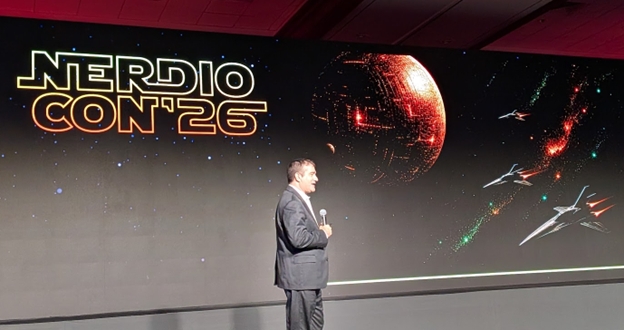
The first keynote featured Lior Bela, Business Director, Microsoft Intune.
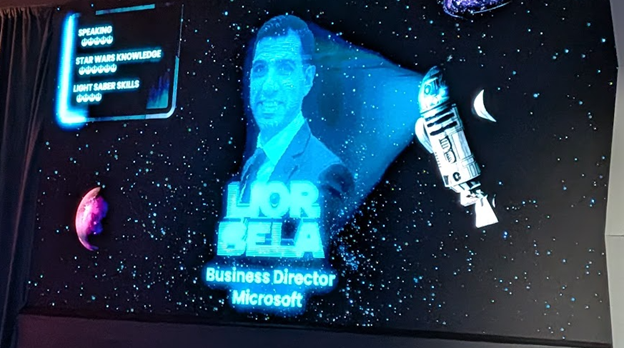
It was no surprise that Bela’s keynote was Intune-specific. He said that many organizations are obsessed with the “penthouse” of AI productivity while building on a foundation of “legacy sand.” He feels that the industry is shifting toward “Identity 2.0,” in which the definition of a user has expanded beyond humans to include autonomous AI agents. Because these agents operate on a task-based model rather than during human office hours, Zero Trust must now evolve to monitor “agent identity at execution time,” treating code with the same, stricter, or even higher guardrails as those applied to high-level administrators.
In what can only be called a “scorched earth” move against competitors, Microsoft is radically changing its security suite by rolling out advanced Intune features as part of standard E3 and E5 licenses. This shift will effectively remove the cost barrier to tools like Remote Help, Cloud PKI, and Advanced Analytics. By making these “premium” features the new baseline, Microsoft is signaling that security is a fundamental requirement for the modern enterprise.
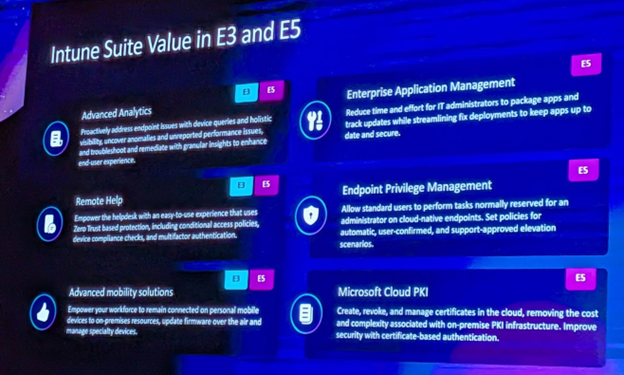
This is the new standard, Endpoint Privilege Management (EPM), which enables “least privilege” security by allowing users to perform specific elevated tasks without granting full admin rights. He highlighted that for organizations in 2026, failing to use these now-standard tools is increasingly viewed not just as being behind the curve, but as operational negligence.
The next keynote featured Huntress’s Tami and Jeremy. They had a great rapport.
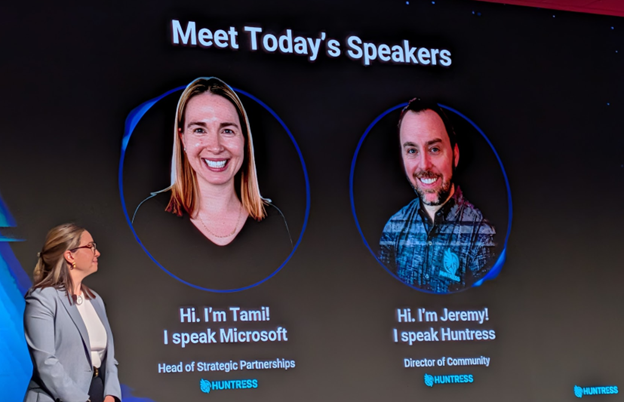
During their interactions, they stated that the cybersecurity landscape has reached a “Tipping Point” where AI-generated phishing boasts a 52% success rate, rendering traditional human detection nearly obsolete. They said attackers are leveraging Large Language Models to discover zero-day vulnerabilities and deploy sophisticated malware such as “ClickFix,” which mimics legitimate system prompts with near-perfect accuracy. This surge of automated “AI slop” is currently overwhelming legacy defense systems and bug bounty programs, signaling that the human perimeter alone is no longer sufficient.
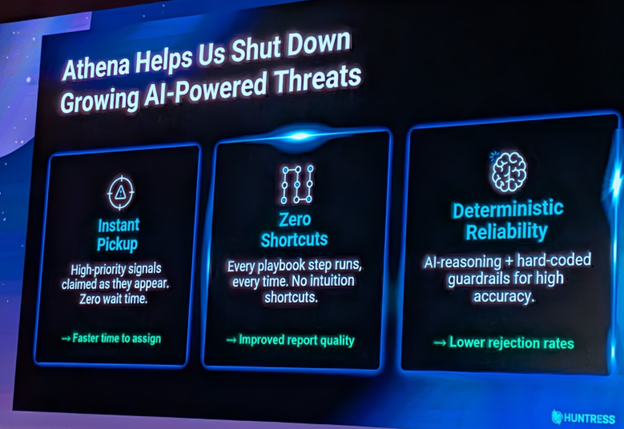
To combat these threats, the industry is pivoting toward the “Agentic SOC,” exemplified by systems like Huntress’s “Athena.” By deploying specialized AI agents to orchestrate playbooks, organizations can achieve instant signal pickup and total consistency without the “alert fatigue” that plagues human analysts. Of course, this approach will not replace people; instead, it uses machine learning to filter noise, routing only the most complex, indeterminate signals to humans for expert intuition.
Finally, they talked about how employee security training, which we can attest to sucks, how they shifted from boring, mandatory lectures that we have all attended to gamified Security Awareness Training (SAT). They did this through simulations, some created by world-class animators, which are driving a 94% behavioral change rate by letting users “play” the role of the attacker.
Looking back, their presentation had the same qualities as the SAT training: fun and interactive.
Final Thoughts
hadn’tn’t spent much time in Palm Springs and were unsure about its location for a conference, but we were pleasantly surprised by how well it worked and, more importantly, impressed by the breadth and depth of the information shared at NerdioCon.

NerdioCon 2026 highlighted a “generational disruption” in the IT landscape as organizations shift from legacy infrastructure toward an “agentic, elastic, and cloud-smart” future. The keynotes from Microsoft, Nerdio, Nutanix, and Huntress emphasized the transition to a “human-led and agent-operated” model, in which AI agents and cloud-native solutions such as Windows 365 and Azure Virtual Desktop (AVD) redefine the modern workstation as a persistent, cloud-delivered service rather than a physical device.
Our technical highlights included the launch of Nerdio Manager for Enterprise 8.0, featuring Intune Policy Studio and Global Pools, and the strategic introduction of Nerdio Compass to help MSPs manage cloud profitability. Security remained a central theme, with speakers advocating for “Identity 2.0” to govern AI agents, the inclusion of advanced features in Intune to combat “operational negligence,” and the rise of the “Agentic SOC” to counter increasingly sophisticated AI-generated cyber threats.
Ultimately, the conference did a good job of positioning the synergy between Microsoft and Nerdio as a vital catalyst for navigating this rapid economic and operational transition toward a hybrid, AI-integrated enterprise.
The post NerdioCon 2026: Manager 8.0 Brings AVD Hybrid to Nutanix, Adds Global Pools appeared first on StorageReview.com.